

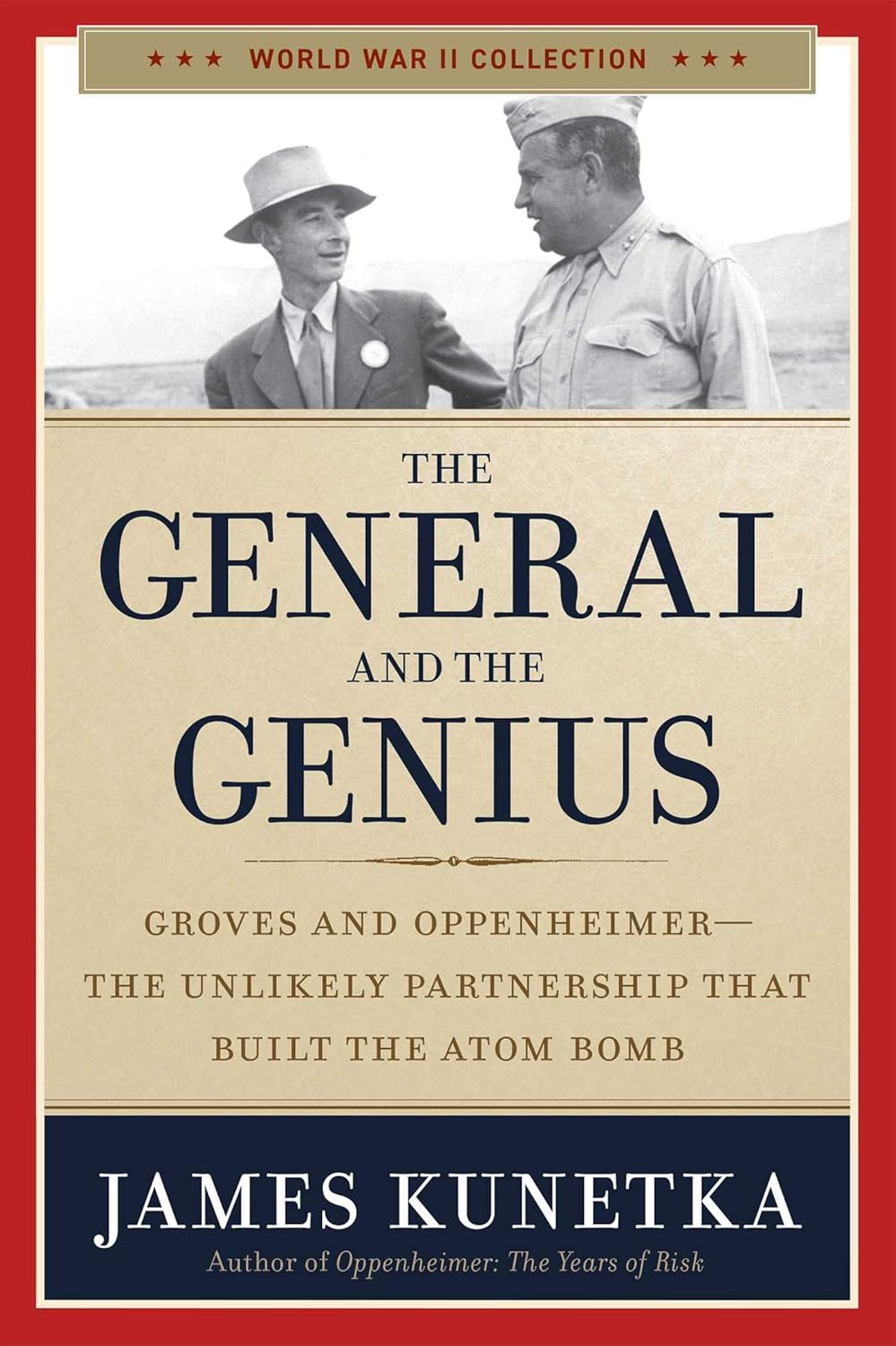
About The General and the Genius by James Kunetka: Inside the Partnership That Built the Atomic Bomb
How did a strict army general and a brilliant theoretical physicist lead one of the largest secret projects in history? The General and the Genius by James Kunetka tells the story of Leslie R. Groves and J. Robert Oppenheimer, two very different men placed at the centre of the American effort to build an atomic bomb during World War II.
The book's full subtitle is Groves and Oppenheimer—The Unlikely Partnership That Built the Atom Bomb. Published in 2015, this detailed work of history and biography follows the Manhattan Project from urgent wartime planning to the Trinity test in New Mexico and the use of atomic bombs against Japan. Its main focus is not only the weapon. It is the working relationship that helped turn a vast, risky idea into reality.
Two Men Who Seemed Unlikely to Work Together
Leslie Groves was a military engineer in the United States Army Corps of Engineers. He valued order, speed, control, security, and results. Before leading the Manhattan Project, he had worked on the construction of the Pentagon. He knew how to move large amounts of money, people, land, and materials under pressure.
J. Robert Oppenheimer came from the world of universities and theoretical physics. He was widely read, intellectually gifted, socially complex, and able to bring strong scientific minds together. Before Los Alamos, he had never managed anything close to the size of the laboratory he was asked to lead.
Their backgrounds and styles were very different. Groves could be hard, direct, and demanding. Oppenheimer could be charming, thoughtful, and flexible with scientists. Yet each man saw something useful in the other. Groves gave Oppenheimer authority and protection. Oppenheimer created a scientific community able to work across difficult fields. Their shared energy, intelligence, and focus made the partnership productive.
A Huge Problem with Almost No Time
The Manhattan Project grew from fear that Nazi Germany might build an atomic weapon first. The United States needed scientific answers, industrial sites, rare materials, trained workers, secure transport, and strict secrecy. Many parts of the work had never been done at such a scale.
This was not one small laboratory project. Uranium enrichment took place at Oak Ridge, Tennessee. Plutonium production developed at Hanford, Washington. Weapon design came together at Los Alamos, New Mexico. Universities, companies, military offices, factories, and research groups worked across long distances, often without knowing the whole plan.
Why Groves Chose Oppenheimer
Oppenheimer was not an obvious choice to direct Los Alamos. He had no Nobel Prize, limited management experience, and personal links that raised security concerns. Several people around him had past or present connections with communist politics. In a secret wartime project, these facts worried officials.
Groves still supported him. Oppenheimer understood many areas of physics, spoke clearly with different specialists, and could see how separate problems fitted together. He also had the force of personality needed to recruit respected scientists and give the new laboratory a common purpose.
The choice shows one of the book's strongest leadership lessons. A leader sometimes has to see ability that a checklist misses. Groves accepted a security and management risk because he believed Oppenheimer had the rare mix needed for the job. The decision later became controversial, but during the project it helped Los Alamos take shape quickly.
Building a Secret Community at Los Alamos
Oppenheimer recruited leading minds from universities across the country. Scientists who normally guarded their own work had to share ideas across theory, chemistry, engineering, explosives, mathematics, and measurement. The aim was not a paper or small experiment. They had to design working weapons under wartime pressure.
Kunetka gives readers a wide cast of scientists, engineers, officers, administrators, and workers. This makes the book broader than a double biography. It becomes an overview of Los Alamos and the Manhattan Project, showing how famous leaders depended on a very large network of people.
Science Had to Become Engineering
Knowing that an atomic chain reaction was possible did not mean a bomb could be built. Teams needed enough enriched uranium or plutonium, a design that could create a rapid critical mass, reliable explosives, careful measurements, and systems that could be produced and used.
The uranium weapon used a gun-type design that brought pieces of material together. Plutonium created a harder problem. Scientists found that the same gun method would not work well with reactor-made plutonium. They turned toward implosion, using carefully shaped explosives to squeeze a plutonium core inward at nearly the same instant.
Leadership Through Tension and Trust
Groves and Oppenheimer did not need to become similar in order to work well. Their partnership rested on a useful division of responsibility. Groves handled the larger military project, production system, resources, and security. Oppenheimer led the scientific work at Los Alamos and translated many specialist problems into a shared program.
Their trust was practical rather than simple. Groves could overrule scientists, and scientists could resist army rules. Oppenheimer had to defend the freedom needed for creative work while accepting the secrecy of war. Both men worked under pressure from Washington, military leaders, scientific uncertainty, and a changing battlefield.
The Trinity Test Changes the World
By 1945, the implosion design still needed proof. The test, named Trinity, took place in the New Mexico desert on July 16, 1945. The device known as the Gadget exploded successfully, creating the world's first human-caused nuclear explosion and opening the nuclear age.
For the teams who had worked for years, the test brought relief, awe, fear, and uncertainty. A scientific and engineering problem had been solved, but a moral and political problem had become real. The weapon was no longer only a plan inside guarded buildings.
Victory Cannot Be Separated from Human Cost
Atomic bombs were dropped on Hiroshima on August 6, 1945, and Nagasaki on August 9. The attacks killed and injured large numbers of people, destroyed cities, and left survivors facing burns, illness, grief, and long-term effects. Japan announced its surrender days later, but historians still debate how the bombs, Soviet entry into the war, military conditions, and political choices worked together.
A responsible reading should avoid reducing this history to a victory story. The project displayed extraordinary organization and science, while producing weapons with terrible human power. It also began a nuclear age shaped by arms competition, secrecy, fear, deterrence, testing, waste, and continuing moral debate.
The Manhattan Project affected more people than its famous leaders. Workers across many sites handled dangerous materials. Communities lost land, including Pueblo, Hispanic, and Anglo residents around Los Alamos. These wider stories help readers place the Groves-Oppenheimer partnership inside a fuller history.
What Makes Kunetka's Account Valuable
Kunetka grew up in Albuquerque and later worked as a consultant at Los Alamos, where he reviewed classified archival documents for historical value. For this book, he drew on records and correspondence to build a detailed account of the project and its leaders.
The writing combines biography with a broad project history. Readers meet Groves and Oppenheimer as people with strengths, flaws, habits, worries, and ambitions. They also follow the changing scientific problems and the large group working around them.
The book is detailed rather than short. Some readers may find that the many secondary figures pull attention away from the two men named in the title. Yet that wide view is also useful because no honest story of the Manhattan Project can belong to only two people.
What You Will Find Inside
-
A clear study of Leslie Groves and J. Robert Oppenheimer.
-
The story of their unlikely but productive working relationship.
-
An accessible account of the Manhattan Project and Los Alamos.
-
Simple explanations of major scientific and engineering problems.
-
Wartime pressure, secrecy, security questions, and political choices.
-
The path from laboratory research to the Trinity test.
-
Discussion of Hiroshima, Nagasaki, and the beginning of the nuclear age.
-
A large cast of scientists, soldiers, engineers, and administrators.
-
Leadership lessons about trust, authority, talent, and different working styles.
-
Material for further study, debate, essays, and presentations.
The result is a book that can satisfy readers looking for both human drama and serious history. It explains how the project moved, who pushed it forward, and why its success created questions that never went away.
Who Should Read This Book?
This title is a strong choice for readers of World War II history, science history, military biography, nuclear history, leadership, engineering, and American politics. It can also appeal to people who watched Oppenheimer and want a broader look at Groves, Los Alamos, and the organization surrounding the scientists.
Students can use it as an introduction to the Manhattan Project before moving to more specialized works. Teachers can use sections to discuss leadership, wartime research, secrecy, ethics, or the relationship between government and science. Book clubs will find many questions that do not have easy answers.
This may not be the best first choice for someone wanting only a short biography of Oppenheimer. The book spends time on many people and parts of the project. Readers who enjoy a wide, detailed narrative are more likely to value its scale.
Read It with Questions, Not Simple Heroes
Groves and Oppenheimer achieved something that many people thought impossible. They also helped create weapons that changed war and placed humanity under a new kind of danger. Reading them only as heroes or villains hides the difficult truth.
Ask how power should be used, how experts should advise leaders, how secrecy changes responsibility, and whether urgent goals can push moral thought aside. Notice who made decisions, who carried out work, who suffered, and whose voices receive less space. These questions turn the book into more than a record of dates.
Made for Long, Focused Reading
Bookish Wonderland offers this printed book with premium eye-soothing cream paper, crystal-clear print, and high-quality stitched and glue binding. The comfortable pages support longer reading sessions, while the strong binding suits repeated use for study, notes, discussions, and returning to important events.
Useful for Study, Discussion, and Gifting
Read it beside a simple Manhattan Project timeline and mark each major site, decision, and test. Students can build essays around leadership, scientific teamwork, military control, nuclear ethics, or public memory. Managers may compare the partnership with modern projects that bring technical experts and administrators together.
It also makes a thoughtful gift for a history reader, science student, engineer, teacher, military enthusiast, or anyone interested in the real people behind the atomic age.
Order Your Copy from Bookish Wonderland
Readers checking the book price in Bangladesh for The General and the Genius by James Kunetka can order easily from Bookish Wonderland. Nationwide delivery is available inside and outside Dhaka, with Cash on Delivery across the country. Fast or urgent delivery is also available within Dhaka when the book is needed sooner.
Choose this book if you want to understand how very different leaders worked together under extreme pressure, how science became a wartime system, and how one project changed global history. It offers tension, personality, discovery, hard choices, and consequences on almost every page.
Add The General and the Genius to your collection today. If you need customization or want to ask about the available copy, please inbox Bookish Wonderland through Facebook or Instagram. Order now and begin a detailed journey through the partnership, people, decisions, and moral questions behind the first atomic weapons.
If you require any customization or have any questions, please inbox us via FB or Insta.
| Primary Specification | |
| Author | James Kunetka |
| Narrator | Malcolm Hillgartner |
| Genre | History, Biography, Military History, World War II History, Science & Technology History |
| ISBN-13/ISSN | 978-1684513598 |
| ISBN-10 | 1684513596 |
| Publisher | Regnery History |
| Publishing Date | September 20, 2022 |
| Language | English |
| Reading Age | 16+ |
| Format | Printed Book |
| Physical Specification & Quality | |
| Paper Quality | Premium eye-soothing cream paper |
| Binding Quality | High quality stitched and glue binding (for longevity) |
| Print Quality | Crystal-clear print |
| Pages | 512 pages |
| Country | USA |
| Logistics Information | |
| Weight | 532 gm |
| Length | 8.5 inches |
| Width | 5.6 inches |
| Height | 1.28 inch |