

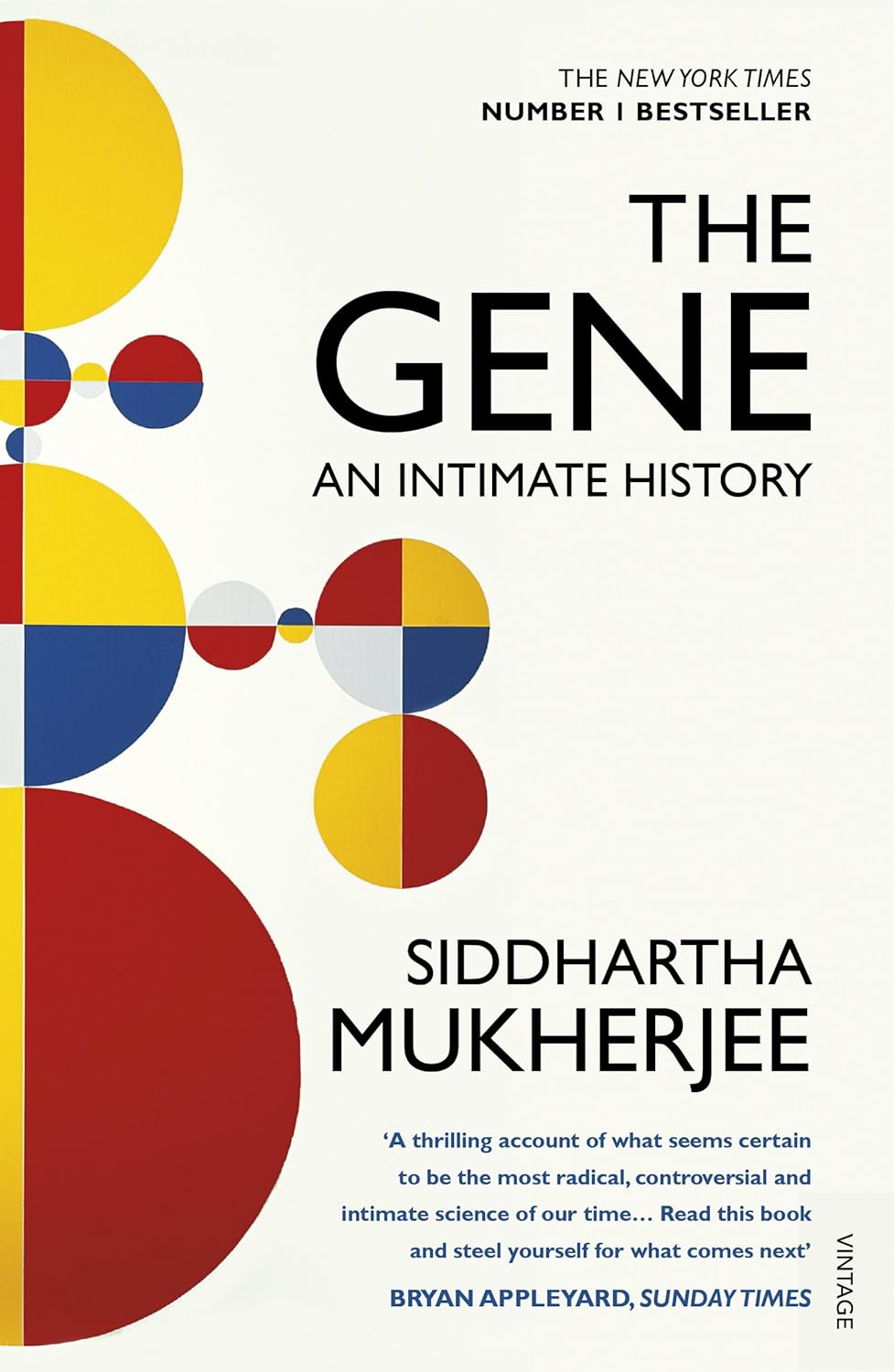
About The Gene by Siddhartha Mukherjee: The Story of Heredity, Identity, and Our Future
Why do children look like their parents? Why can one illness appear again and again in a family? Can genes shape the way we look, feel, think, or act? The Gene by Siddhartha Mukherjee takes these large questions and turns them into a clear, moving story about heredity.
The full title is The Gene: An Intimate History. It is a work of science, history, biography, and personal reflection. Mukherjee begins with early ideas about inheritance and follows the search for the gene through more than a century of discovery. Along the way, he introduces the people who changed genetics, the patients affected by it, and the hard moral questions created by our growing power over DNA.
This is not a cold textbook filled only with difficult terms. It is a human story about families, illness, ambition, mistakes, hope, and choice. Mukherjee is a doctor and cancer researcher, but he writes for general readers. He explains complex science through people, events, and simple examples, making the book useful even if you have never studied genetics before.
A Question That Begins inside One Family
Mental illness has appeared in Mukherjee’s own family. Two uncles and a cousin were affected by conditions including schizophrenia and bipolar disorder. Their lives lead him toward a question that many families quietly ask: what do we inherit, and what may we pass to the next generation?
That personal thread gives the history warmth and urgency. Genes are not only objects inside a laboratory. They can influence health, family decisions, fear, care, and the way people understand themselves. Yet the book does not say that a gene is a fixed order that controls every part of a life. It shows how heredity can work with environment, chance, development, and experience.
From Pea Plants to a New Science
The journey begins with Gregor Mendel, an Augustinian monk who studied pea plants in the nineteenth century. By tracking traits across generations, Mendel found patterns that pointed to separate units of inheritance. His work was largely overlooked at first, but it later became a foundation of genetics.
Mukherjee then follows Charles Darwin, Thomas Hunt Morgan, and many other thinkers who tried to explain how traits move from parent to child. Fruit flies, plants, cells, and careful records all helped scientists see that heredity followed rules. The word “gene” eventually gave a name to the unit they were trying to understand.
This part solves a common problem for readers. Genetics can feel like a list of strange names and hard words. Mukherjee places each idea in a story, explains why it mattered, and shows how one finding opened the door to another. Instead of memorising facts, the reader follows a mystery as it slowly becomes clearer.
Finding the Material of Heredity
Knowing that genes existed did not explain what they were made of. Scientists had to discover where genetic information lived and how it worked. The search led to chromosomes, DNA, and the double-helix structure associated with James Watson and Francis Crick, built with key evidence produced by Rosalind Franklin and Maurice Wilkins.
The book moves from the shape of DNA to the genetic code. It explains how information held in DNA helps cells make proteins, how genes can switch on or off, and why cells with the same genome can perform very different jobs. A nerve cell and a liver cell carry the same basic DNA, yet they use different parts of that information.
Mukherjee keeps returning to a useful truth: genes matter greatly, but genes do not act alone. Biology is shaped by networks, signals, surroundings, and chance. This wider view helps readers move beyond the false idea that one gene always creates one clear result.
When Science Was Used to Harm People
The history of genetics also contains cruelty. Ideas about heredity were twisted into eugenics, a movement that claimed society could be improved by controlling who was allowed to have children. In the United States, eugenic laws supported forced sterilisation. Nazi Germany took racial eugenics to a horrific extreme, joining false biological claims with persecution and mass murder.
Mukherjee includes Carrie Buck, a young American woman who was sterilised after being labelled “feebleminded.” Her story shows what can happen when weak science, social prejudice, and state power work together. People were reduced to labels, while poverty, disability, race, class, and family history were treated as proof of genetic worth.
These chapters make the book more than a celebration of discovery. They ask readers to notice who controls scientific language and how claims about biology can be used against vulnerable people. Knowledge can heal, but it can also become dangerous when certainty, prejudice, and power replace care.
The Human Genome Opens a New Door
Later chapters follow recombinant DNA, gene mapping, gene therapy, and the Human Genome Project. Scientists learned not only to read pieces of genetic information but also to copy, move, compare, and sometimes alter them. These tools brought new ways to study inherited illness and create medicines.
The Human Genome Project aimed to read the full sequence of human DNA. Its success did not provide a simple instruction book for every person. Instead, it revealed an even more complex system. Many traits involve numerous genes, and much of the genome works through regulation and relationships that scientists are still studying.
This is one of the book’s most useful lessons. More data does not always create easy answers. A genetic result may show risk rather than certainty. It may tell a person that an illness is more likely without saying whether or when it will happen. Such knowledge can guide care, but it can also bring worry and difficult choices.
The Promise and Risk of Gene Editing
Modern gene-editing tools make the final part of the book feel close to the present. If scientists can change faulty genes, they may be able to treat or prevent some inherited diseases. That hope is powerful, especially for families living with severe genetic conditions.
But the same power raises hard questions. Should a change be made only in the body of one patient, or in eggs, sperm, or embryos where it may pass to future children? Who decides which conditions should be removed? Could treatment slowly turn into a market for preferred traits? Would only rich families gain access?
Mukherjee does not give a neat answer to every question. Instead, he gives readers enough history to see why caution matters. The older story of eugenics warns that ideas about improving human beings can quickly become unfair or cruel. The future of genetics needs science, public discussion, strong rules, and respect for human difference.
Why the Book Remains Worth Reading
The Gene was first published in 2016, so some tools and discoveries have moved forward since then. Still, its main questions remain urgent. Genetic testing is easier to access, gene editing continues to develop, and people often hear claims about DNA in health news, family history services, and social media.
The book still gives readers a strong base for judging those claims. It teaches that a link is not always a cause, a risk is not a fate, and a scientific tool is not automatically wise or fair. It also shows that every discovery comes from people working inside a social and political world.
The Gene was shortlisted for the Royal Society’s 2016 science book prize. It was also named among notable books of 2016 by major publications. Those honours fit its special strength: it makes a large scientific history readable without removing the wonder, danger, or human cost.
Ideas You Will Explore
-
How traits pass from parents to children.
-
Why Gregor Mendel’s pea experiments mattered.
-
How chromosomes, DNA, and genes are connected.
-
How scientists discovered the double helix and genetic code.
-
Why genes interact with environment, development, and chance.
-
How eugenics harmed people in America and Nazi Germany.
-
What the Human Genome Project achieved and left unanswered.
-
How genetic testing can offer knowledge without certainty.
-
Why gene therapy and gene editing bring both hope and risk.
-
How family history makes scientific questions deeply personal.
Who Will Enjoy This Book?
This title is a strong choice for curious general readers, science students, doctors, teachers, researchers, and people interested in medicine, psychology, history, or ethics. It also suits readers who enjoy nonfiction that connects a major idea to real lives.
Even readers who already know basic biology can gain a clearer view of how scientific ideas grow, change, and affect families, hospitals, laws, and public life over time today.
A student can use the book as a broad introduction before studying genetics in greater detail. A teacher can use its events to begin discussion about evidence, bias, medical ethics, and responsibility.
Book clubs can explore questions about nature and nurture, genetic privacy, disability, treatment, and the meaning of a “normal” life. Families touched by inherited illness may also find language for questions that are hard to ask, although this book is educational and should not replace advice from a qualified medical professional or genetic counsellor.
What You Gain from Reading It
The book helps you understand common words such as gene, DNA, chromosome, mutation, genome, heredity, and gene therapy. More importantly, it shows how these ideas developed and why their history matters.
You will become better prepared to read news about genetic tests and medical research. You will see why one study should not be treated as final proof and why complex human traits rarely have one simple genetic cause. You may also think more carefully about privacy, choice, fairness, and the limits of scientific power.
A Comfortable Copy for Focused Reading
Bookish Wonderland offers this printed book with premium eye-soothing cream paper, crystal-clear printing, and high-quality stitched and glue binding. The paper supports comfortable reading during long chapters, while the firm binding helps the book stay useful through study, discussion, and repeated reading.
Ways to Use This Book
Read one section at a time and keep a small list of new terms. Use the timeline of discoveries to connect Mendel, chromosomes, DNA, the genetic code, genome sequencing, and gene editing. Students can build essays or presentations around eugenics, heredity, medical ethics, or the Human Genome Project.
Teachers may pair a chapter with a simple science lesson or historical case. Book clubs can choose one moral question for each meeting.
It also makes a thoughtful gift for a medical student, biology learner, teacher, doctor, researcher, or curious reader who wants serious science written as a compelling human story.
Order Your Copy from Bookish Wonderland
Readers comparing the book price in Bangladesh for The Gene by Siddhartha Mukherjee can order easily from Bookish Wonderland. Delivery is available inside Dhaka and across the country, with Cash on Delivery nationwide. Fast or urgent delivery is also available within Dhaka when you need the book sooner.
Choose this book if you want to understand where genetics came from, how it shapes medicine, and why its power must be handled with care. It offers discovery, family history, human drama, and questions that will stay with you after the final page.
Add The Gene to your reading list today. If you need customization or want to ask about the available copy, inbox Bookish Wonderland through Facebook or Instagram. Order now and begin a clear, thoughtful journey through the science that helps explain inheritance, identity, illness, and the future we may create.
If you require any customization or have any questions, please inbox us via FB or Insta.
| Primary Specification | |
| Author | Siddhartha Mukherjee |
| Narrator | Dennis Boutsikaris |
| Editor | Kyle Kabel |
| Genre | Genetics, Popular Science, History of Science, Medical History, Biography & Memoir |
| ISBN-13/ISSN | 978-1476733524 |
| ISBN-10 | 1476733524 |
| Publisher | Scribner |
| Publishing Date | May 2, 2017 |
| Language | English |
| Reading Age | 16+ |
| Format | Printed Book |
| Physical Specification & Quality | |
| Paper Quality | Premium eye-soothing cream paper |
| Binding Quality | High quality stitched and glue binding (for longevity) |
| Print Quality | Crystal-clear print |
| Pages | 608 pages |
| Country | USA |
| Logistics Information | |
| Weight | 631 gm |
| Length | 8.5 inches |
| Width | 5.6 inches |
| Height | 1.5 inch |