

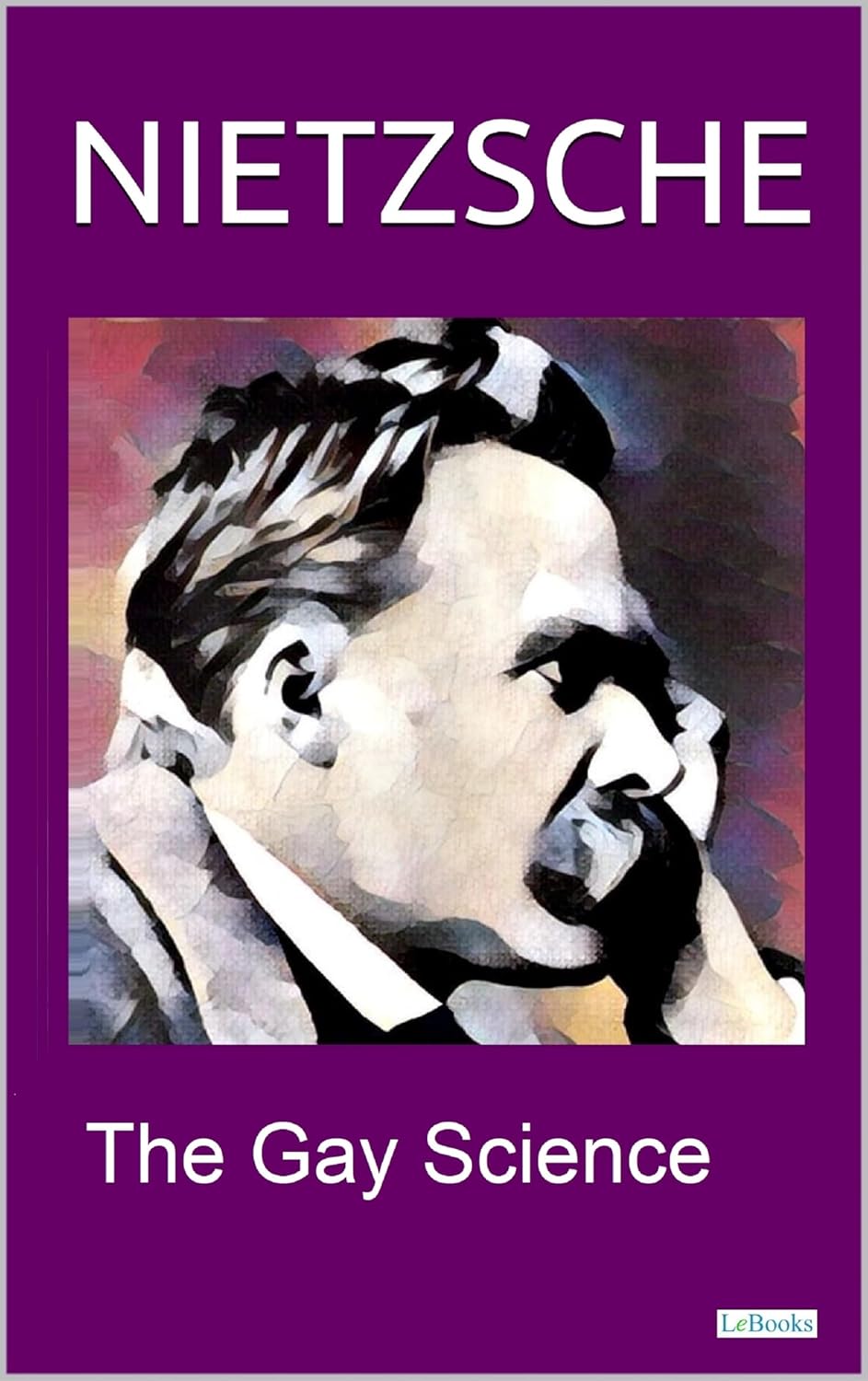
About The Gay Science by Friedrich Nietzsche – A Bold Book About Truth, Meaning, and How to Live
Some books give you answers. The Gay Science by Friedrich Nietzsche does something more difficult: it makes you ask better questions. Nietzsche looks at truth, religion, morality, art, suffering, knowledge, love, courage, and the way people build meaning in life. He does not explain these ideas like a normal textbook. Instead, he writes in short sections, sharp observations, poems, jokes, challenges, and thought experiments. This makes the book feel alive.
First published in 1882 and expanded in 1887, The Gay Science is one of Nietzsche’s most important middle-period works. The later edition added a preface, a fifth book, and an appendix of songs. It also contains famous ideas linked with Nietzsche’s later philosophy, including the “death of God,” nihilism, and eternal recurrence. Cambridge University Press describes the work as a major treatment of truth, suffering, nihilism, human achievement, and the question of how people should live after old certainties begin to lose their power.
Why this book still feels modern
Many people feel confused when they first try philosophy. Nietzsche takes a different path.
The Gay Science is made of many short passages called aphorisms. Another may take a page or two. Nietzsche often asks readers to question what they have accepted without thinking. Why do we call something true? Where do our moral rules come from? Why do people need certainty? Can pain have value? What happens when old beliefs no longer guide society?
You can read one section, think about it, mark a line, and come back later.
This way of writing makes the book feel less like a classroom lesson and more like an ongoing conversation. Nietzsche does not expect you to agree with everything. He wants you to notice what you believe, why you believe it, and whether those ideas can survive careful questioning.
What The Gay Science is really about
The title can confuse new readers. “Gay” here uses an older meaning connected with joy, lightness, cheerfulness, and a spirited approach to knowledge. Nietzsche was interested in whether serious thinking had to be heavy, fearful, or gloomy.
The book asks what it means to search for truth while knowing that human beings are limited. Nietzsche questions the idea that people can stand completely outside life and look at the world with perfect objectivity. He studies how desire, fear, habit, culture, health, and power can influence what people believe.
Religion is another major theme. The famous “God is dead” passage is not simply a slogan against religion. Nietzsche uses it to ask what happens to European culture when traditional Christian belief no longer provides the same shared foundation for morality and meaning. The problem that follows is nihilism: if old values lose their authority, how should people live?
Nietzsche does not offer an easy replacement. Instead, he pushes readers toward responsibility.
This is why the book remains important in discussions of modern philosophy. Nietzsche is not only attacking old ideas. He is asking what people should do after those ideas stop feeling certain.
Eternal recurrence and the hardest question in the book
One of the most memorable ideas in The Gay Science is eternal recurrence. Nietzsche asks you to imagine that your life, with every joy, mistake, pain, boring day, love, loss, and small detail, must happen again in exactly the same way, endlessly.
The point is not only to ask whether this could literally happen. It can also work as a test. How would you react if someone told you that you had to live your exact life again and again? Would the idea crush you? Or could you say yes to your life so fully that you would accept it?
Stanford’s overview of Nietzsche explains that eternal recurrence can be read as a way of measuring a person’s ability to affirm life, although scholars disagree about whether Nietzsche meant it as a literal metaphysical claim or as a philosophical and psychological challenge.
This is one reason the book stays with readers. It turns a huge philosophical idea into a personal question you cannot answer for anyone else.
A book you can argue with
You do not need to agree with Nietzsche to get value from this book. In fact, reading him works best when you argue with him.
He can be funny, rude, playful, proud, skeptical, and deliberately provocative. He may make a point that feels brilliant on one page and frustrating on the next. That tension is part of the experience. The goal is not to memorize Nietzsche’s opinions. The goal is to notice where his questions push your own thinking.
Readers interested in psychology may enjoy his comments about motives, pride, self-deception, desire, guilt, and social behavior. Readers interested in religion may focus on faith, morality, and the consequences of secular culture. Readers interested in literature may notice his style, images, rhythm, and short poetic pieces. Students of philosophy can trace ideas that later become important in Thus Spoke Zarathustra, Beyond Good and Evil, and On the Genealogy of Morality.
That makes The Gay Science useful even if Nietzsche is not your favorite philosopher. A book that makes you disagree carefully can still sharpen the way you think.
Why this edition deserves a place on your shelf
A difficult book becomes easier to return to when the physical copy feels comfortable in your hands. Bookish Wonderland offers this title for readers who want a durable reading copy rather than something that feels temporary.
The book is produced with premium eye-soothing cream paper, which gives the pages a softer look during long reading sessions. Crystal-clear printing helps keep small philosophical passages easy to follow. High-quality stitched and glue binding gives the book stronger support for repeated reading, note-taking, and frequent opening.
These details matter with a book like The Gay Science because it is rarely a one-time read. Many readers return to marked passages months or years later. A strong copy makes that kind of reading easier.
Instead of rushing through the pages, you can keep the book beside you, underline important thoughts, add small notes, and return whenever a question stays in your mind.
What you may gain from reading it
The biggest benefit of The Gay Science is not a list of facts. It is a change in the way you look at questions.
You may become more careful about ideas you once accepted automatically. You may notice how words like truth, morality, happiness, success, duty, and meaning can hide many assumptions. You may learn to sit with uncertainty instead of rushing toward an easy answer.
The book can also help you see philosophy as something connected to daily life. Nietzsche writes about loneliness, friendship, love, pain, health, art, ambition, social approval, and the wish to belong. These are not only classroom topics. They are part of ordinary human life.
For students, the book can support essays and discussion about Nietzsche, nihilism, secularism, morality, epistemology, existential thought, and modern European philosophy. For general readers, it can become a personal book to underline, question, and revisit.
It is especially useful for readers who want to understand why Nietzsche became such an important influence on later philosophy, psychology, literature, and cultural debate.
Who should read The Gay Science?
This book is a good choice if you enjoy ideas more than plot. It does not tell one continuous story like a novel. You are moving through a mind at work.
It may suit:
- Readers starting to explore Friedrich Nietzsche.
- Philosophy students who want one of his major works.
- Readers interested in existentialism, nihilism, morality, religion, and meaning.
- People who enjoy short, thought-provoking passages.
- Writers and artists interested in creativity, style, and self-expression.
- Readers who like books that challenge common beliefs.
- Anyone who wants a book that rewards rereading rather than quick completion.
The Cambridge edition is used at undergraduate level and includes an introduction and notes by philosopher Bernard Williams, with translation by Josefine Nauckhoff and poems translated by Adrian Del Caro. Cambridge lists the paperback at 305 pages.
That edition is especially useful for readers who want scholarly support while reading the text.
How to read this book without getting lost
Do not rush.
A good way to read The Gay Science is to take five or ten aphorisms at a time. Keep a pencil nearby. Mark passages that surprise you, confuse you, or annoy you. Write a short question in the margin. Then continue.
You can also keep a simple notebook with three headings: “What Nietzsche says,” “What I think,” and “What I need to learn.” This turns reading into a conversation instead of a test.
If one section feels too hard, move on. Nietzsche often returns to the same themes from a different angle. Understanding can grow slowly.
New readers may also benefit from reading a short introduction to Nietzsche’s life and vocabulary before starting. But you do not need to understand every debate in nineteenth-century philosophy. The book has enough direct questions about life, belief, fear, joy, and meaning to speak to a careful modern reader.
A few pages each day may work better than trying to finish fifty pages at once.
The style is part of the experience
The Gay Science is not written like a dry academic manual. Nietzsche uses aphorisms, poems, jokes, images, attacks, questions, and sudden shifts of mood. The Cambridge edition even carries the fuller title With a Prelude in German Rhymes and an Appendix of Songs and contains five books in the expanded form.
This variety is important. Nietzsche does not only tell readers to think differently; he tries to write differently. His style can move from serious philosophy to playful verse and then to a sharp psychological observation within a few pages.
That makes the book easier to dip into, but it also means context matters. A famous sentence can be misunderstood when removed from the argument around it. Reading the surrounding sections gives you a much better sense of what Nietzsche is doing.
It is the kind of writing where one paragraph can become the reason you stop reading for ten minutes just to think.
A useful book for study, discussion, and personal reflection
The Gay Science can work in several ways.
You can read it for a university course. You can use it for a philosophy reading group. You can compare it with later Nietzsche books. You can keep it beside a journal and use one aphorism as a writing prompt. You can discuss its ideas with friends. You can also read it slowly on your own without any academic goal.
That flexibility is one of its strengths.
The same passage may feel very different when you return to it after a major change in your life.
The book is especially useful for readers who do not want self-help advice but still want a book that asks serious questions about how to live.
It does not promise a simple formula for happiness. Instead, it asks whether a stronger life may come from learning to face doubt, difficulty, change, and responsibility.
Buying The Gay Science in Bangladesh
Finding a readable physical copy of a philosophy classic can be harder than it should be. Thin paper, weak binding, or unclear print can make a demanding text even more tiring.
Bookish Wonderland focuses on a comfortable reading experience. You can order The Gay Science by Friedrich Nietzsche with nationwide delivery across Bangladesh and Cash on Delivery. Delivery is available both inside and outside Dhaka, and a fast or urgent delivery option is available in Dhaka.
If you are comparing The Gay Science by Friedrich Nietzsche book price in Bangladesh, remember that the value of a reading copy is not only the price tag. Paper comfort, print clarity, and binding strength matter when you plan to underline, revisit, and keep a book for years.
This makes the book suitable for students, personal libraries, philosophy lovers, teachers, and readers building a long-term collection of classic works.
Add a book to your shelf that keeps giving you new questions
Some books are finished when you reach the last page. The Gay Science is more likely to stay open in your mind.
You may return to it because one idea still bothers you. You may reread a passage and discover that it means something different after a year. You may disagree with Nietzsche more strongly the second time. That is part of what makes the book worth owning.
If you want a philosophy book about truth, belief, values, suffering, joy, freedom, and the courage to question old ideas, The Gay Science by Friedrich Nietzsche is a powerful choice.
Order your copy from Bookish Wonderland for nationwide delivery across Bangladesh. Cash on Delivery is available, and readers in Dhaka can ask about fast or urgent delivery. For customization or questions about the available edition, message Bookish Wonderland through Facebook or Instagram.
If you require any customization or have any questions, please inbox us via FB or Insta.
| Primary Specification | |
| Author | Friedrich Nietzsche |
| Translator | Walter Kaufmann |
| Genre | Philosophy, Existential Philosophy, Moral Philosophy, Aphorisms, Philosophical Literature |
| ISBN-13/ISSN | 978-0394719856 |
| ISBN-10 | 0394719859 |
| Publisher | Vintage |
| Publishing Date | January 12, 1974 |
| Language | English |
| Reading Age | 16+ |
| Format | Printed Book |
| Physical Specification & Quality | |
| Paper Quality | Premium eye-soothing cream paper |
| Binding Quality | High quality stitched and glue binding (for longevity) |
| Print Quality | Crystal-clear print |
| Pages | 396 pages |
| Country | Germany |
| Logistics Information | |
| Weight | 417 gm |
| Length | 8.5 inches |
| Width | 5.6 inches |
| Height | 0.91 inch |