

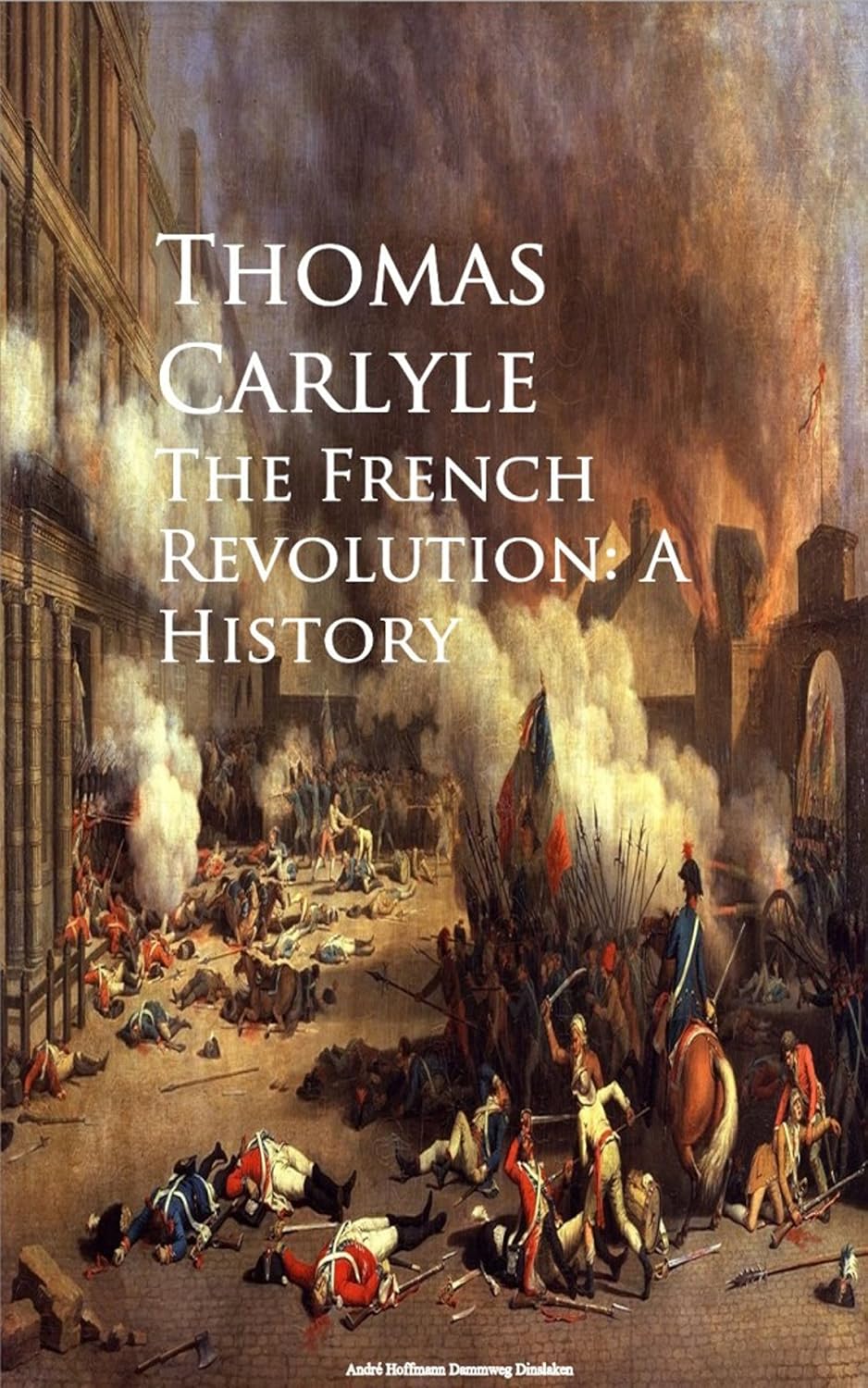
About The French Revolution by Thomas Carlyle – A Powerful History of Revolution, Chaos, Fear and the Fall of an Old Order
The French Revolution by Thomas Carlyle is not a calm textbook that simply lists dates, laws, and political changes. Carlyle wanted readers to feel the Revolution as if they were standing inside the streets of Paris while the old order was breaking apart. First published in 1837, the work follows the crisis from the final years of the French monarchy through the fall of the Bastille, the execution of Louis XVI, the Reign of Terror, the fall of Robespierre, and the rise of Napoleon. It is history written with energy, drama, anger, humor, and a strong sense of human confusion.
Carlyle begins before 1789 so readers can see why the country was moving toward crisis. France had a powerful monarchy, social divisions, heavy financial problems, and a political system that could no longer answer the pressure building around it. As events move forward, kings, ministers, nobles, workers, crowds, soldiers, journalists, and revolutionaries all become part of the story. Carlyle does not reduce the Revolution to one simple cause. He shows a society losing control of the rules that had held it together.
A History Book That Reads Like a Crowd Is Moving Around You
One reason The French Revolution remains unusual is Carlyle's style. He often writes in the present tense, addresses the reader directly, changes pace suddenly, and describes political events with the force of scenes from a novel. Instead of keeping the Revolution at a safe distance, he tries to put noise, fear, hunger, rumor, violence, and excitement on the page.
That style can be demanding at first. Carlyle uses nineteenth-century language, unusual sentence shapes, references to classical literature, and dramatic descriptions that are very different from modern history books. Once readers adjust to the voice, however, the book can feel surprisingly alive. The fall of the Bastille is not treated as a dry entry in a timeline. Crowds move, leaders hesitate, rumors spread, and political choices suddenly become physical events.
This makes the book especially interesting for readers who already know the basic facts of the French Revolution and want to see how one of the nineteenth century's most famous writers imagined its emotional force.
Why France Reached the Point of Revolution
Carlyle's story opens with the death of Louis XV in 1774 and the beginning of the reign of Louis XVI. The monarchy inherited serious financial problems, while French society remained divided into estates with very unequal privileges and duties. Taxes, debt, food pressure, political frustration, and demands for reform all increased the strain.
By 1789, the meeting of the Estates-General opened a political struggle that the monarchy could no longer control. Representatives of the Third Estate claimed a wider national authority, and arguments about representation quickly became arguments about who actually had the right to rule France.
Carlyle presents these events as more than constitutional debate. He keeps returning to the pressure outside official rooms. Ordinary people were hungry, angry, hopeful, frightened, and increasingly willing to act for themselves. The Revolution becomes understandable not only through speeches and laws but also through the growing feeling that the existing order had lost its authority.
The Bastille and the Moment Everything Changes
The fall of the Bastille on 14 July 1789 is one of the central scenes in Carlyle's first volume. The prison itself held only a small number of prisoners, but its political meaning was enormous. It represented royal power, secrecy, and the ability of the monarchy to imprison people by authority from above.
For Carlyle, the attack on the Bastille shows what happens when a crowd stops waiting for permission. The event becomes both destruction and creation. An old symbol falls, while a new political force appears in the streets.
The scenes that follow show how quickly revolutionary change can spread. Power moves away from institutions that once seemed permanent. People who were ignored suddenly become politically important. At the same time, fear and rumor make events harder to control.
This is one reason the book remains valuable. Carlyle understands that revolutions do not move like carefully prepared plans. They move through uncertainty, emotion, accident, leadership, misjudgment, and moments when thousands of people decide that the old rules no longer apply.
Louis XVI, Marie Antoinette and a Monarchy Losing Control
The royal family remains important throughout the work. Carlyle does not write about Louis XVI and Marie Antoinette as distant names in a textbook. He places them inside a political world that is closing around them.
Louis appears as a ruler who struggles to act with the speed and confidence the crisis demands. Marie Antoinette becomes one of the most visible symbols of public anger against the court. Their attempt to escape France in 1791, known as the Flight to Varennes, destroys much of the remaining trust between the monarchy and the Revolution.
From that point, compromise becomes harder. France moves toward a republic, and the king eventually goes on trial. Louis XVI is executed in January 1793, while Marie Antoinette follows later that year.
Carlyle's account gives these events dramatic weight because he is interested in the human experience of political collapse. Institutions may disappear in a sentence, but the people inside them still have to face what that change means.
When Revolution Turns Into Terror
The Revolution did not end when the monarchy fell. France faced war abroad, rebellion at home, political conflict in Paris, shortages, suspicion, and fear of enemies inside the new republic.
These pressures helped create the period known as the Reign of Terror. Revolutionary government became increasingly willing to use arrest, emergency power, and execution against people believed to threaten the republic. The guillotine became the most famous symbol of that period.
Carlyle follows figures such as Georges Danton, Jean-Paul Marat, and Maximilien Robespierre while showing how quickly revolutionary leaders could move from power to danger. Political language became a matter of survival. Yesterday's patriot could become tomorrow's suspect.
The book does not make this period comfortable. Violence is part of the story, and Carlyle's descriptions can be intense. Readers interested in how political fear changes institutions will find these sections especially powerful because the book shows how a movement that began with hopes of reform can become trapped in cycles of suspicion and punishment.
Robespierre, Thermidor and the End of the Terror
Robespierre becomes one of the central figures near the end of Carlyle's account. He rose as a voice of revolutionary virtue and became closely connected with the Committee of Public Safety during the Terror. Yet revolutionary power was unstable, and the same system that destroyed opponents could turn against its own leaders.
In July 1794, or Thermidor in the revolutionary calendar, Robespierre was overthrown and executed. His fall marked a major turning point and helped bring the Terror to an end.
Carlyle continues beyond this moment because the Revolution itself was not finished. France remained politically unstable, and the struggle over the future continued.
The work finally reaches 1795, when Napoleon Bonaparte helped suppress the royalist insurrection of 13 Vendémiaire. Carlyle ends at a point where the most explosive revolutionary period is closing and another era is beginning.
Who Will Enjoy The French Revolution?
The French Revolution by Thomas Carlyle is a strong choice for readers interested in European history, political revolutions, France, monarchy, social change, and nineteenth-century historical writing. It may also appeal to readers who like long nonfiction works with a strong literary voice rather than a neutral textbook style.
Students of history, political thought, literature, and revolutionary movements can find useful material here, while experienced general readers may enjoy Carlyle's vivid scenes and memorable descriptions. Readers who only want a short introduction to the French Revolution may prefer to begin with a modern overview and return to Carlyle afterward.
The language is older and sometimes difficult, so patience helps. The reward is a historical work with a voice unlike almost anything written today.
A Physical Copy Made for Serious Reading
Bookish Wonderland offers this title for readers who want a physical copy that can handle a long and demanding work. Premium eye-soothing cream paper gives the pages a softer appearance during extended reading, while crystal-clear printing helps keep Carlyle's dense prose easy to follow. High-quality stitched and glue binding gives the book stronger support for repeated opening, study, note-taking, and long-term shelf use.
A durable copy is useful because this is not always a book readers finish quickly. You may read one section, pause to check another historical source, and return later. A physical edition also makes it easier to move between major events, compare passages, or revisit Carlyle's descriptions of the Bastille, the royal family, the Terror, and Napoleon.
Looking for The French Revolution Book Price in Bangladesh?
If you are comparing The French Revolution by Thomas Carlyle and its Book price in Bangladesh, Bookish Wonderland offers a simple way to order a reader-friendly physical copy. Nationwide delivery is available inside and outside Dhaka, while Cash on Delivery is available across Bangladesh. Readers in Dhaka can also ask about fast or urgent delivery when available.
The book can be a useful addition to a personal history collection, university reading list, political thought shelf, or classic nonfiction library. It can also make a thoughtful gift for a reader who enjoys serious history and wants to experience one of the most famous nineteenth-century accounts of the French Revolution.
Why Buy From Bookish Wonderland?
Bookish Wonderland focuses on English books that are comfortable to read and durable enough to keep. The store offers nationwide delivery, Cash on Delivery, service inside and outside Dhaka, and access to a large collection of English titles.
The French Revolution is especially suited to a physical edition because it is a long work with many events, people, speeches, and political changes. A printed copy makes it easier to move backward and forward, mark important passages, compare sections, and return to memorable scenes after finishing the book.
Enter the Revolution Through Carlyle's Eyes
The French Revolution by Thomas Carlyle is not the simplest book about 1789, but that is exactly why it has lasted. Carlyle does not stand outside the Revolution and calmly explain it. He pushes the reader into its noise, confusion, hope, fear, cruelty, and sudden change.
You meet a monarchy that cannot hold its old authority, crowds discovering political power, leaders rising and falling, a king going to the guillotine, a republic struggling to survive, and a revolution beginning to consume some of the people who helped create it.
Modern readers should balance Carlyle with newer historical scholarship, but his work remains a remarkable example of how history can be written with literary force. It shows why the French Revolution was not simply a change of government but an event that changed the political imagination of Europe.
Order The French Revolution by Thomas Carlyle from Bookish Wonderland if you want a demanding, dramatic, and unforgettable classic that brings one of history's great political upheavals to life through the voice of a writer who believed history should be felt as well as understood.
If you require any customization or have any questions, please inbox us via FB or Insta.
| Primary Specification | |
| Author | Thomas Carlyle |
| Editor | David R. Sorensen, Brent E. Kinser |
| Genre | History, French Revolution, Political History, Narrative History, Historical Nonfiction |
| ISBN-13/ISSN | 978-0198815594 |
| ISBN-10 | 019881559X |
| Publisher | Oxford University Press |
| Publishing Date | April 1, 2019 |
| Language | English |
| Reading Age | 16+ |
| Format | Printed Book |
| Physical Specification & Quality | |
| Paper Quality | Premium eye-soothing cream paper |
| Binding Quality | High quality stitched and glue binding (for longevity) |
| Print Quality | Crystal-clear print |
| Pages | 944 pages |
| Country | UK |
| Logistics Information | |
| Weight | 967 gm |
| Length | 8.5 inches |
| Width | 5.6 inches |
| Height | 1.7 inch |