

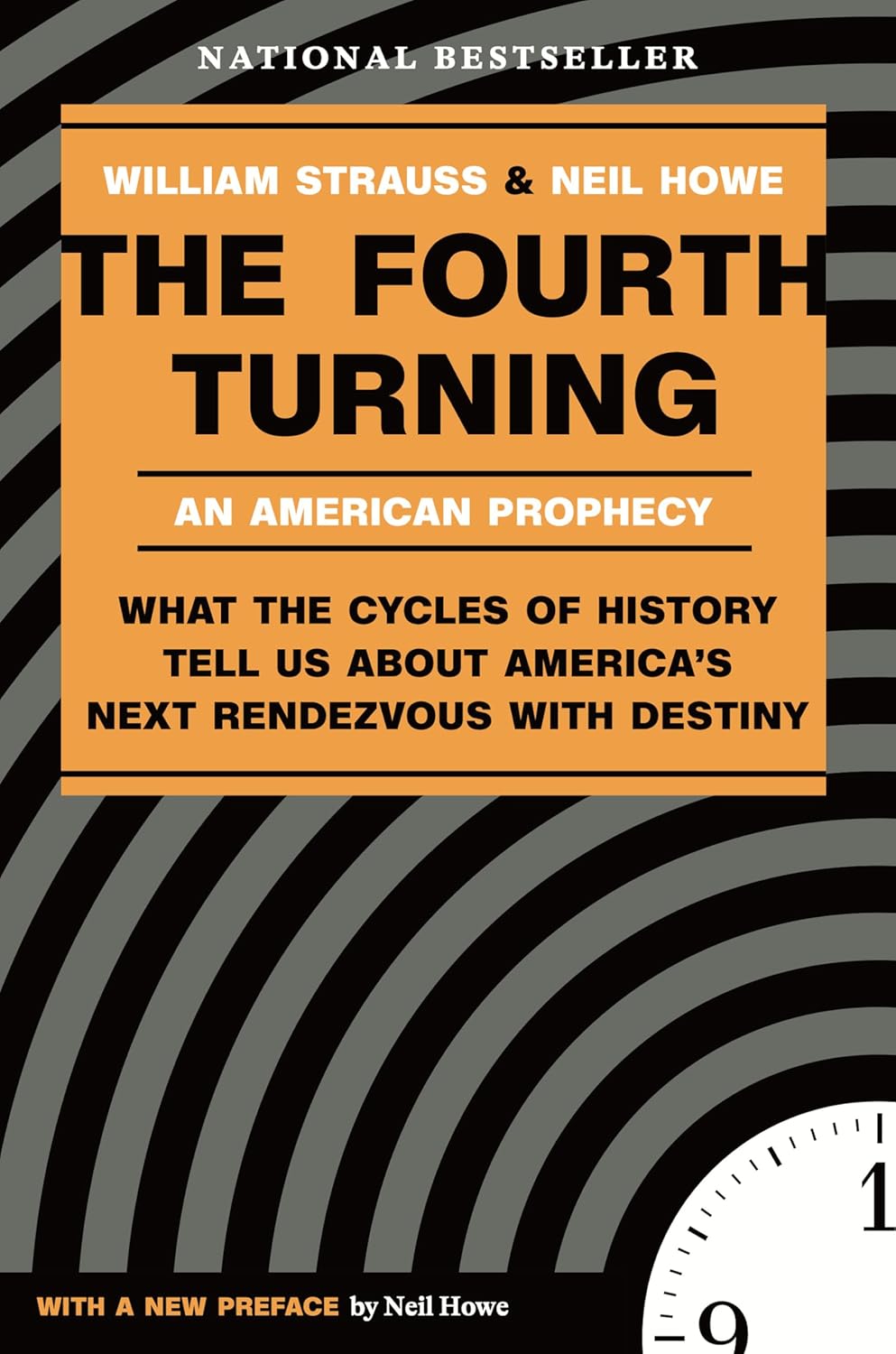
About The Fourth Turning by William Strauss and Neil Howe – A Bold Theory of Generations, Historical Cycles and Times of Crisis
The Fourth Turning by William Strauss and Neil Howe is a nonfiction book about history, generations, and the idea that public life moves through repeating cycles. First published in 1997, the book argues that modern Anglo-American history often follows a pattern lasting roughly the length of a long human life. The authors call this cycle a saeculum. Each saeculum, in their model, contains four stages or “turnings”: a High, an Awakening, an Unraveling, and a Crisis.
Strauss and Howe use examples from American and British history to explain how one generation grows up under conditions created by the generation before it. They argue that these changes affect institutions, culture, politics, family life, and public mood. Their main claim is not that every event repeats in exactly the same way, but that certain patterns of social confidence, rebellion, fragmentation, and crisis can return across generations.
The Four Turnings in Simple Words
The first turning is called a High. In this period, public institutions are strong, people tend to trust major systems, and society often puts shared goals above personal differences. Strauss and Howe connect the post-Second World War years in the United States with this kind of mood. The country had recently passed through war and depression, and many people focused on rebuilding, stability, and national purpose.
The second turning is an Awakening. During an Awakening, people begin questioning the strong institutions created during the earlier High. Personal freedom, spiritual searching, cultural change, and protest become more important. The authors connect this stage with the social and cultural movements that grew during the 1960s and 1970s.
The third turning is an Unraveling. Here, individualism becomes stronger while trust in institutions becomes weaker. Political and cultural divisions grow, and people often disagree more sharply about values, identity, and authority.
The fourth turning is a Crisis. Strauss and Howe describe this as a period when major institutions are tested by serious political, economic, military, or social pressure. Old systems may break down or be rebuilt. According to their theory, a Crisis can create danger, conflict, sacrifice, and major change, but it can also lead to a new public order.
Why Generations Matter in the Theory
The book does not only describe historical periods. It also gives generations an important role in producing change. Strauss and Howe argue that people who grow up during similar social conditions often develop some shared attitudes. Those attitudes can then influence society when that generation reaches adulthood, middle age, and leadership.
Their model uses four broad generational archetypes: Prophet, Nomad, Hero, and Artist. These are not meant to describe every individual person. Instead, they are large categories the authors use to explain how groups may respond differently to the same historical moment.
A generation shaped by stability may challenge the system it inherited. A generation shaped by disorder may become more practical and independent. A generation that comes of age during a major crisis may later become closely connected with rebuilding institutions. The authors use these repeating generational roles to support their larger cycle of history.
A Book That Tries to Connect the Past With the Future
One reason The Fourth Turning became widely discussed is that Strauss and Howe did more than describe earlier history. Writing in the 1990s, they argued that the United States would eventually move from an Unraveling into another Crisis period in the early twenty-first century.
That prediction gave the book a long life in public discussion. Readers have returned to it during financial crashes, political conflict, war, public health emergencies, and other moments of instability to ask whether the authors’ model helps explain what they are seeing.
The book should not be treated as proven science or as a guaranteed prediction of future events. Historians, reviewers, and social scientists have debated the strength of its evidence and whether complicated history can really be placed into a repeating four-part pattern. Even readers who disagree with the theory may still find the framework useful as a way to think about generations, institutions, and long-term social change.
High, Awakening, Unraveling and Crisis as Social Moods
The idea of a “turning” is easier to understand if you think of it as a broad public mood rather than a single event. A High is not a time when everyone is happy. An Awakening is not a period when everyone rebels. An Unraveling does not mean every institution suddenly fails. A Crisis does not mean that every day is full of disaster.
Instead, the authors try to describe the general direction of social life during each period. They look at whether people trust institutions, whether personal freedom or collective duty is more important, whether culture feels united or divided, and whether society is building a common order or fighting over an old one.
This approach lets the book connect politics with family life, popular culture, education, economics, religion, and generational identity. That wide view is part of what makes the book ambitious.
Why the Book Is Still Discussed
The Fourth Turning continues to attract attention because readers often feel that the present is unusually unstable. When politics becomes more divided, institutions lose trust, or economic and global crises overlap, a theory that promises a larger historical pattern can feel especially interesting.
Some readers see the book as surprisingly insightful because it anticipated a period of serious national strain. Others believe its categories are too broad and can be fitted to events after they happen. Both reactions are worth understanding.
The most useful way to read the book is with curiosity rather than blind agreement. Ask whether the historical examples support the pattern. Notice where the model explains something clearly and where it seems too simple. Compare the authors’ claims with other histories of the same events.
That approach turns the book into something more valuable than a prediction manual. It becomes a tool for thinking critically about how societies change over time.
What Readers Can Learn From It
The book encourages readers to think beyond daily news. Instead of looking only at one election, one recession, or one protest movement, Strauss and Howe ask readers to consider how decades of social change connect with one another.
The framework can help readers think about why people from different age groups may have different expectations about work, government, family, authority, technology, and social responsibility. It also raises an important question: how much of our behavior comes from personal choice, and how much is shaped by the period in which we grow up?
The authors also encourage preparation. Their argument is that societies can respond better to crisis when people understand that periods of major change can place unusual pressure on institutions and communities.
Who Will Enjoy The Fourth Turning?
The Fourth Turning is a good choice for readers interested in history, politics, sociology, generational change, social theory, and long-term patterns in public life. It may also appeal to readers who enjoy books that make large arguments and invite debate rather than simply presenting a timeline of events.
Students of political science, history, economics, and sociology may find the framework useful to compare with other theories. Business readers may also be interested in the way generations influence institutions, leadership, consumer behavior, and workplace culture.
The book is detailed and can feel dense in places, so it suits readers who enjoy serious nonfiction. You do not need specialist knowledge before starting, but patience helps because the authors move across many historical periods and use a large number of examples.
A National Bestseller With a Long Afterlife
Penguin Random House currently describes The Fourth Turning as a national bestseller. The current Crown paperback is 400 pages and includes a new preface by Neil Howe.
The book’s influence continued long after its original publication because debates about generations and political cycles did not disappear. Neil Howe later returned to the framework in The Fourth Turning Is Here, published in 2023, where he revisited the idea of a Crisis era after William Strauss’s death.
That later book does not turn the original into a numbered fiction-style series. The Fourth Turning remains a complete nonfiction work that can be read on its own.
A Comfortable Physical Copy for Serious Reading
Bookish Wonderland offers The Fourth Turning for readers who want a physical copy that feels comfortable during long reading sessions. Premium eye-soothing cream paper gives the pages a softer appearance, while crystal-clear printing keeps dense historical discussion and long paragraphs easier to follow. High-quality stitched and glue binding provides stronger support for regular reading, study, annotation, and long-term shelf use.
This is useful for a book that readers may want to pause, question, and revisit. You may want to compare one historical cycle with another, return to the explanation of a generational archetype, or check an earlier prediction after reading a later chapter.
Looking for The Fourth Turning Book Price in Bangladesh?
If you are comparing The Fourth Turning by William Strauss and Neil Howe and its Book price in Bangladesh, Bookish Wonderland gives you an easy way to order a reader-friendly physical copy. Nationwide delivery is available inside and outside Dhaka, and Cash on Delivery is available across Bangladesh. Readers in Dhaka can also ask about fast or urgent delivery when available.
The book can be a useful choice for personal reading, university study, discussion groups, political science students, history readers, or anyone interested in how generations may shape public life.
Why Buy From Bookish Wonderland?
Bookish Wonderland focuses on English books that are comfortable to read and durable enough to keep. The store offers nationwide delivery, Cash on Delivery, service inside and outside Dhaka, and access to a large collection of English titles.
The Fourth Turning is especially suited to a physical edition because the argument builds across many chapters. A printed copy makes it easier to return to earlier sections, compare the four turnings, mark important ideas, or revisit historical examples after finishing the book.
Read It as a Theory, Then Decide What You Think
The Fourth Turning by William Strauss and Neil Howe is most interesting when it makes you question how you think about history. Instead of seeing every decade as completely separate, the authors ask whether generations, institutions, and public moods move through recurring stages.
Their answer is bold: history passes through a High, an Awakening, an Unraveling, and finally a Crisis before a new cycle begins. Whether you accept that model completely, partly, or not at all, the book gives you a clear framework to test against the past and present.
That is why the book has remained part of public debate for decades. It offers a large idea, many historical examples, and a theory strong enough to argue with.
Order The Fourth Turning by William Strauss and Neil Howe from Bookish Wonderland if you enjoy serious nonfiction about history, political change, generations, and the forces that may shape society during periods of uncertainty.
It is especially useful for readers who enjoy comparing bold theories with historical evidence.
If you require any customization or have any questions, please inbox us via FB or Insta.
| Primary Specification | |
| Author | William Strauss, Neil Howe |
| Narrator | Tom Parks |
| Editor | Marysarah Quinn |
| Genre | U.S. History, Political Science, Sociology, Generational Studies, Social Forecasting |
| ISBN-13/ISSN | 978-0767900461 |
| ISBN-10 | 0767900464 |
| Publisher | Crown |
| Publishing Date | December 29, 1997 |
| Language | English |
| Reading Age | 16+ |
| Format | Printed Book |
| Physical Specification & Quality | |
| Paper Quality | Premium eye-soothing cream paper |
| Binding Quality | High quality stitched and glue binding (for longevity) |
| Print Quality | Crystal-clear print |
| Pages | 401 pages |
| Country | USA |
| Logistics Information | |
| Weight | 423 gm |
| Length | 8.5 inches |
| Width | 5.6 inches |
| Height | 0.98 inch |