

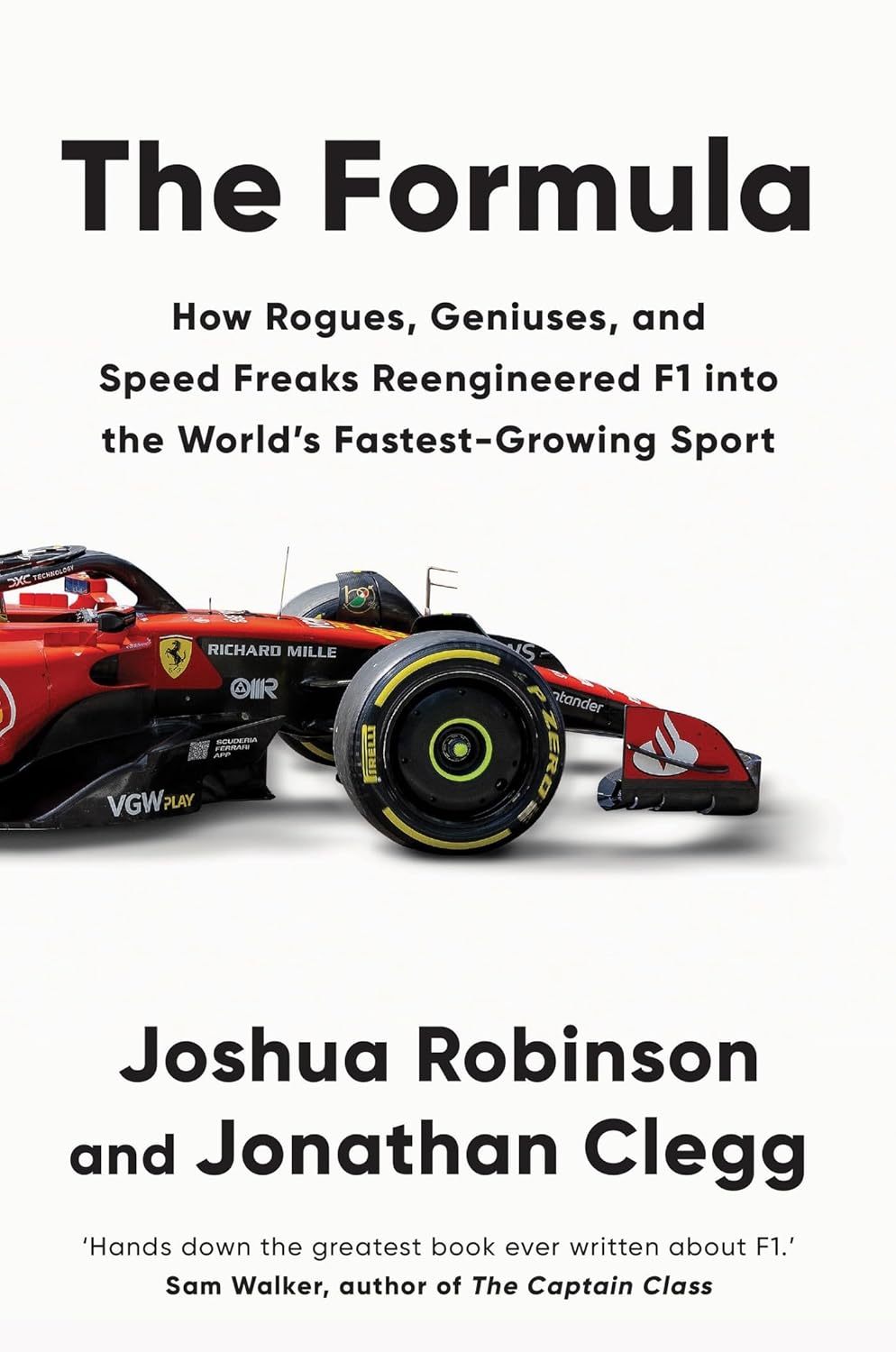
About The Formula by Joshua Robinson and Jonathan Clegg: Inside the Fast Rise of Formula 1
The Formula by Joshua Robinson and Jonathan Clegg explains how Formula 1 changed from a risky European racing world into a huge global sports and entertainment business. The book goes beyond fast cars and famous drivers. It looks at the inventors, team leaders, dealmakers, rule breakers, media owners, engineers, and bold personalities who kept rebuilding the sport.
Many viewers see twenty drivers racing on Sunday. Behind that race stand thousands of choices about design, money, television, rules, sponsors, safety, politics, and public attention. A small change made in a wind tunnel can decide a championship. A business deal made far from the track can change who gets to watch. A driver’s personality can bring millions of new fans.
The authors connect all these parts in one clear story. They show that modern Formula 1 did not grow because of one secret plan. It grew through constant experiments, brave ideas, bitter fights, costly mistakes, and the need to move faster than every rival.
When Formula 1 feels difficult to understand
New fans often enjoy the speed but feel lost when people talk about aerodynamics, tyre choices, team orders, budgets, regulations, or racing history. Longtime fans may know the results but still wonder how Formula 1 became such a powerful business.
This book gives both groups a helpful path. It does not work like a technical manual filled with hard formulas. Instead, it explains the sport through people, choices, conflicts, and turning points. Readers learn why engineering matters by seeing teams search for tiny advantages. They understand the business by following the leaders who turned races into television events watched around the world.
From postwar workshops to a world championship
The story reaches back to the years after the Second World War, when British engineering knowledge helped create a new racing culture. Small teams worked with limited money, clever designs, and people willing to test dangerous ideas. Early Formula 1 was exciting, but it could also be chaotic and deadly.
Winning required more than a brave driver. Teams had to learn how to make cars lighter, faster, safer, and more reliable. Every strong idea was soon copied or beaten. That pattern became part of Formula 1’s nature: find an advantage, win for a short time, then start again when competitors catch up or rules change.
Bernie Ecclestone changes the business
One of the most important figures in the book is Bernie Ecclestone. Formula 1 once operated like a loose travelling show in which teams, race organisers, and officials often pulled in different directions. Ecclestone understood that control, television, and united commercial rights could turn that confusion into a valuable global product.
His methods were bold, secretive, and often controversial. He could see value where others saw disorder. By gathering power and making hard deals, he helped package races for broadcasters, sponsors, and promoters. Formula 1 became more consistent, more visible, and far more profitable.
Engineering as a battle without rest
Formula 1 is a competition between drivers, but it is also a race between ideas. Teams spend enormous time and money searching for fractions of a second. A new wing shape, engine choice, suspension detail, or way of reading a rule can move a car forward. One mistake can waste a season.
The Formula makes this engineering battle exciting without asking readers to become scientists. It explains why a major technical gain can feel like a moon landing and why success never lasts for long. Rivals study every visible detail. Officials may close a rule loophole. New regulations can erase years of advantage overnight.
Famous rivalries make the history personal
Technology matters, but people give Formula 1 its emotion. The book explores strong personalities and rivalries that turned races into larger stories. Drivers compete for points, contracts, respect, and the right to be remembered as the best. Team leaders fight for talent, money, influence, and control.
The world includes names such as Ayrton Senna, Lewis Hamilton, Daniel Ricciardo, Christian Horner, and many others who helped shape different periods. Ferrari brings its own history, pride, pressure, and devoted fan base. Every leading team carries a culture that affects how it wins and how it fails.
Scandals reveal the pressure to win
Formula 1’s hunger for advantage has sometimes crossed important lines. The Formula looks at famous scandals, including Spygate and Crashgate, to show how pressure can lead talented people toward dangerous or dishonest choices.
These events are not included only for drama. They reveal how much is at stake. A team may spend hundreds of millions, employ many people, answer to global sponsors, and build its identity around winning. In that world, information becomes a weapon and a single decision can damage careers, reputations, and trust.
How Formula 1 finally won America
For many years, Formula 1 struggled to become a major sport in the United States. American racing fans already had NASCAR and IndyCar, while F1 could feel distant, complicated, and tied to European time zones. Some earlier attempts to build attention ended in confusion or failure.
The modern breakthrough came through a mix of new ownership, better digital media, stronger storytelling, fresh races, and a clearer focus on entertainment. Liberty Media understood that fans wanted access to drivers and team drama, not only the final result. Social platforms and the Netflix series Drive to Survive helped people learn the faces, rivalries, and pressure behind each weekend.
More than a book about cars
Readers do not need to love engines to enjoy this story. The Formula is also about business strategy, leadership, branding, innovation, risk, and change. It shows how an old organisation can become slow, lose touch with audiences, and then rebuild itself for a new age.
The sport’s leaders had to decide what should remain traditional and what needed to change. Too much change could push away loyal fans. Too little could make F1 invisible to younger viewers. The solution involved shorter digital content, closer access to personalities, global events, and a stronger understanding that modern sport competes with every other form of entertainment.
What makes this sports history stand out
Joshua Robinson and Jonathan Clegg are experienced sports reporters who know how to connect a large business story with human detail. Their writing moves quickly, but it still explains why each turning point matters. They take readers from workshops and wind tunnels to boardrooms, paddocks, glamorous streets, and high-pressure races.
The book combines sporting history, business reporting, engineering drama, famous personalities, and media change in one connected account. It offers enough detail to satisfy an F1 follower without becoming too technical for a beginner. Moments of ambition, rivalry, scandal, failure, and reinvention keep the history moving.
Useful ideas beyond the racetrack
The book shows that lasting success needs repeated change. A winning car becomes old. A powerful media plan loses attention. A famous leader eventually leaves. Formula 1 survives by treating every advantage as temporary.
That lesson can help readers think about work and business. Strong teams mix different skills, make decisions under pressure, study competitors, and learn from failure. Innovation matters, but so do timing, communication, leadership, and the ability to explain value to an audience.
Who should read The Formula?
This book is a strong choice for new F1 fans who discovered the sport through recent races, social media, or Drive to Survive. It gives the history needed to understand why modern teams, leaders, and rivalries matter. Longtime supporters can enjoy the larger commercial story and revisit events from a new angle.
It also suits readers who like business biographies, sports history, technology, marketing, or stories about organisations that reinvent themselves. Students can use it to explore sports media, brand growth, innovation, and global business. Book clubs can discuss whether entertainment has improved Formula 1 or changed too much of its old identity.
A good read for many moments
Open this book before a race weekend to understand the business and history behind the action. Read it during the off-season when you miss the paddock, or take it on a trip when you want nonfiction that moves with the energy of a sports story.
It can be a thoughtful gift for an F1 fan, a new motorsport viewer, an engineering student, or someone interested in global brands. A business reader may focus on Ecclestone and Liberty Media, while a racing fan may care most about drivers, teams, technical leaps, and scandals. Both paths lead through the same fast-moving story.
The chapters can also start conversations between fans with different levels of knowledge. A beginner can ask simple questions without feeling lost, and an experienced viewer can add memories of famous races and seasons.
Recognition that matches its wide appeal
The Formula became a New York Times bestseller and was selected as one of the Financial Times’ best books of summer 2024. It was also shortlisted for the 2025 Charles Tyrwhitt Sports Writing Award.
This recognition reflects the book’s ability to reach beyond a small group of racing experts. It offers an exciting sports story, a sharp business history, and an accessible account of technology and media change. Readers can enter through their interest in cars, famous drivers, business, engineering, television, or modern entertainment.
Comfortable quality for a fast-moving book
Bookish Wonderland offers a reader-friendly copy designed for comfortable use and longer life. Premium eye-soothing cream paper gives the pages a soft appearance during extended reading, while crystal-clear print keeps every line sharp and easy to follow. High-quality stitched and glue binding supports regular page turning and helps the book stay secure. Its durable finish makes it suitable for a personal shelf, study collection, office library, or gift.
Easy ordering through Bookish Wonderland
When comparing the book price in Bangladesh for The Formula by Joshua Robinson and Jonathan Clegg, consider the print comfort, binding strength, and lasting reading value along with the cost. Bookish Wonderland combines these qualities with simple local ordering.
Cash on Delivery is available nationwide, including orders inside and outside Dhaka. A fast or urgent delivery option is also available in Dhaka when the book is needed quickly. It can be ordered for personal reading, study, an office, a book club, a birthday, or an F1 fan’s gift.
For the current price, delivery time, or customization questions, contact Bookish Wonderland through Facebook or Instagram. The team can confirm the best available choice for your location.
Discover what really powers Formula 1
The Formula shows that the world’s fastest racing series is driven by much more than engines. It runs on ideas, money, courage, conflict, media, science, personality, and a constant fear of falling behind. Every era brings a new leader, machine, audience, and challenge.
Read it to understand the people behind the cars and the business behind the spectacle. Keep it for the lessons about innovation, risk, leadership, and reinvention. Share it with anyone who watches a Grand Prix and wonders how this loud, costly, complicated sport captured the world.
Order The Formula by Joshua Robinson and Jonathan Clegg from Bookish Wonderland today. Bring home a New York Times bestselling history that turns the speed, drama, genius, and business of Formula 1 into one gripping journey.
If you require any customization or have any questions, please inbox us via FB or Insta.
| Primary Specification | |
| Author | Jonathan Clegg, Joshua Robinson |
| Narrator | Qarie Marshall |
| Genre | Sports History, Business, Motorsport, Sports Journalism, Nonfiction |
| ISBN-13/ISSN | 978-1800962453 |
| ISBN-10 | 1800962452 |
| Publisher | Monoray |
| Publishing Date | February 13, 2025 |
| Language | English |
| Reading Age | 14+ |
| Format | Printed Book |
| Physical Specification & Quality | |
| Paper Quality | Premium eye-soothing cream paper |
| Binding Quality | High quality stitched and glue binding (for longevity) |
| Print Quality | Crystal-clear print |
| Pages | 304 pages |
| Country | USA |
| Logistics Information | |
| Weight | 326 gm |
| Length | 8.5 inches |
| Width | 5.6 inches |
| Height | 1.1 inch |