

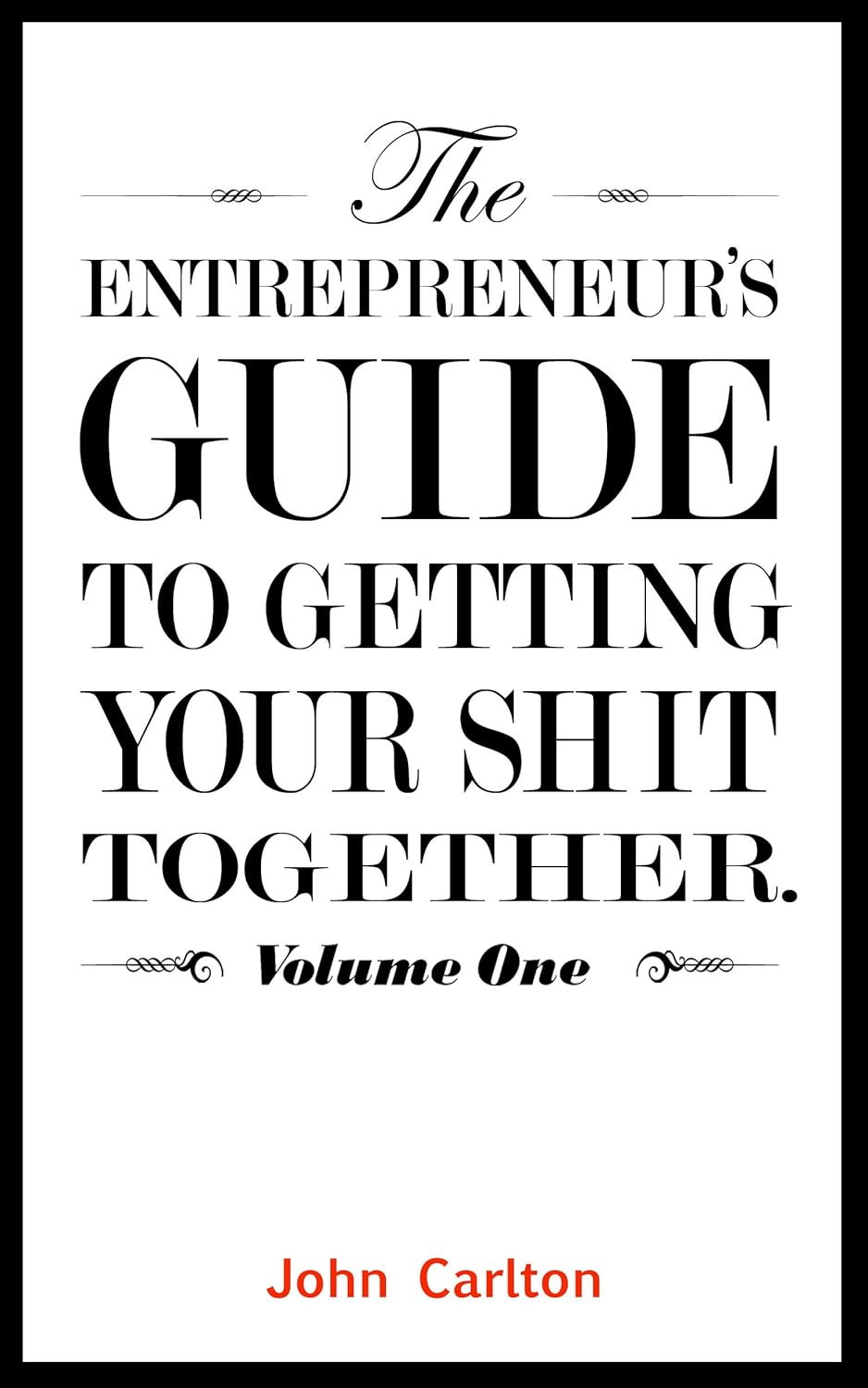
About The Entrepreneur's Guide To Getting Your Shit Together by John Carlton (Volume 1 of 2): A Bold Start for Smarter Business
Starting a business can make you feel free, proud, scared, and lost at the same time. You may know what you want to sell, but not how to find buyers. You may sit down to write an ad and find that no words come. You may work all day without knowing whether the work truly matters. The Entrepreneur's Guide To Getting Your Shit Together by John Carlton (Volume 1 of 2) was written for people facing these real problems. It gives blunt, practical thoughts about marketing, writing, courage, work, and building a life around business.
John Carlton does not write like a quiet teacher standing beside a board. He writes like an experienced professional talking across a table. His voice is funny, direct, personal, and often profane. He shares mistakes as well as wins, using stories from his journey as a freelance copywriter and marketing adviser. This first volume brings together lessons shaped by years of work in direct-response advertising. Much of the material came from his paid Marketing Rebel Rant newsletter, which was read by business owners, marketers, and copywriters.
Stop guessing and start seeing the real problem
New entrepreneurs often collect advice without building a clear plan. One video says to post more. Another says to change the brand. A course says to build a funnel. A friend says to lower the price. Soon, the owner has a full notebook and an empty sense of direction. The problem is not always a lack of information. It may be a lack of focus, customer knowledge, honest feedback, or action.
Carlton brings readers back to basic questions. Who is the customer? What does that person want? What problem feels urgent? Why should the buyer trust this offer? What words will make the value clear? These questions can cut through noise because they deal with real people and real choices. A beautiful page cannot save a weak offer, and a busy schedule cannot replace useful work. The book encourages readers to test their ideas against reality and learn from the answer.
What you will meet inside Volume One
The book begins by introducing Carlton's path from a struggling beginner to an established copywriter. He explains that he did not enter business with a perfect map. He learned through study, mistakes, difficult clients, repeated practice, and close attention to results. That background gives the book its main feeling: progress does not require magic, but it does require responsibility. Nobody can do the hard thinking or useful work in your place.
Volume One contains 17 chapters and a foreword by Joe Polish. The subjects move widely, yet they connect around the life of an entrepreneur. Carlton writes about building and using a list, breaking writer's block, understanding buyers, creating a strong career, handling the hidden cost of good deeds, learning courage, guarding important information, and telling stories. Later chapters examine advanced storytelling and the emotional weight that can come with work and life.
The wide range keeps the book from feeling like one long lesson. One chapter may make you rethink an advertisement. The next may make you look at a business relationship or a choice you have avoided. Carlton uses unusual chapter names and sharp changes of pace to keep readers alert. His aim is not to hand over a neat school formula. He wants the reader to notice patterns, question weak ideas, and develop judgment that can be used in changing situations.
Stories that make the lessons easier to remember
Many business books explain an idea and then repeat it in formal words. Carlton often begins with a scene, a mistake, a strange person, or a hard moment. He pulls the reader into the story before showing the business point. This approach does more than entertain. It demonstrates how a story can hold attention, create emotion, and make a message stay in the mind.
That is especially useful for anyone who sells through words. Customers may forget a long list of claims, but they often remember a clear story. A useful story can show where a problem began, how it felt, what changed, and why the solution matters. Carlton's chapters let readers see this method in action. The book includes both basic and more advanced discussions of storytelling, making the subject an important part of Volume One.
Useful ideas for more than copywriters
Professional copywriters are an obvious audience, but the lessons can serve many kinds of readers. An online seller needs to explain a product. A freelancer needs to present a service. A consultant needs to show why advice has value. A founder must help people understand a new idea. A student with a small project must learn how to speak to buyers. All of these tasks depend on attention, clear language, trust, and a sound offer.
The book also shows why knowing people matters. Buyers do not make every choice through calm logic. They carry hopes, worries, memories, habits, and private reasons. Marketing becomes stronger when it respects what the customer truly cares about. This does not mean tricking people. It means doing better research, listening closely, and explaining an honest benefit in a way the reader can quickly understand.
Carlton also treats reputation as something built through action. A clever ad may bring attention, but poor work can destroy trust. A long career depends on meeting duties, learning from errors, protecting important relationships, and growing real skill. These lessons can help readers think beyond one sale. The larger goal is to become the kind of professional people can rely on when a project matters.
Why an older marketing book still feels useful
Volume One was published in 2013, but many of its central questions are not tied to one website or app. People still notice stories. Buyers still want a clear reason to care. Weak offers still fail. Trust still matters. Writers still face blank pages, and owners still waste time on tasks that look important but create little value. The tools around business change, while these human problems remain familiar.
That makes the book a useful balance to fast online advice. A platform tip may work for a few months. A lesson about customers, communication, courage, or reputation can remain helpful much longer. Readers can use Carlton's ideas when thinking about an email, product page, video script, sales call, shop display, proposal, or social post. The channel changes, but the need to understand and persuade a real person stays.
The book should still be read with judgment. No single writer has the right answer for every market, culture, or business. Some examples come from Carlton's own time and field. The smart approach is to study the principle, compare it with the present situation, and test it in a fair way. This active reading style turns the book into a source of questions and experiments instead of a set of orders.
A printed copy made for active reading
Bookish Wonderland offers a reader-friendly printed edition for people who want to keep useful ideas close at hand. Its physical qualities support long reading and regular study:
-
Crystal-clear printing makes the text sharp and simple to follow.
-
Premium eye-soothing cream paper gives each page a comfortable, soft colour.
-
High-quality stitched and glue binding supports repeated opening and careful use.
-
The printed format leaves readers free to underline points, add notes, and mark important chapters.
What this book may help you do
-
Look at a product or service from the customer's point of view.
-
Turn a large writing task into a clear first step.
-
Use stories to make a sales message easier to understand and remember.
-
Notice the difference between busy activity and work that moves a project forward.
-
Think more carefully about trust, reputation, courage, and professional choices.
-
Build a stronger base before chasing a new marketing trend.
The book cannot guarantee sales or remove every business problem. Its value comes from the way you use it. Read with a live project in mind. When a chapter raises a useful point, connect it to an ad, offer, client message, or decision. Choose one small change, try it, and observe what happens. This keeps the reading practical and protects you from changing everything at once.
Who should begin with Volume One?
This book can suit entrepreneurs, online sellers, small business owners, freelancers, copywriters, marketers, consultants, creators, and students interested in business. It is especially suited to readers who enjoy story-led teaching and direct advice. Beginners can gain a broad view of customers, writing, and professional life. Experienced readers may find reminders that bring attention back to basic skills they have ignored.
As the opening book in the set, Volume One is the natural place to begin. It introduces Carlton's style, background, major ideas, and way of looking at business. The chapters cover a wide field, so you do not need to finish the entire book before finding something useful. Read in order for the full experience, or return later to a chapter that matches a current problem.
Put the lessons beside your daily work
Try reading one short section before starting your workday. Write the central idea in your own words. Then ask where it appears in your business. If the lesson is about customers, review the words buyers use in messages and reviews. If it is about storytelling, study your product page. If it is about courage, name one useful action you have delayed. This method turns reading into movement.
The book can also support a small team. Choose one chapter, let everyone note a different lesson, and discuss where the business is strong or unclear. A team does not have to accept every view in the book. The value may come from the conversation it starts. Clear questions can reveal weak offers, confused messages, hidden risks, or better ways to serve buyers.
Follow the complete two-volume path
Volume One begins the collection, while Volume Two continues with more advice and stories from Carlton's work in marketing and advertising. Readers who enjoy this first book can move directly to the second volume and complete the set.
Follow the complete two-volume path
Volume One begins the collection, while Volume Two continues with more advice and stories from Carlton's work in marketing and advertising. Readers who enjoy this first book can move directly to the second volume and complete the set.
What books are in The Entrepreneur's Guide To Getting Your Shit Together series by John Carlton?:
-
The Entrepreneur's Guide To Getting Your Shit Together by John Carlton (Volume 1 of 2)
-
The Entrepreneur's Guide To Getting Your Shit Together by John Carlton (Volume 2 of 2)
Bring clearer thinking to your next project
If you are checking the Book price in Bangladesh for The Entrepreneur's Guide To Getting Your Shit Together by John Carlton, also consider the value of a copy made for regular reading. Comfortable paper, clear text, and a lasting binding are useful when you want to study the pages, make notes, and return to important lessons.
Bookish Wonderland provides nationwide delivery, including delivery inside and outside Dhaka. Cash on Delivery is available across the country. Customers in Dhaka may also ask about fast or urgent delivery when the book is needed sooner. For questions or available customization options, contact Bookish Wonderland through Facebook or Instagram.
The Entrepreneur's Guide To Getting Your Shit Together by John Carlton (Volume 1 of 2) offers a lively entry into business thinking, marketing, copywriting, and entrepreneurial life. It does not hide the hard parts behind sweet words. It asks readers to face real customers, real choices, and real work with greater skill. If you want a book that can make you think, laugh, question old habits, and reach for a stronger way to communicate, this is a powerful place to start. Order Volume One from Bookish Wonderland today and begin building the foundation for your next better decision.
If you require any customization or have any questions, please inbox us via FB or Insta.
| Primary Specification | |
| Volume | 1 of 2 |
| Author | John Carlton |
| Genre | Business, Entrepreneurship, Marketing, Copywriting, Self-Help, Personal Development |
| ISBN-13/ISSN | 978-1483996967 |
| ISBN-10 | 1483996964 |
| Publisher | CreateSpace Independent Publishing Platform |
| Publishing Date | July 18, 2013 |
| Language | English |
| Reading Age | 18+ |
| Format | Printed Book |
| Physical Specification & Quality | |
| Paper Quality | Premium eye-soothing cream paper |
| Binding Quality | High quality stitched and glue binding (for longevity) |
| Print Quality | Crystal-clear print |
| Pages | 394 pages |
| Country | USA |
| Logistics Information | |
| Weight | 419 gm |
| Length | 8.5 inches |
| Width | 5.6 inches |
| Height | 0.89 inch |