

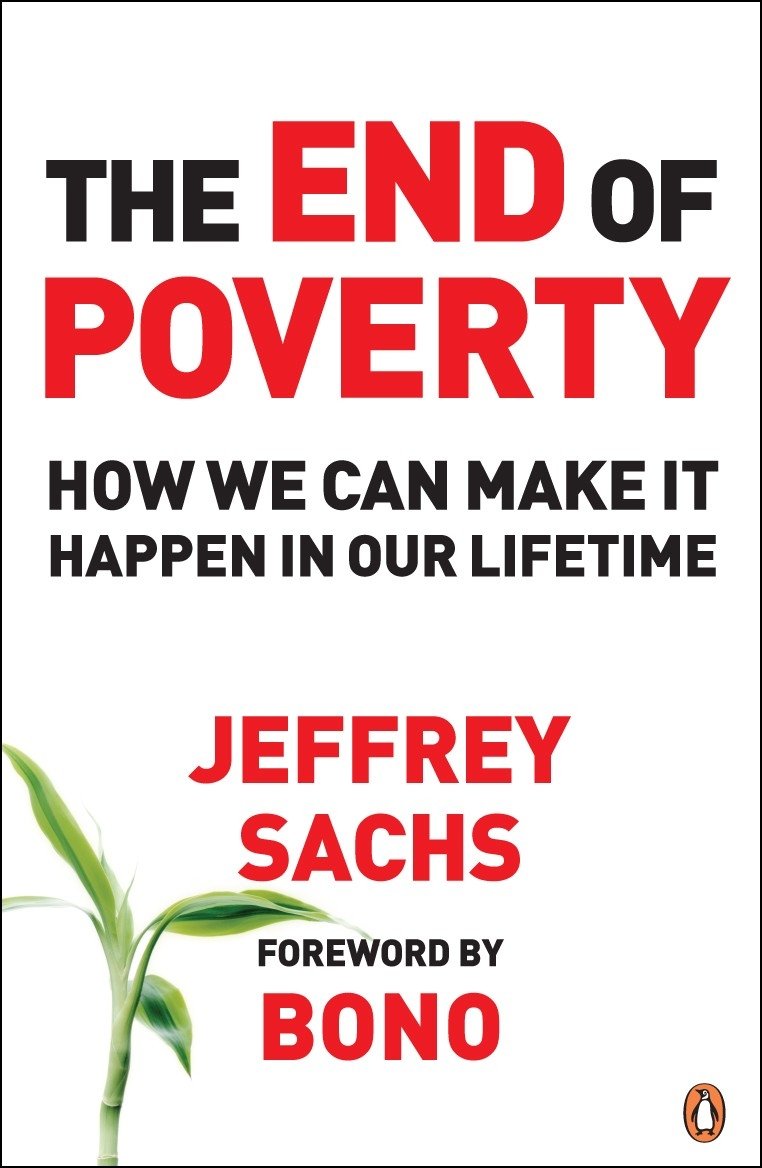
About The End of Poverty by Jeffrey Sachs: A Bold Plan for Building a Fairer World
Why are some countries rich while millions of people in other places struggle for food, medicine, clean water, school, and safe homes? The End of Poverty by Jeffrey Sachs begins with this large question. It argues that extreme poverty is not a fixed part of human life. With the right public investment, local action, and global support, Sachs believes very poor communities can begin moving toward lasting growth.
First published in 2005 with the subtitle Economic Possibilities for Our Time, the book combines economic history, policy ideas, personal travel, and stories from Sachs's work around the world. He takes readers from Bolivia, Poland, Russia, India, and China to villages in Africa. In each place, he asks what blocks progress and what kind of help could make a practical difference.
This is not simply a book asking rich people to give more money. Sachs tries to show where money should go, how different problems connect, and why one solution cannot fit every country. His plan is hopeful and ambitious. It has also been debated by economists who question parts of his poverty-trap theory, aid strategy, and evidence. That debate makes the book useful for anyone who wants to understand both the promise and difficulty of global development.
Poverty Is More Than a Low Income
Many problems can make one another worse. Poor health reduces a person's ability to work. Low income makes treatment hard to buy. Weak roads raise the cost of food and trade. A government with little tax income cannot build the services that might help the economy grow. Poverty therefore becomes a circle that is difficult to break.
The book gives readers a simple way to see this circle. People do not always remain poor because they lack effort or ideas. They may be trapped below the level where saving, investment, and growth become possible. Sachs calls this the poverty trap and makes it the centre of his argument.
The First Step onto the Development Ladder
Sachs compares economic progress to climbing a ladder. Families in moderate poverty may already have a foot on the first step. They can sometimes save, improve a farm, open a shop, or pay for education. Families in extreme poverty may use every resource simply to survive. They have nothing left for the investment that could improve tomorrow.
His proposed solution is a strong first push. Outside support and public spending can provide basic tools that communities cannot yet finance alone. Once health, farming, education, transport, water, and power improve together, people may earn more and save more. Local business and tax income can then grow, reducing the need for aid over time.
This idea is important because it changes the purpose of assistance. Aid is not presented as endless charity. It is meant to help people reach the first step, after which their own work, markets, public systems, and skills can support further growth. Whether this process works the same way everywhere remains an important question for readers to examine.
Economic Problems Need a Careful Diagnosis
One of the book's best-known ideas is “clinical economics.” Sachs compares an economist with a doctor. A good doctor does not give every patient the same medicine. The doctor listens, checks symptoms, studies history, considers several causes, and then chooses a treatment.
Sachs says countries should be studied in the same careful way. One country may be blocked by malaria and poor roads. Another may struggle with debt, weak government, dry land, conflict, or distance from a port. Culture, gender rules, trade barriers, climate, and population change may also matter. A plan that helps one place may fail in another.
This approach gives the reader a useful tool. Before blaming a government or population, ask what the full diagnosis shows. Look at geography, health, education, farming, infrastructure, public finance, law, and links with nearby markets. Good policy begins with the real local problem rather than a favourite answer chosen in advance.
The Basic Investments Sachs Believes Can Work
The End of Poverty turns a huge goal into several clear areas of action. Sachs argues that very poor communities need progress across connected needs, including:
-
Better seeds, soil care, fertiliser, irrigation, and training for farmers.
-
Clinics, medicine, vaccines, disease control, and support for mothers and children.
-
Schools, trained teachers, learning materials, and meals for students.
-
Safe drinking water, toilets, sanitation, and basic waste systems.
-
Roads, electricity, phones, internet access, and links to larger markets.
-
Stronger public services that can manage money and deliver help fairly.
The main point is that one investment may fail if the others are missing. A healthy farmer still needs a road to sell crops. A school cannot work well when children are hungry or ill. A clinic needs electricity, trained staff, medicine, and transport. Sachs therefore supports a joined plan instead of many small projects that never connect.
Real Countries Make the Economics Easier to See
Sachs draws on decades of work advising governments and international groups. He describes economic reform and crisis in several regions, showing that poverty does not have one history. Bolivia faced high inflation. Poland moved away from communist rule. Russia struggled through a painful transition. China and India followed their own paths into faster growth.
The African examples focus strongly on disease, farming, transport, and isolation. Sachs explains why malaria can damage both health and economic life, why weak soil can keep harvests low, and why landlocked communities face costly trade. These stories help readers connect large economic words with daily experience.
Not every reader will agree with Sachs's interpretation of each country. Some critics believe he gives too much weight to outside experts, large aid packages, or planned interventions. Others argue that institutions, political power, local knowledge, business rules, and careful testing deserve more attention. Reading the book with these questions in mind creates a richer experience.
A Global Plan Built Around Shared Goals
The book was written during the era of the United Nations Millennium Development Goals. These goals asked the world to reduce extreme poverty and improve health, education, equality, and access to basic services. Sachs argues that wealthy countries had promised support but often gave too little or gave it in weak, poorly planned ways.
He calls for richer nations to meet the long-discussed aid target of 0.7 percent of national income. In his view, this level of support was affordable and could finance practical steps against hunger, disease, poor schools, unsafe water, and weak infrastructure. He also argues that ending extreme poverty would serve both moral duty and global security.
The original book looked toward ending extreme poverty by 2025. That deadline has passed without the goal being reached. Later editions discuss the United Nations target of 2030, but current international estimates show that this goal is also far from reach. This does not make the book useless. It gives readers a clear plan to compare with real progress, missed promises, new evidence, and changing global conditions.
Hopeful Ideas That Should Still Be Questioned
The End of Poverty is persuasive because it refuses to treat suffering as normal. Sachs believes modern knowledge and wealth give humanity the power to meet basic needs. His confidence can make a difficult subject feel possible rather than hopeless.
At the same time, confidence is not proof. Development programs must be measured against what would have happened without them. Money can be wasted, local voices can be ignored, and a short improvement may not create lasting growth. Economists continue to debate how common national poverty traps are and when large first investments produce self-sustaining change.
A careful reader can value the moral purpose of the book while testing its policy claims. The strongest reading question is not simply, “Is Sachs right or wrong?” Better questions are: Which parts work, where do they work, how do we know, who controls the plan, and what happens after outside funding ends?
What You Gain from Reading This Book
-
A clear introduction to extreme poverty and development economics.
-
A simple explanation of poverty traps and the development ladder.
-
A practical model for diagnosing different national problems.
-
Examples connecting health, farming, education, roads, and trade.
-
A major argument for targeted foreign aid and global cooperation.
-
Material for debating evidence, institutions, responsibility, and policy.
-
A hopeful view that treats poverty as a solvable human problem.
The book also teaches readers to connect fields that are often studied alone. Health policy affects work. Roads affect food prices. Schooling affects future income. Geography affects trade. Government capacity affects every public program. Seeing these links helps readers understand why development is difficult and why simple slogans rarely solve it.
Who Should Read The End of Poverty?
This book is a strong choice for students of economics, business, public health, international relations, sociology, development studies, and government. It is also suitable for NGO workers, teachers, policy readers, and general readers who want a broad introduction to global poverty.
Sachs explains many ideas through stories and examples, making the main argument easier to follow than a technical textbook. Some sections still include data, policy language, and economic history, so slow reading may help. Readers can mark unfamiliar terms and return to the country examples when the theory becomes difficult.
It works especially well in a class or reading group. One person can present Sachs's plan while another studies criticism of aid or poverty traps. The group can then compare the book's 2005 hopes with present-day evidence. This turns the title into a living debate rather than an old prediction.
A Comfortable Copy for Serious Study
Bookish Wonderland offers a reader-friendly printed copy for regular reading and study. Premium eye-soothing cream paper makes long chapters more comfortable. Crystal-clear printing keeps figures, headings, notes, and detailed paragraphs easy to follow. High-quality stitched and glue binding supports repeated use at home, in class, at work, or during group discussion.
The book is useful for highlighting key ideas, preparing presentations, and returning to country examples. A durable copy can remain part of a personal economics, policy, or social-science library for years.
Practical Ways to Use the Book
Students can use the book as a starting point for essays about foreign aid, sustainable development, poverty measurement, public health, or the Millennium Development Goals. NGO teams can discuss how local leadership and evaluation should fit with Sachs's integrated plan. General readers can use it to understand news about debt, aid, disease, food security, and international development.
Order The End of Poverty from Bookish Wonderland
Readers comparing the book price in Bangladesh for The End of Poverty by Jeffrey Sachs can order easily from Bookish Wonderland. Delivery is available inside Dhaka and across the country. Cash on Delivery is available nationwide, and fast or urgent delivery may be requested within Dhaka when the book is needed sooner.
Choose this book if you want economics connected to real lives. Its original deadline was too hopeful, and some solutions remain disputed, but the central challenge still matters. The book asks readers to imagine a world where birthplace no longer decides whether a person can eat, learn, stay healthy, and build a future.
Add The End of Poverty to your shelf and join one of the most important debates of our time. For customization or questions about the available edition, please inbox Bookish Wonderland through Facebook or Instagram before ordering.
If you require any customization or have any questions, please inbox us via FB or Insta.
| Primary Specification | |
| Author | Jeffrey Sachs |
| Narrator | Malcolm Hillgartner |
| Editor | Mauna Eichner |
| Genre | Development Economics, Economics, Global Development, Poverty Studies, Public Policy, Nonfiction |
| ISBN-13/ISSN | 978-0143036586 |
| ISBN-10 | 0143036580 |
| Publisher | Penguin Books |
| Publishing Date | February 28, 2006 |
| Language | English |
| Reading Age | 16+ |
| Format | Printed Book |
| Physical Specification & Quality | |
| Paper Quality | Premium eye-soothing cream paper |
| Binding Quality | High quality stitched and glue binding (for longevity) |
| Print Quality | Crystal-clear print |
| Pages | 464 pages |
| Country | USA |
| Logistics Information | |
| Weight | 485 gm |
| Length | 8.5 inches |
| Width | 5.6 inches |
| Height | 1.3 inch |