

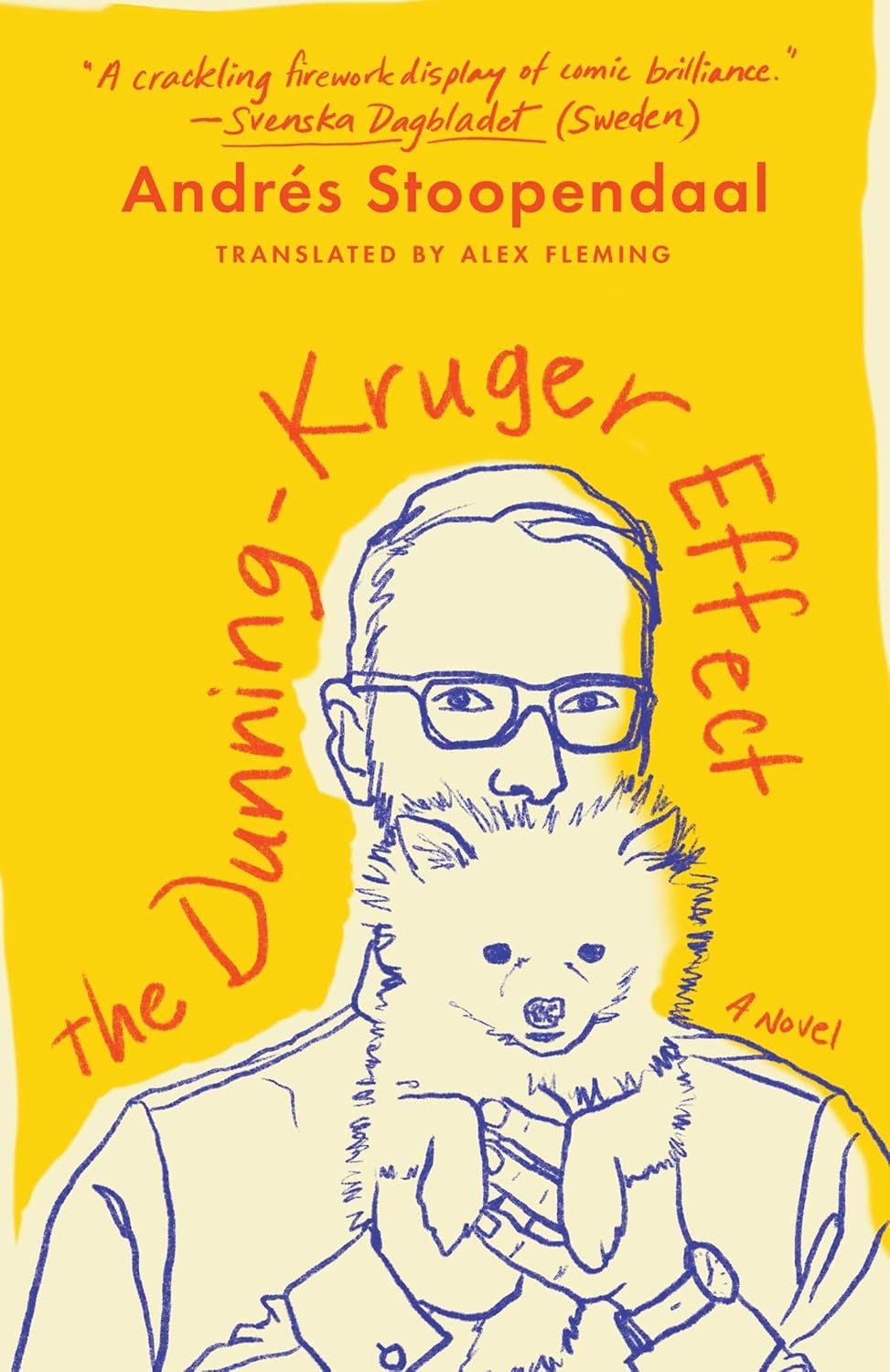
About The Dunning-Kruger Effect by Andrés Stoopendaal: A Sharp, Funny Novel About Ego, Ambition and Modern Life
What happens when a man is sure he is smarter than everyone around him, but cannot see his own mistakes?
The Dunning-Kruger Effect by Andrés Stoopendaal turns that uncomfortable question into a clever and darkly funny story. Set during a very hot summer in Gothenburg, Sweden, the novel follows an unnamed man who wants to become a serious writer. He sees himself as a deep thinker. He has strong views about books, society, culture, men, women and politics. Yet his daily life tells a different story.
He works part-time in a government office, struggles to write his novel and depends on his girlfriend, Maria, to manage much of his social life. Even a simple duty—looking after Maria’s small Pomeranian dog—becomes harder than he expects.
This is not a textbook about the real Dunning-Kruger effect. It is a literary satire that shows the idea through the thoughts and behaviour of its main character. The title refers to the bias in which people with limited ability may fail to understand the limits of their ability. Stoopendaal uses that idea to build an uneasy but very funny portrait of confidence without enough self-awareness.
The official English edition is translated from Swedish by Alex Fleming. The publisher presents it as a biting satire about an overeducated and underemployed man trying to finish a novel and repair his life over one scorching summer.
A Man Who Wants to Be Extraordinary
The unnamed narrator does not want to live an ordinary life. He wants to be seen as a bold writer and an important thinker. In his own mind, he understands culture better than most people. He believes his ideas are original, brave and much deeper than normal conversation.
The problem is simple: thinking about being a writer is not the same as writing a good book.
Inspired by Stephen King’s On Writing, he creates a plan to work on his novel for four hours every day. It sounds clear and sensible. But once he begins, he learns that routine cannot automatically create imagination, discipline or honest writing. His planned masterpiece slowly changes into strange fan fiction involving French author Michel Houellebecq.
The gap between what the narrator believes and what he actually produces creates much of the comedy. Readers can see things that he cannot. He tries to appear wise, but his words often reveal confusion. He wants to escape every common label, yet he slowly becomes a familiar type: a self-important man who talks more than he listens.
This difference between his self-image and real life gives the novel its heart. It is also what makes the title so fitting.
When Confidence Hides a Deeper Problem
Many people know the pain of having a goal but failing to begin. Some buy notebooks, make plans and read advice, yet still do not complete the work. Others fear being ordinary so much that they spend more time building an image than improving their skills.
Stoopendaal takes this common problem and makes it both funny and uncomfortable.
His narrator wants success, meaning and respect. However, he is trapped by his own pride. He cannot grow because he is always trying to prove that he has already grown. He studies the world but rarely studies himself. Every talk becomes a stage, and every opinion becomes a way to show how clever he is.
The story offers no quick self-help cure. Instead, it gives readers a useful mirror. It shows why honest self-knowledge matters. Real improvement begins when a person accepts that they may be wrong, weak or unfinished. The narrator must face the space between the man he imagines himself to be and the man his actions reveal.
That struggle can speak to writers, students, workers and anyone who has ever wanted to seem more capable than they felt.
One Hot Summer Filled with Big Ideas
The story takes place during the hot Swedish summer of 2018. The heat adds pressure to the narrator’s already busy mind. He works at his part-time government job, spends time with Maria, meets friends, drinks, talks about culture and tries to force his unfinished novel into shape.
He also thinks constantly.
His thoughts move through literature, popular culture, internet debates, identity, gender, class, religion and public figures. He can turn an ordinary dinner or small disagreement into a long argument. Even when nobody is listening, he imagines an audience and prepares a case for or against the latest cultural question.
This may sound serious, but the book uses these moments for comedy. The narrator’s long speeches often reveal more about his insecurity than the topic he is discussing.
Readers should know that this is a character-led novel. It does not depend on fast action, a crime mystery or a large romantic plot. Its main drama happens inside the narrator’s mind and through his conversations. Kirkus describes it as a cerebral, darkly humorous novel with many high- and low-culture references and relatively little traditional plot.
If you enjoy books about ideas, flawed narrators and social behaviour, this slow and thoughtful style may be a strong match.
A Small Dog Creates a Big Moment
Maria’s Pomeranian, Molly, plays an important part in the story. The narrator is asked to care for the dog, but after drinking and talking late into the night, he wakes with a frightening problem: Molly seems to be missing.
The event is funny on the surface, but it also places the narrator face-to-face with his lack of responsibility. For once, his clever words cannot protect him. A living creature was under his care, and he may have failed her.
Molly is eventually found safe in a laundry hamper. Yet the narrator’s fear and shame remain important. The experience pushes him to think about his drinking, his choices and the kind of man he has become. Kirkus identifies this episode as the novel’s main dramatic event and notes that it leads him to stop drinking and consider the Bible.
The dog therefore becomes more than a comic side character. She brings a real duty into a life built around ideas. She reminds the narrator—and the reader—that how we treat others may say more about us than our smartest speech.
Humour That May Make You Laugh and Cringe
The humour in The Dunning-Kruger Effect is sharp, awkward and often uncomfortable. Readers are not always laughing with the narrator. Many times, they are laughing at the large difference between his confidence and his actual understanding.
He believes he is unusual, but his desire to appear special is very common. He thinks he challenges society, but he often repeats old ideas. He wants to be brave, yet he is deeply worried about how people see him.
This kind of satire works by allowing a character to expose himself. Stoopendaal does not need to explain every joke. The narrator speaks at length, and readers notice what he misses. His serious tone can make his worst ideas even funnier.
The book also asks a hard question: how different are we from him?
Most people have defended an opinion without enough knowledge. Many have judged others too quickly or imagined that their work was better than it really was. The narrator is an extreme example, but the weakness behind his behaviour is widely human.
That makes the novel more than a joke about one foolish man. It becomes a story about pride, fear and the stories people tell themselves.
A Story About Writing and the Fear of Failure
Anyone who wants to write may recognise the narrator’s struggle. He dreams about completing an important novel. He makes rules, thinks about famous writers and imagines how readers might react. Yet the actual pages refuse to become the great work he sees in his head.
This part of the story explores the distance between ambition and skill.
Wanting to create something special can be good. The trouble begins when a person loves the image of success more than the work required to earn it. The narrator wants the identity of “writer,” but writing asks for patience, editing, listening and the ability to see faults in one’s own work.
His trouble is not only a lack of ideas. It is also his poor ability to judge his ideas. Because he assumes he is already brilliant, he cannot easily make his work better.
For new writers, the lesson is simple and useful: confidence can help you start, but honest feedback helps you grow. Reading, practice and revision matter. A person must be willing to write badly before learning to write well.
The book delivers this message through satire instead of direct advice, making it an interesting choice for writing groups and creative students.
Ideas About Class, Gender and Identity
The narrator spends much of his time thinking and talking about modern social questions. He discusses identity politics, manhood, class, culture and public figures. However, readers should not treat every claim he makes as the author’s own belief.
He is an unreliable and highly self-involved narrator. His opinions help reveal his weaknesses. He may believe he is making a strong argument while the wider scene shows how limited or foolish that argument is.
The novel therefore asks readers to remain active. You must notice tone, irony and contradiction. A sentence may mean more than its plain words suggest. A speech that sounds confident may actually be exposing ignorance.
This is also why the book can lead to strong discussion. Two readers may disagree about whether a moment is funny, offensive, sad or all three. Some may see the narrator mainly as a target of satire. Others may find parts of his inner life painfully familiar.
The official publisher calls the book a portrait of delayed maturity and a takedown of a privileged man who believes he is a revolutionary.
Why This Novel Feels Relevant Today
Modern life rewards strong opinions. Social media gives everyone a place to speak, judge and build a public image. People can watch a short video or read one post and quickly feel like experts.
The narrator belongs perfectly in this world. He takes in books, talks, trends and public debates, then uses them to form a grand picture of himself. He wants to be the person who understands everything. But the more he tries to prove his intelligence, the more clearly readers can see his blind spots.
This makes the story useful for readers interested in internet culture and modern manhood. It asks how people build identity from the media they consume. It also shows how borrowed ideas may create the feeling of knowledge without deep understanding.
The book does not ask readers to stop having opinions. It asks them to look closely at the way opinions are formed. Are we trying to understand a subject, or are we trying to win? Are we listening, or waiting to speak? Are we learning, or only collecting words that support the person we already believe ourselves to be?
These questions make the novel timely even beyond its Swedish setting.
Who Will Enjoy The Dunning-Kruger Effect?
This book may appeal to readers who enjoy literary fiction with a strong voice and a deeply flawed main character. It is also a good choice for people who like social satire, dark humour and stories that examine the thoughts of one person in great detail.
You may especially enjoy it if you like:
- Unreliable or self-important narrators
- Novels about writers and unfinished creative work
- Dark, awkward and intelligent humour
- Social commentary about class, gender and identity
- Stories set in modern Sweden
- Character studies with more ideas than action
- Books that invite debate after the final page
- Literary references and playful footnotes
- Stories about delayed maturity and self-discovery
Readers looking for a fast thriller or a simple heroic character should know that this is a different kind of experience. The narrator can be frustrating, and that frustration is part of the design. You are invited to examine him, question him and decide what his mistakes reveal.
The book also contains adult discussions involving sex, drinking, gender and politics. It is more suitable for mature readers than young children.
A Strong Choice for Discussion and Study
The Dunning-Kruger Effect can work well for book clubs because it offers many questions without giving easy answers.
Readers can discuss whether the narrator changes, whether his shame creates real growth and how much sympathy he deserves. A group may also explore why Stoopendaal leaves him unnamed. Perhaps the lack of a name turns him into a wider type rather than one special person. He can represent anyone who builds a grand identity while failing to understand their own behaviour.
The novel can also support discussion about satire. Readers may ask where the author’s voice ends and the narrator’s voice begins. They can identify moments of irony, compare what the narrator says with what he does and study how comedy reveals social problems.
Creative-writing students may find the failed-novel plot especially useful. It shows how fear, ego and the desire for praise can stop honest work. Psychology students should remember that this is fiction, not an academic guide, but they may still find its portrait of self-deception interesting.
Because the story can make people laugh, disagree and feel uncomfortable, it has the qualities needed for a lively group discussion.
An English Translation That Brings Swedish Satire to More Readers
Andrés Stoopendaal is a Swedish author and literary critic. The English-language edition was translated by Alex Fleming and published in the United States by Atria Books. The publisher lists the trade paperback edition as 256 pages with ISBN-13 9781668020203 and a publication date of May 20, 2025. An earlier Atria hardcover edition, ISBN-13 9781668020197, was released on June 11, 2024.
The translation gives English-language readers access to a novel shaped by Swedish life but filled with wider concerns. The wish to seem clever, the fear of being ordinary and the trouble of turning plans into action are not limited to one country.
The Gothenburg setting offers a fresh background for readers who want contemporary fiction beyond the most familiar American and British locations. At the same time, references to global books, public thinkers, popular culture and online debates make the narrator’s world easy to recognise.
Made for Comfortable, Long-Term Reading
A thoughtful novel deserves a physical copy that feels comfortable in your hands. Bookish Wonderland provides a premium printed edition for readers who care about both the story and the reading experience.
The book is produced with premium, eye-soothing cream paper. The softer page colour reduces the harsh look of bright white paper and makes long reading sessions more comfortable.
Its crystal-clear print keeps the letters sharp and easy to follow. This is especially helpful in a novel filled with long thoughts, cultural references and detailed conversations.
High-quality stitched and glue binding gives the book added strength. The pages are held securely so the copy can handle regular reading and remain part of your shelf for years when stored with proper care.
These physical features make it suitable for personal reading, book-club meetings, study, gifting or building a durable English literature collection.
What You Receive from Bookish Wonderland
When you order from Bookish Wonderland, you receive more than access to an interesting contemporary novel.
- Premium eye-soothing cream paper for comfortable reading
- Crystal-clear printing with sharp, clean text
- High-quality stitched and glue binding for longevity
- A durable printed copy suitable for repeated reading
- Cash on Delivery across Bangladesh
- Delivery inside and outside Dhaka
- Nationwide delivery service
- Fast or urgent delivery options in Dhaka
- Customer support through Facebook and Instagram
The Dunning-Kruger Effect by Andrés Stoopendaal price in Bangladesh may depend on current stock, edition and available offers. Check the latest listed price on the product page before placing your order.
A Gift for Readers Who Like Clever and Unusual Books
This novel can make a memorable gift for a reader who enjoys books that are funny, strange and full of ideas. Its unusual title quickly creates curiosity, while its subject opens the door to conversations about confidence, skill and self-awareness.
It may be a fitting gift for:
- A fan of literary or translated fiction
- A friend who enjoys dark social comedy
- A student interested in culture and identity
- A new writer learning to face creative failure
- A book-club member who loves debate
- A reader interested in modern Swedish literature
- Someone who enjoys deeply flawed narrators
The story is not designed to give easy comfort. Its pleasure comes from watching a man explain himself while revealing far more than he intends. For the right reader, that creates a bold, funny and thought-provoking experience.
Add a Bold and Thoughtful Novel to Your Shelf
The Dunning-Kruger Effect is for readers who are willing to spend time with a difficult, funny and painfully human character. It shows what can happen when confidence grows faster than ability and when the wish to look intelligent becomes stronger than the wish to learn.
The narrator may annoy you. He may make you laugh. At times, he may even remind you of someone you know—or of a part of yourself you would rather ignore. That is where the novel finds its power.
Order The Dunning-Kruger Effect by Andrés Stoopendaal from Bookish Wonderland and enjoy a premium reading copy with comfortable cream paper, clean print and durable binding. Cash on Delivery is available nationwide, with delivery inside and outside Dhaka and an urgent delivery option available in Dhaka.
Get your copy today and enter one hot Swedish summer filled with ambition, awkward ideas, failed plans, sharp humour and a long-overdue lesson in self-awareness.
If you require any customization or have any questions, please inbox us via FB or Insta.
| Primary Specification | |
| Author | Andrés Stoopendaal |
| Translator | Alex Fleming |
| Narrator | Kevin R. Free |
| Genre | Literary Fiction, Satirical Fiction, Humorous Fiction, Contemporary Fiction |
| ISBN-13/ISSN | 978-1668020203 |
| ISBN-10 | 1668020203 |
| Publisher | Atria Books |
| Publishing Date | May 20, 2025 |
| Language | English |
| Reading Age | 18+ years |
| Format | Printed book |
| Physical Specification & Quality | |
| Paper Quality | Premium eye-soothing cream paper |
| Binding Quality | High quality stitched and glue binding (for longevity) |
| Print Quality | Crystal-clear print |
| Pages | 256 pages |
| Country | Sweden |
| Logistics Information | |
| Weight | 273 gm |
| Length | 8.5 inches |
| Width | 5.6 inches |
| Height | 0.7 inch |