

About The Dune Encyclopedia by Frank Herbert—A Vast Guide to the World of Dune
Some fictional worlds end when the story ends. Dune does not. Its planets, noble families, religions, wars, machines, customs, and secret groups seem to continue far beyond the pages of the novels. The Dune Encyclopedia was made for readers who want to travel deeper into that enormous universe.
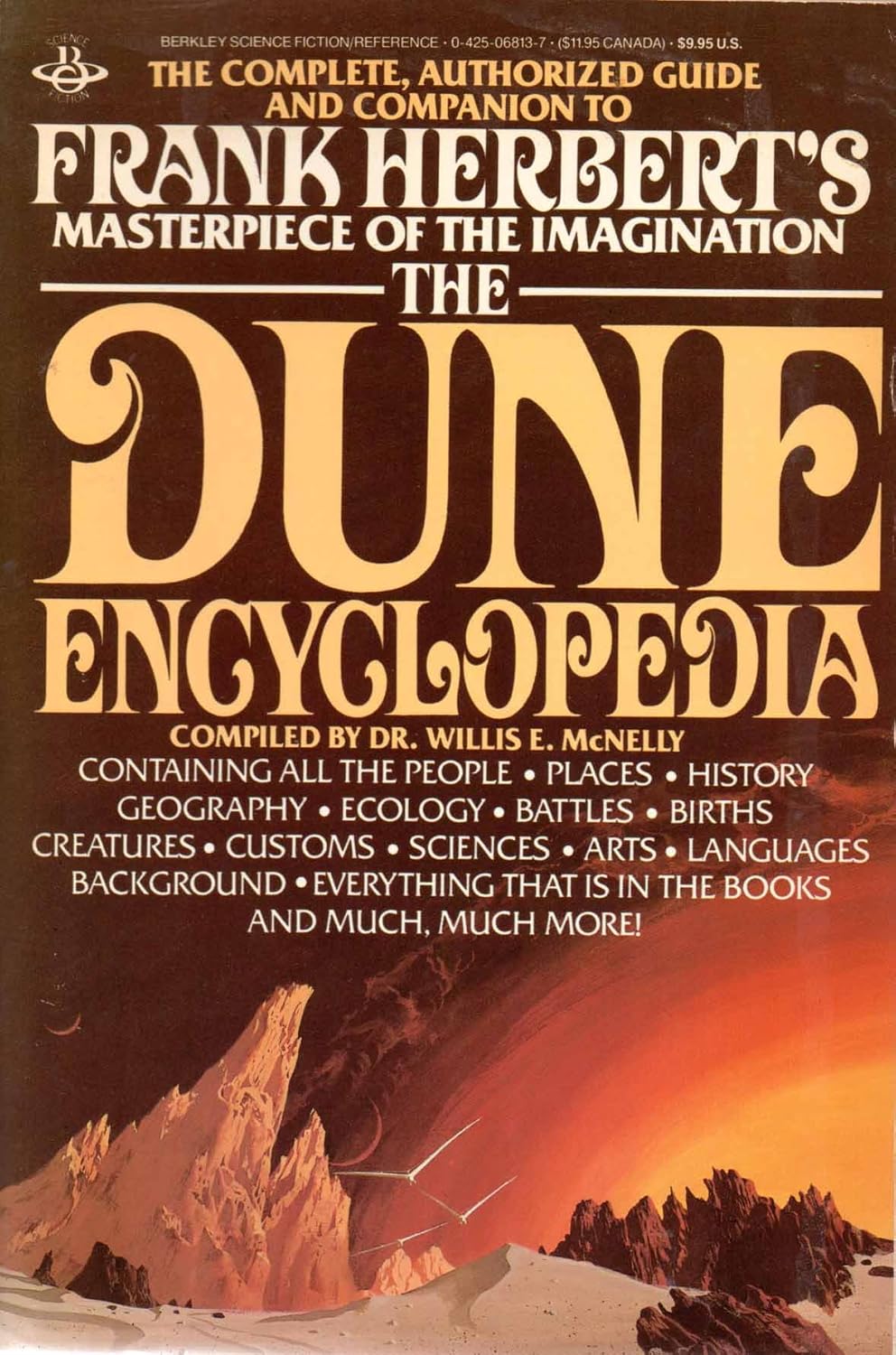
Although the book is often searched for as The Dune Encyclopedia by Frank Herbert, the correct credit matters. Dr. Willis E. McNelly compiled and edited the encyclopedia with work from many contributors. Frank Herbert, creator of Dune, wrote the foreword and approved the original publication. This connection gives the volume a special place in Dune history.
First published in 1984, the book presents its information as if it were a real reference work from inside the Dune universe. Instead of simply explaining the novels from an outside point of view, it treats Arrakis, House Atreides, the Bene Gesserit, the spice melange, and other subjects like parts of recorded history. That creative design makes the book feel less like a normal guide and more like an old document discovered in the Imperium.
When the Dune World Feels Too Large
Reading Dune can be thrilling, but its world is not simple. The story contains noble houses, changing alliances, unusual titles, ancient conflicts, religious ideas, special technologies, and thousands of years of imagined history. A reader may remember Paul Atreides but forget how one political group connects to another. A strange name may appear again long after its first introduction. Important events may be discussed without a full explanation.
This encyclopedia gives curious readers another way to explore those details. Its reference-style entries help place people, groups, objects, beliefs, and historical events within a wider picture. You can open it when you want more information about a familiar subject or read through it slowly to discover ideas that never received much space in the main novels.
The result is a richer view of Dune. The desert planet is no longer only the place where Paul’s story begins. It becomes part of a long history filled with rulers, scholars, religions, struggles, discoveries, and competing versions of truth.
A Book That Feels Like It Came from the Imperium
One of the most interesting features of The Dune Encyclopedia is its voice. The material is presented as an in-world historical document edited by the fictional scholar Hadi Benotto. This means the entries speak about Dune’s people and events as if they truly existed.
That choice creates a powerful reading experience. You are not merely being told facts about a novel. You feel as if you are studying the history, culture, and records of a distant human civilization. Some entries may sound scholarly, while others contain stories, traditions, claims, or uncertain accounts. This makes the book feel like a real encyclopedia created by people who have their own limits and opinions.
The format also suits one of the main ideas found throughout Frank Herbert’s fiction: history is not always simple or neutral. Records may be incomplete. Powerful people can shape what later generations believe. Even an encyclopedia may show the influence of politics, religion, and memory.
Readers who enjoy fictional archives, invented history, detailed lore, and literary world-building can find much to explore here.
More Than a List of Names
This is not simply a dictionary of Dune words. The book expands upon many parts of the universe known through the novels available when the encyclopedia was created. Its entries discuss major characters, noble families, planets, social groups, political systems, religious traditions, machines, weapons, important events, and everyday objects.
Readers can explore subjects connected with the Atreides and Harkonnen families, the Bene Gesserit, Mentats, the Spacing Guild, the Fremen, spice, stillsuits, sandworms, interstellar travel, and the history of the Imperium. The volume also contains material about events and people that receive little attention in the novels.
These extra details make the universe feel wider. A passing reference can become a long story. A family name can open the door to generations of conflict. A tool can reveal how people learned to survive in a harsh place. A political title can show how power moved from one ruler to another.
For a reader who enjoys asking “What happened before this?” or “How does this work?”, the encyclopedia offers many possible answers.
Read It Your Own Way
There is no single correct way to use this book. New Dune readers can keep it nearby as a guide, although some entries may reveal information from the early novels. Experienced readers can use it to revisit people and subjects they already know. Collectors can value it as an unusual publication from the period when Frank Herbert was still writing the original saga.
You may read one entry after finishing a chapter of Dune. You may follow related names and ideas from one page to another. You may also start at the beginning and read the whole encyclopedia as a long work of fictional history.
The book is especially enjoyable during a reread of the novels. Details that once seemed small may become more meaningful after you see their possible historical or cultural background. It can also support book-club discussions because readers can compare the encyclopedia’s account with what the novels actually show.
This flexible format makes it useful for quick visits as well as long reading sessions.
An Important Part of Dune Publishing History
The Dune Encyclopedia appeared in 1984, after God Emperor of Dune and around the time Heretics of Dune was published. It was therefore built mainly around the Dune material available during that stage of Frank Herbert’s original series.
The original paperback was published by Berkley Books. A hardcover edition was also released by Putnam. The work included contributions from 43 people in total and carried a foreword written by Frank Herbert. Its original presentation described it as an authorized Dune reference work.
This history makes the encyclopedia especially interesting today. It shows how scholars and writers imagined the wider Dune universe before many later prequels, sequels, guides, films, and television productions existed. In that sense, the volume is both a Dune companion and a record of how the fictional universe was understood in the early 1980s.
It captures a particular moment in the growth of one of science fiction’s most famous worlds.
Is The Dune Encyclopedia Canon?
Modern readers should understand that the book is not currently treated as official Dune canon. Some of its material conflicts with information introduced in later novels and in books published after Frank Herbert’s death. The Herbert Estate later declared it non-canon.
That does not mean the encyclopedia has no value. Frank Herbert approved its original publication, supplied the foreword, and described the project positively. The book was also deliberately written as an imperfect historical work from within the fictional universe. Its own framing allows for missing facts, mistakes, uncertain claims, and biased records.
A good way to read it is as an authorized, imaginative interpretation of Dune history rather than a final rulebook. It offers possible stories, explanations, and traditions that can deepen your experience without replacing the novels.
For many fans, the differences are part of the attraction. Comparing the encyclopedia with later Dune books shows how the universe changed as new stories were written. It can lead to thoughtful questions about which sources readers trust and how fictional history develops.
Made for Readers Who Want to Go Deeper
This companion is best suited to readers who have already entered the Dune universe and want more. It may appeal strongly to fans of detailed world-building, fictional histories, family records, political systems, invented religions, and science-fiction scholarship.
It is also a thoughtful choice for collectors. The book has a distinct identity that separates it from the main novels. It is not another retelling of Paul Atreides’ journey. Instead, it looks outward at the civilization surrounding that journey.
Writers and students of storytelling may also find it useful. The entries show how small pieces of information can make an invented society feel old and complex. They demonstrate how history, ecology, politics, belief, language, and technology can support one another inside a fictional setting.
For book clubs, it offers many discussion points. Readers can debate whether an entry agrees with the novels, whether its narrator seems reliable, or why a particular historical account might be incomplete.
A Premium Physical Reading Experience
Bookish Wonderland offers this edition for readers who want clear text and a strong physical book suitable for regular study. The crystal-clear print keeps the detailed entries easy to follow. Names, dates, and longer passages remain sharp, helping readers move through a large amount of information without unnecessary strain.
Premium eye-soothing cream paper gives the pages a soft, comfortable appearance. Its warm tone is suitable for long reading sessions, especially when exploring several connected entries at once.
High-quality stitched and glue binding adds strength and helps the pages remain secure through repeated use. This is important for an encyclopedia that readers may open often, move between sections, and return to over many years.
Together, these qualities create a durable reference volume that can sit beside the main Dune novels and remain ready whenever a name, place, group, or event makes you curious.
What This Book Gives the Reader
The greatest benefit of this encyclopedia is not simply that it contains more Dune information. It changes the way readers see the scale of the universe.
A person mentioned briefly in a novel may gain a larger history. A political group may become easier to understand. A machine or survival tool may reveal the needs of the culture that created it. A religious belief may connect to events separated by thousands of years.
The reference format also saves readers from needing to follow one straight story. You can choose a subject that interests you and begin there. If you want to learn about the Fremen, you can focus on their world. If political power interests you, you can study houses, rulers, and institutions. If technology interests you, you can explore transport, weapons, machines, and survival equipment.
Each path can lead to another. That sense of discovery makes the book rewarding for readers who enjoy exploring at their own pace.
A Strong Companion for the Original Novels
The encyclopedia was developed when the first four major Dune novels formed its main published background: Dune, Dune Messiah, Children of Dune, and God Emperor of Dune. Readers familiar with those books will recognize many of the central subjects and understand more of the connections.
However, this encyclopedia is not a numbered novel in Frank Herbert’s main six-book sequence. It does not continue the plot after one particular volume. It is a standalone companion that looks across the wider fictional setting.
For that reason, you do not have to read it between two exact novels. Many readers may enjoy it most after completing at least the first Dune book. Reading more of the original saga first can make the entries easier to understand and reduce the chance of encountering story details too early.
It can then stay beside the novels as a long-term guide. Every new reading of Dune may give you a new reason to open the encyclopedia again.
A Memorable Gift for a Dune Fan
Choosing a gift for a serious reader can be difficult when that person already owns the main novels. The Dune Encyclopedia offers something different. It provides a deeper journey into the same universe without simply repeating a familiar story.
It can be a meaningful gift for someone who loves Arrakis, follows the history of House Atreides, enjoys discussing Dune lore, or collects unusual science-fiction reference books. It may also suit a reader who became interested in Dune through film adaptations and now wants to understand how much larger the literary world is.
The encyclopedia encourages slow discovery. It is the kind of book a fan can open for one answer and continue reading for an hour. That lasting usefulness makes it more than a display item.
If you are comparing The Dune Encyclopedia by Frank Herbert price in Bangladesh, remember that this listing refers to the encyclopedia compiled by Willis E. McNelly and featuring Frank Herbert’s foreword.
Why Order from Bookish Wonderland?
Bookish Wonderland serves readers who want premium and durable English books without a difficult ordering process. Cash on Delivery is available nationwide, allowing customers to pay when their order arrives.
Delivery is available both inside and outside Dhaka. Readers in Dhaka may also request a fast or urgent delivery option when they need the book sooner. This can be helpful when purchasing a birthday gift, completing a collection, or preparing for a book-club meeting.
The store’s focus on readable print, comfortable cream paper, and durable binding makes this edition suitable for readers who care about the physical experience of owning a large reference book.
When checking The Dune Encyclopedia by Frank Herbert book price in Bangladesh, you can order from Bookish Wonderland for dependable delivery and a reader-friendly printed edition.
Bring the History of Dune to Your Shelf
If the main novels made you wonder about every hidden event, forgotten ruler, strange machine, secret order, or ancient belief, this book gives you hundreds of new paths to explore.
Order The Dune Encyclopedia from Bookish Wonderland and discover a rare kind of science-fiction companion: a reference work that feels like an object from the universe it describes. With comfortable cream paper, clear printing, strong binding, nationwide Cash on Delivery, and fast delivery options in Dhaka, it is ready to become a lasting part of your Dune collection.
If you require any customization or have any questions, please inbox us via FB or Insta.
| Primary Specification | |
| Author | Frank Herbert |
| Editor | Willis E. McNelly |
| Genre | Science Fiction, Reference, Encyclopedia, Speculative Fiction |
| ISBN-13/ISSN | 978-0425068137 |
| ISBN-10 | 0425068137 |
| Publisher | Berkley Books |
| Publishing Date | June 1, 1984 |
| Edition | First |
| Language | English |
| Reading Age | 16+ years |
| Format | Printed book |
| Physical Specification & Quality | |
| Paper Quality | Premium eye-soothing cream paper |
| Binding Quality | High quality stitched and glue binding (for longevity) |
| Print Quality | Crystal-clear print |
| Pages | 526 pages |
| Country | United States of America |
| Logistics Information | |
| Weight | 547 gm |
| Length | 8.5 inches |
| Width | 5.6 inches |
| Height | 1 inch |