

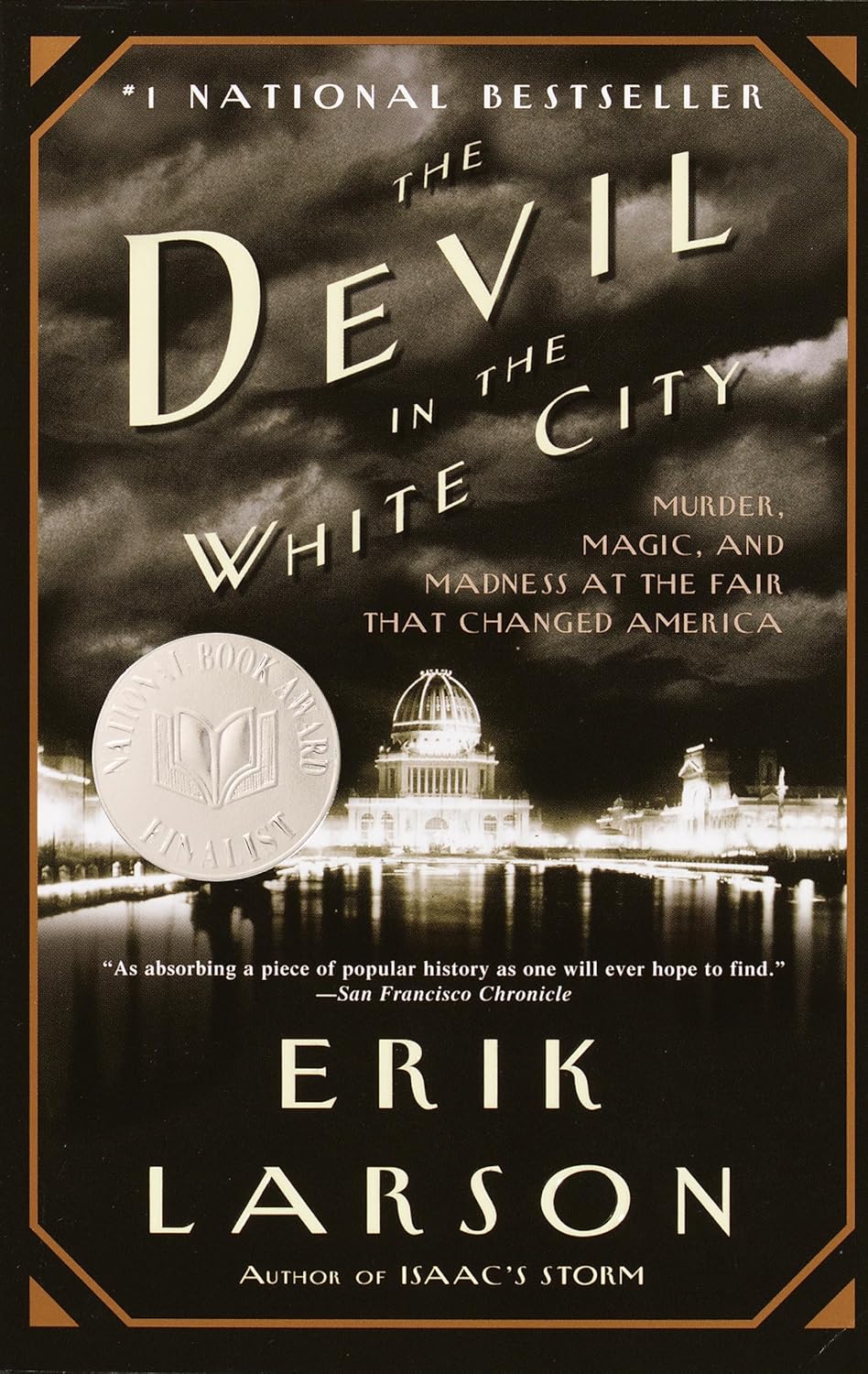
About The Devil in the White City by Erik Larson – A True Story of Ambition, Murder and the 1893 Chicago World’s Fair
The Devil in the White City by Erik Larson is a gripping work of narrative nonfiction that brings together two very different stories from Chicago in the 1890s. One follows Daniel H. Burnham, the architect and planner helping lead the creation of the 1893 World’s Columbian Exposition. The other follows H. H. Holmes, a criminal and murderer who operated nearby during the same period.
Larson moves between these stories to show two sides of the same city. One side is filled with huge buildings, new ideas, electric lights, engineering, art, ambition, and the dream of creating a fair that could impress the world. The other side is darker, shaped by deception, violence, and people who disappear.
Because the book is based on real events, the tension feels different from a normal thriller. You already know these people lived. You know the fair happened. You know Holmes became infamous. What keeps you reading is how Larson brings the people, choices, risks, and atmosphere together.
Why the 1893 World’s Fair matters so much
The World’s Columbian Exposition was one of the biggest public events of its time. Chicago wanted to prove that it could create something grand enough to stand beside the great cities of Europe. The project was enormous, expensive, difficult, and often in danger of falling behind.
Daniel Burnham had to work with architects, engineers, artists, government officials, workers, and business leaders. The fair required planning on a scale that was hard to imagine. Buildings had to rise quickly. Roads, water, lighting, landscaping, transport, and public spaces all had to work together.
The result became known as the White City because of its bright buildings and impressive design. Millions of visitors came to see the fair.
Larson uses the fair to show what people can build when ambition, money, talent, and pressure come together. It becomes the bright half of the book, but even this side has stress, accidents, arguments, deadlines, and fear of failure.
A dark story grows beside the bright city
While Burnham and his team work to create a place of beauty, H. H. Holmes builds a very different kind of world.
Holmes presents himself as charming, confident, and respectable. Behind that image is manipulation, fraud, and murder. Larson follows how Holmes gained trust, created opportunities for control, and used the fast-growing city to hide his actions.
This contrast gives the book its strong structure. The White City represents creation, public hope, and progress. Holmes represents secrecy, exploitation, and destruction.
The two men are not partners, and the book does not claim they worked together. Their stories are placed side by side because they happened in the same city and era. That parallel creates a powerful picture of Chicago at a moment when modern America was changing quickly.
The city could offer opportunity to architects, workers, business owners, visitors, and newcomers. It could also make it easier for a clever criminal to disappear inside crowds and constant movement.
True crime without reading like a police report
Readers often choose this book because they like true crime but want more than a list of crimes and dates.
Erik Larson writes history with the pace and scene-building of a novel. He uses research, letters, records, newspapers, and other historical material to create a story that feels alive. The people are real, but the writing is shaped to keep the reader moving through events.
That makes the book accessible even if you normally find history books too dry.
You learn about architecture, city planning, business pressure, technology, crime, and social life while following a clear narrative. The historical information is not placed in a separate textbook-style section. It grows naturally from what Burnham, Holmes, and the people around them are doing.
This approach is one reason the book has remained popular with both history readers and true-crime readers.
Daniel Burnham’s challenge is almost a thriller by itself
The murder story gets much attention, but Burnham’s part of the book carries its own tension.
The fair has a fixed opening date. Money is limited. Chicago weather is difficult. Important people disagree. Construction is slow. Workers face danger. The national economy becomes unstable. Every delay creates new pressure.
Burnham has to keep moving.
He works with major figures in American architecture and design, including landscape architect Frederick Law Olmsted. Their challenge is not simply to build a few attractive buildings. They are trying to create a complete environment large enough to astonish visitors from around the world.
The famous Ferris Wheel also becomes part of this story of invention and competition. The fair wants an engineering achievement that can stand as an American answer to the Eiffel Tower.
These details make the fair chapters interesting even for readers who begin the book mainly because of H. H. Holmes.
The book shows how fast Chicago was changing
Chicago in the late nineteenth century was crowded, ambitious, noisy, dangerous, and full of opportunity.
People arrived looking for work and a new start. Industry grew. Railways brought huge numbers of travelers. Construction changed the skyline. Businesses appeared quickly. The city felt modern and unstable at the same time.
Larson uses this setting to explain why both Burnham and Holmes could operate there.
Burnham needed a city bold enough to attempt a massive international fair. Holmes benefited from a place where people moved often, rented rooms, changed jobs, and could lose contact with family.
The setting therefore matters as much as the main characters. Chicago is not only the background. It helps explain the opportunities, risks, and choices found throughout the book.
Is everything in the book historical fact?
The Devil in the White City is nonfiction, but readers should understand what narrative nonfiction means.
Larson builds scenes from historical evidence and writes them in a smooth, dramatic way. He uses documented events and researched details, while sometimes reconstructing moments from the information available.
This makes the book easier to read than a traditional academic history, but it is still important to remember that historical sources can have limits. Claims about H. H. Holmes have also grown through legend, newspaper reporting, and later retellings.
For that reason, the book is best read as carefully researched narrative history rather than as a complete final record of every fact about Holmes.
That distinction does not reduce the value of the book. It helps readers enjoy the story while understanding how historical writing works.
A strong choice for readers who want history with tension
This book is a good match for readers who enjoy true crime, American history, architecture, urban history, biographies, and stories about large projects under pressure.
It is also useful for readers who want to try nonfiction but usually prefer novels. Larson’s style creates momentum, shortens the distance between the reader and the past, and gives each chapter a clear purpose.
The book can work well for book clubs because it raises many discussion questions. Why were people so excited by the fair? What did the White City represent? How did rapid urban growth create both opportunity and danger? Why do stories about Holmes continue to fascinate people? How much should we trust dramatic historical accounts?
These questions give the book value beyond simple entertainment.
Not a light book, even when the fair feels magical
The fair chapters contain wonder, invention, and public excitement, but the Holmes chapters deal with murder, manipulation, fraud, and disturbing behavior.
Readers should expect serious true-crime material. The book is better suited to mature teens and adults who are comfortable reading about real violence and death.
At the same time, Larson does not write the entire book as graphic horror. Much of the tension comes from what Holmes is planning, how he gains trust, and how easily people around him fail to see the danger.
This can make the story disturbing in a quieter way. The reader sees how normal life can continue beside terrible events.
Premium quality for a long and focused read
Bookish Wonderland offers this edition for readers who want a physical copy that feels comfortable during longer reading sessions.
The book uses premium eye-soothing cream paper, giving the pages a softer look than bright white paper. Crystal-clear printing helps keep names, dates, and detailed passages easy to follow.
High-quality stitched and glue binding supports durability and helps keep the pages secure during repeated reading. This is useful for a nonfiction title that readers may return to for notes, study, book-club discussion, or another reading later.
The focus is simple: clear text, comfortable pages, and a strong physical build.
Who should read The Devil in the White City?
This book is especially suitable for adults and mature readers interested in true crime, history, architecture, major public events, and real stories told with strong narrative energy.
A true-crime reader gets the disturbing story of H. H. Holmes. A history reader gets a detailed picture of the World’s Columbian Exposition. A business or leadership reader may become interested in the planning pressure surrounding Burnham. Architecture readers can follow the creation of the White City and the people who shaped it.
That mix is one of the book’s biggest strengths. Two readers can finish the same book and remember completely different parts.
The Devil in the White City by Erik Larson Book price in Bangladesh
If you are checking The Devil in the White City by Erik Larson Book price in Bangladesh, Bookish Wonderland gives you a convenient way to order a premium reading copy.
Cash on Delivery is available across Bangladesh. Delivery is available inside Dhaka and outside Dhaka, helping readers order without needing to visit a physical bookstore. Customers in Dhaka can also ask about fast or urgent delivery when they need the book sooner.
The title is a good choice for personal reading, study, gifting, or adding to a true-crime and history collection.
A thoughtful gift for curious readers
This title also works well as a gift for someone who likes unusual true stories. It brings together crime, architecture, invention, city history, and human ambition in one book, so it can appeal to readers with different interests. It is especially suitable for people who enjoy documentaries, historical podcasts, museum stories, or nonfiction that feels cinematic. Because the book is standalone, the reader can enjoy the full experience without buying another volume first. It can sit comfortably beside history, biography, true crime, or narrative nonfiction on a shelf.
Why this book can stay with you after the final page
The Devil in the White City works because its two main stories keep pulling against each other.
Burnham is trying to create something that will be remembered. Holmes is hiding acts that he does not want the world to see.
One story is about building. The other is about destruction.
Between them is Chicago, a city moving quickly toward the twentieth century.
By the end, the fair is more than a historical event and Holmes is more than a name from true-crime history. Together, they show how beauty, ambition, danger, technology, wealth, fear, and human weakness can exist in the same place at the same time.
If you want nonfiction that teaches real history while still giving you the tension of a thriller, this book deserves a place on your reading list.
Order The Devil in the White City by Erik Larson from Bookish Wonderland and enjoy nationwide delivery, Cash on Delivery, premium cream paper, clear printing, and durable binding.
If you require any customization or have any questions, please inbox us via FB or Insta.
| Primary Specification | |
| Author | Erik Larson |
| Narrator | Scott Brick |
| Editor | Leonard W. Henderson |
| Genre | Historical Nonfiction, True Crime, American History |
| ISBN-13/ISSN | 978-0375725609 |
| ISBN-10 | 0375725601 |
| Publisher | Vintage |
| Publishing Date | February 10, 2004 |
| Language | English |
| Reading Age | 14+ |
| Format | Printed Book |
| Physical Specification & Quality | |
| Paper Quality | Premium eye-soothing cream paper |
| Binding Quality | High quality stitched and glue binding (for longevity) |
| Print Quality | Crystal-clear print |
| Pages | 447 pages |
| Country | USA |
| Logistics Information | |
| Weight | 469 gm |
| Length | 8.5 inches |
| Width | 5.6 inches |
| Height | 0.95 inch |