

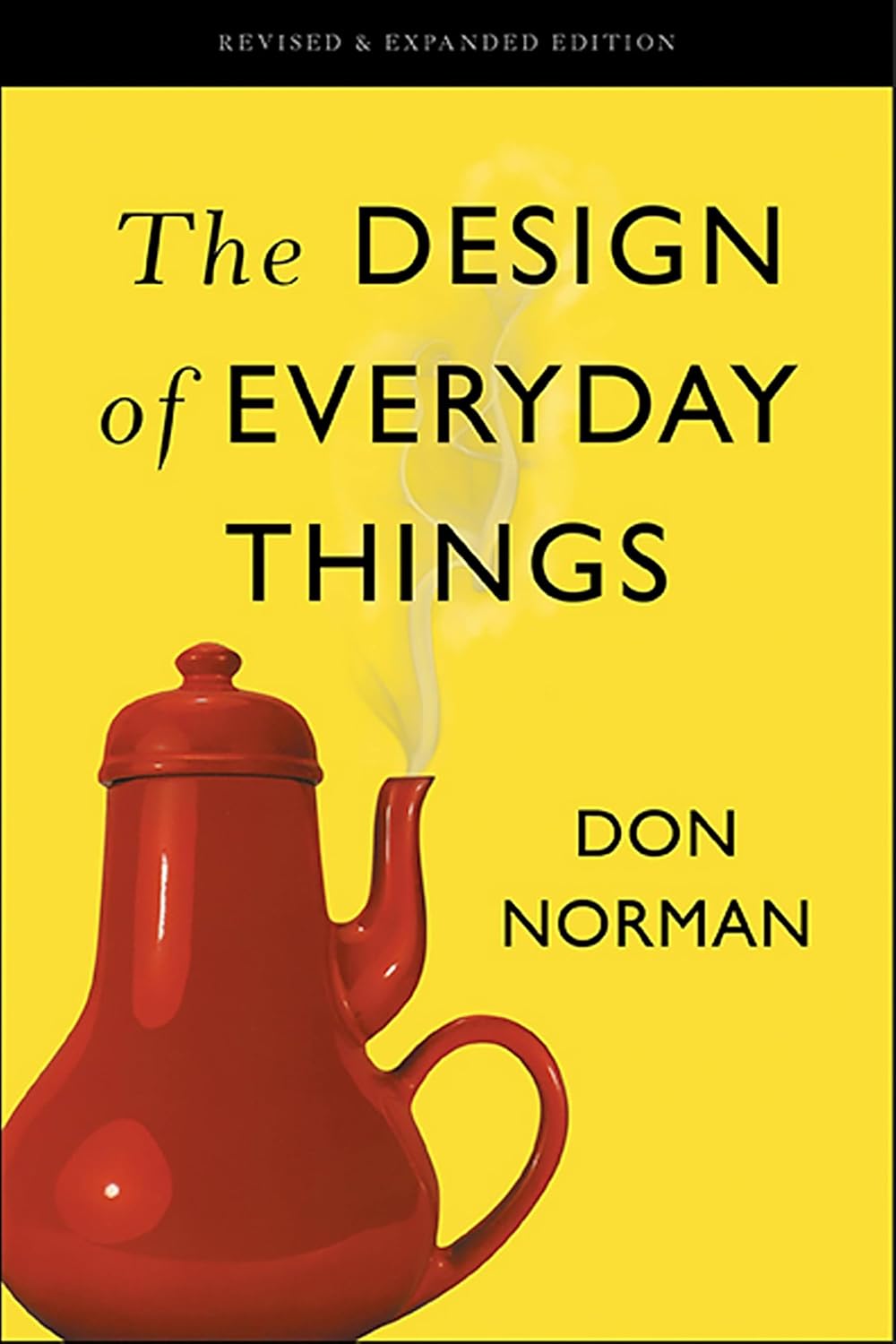
About The Design of Everyday Things by Don Norman – A Practical Guide to Better Products, Clearer Interfaces and Human-Centered Design
The Design of Everyday Things by Don Norman is one of the influential books about how people interact with products, tools, machines, websites, controls, and everyday objects. Its main idea is simple: when something is difficult to use, the problem is often not the user. The design may be giving poor clues, hiding important information, or asking people to remember too much. Norman uses familiar examples such as doors, switches, taps, ovens, phones, and other common objects to show why some products feel natural while others cause confusion.
Originally published in 1988 as The Psychology of Everyday Things, the book later appeared under its better-known title and was revised and expanded for modern technology. The updated edition keeps the core lessons while connecting them to newer products, digital systems, design thinking, and business. This makes the book useful for designers, engineers, product managers, developers, students, entrepreneurs, and anyone who wants to understand why people struggle with badly designed things.
Why simple products can become frustrating
A door should be easy to use, yet many people have stood in front of one wondering whether to push, pull, slide, or turn something. Norman uses examples like this to explain that good design should help people understand what to do without forcing them to stop and think about every step.
When an object gives the wrong signal, users may blame themselves. A person may think they are careless because they pressed the wrong button, turned the wrong burner on, or could not work out a control panel. Norman asks readers to look at the design first. If many people make the same mistake, there may be a design problem rather than a human problem.
This way of thinking changes how readers look at everyday life. After reading the book, ordinary objects become examples of design decisions. A handle, label, button position, warning sound, menu, or light can either guide the user or create unnecessary confusion.
Affordances and signifiers explained in simple language
One of the book’s most useful ideas is that people need clues about how an object can be used. An affordance is about the possible actions between a person and an object. A chair can support sitting, a button can be pressed, and a handle can be pulled. Good design makes useful actions easier to notice.
Signifiers are the visible or understandable signals that tell people where or how to act. A flat plate on a door may suggest pushing, while a handle may suggest pulling. A label, icon, arrow, sound, or highlighted area can also act as a signifier.
These ideas are useful far beyond physical products. A website button should look clickable. A form should make it clear which fields are required. A mobile app should show users where they can tap and what will happen next. The principle stays the same: people should not have to guess what the designer expects them to do.
Good mapping makes controls easier to understand
Mapping describes the relationship between a control and the result it produces. When the relationship is clear, people can use a product with less effort. When it is confusing, they may need labels, instructions, or repeated trial and error.
A common example is a stove with several burners and a row of controls. If the control layout does not match the burner layout, users have to remember which knob belongs to which burner. A better arrangement can make the relationship obvious at a glance.
Norman uses ideas like this to show that good design can reduce the amount of information people must keep in their heads. Designers should place useful knowledge in the world whenever possible, using layout, shape, position, labels, and other cues to make the next action easier to understand.
Feedback tells users what just happened
People need to know whether an action worked. When you press a button, send a message, save a file, turn on a machine, or complete a payment, the system should give useful feedback.
Feedback can take many forms. A light may turn on, a sound may play, a screen may change, a message may appear, or a physical control may move. The important point is that the response should be clear enough for the user to understand what happened.
Poor feedback creates uncertainty. A person may press the same button several times because nothing seems to happen, or they may leave a process because they do not know whether it is still working. Norman explains why designers need to think about the full cycle of action, from what a person wants to do to how the product communicates the result.
Human error often reveals a design weakness
Another major lesson in The Design of Everyday Things is that errors should not automatically be treated as proof that users are careless. People make mistakes, forget steps, become distracted, and misunderstand unclear signals. Good design should expect these normal human limits.
Norman discusses slips, mistakes, constraints, and ways to reduce the chance of serious errors. A useful system can prevent impossible actions, warn users before a risky step, make recovery easy, or clearly show the difference between similar choices.
This approach is valuable in everyday products, but it becomes even more important in workplaces, healthcare, transportation, finance, and technology, where a small mistake can have a larger result. Designers should not simply tell users to be more careful. They should ask whether the system can be improved so that the right action becomes easier and the wrong action becomes harder.
Design should begin with the people using the product
The book is strongly connected with human-centered design, an approach that starts by understanding people, their goals, their environment, and the problems they actually face. Instead of designing only from the viewpoint of the company or engineer, teams should observe how real users behave.
People do not always use products in the way designers expect. They may create shortcuts, misunderstand instructions, use features differently, or ignore functions that seem obvious to the team that built them. Watching real behavior can reveal problems that meetings and technical documents miss.
Norman explains why designers need repeated testing and improvement. A first idea may look good but still fail when real people try it. Testing, learning, changing, and testing again can lead to a product that is easier to understand and more useful in everyday life.
Why UX and UI designers still read this book
The book began with many examples from physical products, but its principles apply naturally to websites, apps, software, and digital services. UX and UI designers regularly think about discoverability, feedback, signifiers, mapping, errors, and mental models, all ideas closely connected with Norman’s work.
A user opening an app should understand what the main options are. A checkout page should make the next step clear. A warning should explain what went wrong and how to fix it. Navigation should help people know where they are. Buttons and controls should behave consistently.
These problems may look modern, but the underlying human needs have not changed very much. People still need clear clues, useful feedback, and systems that match the way they think. This is why The Design of Everyday Things remains useful even as technology changes.
Useful for product managers, founders and business teams
The lessons are not limited to professional designers. Product managers and founders can use the book to ask better questions about what they are building. A product may have many features and still fail if customers cannot understand how to use them.
Norman also connects design with the wider product development process. Good design must work with engineering, business goals, manufacturing, technology, and real-world limits. The goal is not to make something attractive only on the surface. It is to create something that works well for the people who need it.
A practical book for students and beginners
You do not need to be a professional designer before reading this book. Norman explains many ideas through ordinary situations, which makes the concepts easier to understand. A student can connect the theory with objects and interfaces they already use every day.
The book is especially useful for students studying UX design, UI design, product design, industrial design, human-computer interaction, cognitive science, engineering, architecture, marketing, or entrepreneurship. It can also help beginners build a stronger design vocabulary before moving into more specialized books and courses.
Because the examples encourage observation, readers can practice immediately. You can examine a door, remote control, website, ATM, kitchen appliance, or mobile app and ask what signals it gives, what might confuse users, and how the experience could be improved.
Revised ideas for a changing technology world
The revised and expanded edition updates the discussion for a world filled with digital products and more complex systems. Norman keeps the original focus on human psychology while adding material related to design thinking, technology, and the business environment.
The core message remains steady because human attention, memory, habits, and expectations still shape the way people use products. New devices may appear, but designers continue to face the same basic challenge: helping people understand what they can do, what they should do next, and what happened after they acted.
Premium reading quality from Bookish Wonderland
Bookish Wonderland offers this edition for readers who want a comfortable physical copy for study, professional development, or regular reference. The book uses premium eye-soothing cream paper, giving the pages a softer appearance during longer reading sessions. Crystal-clear printing keeps diagrams, examples, and text easy to follow, while high-quality stitched and glue binding helps the pages remain secure through repeated use.
These qualities are especially useful for a practical book that readers may underline, annotate, revisit, or keep near their workspace. The focus is on clear reading, durable construction, and a copy that can remain useful beyond a single read.
The Design of Everyday Things by Don Norman Book price in Bangladesh
Readers looking for The Design of Everyday Things by Don Norman Book price in Bangladesh can order the title from Bookish Wonderland with convenient delivery options. Cash on Delivery is available across Bangladesh, so customers can place an order and pay when the parcel arrives.
Delivery is available inside and outside Dhaka, while customers in Dhaka can also ask about fast or urgent delivery when they need the book sooner. The title is suitable for students, professional designers, developers, product teams, entrepreneurs, and anyone building a personal collection of business, technology, psychology, or design books.
A book that changes how you notice everyday objects
One of the lasting benefits of this book is that it teaches readers to pay closer attention to ordinary experiences. A confusing switch, unclear website, difficult remote, badly labeled control, or well-designed handle becomes easier to analyze once you understand the principles behind it.
The Design of Everyday Things by Don Norman gives readers a practical foundation for thinking about usability, human behavior, product design, and user experience. Whether you are studying design, building digital products, managing a team, starting a business, or simply curious about why some objects feel easy to use, the book offers ideas that can be applied to real situations.
Order your copy from Bookish Wonderland and enjoy nationwide delivery, Cash on Delivery, premium cream paper, crystal-clear printing, and durable stitched and glue binding.
If you require any customization or have any questions, please inbox us via FB or Insta.
| Primary Specification | |
| Author | Don Norman |
| Narrator | Neil Hellegers |
| Genre | Design, Cognitive Psychology, Human-Centered Design, UX, Ergonomics |
| ISBN-13/ISSN | 978-0465050659 |
| ISBN-10 | 0465050659 |
| Publisher | Basic Books |
| Publishing Date | November 5, 2013 |
| Language | English |
| Reading Age | 16+ |
| Format | Printed Book |
| Physical Specification & Quality | |
| Paper Quality | Premium eye-soothing cream paper |
| Binding Quality | High quality stitched and glue binding (for longevity) |
| Print Quality | Crystal-clear print |
| Pages | 368 pages |
| Country | USA |
| Logistics Information | |
| Weight | 389 gm |
| Length | 8.5 inches |
| Width | 5.6 inches |
| Height | 1 inch |