

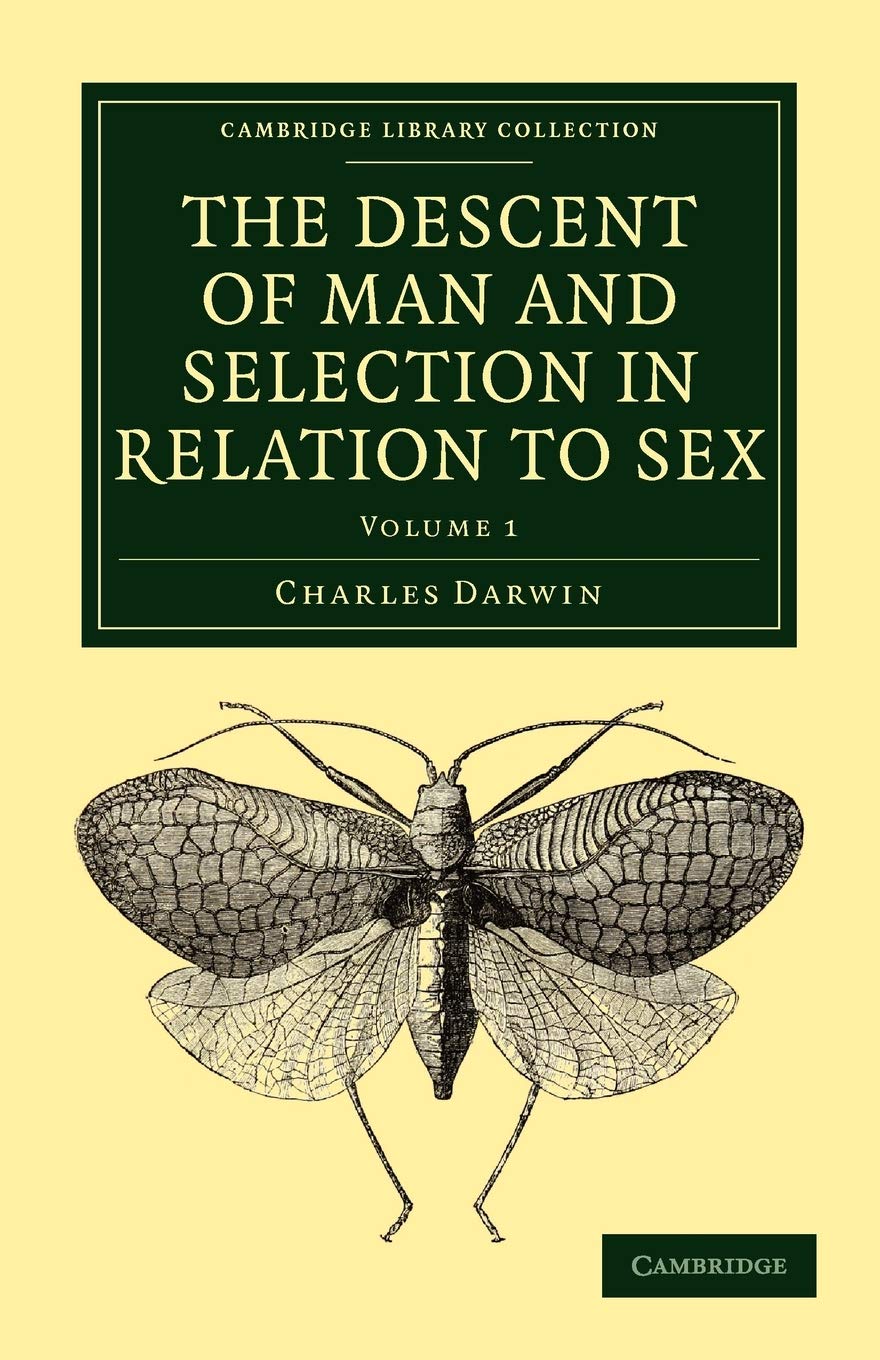
About The Descent of Man and Selection in Relation to Sex by Charles Darwin – A Landmark Study of Human Evolution and Sexual Selection
The Descent of Man and Selection in Relation to Sex by Charles Darwin is one of the most important works in the history of evolutionary thought. First published in 1871, the book applies Darwin’s ideas about evolution directly to human beings and explores how physical traits, behavior, mental abilities, and differences between the sexes may have developed over long periods of time. It also introduces and develops Darwin’s theory of sexual selection, which explains how certain traits can spread because they help an individual attract a mate or compete with rivals.
The book was written after On the Origin of Species, where Darwin had mostly avoided a full discussion of human evolution. In The Descent of Man, he addresses the subject directly and argues that humans are part of the same natural history as other animals. This made the book controversial in the nineteenth century, but it also made it central to later discussions in biology, anthropology, psychology, and the history of science.
Why Darwin wrote about human evolution
Darwin had already transformed scientific debate with On the Origin of Species, but he knew that one major question remained. If natural selection explained how species changed over time, what did that mean for human beings? In The Descent of Man, he examines anatomical similarities, behavior, mental abilities, instincts, emotions, and development in order to argue that humans also share an evolutionary history with other forms of life.
This argument challenged many common beliefs of his time. Darwin compared human characteristics with those of other animals and tried to show that the differences were often differences of degree rather than completely separate kinds of ability. His discussion includes memory, curiosity, social behavior, sympathy, communication, and moral development, giving readers a wide view of how he thought human traits could be connected with evolutionary processes.
Sexual selection is one of the book’s central ideas
A large part of the book is devoted to sexual selection. Natural selection is mainly about survival and reproduction in a broad sense, while sexual selection focuses on traits that can help an individual gain mates. Darwin discusses two main patterns: competition among members of the same sex and preference shown by potential mates.
He uses examples from many animals, including birds, insects, mammals, and fish, to explain why males and females may develop different colors, ornaments, weapons, sounds, or behaviors. The peacock’s tail is one of the most familiar kinds of example connected with this idea. A trait may seem costly for survival, yet it can continue if it gives an advantage in attracting mates.
This part of the book became highly influential because sexual selection later became an important area of evolutionary biology. Modern research has expanded, corrected, and refined Darwin’s ideas, but the basic question he raised remains central: how does mating behavior shape evolution?
A book that connects biology with human behavior
The Descent of Man is not limited to anatomy. Darwin also tries to explain how human mental and social qualities may have developed. He discusses cooperation, sympathy, group life, communication, moral feelings, and the ways social behavior can influence survival.
Some of these sections are historically important because they show Darwin trying to connect biology with questions that had often been treated only through philosophy or religion. At the same time, readers should remember that the book was written in the Victorian period. Some of Darwin’s statements about race, sex, society, and cultural difference reflect nineteenth-century assumptions that modern science does not accept.
For this reason, the book is valuable both as a scientific classic and as a historical document. It allows readers to see how evolutionary ideas were being formed while also showing the limits and biases of the period in which Darwin worked.
Why the book still matters today
Modern evolutionary science has advanced far beyond what Darwin could know in 1871. Genetics, DNA, population biology, molecular evolution, neuroscience, and modern anthropology have added evidence and explanations that were unavailable to him. Some of his specific claims have been revised or rejected, while others helped shape questions that scientists still study.
The lasting value of The Descent of Man comes from the scale of the questions it asks. Darwin wanted to know where humans fit in nature, how human traits developed, why males and females can differ, and how social and mental abilities may have evolved. Those questions remain important even though the scientific answers are now much more detailed.
For students and serious readers, the book is useful because it shows science in development. Readers can see how Darwin builds arguments from observation, comparison, examples, and available evidence rather than simply reading a modern summary of his conclusions.
What makes this different from On the Origin of Species
On the Origin of Species explains Darwin’s wider theory of evolution through natural selection and gives only limited attention to humans. The Descent of Man takes the next major step by applying evolutionary thinking to human origins and by giving sexual selection a much larger role.
Readers who have already studied Origin of Species may find this book useful because it expands areas that Darwin previously left open. Readers who have not read Origin can still understand the general direction of the argument, although some knowledge of natural selection will make the book easier.
The two books are related in subject, but they are separate works rather than numbered volumes in a series. The Descent of Man stands on its own as a major study of human evolution and sexual selection.
Who should read this book
This title is especially suitable for readers interested in evolution, biology, anthropology, history of science, human behavior, scientific classics, and nineteenth-century intellectual history. It can also be useful for university students, teachers, researchers, and readers who want to understand Darwin’s ideas from his own writing rather than only through modern explanations.
The language is older and more formal than most modern science books, so readers should expect a slower experience. Darwin uses many examples and long discussions, and some sections require patience. The benefit is that readers get direct access to the reasoning of one of the most influential scientists in history.
It is also a useful choice for readers who enjoy comparing historical scientific ideas with current knowledge. Because some parts are outdated, the book works best when read thoughtfully and, where possible, alongside modern scientific sources.
A valuable book for study and discussion
The Descent of Man can support classroom discussion on several subjects. Biology students can examine natural selection, sexual selection, variation, and human evolution. History students can study how scientific ideas changed nineteenth-century society. Philosophy and social science students can discuss how scientific arguments interact with ideas about morality, culture, and human difference.
The book also raises questions about how science changes over time. A famous scientist can make major contributions while still being limited by the evidence and social assumptions of his period. Reading Darwin directly helps students understand that scientific knowledge is not fixed forever. It develops through criticism, new evidence, better methods, and continuing debate.
This makes the book more than a historical curiosity. It can teach readers how scientific ideas are built, challenged, and improved.
Important context for modern readers
Readers should approach some sections with historical awareness. Darwin wrote before genetics was understood and before modern ideas about human population variation were developed. His discussions of race and sex include claims and language that can feel dated or offensive today, and several of those conclusions are not supported by current science.
Recognizing this context is important because it allows readers to separate the book’s historical importance from the parts that modern research has corrected. The best way to read the work today is neither to treat every statement as current fact nor to dismiss the whole book because some claims are outdated.
Instead, readers can study it as a major step in the history of evolutionary theory, understanding both the strength of Darwin’s central ideas and the limits of the scientific world in which he worked.
How to get more value from a first reading
Because the book uses nineteenth-century English, many readers benefit from taking it section by section instead of trying to rush through it. Keeping a note of Darwin’s main claim in each chapter can make the argument easier to follow, especially when he moves through many examples. Readers may also find it useful to compare difficult passages with a modern biology reference so they can see which ideas remain influential and which have changed. This approach turns the book into both a reading experience and a study of how scientific knowledge develops.
Premium reading quality from Bookish Wonderland
Bookish Wonderland offers this edition for readers who want a comfortable physical copy for study, personal reading, or long-term collection. The book uses premium eye-soothing cream paper, which gives the pages a softer appearance and makes long reading sessions more comfortable. Crystal-clear printing helps keep the text, headings, and detailed passages easy to follow.
High-quality stitched and glue binding supports the pages through regular use and makes the copy suitable for students, researchers, and readers who may return to important sections more than once. The focus is on practical reading quality, durability, and a clean presentation that works well for a long scientific classic.
The Descent of Man and Selection in Relation to Sex by Charles Darwin Book price in Bangladesh
Readers searching for The Descent of Man and Selection in Relation to Sex by Charles Darwin Book price in Bangladesh can order this title from Bookish Wonderland with convenient delivery options. Cash on Delivery is available across Bangladesh, allowing customers to place an order and pay when the parcel arrives.
Delivery is available both inside and outside Dhaka, while customers in Dhaka can also ask about fast or urgent delivery when they need the book sooner. The title is suitable for students, teachers, science readers, researchers, history enthusiasts, and collectors looking for an important work in evolutionary thought.
Bookish Wonderland also carries a large collection of premium English books across science, philosophy, history, literature, business, and many other subjects, making it easier to build a broader reading collection from one store.
Why this book belongs in a serious science collection
Few books have had as much influence on discussions about human origins as The Descent of Man. Its importance comes from Darwin’s decision to place human beings inside the wider story of evolution and to develop sexual selection as a major evolutionary process. Even where modern science has moved beyond his conclusions, the questions he raised helped shape later research.
For readers interested in how scientific ideas grow, the book offers something modern textbooks cannot provide. It shows the original argument, the examples Darwin considered important, and the way he tried to connect human life with the rest of the natural world.
The Descent of Man and Selection in Relation to Sex by Charles Darwin is therefore a strong choice for readers who want both scientific history and a deeper understanding of evolutionary thought. Order your copy from Bookish Wonderland and enjoy nationwide delivery, Cash on Delivery, premium cream paper, crystal-clear printing, and durable stitched and glue binding.
If you require any customization or have any questions, please inbox us via FB or Insta.
| Primary Specification | |
| Author | Charles Darwin |
| Genre | Science, Evolutionary Biology, Anthropology, Natural History |
| ISBN-13/ISSN | 978-1508872382 |
| ISBN-10 | 1508872384 |
| Publisher | CreateSpace Independent Publishing Platform |
| Publishing Date | March 15, 2015 |
| Language | English |
| Reading Age | 16+ |
| Format | Printed Book |
| Physical Specification & Quality | |
| Paper Quality | Premium eye-soothing cream paper |
| Binding Quality | High quality stitched and glue binding (for longevity) |
| Print Quality | Crystal-clear print |
| Pages | 314 pages |
| Country | UK |
| Logistics Information | |
| Weight | 336 gm |
| Length | 8.5 inches |
| Width | 5.6 inches |
| Height | 0.71 inch |