

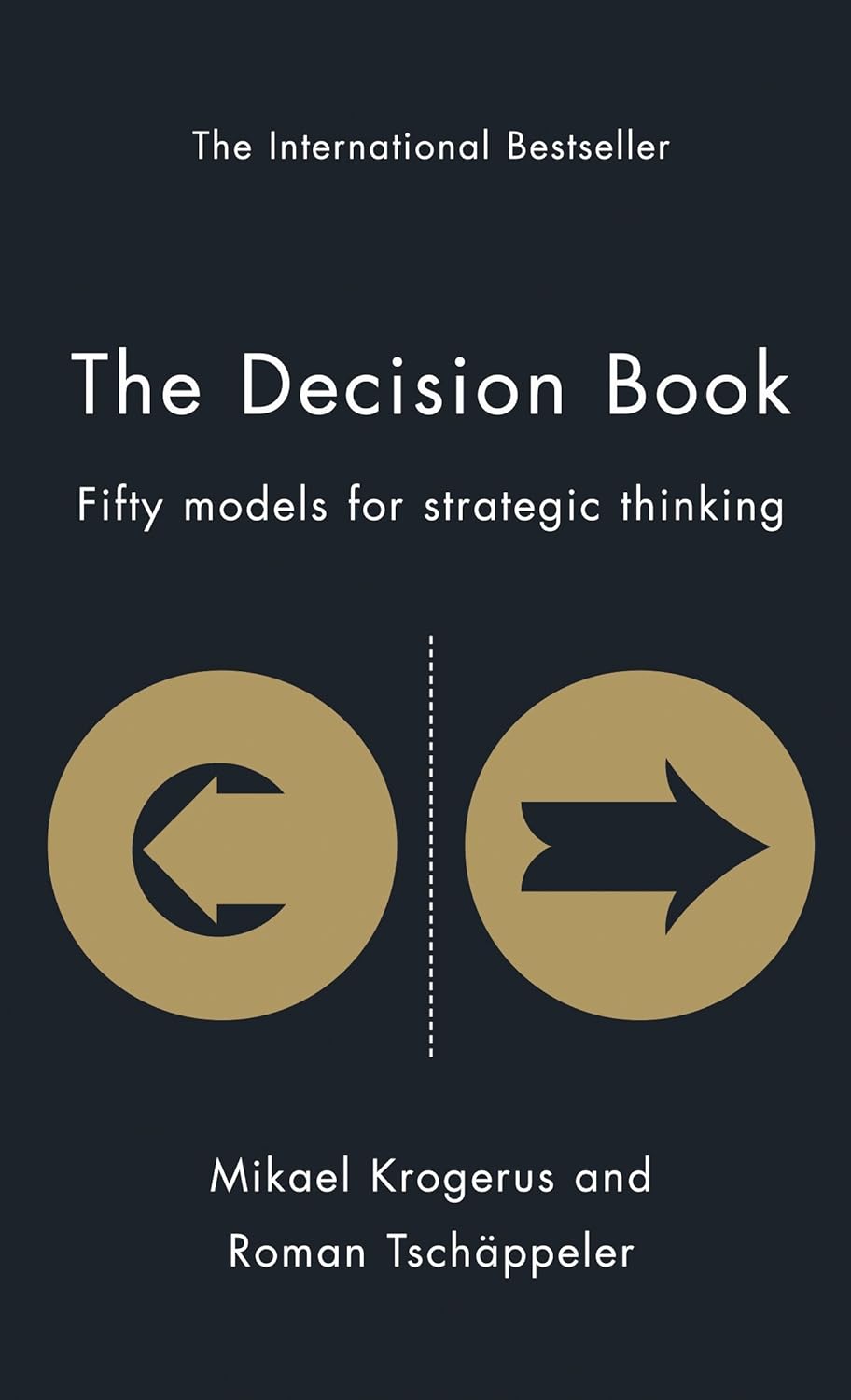
About The Decision Book by Mikael Krogerus and Roman Tschappeler: 50 Simple Models for Smarter Choices
Do you spend too much time thinking before making a choice? Do you worry that you may choose the wrong path? The Decision Book by Mikael Krogerus and Roman Tschappeler can help you see problems more clearly and make better choices with less stress.
Every day brings decisions. Some are small, such as deciding what work to do first. Others can change your life, such as choosing a job, starting a business, making an investment, ending a bad habit, or setting a new goal. When too many thoughts fill your mind, even an easy choice can feel difficult. This book gives you simple models that help put those thoughts in order.
The book brings together 50 well-known thinking and decision-making models. Many of these models are used in business schools, offices, meetings, and personal planning. Each model is explained in a short and clear way, usually with a simple diagram. You do not need to be a business student or an expert to understand the ideas.
The updated edition is a compact guide created for people who want useful answers without reading hundreds of pages of heavy theory. It includes familiar tools such as the Eisenhower Matrix, SWOT Analysis, the Pareto Principle, Maslow’s Pyramid, the Rubber Band Model, and the Swiss Cheese Model.
Stop Guessing and Start Thinking Clearly
A difficult choice often becomes harder because we try to solve everything inside our heads. We remember one fact, forget another, imagine the worst result, and keep moving between different options. This can lead to worry, delay, and poor decisions.
The Decision Book offers a simple answer to this common problem: take the thoughts out of your head and place them inside a clear model. A model helps you look at one part of a problem at a time. It can show what matters, what does not matter, what you can control, and what may happen next.
For example, you may have many tasks but very little time. Instead of working without a plan, you can use the Eisenhower Matrix to separate important tasks from urgent tasks. You may be thinking about changing your job. A suitable model can help you compare what pulls you toward the new job with what keeps you in your present position.
The book does not promise that every decision will become perfect. No tool can know the future for you. Instead, it helps you ask better questions, notice hidden risks, and understand your own reasons. This can make your final choice more thoughtful and easier to explain.
What Makes This Book So Useful?
The strongest feature of The Decision Book is its simple design. Each idea is presented in a small, focused section. You can read the book from the first page to the last, but you do not have to. You can also open it when you face a problem, find a useful model, and begin working on your choice.
This makes the book more than something you read once. It can become a small reference guide that you return to whenever you feel confused. Keep it on your desk, carry it to a meeting, or use it while planning at home.
The visual models also make difficult ideas easier to remember. A short diagram can sometimes explain a problem faster than a long chapter. By drawing, comparing, ranking, or dividing information, you can see links that were hidden before.
The writing is short and direct. The authors do not fill the pages with unnecessary stories or complicated academic words. They present the main idea, explain how it works, and help you consider where it may be useful. The official publisher describes it as a compact book that can help readers simplify problems and move toward the right decision.
Explore 50 Powerful Thinking Models
The book collects models from many areas, including business, psychology, planning, teamwork, strategy, productivity, and personal growth. This variety is important because not every problem can be solved in the same way.
Some models help you understand yourself. They may encourage you to study your goals, fears, skills, habits, or values. Others help you understand a team, a market, a project, or a difficult relationship. Certain tools focus on time, while others focus on risk, change, motivation, or possible results.
SWOT Analysis can help you examine strengths, weaknesses, opportunities, and threats. The Pareto Principle can help you look for the small number of actions that produce a large part of the result. Maslow’s Pyramid offers a way to think about human needs. The Prisoner’s Dilemma explores trust, cooperation, and personal gain. Cognitive Dissonance helps explain why people can feel uncomfortable when their actions and beliefs do not agree.
The Rubber Band Model can be useful when you feel pulled between two choices. Instead of asking only, “Which choice is better?” you can ask what is pulling you toward an option and what is holding you back. This small change in the question can reveal the true cause of your uncertainty.
You do not need to use all 50 models. The value comes from finding the right tool for the problem in front of you.
A Book That Turns Ideas into Action
Many self-help and business books give advice that sounds good but is hard to use. The Decision Book takes a more practical path. Its models invite you to write, draw, compare, and think. This active style can help you move from reading to doing.
Suppose you want to start a new business. You may use one model to study the good and bad sides of your idea, another to identify risks, and another to decide what task should come first. If you are preparing a presentation, you can use a model to arrange your message and understand the people who will hear it.
Students can use the book when choosing a subject, planning study time, or working on a group project. Office workers can use it to set priorities, study a problem, or prepare for a meeting. Business owners can apply the models to new products, customer needs, team roles, and future plans.
The book can also help with personal questions. You may use its ideas when thinking about your career, daily habits, relationships, money, or long-term goals. It does not make the choice for you. It gives you a structure that makes your own answer easier to find.
That is why this book can remain useful for years. Your problems may change, but clear thinking will always matter.
Easy to Read Even When You Are Busy
You do not need a long holiday or a quiet weekend to benefit from this book. Its short sections make it easy to read in small amounts. You can study one model before work, during a break, or before an important meeting.
This format is especially helpful for busy readers who often leave long books unfinished. You can learn one idea, try it in real life, and return for another idea later. There is no pressure to remember every page at once.
The simple presentation also makes the book suitable for readers who are new to business and strategic thinking. Although many of its tools are discussed in MBA courses and professional settings, the explanations are made for general readers. The official description confirms that the book gathers 50 decision-making models used in MBA courses and other settings within one accessible volume.
Experienced managers may know some of the models already. However, having them together in one compact guide makes them easier to review and compare. A familiar tool may also produce a new answer when it is applied to a different problem.
The Decision Book respects your time. It gives you important ideas in a form that is quick to understand, easy to revisit, and simple to use.
Who Should Read The Decision Book?
This book is a strong choice for anyone who makes decisions, which means almost everyone can find something useful inside it.
Students can read it to improve planning, problem-solving, and logical thinking. Young professionals can use it while choosing career paths or managing new duties. Team leaders may use its models to guide talks, solve disagreements, and organize work.
Entrepreneurs and business owners can apply the tools when comparing ideas, studying risks, setting goals, or deciding how to use limited money and time. Managers can use the book before meetings, reviews, and planning sessions. Teachers, trainers, and coaches may also find its diagrams helpful when explaining ideas to other people.
The book is also useful for readers who often overthink. If you repeatedly ask friends for advice, change your mind, or delay important choices because you fear making a mistake, these models can help you slow down and study the problem in a more orderly way.
It may also be a thoughtful gift for a graduate, new employee, manager, business owner, or anyone beginning a new part of life. It offers knowledge that can be used in many situations rather than advice for only one short period.
No special degree or business experience is needed. Curiosity and a willingness to think honestly are enough.
Main Features of This Practical Guide
- It presents 50 useful models for strategic thinking and decision-making.
- The models come from areas such as business, psychology, productivity, personal development, and management.
- Short explanations help readers learn without facing long and difficult chapters.
- Clear diagrams make many ideas easier to see, understand, and remember.
- The book can be read from beginning to end or used as a quick reference guide.
- Well-known tools include SWOT Analysis, the Eisenhower Matrix, Maslow’s Pyramid, the Pareto Principle, and the Prisoner’s Dilemma.
- The models can support choices involving work, study, business, relationships, time, and personal goals.
- Its compact structure makes it helpful at home, in the office, or during meetings.
- Readers can compare different tools and choose the one that best matches a current problem.
- The book encourages active thinking instead of offering empty motivation.
How This Book Can Benefit You
The first benefit is greater clarity. A model can break a large problem into smaller parts, making the full situation easier to understand.
The second benefit is better focus. When every task appears important, tools such as the Eisenhower Matrix can help you decide what deserves attention first.
The third benefit is stronger self-awareness. Some models encourage you to study what you truly want, why you behave in a certain way, and what may be stopping you from moving forward.
The fourth benefit is more confident communication. When you use a clear model, you can explain the reasons behind your decision to a teacher, partner, customer, manager, or team member.
The fifth benefit is reduced overthinking. You may still need time to decide, but you will have a clear process instead of repeating the same worries.
The sixth benefit is improved planning. By studying risks, goals, resources, and possible results, you can create a plan based on useful information.
Finally, the book can help you build a lasting habit of thoughtful decision-making. With regular practice, you may begin to study problems more calmly and ask better questions before acting.
The aim is not to remove every mistake. The aim is to help you make choices with stronger reasons and a clearer view of what may happen next.
Use It at Work, in Business, and at Home
Imagine that two business ideas look equally good. You can use a comparison model to study the possible cost, value, risk, and future result of each idea. This will not choose for you, but it can show which option matches your goal more closely.
If your daily task list feels too large, a priority model can help you find the work that needs attention now. Less important tasks can be planned for later, passed to someone else, or removed.
If a team project is going badly, you can use a model to study roles, communication, weak points, or possible causes of failure. This helps move the conversation away from blame and toward a clear solution.
At home, you might use the book when deciding whether to move, study a new subject, buy something expensive, or change a habit. A model can help you compare emotional wishes with practical facts.
You can also use the book with another person. Draw a model together and let each person explain what they see. Two people may look at the same problem in very different ways. Seeing those differences can create a better conversation.
The Decision Book is most valuable when you use it. Write notes, draw the diagrams, answer the questions honestly, and test more than one model when the first one does not fit.
A Premium Reading Experience from Bookish Wonderland
Bookish Wonderland offers this useful title for readers who care about both knowledge and physical quality. The pages use premium eye-soothing cream paper, which creates a calm reading surface for longer study sessions. The crystal-clear print keeps words and diagrams sharp, helping you follow each model without unnecessary strain.
High-quality stitched and glue binding gives the book added strength and longevity. This matters because The Decision Book is not only meant for one quick reading. You may open it many times while planning projects, preparing meetings, or making personal choices. Durable binding helps it remain a dependable part of your desk or bookshelf.
These physical features work together to make reading comfortable and practical. The cream paper supports easy reading, the clear print presents the visual models neatly, and the strong binding supports repeated use. Each specification has a clear purpose and is not included only for appearance.
Customers searching for The Decision Book by Mikael Krogerus and Roman Tschappeler price in Bangladesh can order it from Bookish Wonderland with nationwide delivery. Cash on Delivery is available across the country, including addresses inside and outside Dhaka. Readers in Dhaka can also ask about fast or urgent delivery when they need the book quickly.
Part of a Helpful Smart-Thinking Collection
The authors’ official website places The Decision Book within the “Small Books for Big Questions” series. The English collection contains six books covering decisions, questions, tests, change, productivity, and collaboration. The collection is thematic rather than a continuing story, so every title can be read independently and the books do not need to be read in a strict order.
What books are in the Small Books for Big Questions series by Mikael Krogerus and Roman Tschappeler?:
- The Decision Book by Mikael Krogerus and Roman Tschappeler (Book 1)
- The Question Book by Mikael Krogerus and Roman Tschappeler (Book 2)
- The Test Book by Mikael Krogerus and Roman Tschappeler (Book 3)
- The Change Book by Mikael Krogerus and Roman Tschappeler (Book 4)
- The Get Things Done Book by Mikael Krogerus and Roman Tschappeler (Book 5)
- The Collaboration Book by Mikael Krogerus and Roman Tschappeler (Book 6)
The book numbers above show the list order used for this product page. They are not an official reading order because each guide covers a separate subject and works on its own.
Make Your Next Choice with Greater Confidence
A good decision does not always begin with an instant answer. It often begins with a better way of looking at the question. The Decision Book gives you 50 ways to examine challenges, organize information, and understand possible choices.
You can read it in short sessions, use it during real problems, and return whenever a new decision appears. Whether you are planning your career, managing a business, leading a team, studying for your future, or trying to understand yourself, this compact guide can help turn confusion into clear thought.
Do not wait until a difficult choice becomes a larger problem. Add The Decision Book by Mikael Krogerus and Roman Tschappeler to your personal library and begin building a smarter way to think.
Order from Bookish Wonderland today and enjoy a premium printed book with eye-soothing cream paper, crystal-clear print, and durable stitched and glue binding. Cash on Delivery and nationwide delivery make ordering simple wherever you live.
If you require any customization or have any questions, please inbox us via FB or Insta.
| Primary Specification | |
| Author | Mikael Krogerus, Roman Tschäppeler |
| Translator | Jenny Piening |
| Narrator | Timothy Andrés Pabon |
| Genre | Business, Decision-Making, Strategic Planning, Problem-Solving, Self-Help, Personal Development |
| ISBN-13/ISSN | 978-0199685943 |
| ISBN-10 | 0199685940 |
| Publisher | W. W. Norton & Company |
| Publishing Date | May 8, 2018 |
| Language | English |
| Reading Age | 18+ years |
| Format | Printed book |
| Physical Specification & Quality | |
| Paper Quality | Premium eye-soothing cream paper |
| Binding Quality | High quality stitched and glue binding (for longevity) |
| Print Quality | Crystal-clear print |
| Pages | 176 pages |
| Country | United States |
| Logistics Information | |
| Weight | 197 gm |
| Length | 5.6 inches |
| Width | 8.5 inches |
| Height | 0.7 inch |