

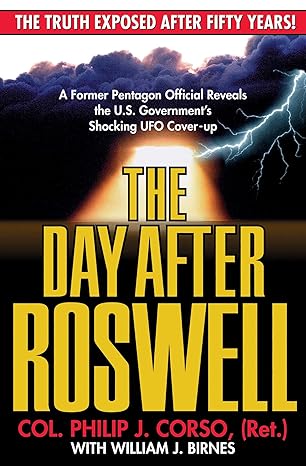
About The Day After Roswell by COL. Philip J. Corso—The Explosive Roswell Story and Its Hidden Legacy
What if one of the biggest events in modern history happened in the New Mexico desert—and the public was never told the full story?
The Day After Roswell by COL. Philip J. Corso takes readers inside one of the world’s most famous UFO mysteries. Written with William J. Birnes, this controversial memoir presents Corso’s account of the 1947 Roswell incident, secret government work, recovered materials, and technology that he believed came from an unidentified spacecraft.
Corso was not writing as an outside observer. He served in the United States Army, worked on President Dwight D. Eisenhower’s National Security Council staff, and later became chief of the Pentagon’s Foreign Technology desk in Army Research and Development. These parts of his career are confirmed in the official publisher’s author biography.
The book asks an extraordinary question: Could materials recovered near Roswell have played a hidden role in the growth of modern technology?
Corso’s answer is bold, detailed, and highly disputed. He claims that recovered objects were quietly studied and shared with American research and industrial groups. According to his account, this secret effort helped support developments involving integrated circuits, fibre optics, lasers, and strong synthetic materials.
These ideas should be understood as Corso’s claims, not as scientifically proven facts. That distinction makes the book even more interesting. Readers are invited to examine a remarkable firsthand story, question its evidence, and decide what they believe.
A Mystery That Did Not End in 1947
The Roswell incident began in July 1947, when unusual debris was found near Roswell, New Mexico. The event soon became the centre of stories about flying saucers, secret military work, weather balloons, recovered bodies, and government silence.
For many people, the main question is simple: What really crashed near Roswell?
The Day After Roswell tries to answer that question from Corso’s point of view. He says that the event did not end when the debris was collected. In his version of events, the recovered material entered a hidden military system where scientists and officials studied it for years.
This changes the focus of the story. Instead of asking only what fell from the sky, the book asks what happened to the material afterward. Where was it stored? Who examined it? What did officials learn from it? Could it have affected military research during the Cold War?
That idea gives the memoir its lasting power. Roswell becomes more than a strange crash. It becomes the starting point of a much larger story about secrecy, invention, national defence, and public trust.
When Official Answers Leave Questions Behind
Many readers interested in Roswell face the same problem: there are countless stories, but few simple answers. Some accounts are based on witnesses. Others come from government reports, later interviews, personal memories, or public rumours. These accounts often disagree.
Corso’s memoir offers a direct and organised version of the story. He connects his military background with his claims about recovered material and secret research. Instead of presenting Roswell as a short event, he places it within a longer history of the Cold War, military intelligence, weapons research, and new technology.
The book does not solve the Roswell debate for everyone. It gives readers something equally valuable: a major claim presented by a former military officer who says he took part in the events that followed.
Readers can compare his account with official explanations and later historical research. They can look for strong details, weak points, missing proof, and possible contradictions. This makes the book useful not only for believers but also for careful sceptics who want to understand one of the most influential Roswell narratives.
A Memoir That Reads Like a Secret File
The Day After Roswell is presented as a memoir, but it often moves with the speed of a political or military thriller. Corso describes restricted information, hidden objects, powerful officials, army offices, secret plans, and technological competition.
The story moves between personal memory and large historical events. Readers enter a world shaped by the Second World War, the early Cold War, nuclear fear, intelligence work, and the race for technological control.
At the heart of the book is Corso’s claim that he handled or managed information connected with objects recovered from Roswell. He says that some items had no clear place in ordinary American technology at the time. He then describes efforts to place these materials or ideas with research teams that could study and develop them without knowing their claimed origin.
This is the central promise of the book: Roswell may not have remained hidden inside a military warehouse. Its alleged technology may have been slowly introduced into normal research.
The official publisher describes the book as an exposé and memoir dealing with the Roswell crash, alleged alien artefacts, government secrecy, and developments such as circuit chips and fibre optics.
The Man Behind the Claims
Philip J. Corso served in the United States Army from 1942 to 1963 and reached the rank of lieutenant colonel. He worked on Eisenhower’s National Security Council staff from 1953 to 1957. In 1961, he became chief of the Foreign Technology desk within Army Research and Development.
That background is important because the book depends heavily on his personal authority. Corso presents himself as someone who understood military systems from the inside. He explains how information could be divided, restricted, renamed, and passed between offices without revealing the whole project.
William J. Birnes is also officially credited as a coauthor. Birnes was the publisher of UFO Magazine and helped shape Corso’s account into a readable book. Simon & Schuster lists the work under both William J. Birnes and Philip Corso.
This shared authorship matters for accurate catalog information. Although the book is closely identified with Colonel Corso and is often promoted under his name, the full credited authorship includes William J. Birnes.
The Technology Question at the Centre of the Book
One of the most exciting parts of The Day After Roswell is its connection between the alleged crash material and twentieth-century inventions.
Corso claims that unfamiliar objects or technical ideas were passed to trusted American companies and researchers. He links this process to fields such as integrated circuits, fibre optics, lasers, night-vision technology, and high-strength materials.
The book’s argument is not simply that scientists copied a complete alien machine. Instead, Corso describes a slow process in which unusual objects inspired or supported existing research. This allows the story to connect the strange world of UFO claims with the real development of military and commercial technology.
However, readers should not treat these technological links as established history. Corso’s claims have been challenged, and the book remains controversial. Many historians, scientists, and sceptical researchers do not accept its central explanation.
A careful reader can still find great value here. The memoir shows how a powerful technological origin story is built. It also raises useful questions about invention. Does new technology arrive through one sudden discovery, or through years of work by many people? How should personal testimony be judged when physical proof is limited? Can a person hold a real government position and still be mistaken about events?
These questions stay with readers long after the final page.
Why Both Believers and Sceptics Read It
A reader does not need to accept every claim to enjoy this book.
Believers may see Corso’s account as rare inside information from a former military officer. They may value the names, departments, events, and claimed connections he provides.
Sceptics may read the same material as a case study in memory, belief, Cold War secrecy, or modern mythology. They can examine where the story is detailed, where proof is missing, and where the timeline deserves closer study.
History readers may enjoy its picture of American military culture. Technology readers may be drawn to its claims about invention and reverse engineering. Fans of unexplained events may enjoy the suspense. Students of media and society can explore why the Roswell story has remained powerful for generations.
That broad appeal helps explain why the book continues to be discussed. It is not merely a report about a supposed UFO crash. It is a story about what people believe governments hide, how secrecy changes public trust, and why some mysteries never disappear.
A Strong Choice for Curious Readers
This book is well suited to readers who enjoy:
- UFOs and unexplained aerial events
- The Roswell incident and its competing explanations
- Military history and secret government programmes
- Cold War politics and defence research
- Memoirs by former government or military officials
- Conspiracy theories and their cultural influence
- The history of modern technology
- Debates about evidence, memory, and official information
- Nonfiction that moves like a thriller
- Books that encourage discussion and independent research
It can also be a good choice for a reading group. Different readers may reach very different conclusions, creating a lively conversation about truth, proof, authority, secrecy, and belief.
Easy to Follow Without Technical Knowledge
The book discusses military departments and advanced technology, but readers do not need to be scientists or defence experts. Its main ideas are explained through events, memories, conversations, and personal experiences.
This makes the story easier to follow than a heavy technical study. The focus remains on people, decisions, secrecy, and discovery. Readers can understand the main argument even if they have never studied electronics, aircraft, military planning, or engineering.
The storytelling style also helps. The book builds curiosity by revealing information in stages. Each chapter adds another piece to Corso’s larger claim. This structure encourages readers to continue because every answer seems to open a new question.
Was the debris ordinary or unknown? Why would officials keep it secret? How could recovered material be studied without exposing its origin? Who controlled the information? Why did Corso wait before telling his story?
These questions give the memoir a strong sense of movement.
A Premium Reading Copy from Bookish Wonderland
A fascinating book deserves a physical edition that feels comfortable and lasts through careful reading. Bookish Wonderland prepares this printed copy for readers who want a clean, durable, and pleasant reading experience.
The book uses premium eye-soothing cream paper. The softer page colour is more comfortable than bright white paper, especially during long reading sessions or under indoor light.
Crystal-clear printing keeps the words sharp and easy to read. This is useful in a detail-rich book filled with names, military roles, historical events, and technical ideas.
High-quality stitched and glue binding gives the book stronger page support. It is made for repeated reading, note-taking, discussion, and long-term shelf storage.
These features make the edition suitable for personal reading, a home library, academic interest, or gifting to someone fascinated by Roswell and UFO history.
What This Book Gives the Reader
The Day After Roswell offers more than a strange story. It gives readers a chance to explore several important ideas at once.
First, it provides one of the best-known insider accounts connected with the Roswell debate. Whether accepted or questioned, Corso’s story became an important part of modern UFO literature.
Second, it introduces readers to the culture of military secrecy. The memoir shows how sensitive work may be divided between departments and how people can know only one small part of a larger project.
Third, it encourages critical thinking. The book presents dramatic claims, but the reader must decide how much trust to place in memory, documents, authority, and supporting evidence.
Fourth, it connects Roswell with the development of modern technology. This connection may be disputed, but it creates a powerful reason to think about where inventions come from and how secret research can influence public life.
Finally, it provides an exciting reading experience. The mixture of history, mystery, technology, and hidden government activity makes the book difficult to put down.
Read It as a Claim, a Mystery, and a Debate
The best way to approach The Day After Roswell is with an open but careful mind.
Do not assume that every statement is proven simply because it comes from a former military officer. At the same time, do not reject the book before understanding what Corso says. Read his account, note the details, compare it with other sources, and form your own conclusion.
This balanced approach makes the reading experience richer. You can enjoy the suspense while also asking serious questions:
What evidence supports the story?
Which parts depend only on memory?
Are the technological claims consistent with known invention timelines?
Could military secrecy explain missing information?
What other explanations could fit the same events?
The book becomes more valuable when it starts this kind of thought. It does not need to settle every question to provide a memorable experience.
A Thought-Provoking Gift
This edition makes a strong gift for readers who enjoy UFO documentaries, unexplained history, military secrets, science mysteries, or government conspiracy stories.
It is also suitable for someone who rarely reads standard history books but enjoys fast and dramatic nonfiction. The personal voice, secretive setting, and large claims make the subject feel immediate.
The durable binding helps the book remain in a collection for years, while the cream paper and clear printing make it pleasant to read. It can become a conversation piece on any shelf, especially when guests notice its famous title.
For birthdays, special occasions, or personal collections, this is a distinctive choice that offers both entertainment and serious debate.
What books are in the The Day After Roswell series by COL. Philip J. Corso?:
The Day After Roswell is a standalone book and does not belong to a numbered series. Therefore, there are no Book 2, Book 3, or later volumes to list.
Find The Day After Roswell Book Price in Bangladesh
Readers searching for The Day After Roswell by COL. Philip J. Corso price in Bangladesh can order this premium printed edition from Bookish Wonderland. It combines a famous and highly debated story with comfortable paper, sharp printing, and binding designed for longevity.
Nationwide delivery is available across Bangladesh, including addresses inside and outside Dhaka. Cash on Delivery is also available across the country. Readers in Dhaka may request fast or urgent delivery when the service is available for their location.
The book is a strong choice if you want an exciting memoir, a major work of UFO literature, or a title that will make you question what may exist behind official history.
Open the File and Judge the Story Yourself
Some books give simple answers. The Day After Roswell gives readers a mystery filled with bold claims, secret work, military history, and questions that remain open.
Corso asks readers to imagine that the Roswell event did not disappear after the debris was removed. He presents it as the beginning of a hidden programme that may have influenced the modern world. His account has supporters and critics, and its central claims remain disputed. Yet the story continues to attract readers because its main question is difficult to forget: What if even part of it is true?
Order your copy from Bookish Wonderland and enter one of the most famous debates in UFO history. Read the evidence presented in the memoir, question every claim, and decide for yourself what may have happened after Roswell.
If you require any customization or have any questions, please inbox us via FB or Insta.
| Primary Specification | |
| Author | Col. Philip J. Corso |
| Narrator | William J. Birnes |
| Genre | Nonfiction, Memoir, UFO Studies, Military History, Conspiracy Theory, Extraterrestrial Studies |
| ISBN-13/ISSN | 978-1501172007 |
| ISBN-10 | 150117200X |
| Publisher | Gallery Books |
| Publishing Date | June 6, 2017 |
| Language | English |
| Reading Age | 18+ years |
| Format | Printed book |
| Physical Specification & Quality | |
| Paper Quality | Premium eye-soothing cream paper |
| Binding Quality | High quality stitched and glue binding (for longevity) |
| Print Quality | Crystal-clear print |
| Pages | 384 pages |
| Country | United States |
| Logistics Information | |
| Weight | 399 gm |
| Length | 8.5 inches |
| Width | 5.6 inches |
| Height | 1 inch |