

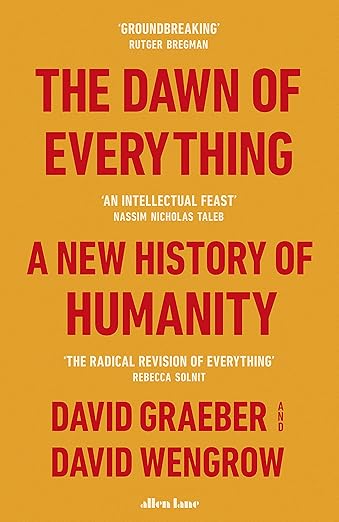
About The Dawn of Everything by David Graeber and David Wengrow—A Bold New History of Humanity
What if much of what we have learned about early human history is too simple—or even wrong?
The Dawn of Everything by David Graeber and David Wengrow asks readers to look at humanity’s past with fresh eyes. This large and deeply researched nonfiction book explores how people lived, worked, formed cities, shared power, and created rules thousands of years ago. It challenges the familiar idea that every human society followed the same fixed path from small hunter-gatherer groups to farming villages, powerful kings, unequal cities, and modern states.
The authors argue that early people were not helpless figures trapped by nature. They could think, plan, debate, and change how they lived. Some communities became more equal during certain seasons and more controlled during others. Some large settlements operated without kings, palaces, or strong central rulers. Farming did not always create private property, strict social classes, or permanent inequality.
This is not a short collection of dates and names. It is a book about ideas, choices, freedom, power, and the many different ways humans have built societies. It invites readers to question old stories and imagine that our present system is not the only possible way to live.
The Old Story Feels Too Simple
Many popular history books tell a neat story. First, humans lived in small and simple groups. Next, they learned to farm. Farming produced extra food, villages became cities, rulers gained power, and social classes appeared. According to that story, inequality was the unavoidable price of civilization.
Graeber and Wengrow believe that this account leaves out too much evidence. They show that the human past was not one straight road. Different communities made different choices. People sometimes adopted farming and later moved away from it. Some groups changed their political structure with the seasons. Others created large settlements without building the kind of ruling system we might expect.
The Dawn of Everything offers a powerful answer to the problem of oversimplified history. It brings together evidence from archaeology, anthropology, Indigenous thought, ancient settlements, and political debate. Instead of showing early humans as passive people waiting for civilization to happen, it presents them as creative thinkers who tested many ways of living.
The result is a richer and more surprising picture of humanity. History becomes less like a ladder and more like a wide field filled with experiments, failures, choices, and new beginnings.
A New Way to Understand Human History
The book begins by questioning the stories often linked with thinkers such as Thomas Hobbes and Jean-Jacques Rousseau. One view presents early human life as violent and unsafe. Another imagines people living in peaceful equality until farming and private property spoiled everything.
Graeber and Wengrow argue that neither picture fully explains the evidence. Early societies were far more varied. Some hunter-gatherer communities had strong ranks and formal leaders. Other communities lived with fewer social divisions. Some people moved between different systems during the year, accepting authority for one season and rejecting it during another.
The authors explore ancient sites and cultures from many regions. Their discussion moves through Europe, Africa, Asia, the Middle East, and the Americas. Readers encounter monuments, settlements, farming communities, Indigenous political ideas, and cities that do not fit the usual story of progress.
These examples support the book’s main point: humans have always been able to make political choices. A society’s size, farming method, or technology does not automatically decide how free or unequal its people must become.
That idea gives the book its emotional force. If inequality was not always unavoidable in the past, it may not be unavoidable in the future.
Were Early Humans Really Simple?
One of the book’s most important goals is to restore intelligence and imagination to early people. The authors reject the idea that prehistoric communities were too simple to think about politics. Human beings living thousands of years ago could observe unfair rules, question leaders, form alliances, and reorganize their communities.
The book looks at evidence of large gatherings, planned settlements, public works, and complex cultural practices. These discoveries suggest that people could cooperate on a great scale without always creating permanent kings or controlling governments.
This changes the way we understand civilization. A large city does not have to mean a palace, a royal family, an army, or a strict ruling class. A farming society does not have to become deeply unequal. A community without writing should not be treated as a community without knowledge.
The authors therefore ask readers to stop measuring every culture by one narrow idea of progress. A society may be skilled in public debate, land care, social freedom, or peaceful cooperation even if it does not resemble a modern state.
This approach makes the book especially valuable for readers who want a wider and more respectful view of world history.
Farming Did Not Change Everything Overnight
The “Agricultural Revolution” is often described as one sudden turning point. Humans began farming, settled permanently, created property, and lost their earlier freedom. Graeber and Wengrow challenge that simple chain of events.
They explain that the move toward farming was often slow, mixed, and reversible. Communities could grow crops while still hunting, fishing, or gathering wild food. Some experimented with cultivation without making it their full way of life. Others farmed for a time and later followed a different path.
This matters because it separates farming from the automatic rise of inequality. Growing food did not force every community to create rulers, armies, private wealth, or social classes. Those arrangements came from human decisions and historical conditions, not from one unavoidable law.
For readers, this section can change the meaning of progress. New tools and food systems create possibilities, but people still decide how those possibilities are used. Technology alone does not write history.
The argument is large, but its basic message is easy to understand: people had choices then, just as people have choices now.
Cities Without Powerful Kings
Many readers may assume that a large ancient city required a king, a palace, a strong army, and a group of officials. The Dawn of Everything examines evidence that complicates this assumption.
The authors discuss settlements that appear to have supported large populations without leaving clear signs of royal rule or extreme class division. Some cities show careful planning and shared public spaces, yet little evidence of grand royal tombs or giant palaces. This suggests that urban life could take more than one political form.
The point is not that every early city was peaceful or equal. The book does not replace one simple story with another. Instead, it asks readers to accept the great variety found in the evidence.
Cities could be controlled by rulers, governed through councils, organised around neighbourhoods, or shaped by systems that researchers still do not fully understand. Human beings repeatedly tested different ways to live together.
This discussion is useful for anyone interested in cities, government, democracy, architecture, or social change. It shows that size and complexity do not always require complete control from the top.
Indigenous Thinkers and the Debate About Freedom
Another major part of the book examines the influence of Indigenous political thought on European ideas. Graeber and Wengrow argue that Indigenous people were not silent objects observed by European writers. They were thinkers and speakers who criticised European society.
Some Indigenous critics questioned Europe’s poverty, punishment, greed, obedience, and lack of personal freedom. Their arguments became part of wider discussions about government and society. The authors give special attention to Kandiaronk, a Wendat leader and skilled diplomat whose reported conversations criticised European customs.
This section asks readers to reconsider who helped shape modern political debate. Ideas did not travel in only one direction from Europe to the rest of the world. Indigenous people also studied European behaviour, formed judgments, and expressed clear political arguments.
The discussion can be challenging because it questions a familiar version of the Enlightenment. Yet it is also one of the book’s most memorable parts. It gives serious attention to voices that standard histories have often reduced or ignored.
Freedom Is at the Heart of the Book
The Dawn of Everything is not only about dates, ruins, and ancient customs. At its centre is a question: how did humans lose the ability to move freely between different forms of society?
The authors identify important kinds of freedom, including the freedom to leave, the freedom to disobey orders, and the freedom to create a different social system. They suggest that many past societies understood and used these freedoms in ways that modern readers may find surprising.
This does not mean ancient life was always fair. War, slavery, violence, and domination existed in many places. However, the evidence also shows resistance, movement, debate, and political change.
The book encourages readers to ask a better question. Instead of asking only where inequality began, we can ask why some forms of power became permanent and difficult to escape.
That change of question is one of the book’s greatest strengths. It moves the reader away from hopeless ideas about human nature. If people created different systems before, then today’s systems are not fixed by nature forever.
A Serious Book That Rewards Patient Readers
This is a long and detailed work. Readers should not expect a light history book that can be finished quickly. It introduces archaeological places, political arguments, cultural practices, and competing ideas about human development.
The writing is lively, but the subject is broad. Some chapters require patience and may be easier to enjoy in short reading sessions. Keeping a notebook nearby can help readers remember important sites, people, and arguments.
The authors also make bold interpretations that have produced debate among scholars and reviewers. The book is best approached as a major argument, not as the final word on every part of human history. Academic reviewers have praised its ambition while also questioning some of its interpretations and use of evidence.
That debate makes the work more useful, not less. Readers can compare its ideas with other books, reviews, and research. It teaches people to question easy answers and examine how historical stories are built.
What You Will Gain from Reading It
The first benefit is a much wider view of history. You will meet communities and political systems that are rarely discussed in basic history lessons.
The second benefit is stronger critical thinking. The book shows how a familiar story can appear natural even when important evidence has been left out. It encourages readers to ask who created a historical theory, what evidence supports it, and what other explanations may exist.
Third, it offers a new way to think about freedom and social change. If past societies could reorganise power, create different kinds of cities, and choose between ways of living, then modern systems should not be treated as the only systems possible.
Finally, the book creates meaningful conversation. Its ideas are suitable for book clubs, university discussions, study groups, research projects, and long talks with curious friends. Even readers who disagree with the authors will find many questions worth discussing.
Who Should Read This Book?
The Dawn of Everything is ideal for readers interested in history, archaeology, anthropology, sociology, politics, philosophy, and human civilization.
It is a strong choice for people who enjoyed broad histories of humanity but now want a different view. Readers familiar with writers such as Yuval Noah Harari, Jared Diamond, or Steven Pinker may find this book especially interesting because it questions many popular accounts of human development.
University students can use it to explore debates about social evolution, farming, cities, Indigenous thought, authority, and inequality. Teachers and researchers may find useful cases for discussion, although academic claims should be checked against specialist sources.
Book clubs can divide the work by chapter and discuss one main idea at each meeting. Independent readers can move slowly, mark important pages, and return to difficult sections later.
It is not designed for very young children. The language, length, evidence, and political ideas make it most suitable for mature teenagers and adults who enjoy serious nonfiction.
Premium Quality for a Long Reading Journey
A large and important book deserves a physical edition that feels comfortable and dependable. Bookish Wonderland offers this printed edition with premium eye-soothing cream paper. The soft page colour is comfortable for long reading sessions and helps reduce the harsh glare often caused by very bright white paper.
Crystal-clear printing keeps the letters sharp and easy to follow. This is especially useful in a detailed nonfiction work containing long explanations, names, places, and historical arguments.
The high-quality stitched and glue binding is designed for longevity. It gives the pages stronger support through repeated reading, study, highlighting, and careful note-taking. The durable construction also makes the book suitable for a personal collection, study shelf, classroom, or book-club library.
These qualities combine comfort, clarity, and durability without distracting from the book itself.
Read It in the Way That Works for You
You do not need to finish the book in a few days. Reading one chapter at a time is a practical approach. Pause after each chapter and write down its main claim. Ask whether the evidence changed your view or raised a new question.
Students can use sticky notes to mark discussions of farming, cities, freedom, Indigenous criticism, and political authority. Book clubs can assign a small section each week. Teachers can select individual chapters when discussing archaeology or theories of civilization.
The book can also be read beside another general history of humanity. Comparing two different interpretations makes the evidence and disagreements much easier to see.
Because the work covers a vast period, readers do not need to agree with every conclusion to enjoy it. Its greatest use may be its ability to make old questions feel new again.
Bring a Bigger View of History to Your Shelf
The Dawn of Everything does more than tell you what happened long ago. It asks why we believe certain stories about humanity and what may become possible when those stories change.
Buy The Dawn of Everything by David Graeber and David Wengrow and begin a thoughtful journey through archaeology, political ideas, cities, farming, freedom, and social change. If you are checking The Dawn of Everything by David Graeber and David Wengrow book price in Bangladesh, Bookish Wonderland offers a premium printed edition made for comfortable reading and lasting use.
Order today for nationwide delivery across Bangladesh. Cash on Delivery is available, with delivery inside and outside Dhaka and a fast or urgent delivery option in Dhaka.
If you require any customization or have any questions, please inbox us via FB or Insta.
| Primary Specification | |
| Author | David Graeber and David Wengrow |
| Narrator | Mark Williams |
| Genre | Nonfiction, World History, Social History, Anthropology, Archaeology, Political Theory |
| ISBN-13/ISSN | 978-1250858801 |
| ISBN-10 | 1250858801 |
| Publisher | Picador Paper |
| Publishing Date | April 4, 2023 |
| Language | English |
| Reading Age | 16+ years |
| Format | Printed book |
| Physical Specification & Quality | |
| Paper Quality | Premium eye-soothing cream paper |
| Binding Quality | High quality stitched and glue binding (for longevity) |
| Print Quality | Crystal-clear print |
| Pages | 720 pages |
| Country | United States |
| Logistics Information | |
| Weight | 741 gm |
| Length | 8.5 inches |
| Width | 5.6 inches |
| Height | 1.8 inch |