

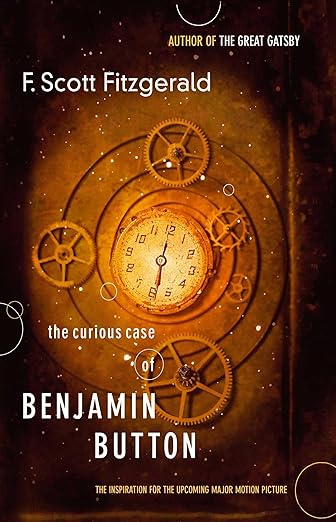
The Curious Case of Benjamin Button by F. Scott Fitzgerald – A Strange, Funny and Thoughtful Classic About Time, Age and Life
That is the strange idea at the heart of The Curious Case of Benjamin Button by F. Scott Fitzgerald. Benjamin Button enters the world in Baltimore in 1860, but nothing about his birth is normal. Instead of looking like a newborn baby, he appears to be an elderly man. His shocked father does not know what to do, and society has no place for a child who looks older than the adults around him.
As the years pass, Benjamin does not grow older in the usual way. He grows younger. His body slowly moves backward through life while everyone around him moves forward. The result is funny at times, uncomfortable at others, and surprisingly sad.
Fitzgerald uses this impossible idea to ask very human questions. What makes someone young or old? How much of identity comes from appearance? What happens when your life moves at a different speed from the people you love? And if time always changes us, what parts of life are truly ours to keep?
A Short Story With a Big Idea
The story is brief, but the idea behind it is huge.
Benjamin begins life with the body and appearance of an old man. His father wants him to behave like a baby, even though Benjamin can talk, think, eat normal food, and understand the world around him. From the beginning, he is forced into a role that does not match who he seems to be.
That problem follows him throughout life.
When he looks too old, people treat him as if he should already have the experience of an older man. When he begins to look younger, people again make assumptions based on his appearance. The world constantly decides what Benjamin should be because of how he looks.
This makes the story more than a fantasy about reverse aging. It becomes a sharp look at social expectations.
Why Benjamin Ages Backward
Fitzgerald does not give a scientific explanation for Benjamin’s condition.
There is no machine, experiment, medicine, or magical rule to study. Benjamin simply begins life old and becomes younger.
That simplicity is important.
The story is not trying to explain how reverse aging could happen. Fitzgerald uses the impossible situation as a literary device. By turning normal aging upside down, he makes readers notice things about age that usually feel ordinary.
We expect children to behave one way, young adults another way, and older people another way. Benjamin breaks those expectations at every stage.
The unusual life also creates irony. At some points Benjamin finally looks the age people expect him to be, but the moment never lasts. Time keeps moving, only in the opposite direction.
Inspired by a Mark Twain Idea
In Tales of the Jazz Age, he wrote that the story was inspired by a remark from Mark Twain about the strange order of human life: the best part comes near the beginning and the hardest part comes at the end.
Love Becomes Complicated When Time Moves Differently
Benjamin eventually meets Hildegarde Moncrief.
At that point, he looks much older than his actual age. Their relationship begins because Hildegarde is attracted to mature-looking men, and Benjamin seems to fit what she wants.
Slowly, the balance between them changes.
This creates one of the story’s saddest ideas. Love can begin at a moment when two people seem perfectly matched, but people do not stay frozen in that moment.
The story exaggerates this truth through reverse aging, but the feeling is familiar. Couples change. Bodies change. Interests change. What one person wants at one age may not be what they want years later.
Benjamin’s strange life makes that ordinary truth impossible to ignore.
Funny, Absurd and Sad at the Same Time
The opening of the story is deliberately absurd.
A father arrives expecting to see a baby and instead finds an elderly-looking person in the nursery. The adults around Benjamin are confused, embarrassed, and worried about what society will think.
Fitzgerald uses this situation for comedy.
Benjamin is given baby clothes even though they do not fit his appearance. He is expected to play with toys even when he would rather do something else. Later, people make new mistakes because they believe his face tells them his age.
But the humour becomes more bittersweet as the story moves forward.
The joke has consequences.
Benjamin can never live at exactly the same pace as everyone around him. Even when he finds periods of success, love, or belonging, his changing appearance pulls him toward another stage.
The final movement of the story turns the original comic idea into something much more fragile.
A Classic From Fitzgerald’s Jazz Age Writing
The Curious Case of Benjamin Button appeared in Fitzgerald’s 1922 collection Tales of the Jazz Age.
The collection also includes stories such as The Diamond as Big as the Ritz and other works from Fitzgerald’s early career.
Penguin Classics places the story within Fitzgerald’s writing about early twentieth-century America and the Jazz Age. His fiction often explores beauty, status, youth, wealth, desire, disappointment, and the way time changes people.
Benjamin Button approaches those subjects from an unusual angle.
Instead of following a young person who grows older and becomes disappointed, Fitzgerald literally reverses the direction of age.
That makes this story very different from The Great Gatsby, but readers can still recognize Fitzgerald’s interest in youth, social expectation, changing desire, and the passing of time.
The Book and the Movie Are Not the Same
Many readers first know Benjamin Button through the 2008 film starring Brad Pitt and Cate Blanchett.
The film was inspired by Fitzgerald’s story, but it is not a scene-by-scene copy.
The original short story is much shorter and has different characters, relationships, events, and emotional details. Fitzgerald’s version is more satirical and compact. It moves quickly through Benjamin’s strange life rather than building the long romantic story seen in the film.
That means the book can still surprise you even if you already know the movie.
Reading the original also lets you see the strange idea in Fitzgerald’s own style.
If you enjoyed the film, the story is worth reading as the literary source that started everything. If you have never seen the film, no background knowledge is needed.
Why This Story Is Easy to Finish but Hard to Forget
Some classics are long and demanding.
This one is different.
The Curious Case of Benjamin Button is a short story, so it can be finished far more quickly than a full-length novel. The central idea is also easy to understand from the first pages.
That makes it a good entry point for readers who want to try F. Scott Fitzgerald but are not ready for a longer classic.
The language comes from the early twentieth century, so a few expressions may feel old-fashioned. Still, the plot is clear and the strange situation keeps the story moving.
Its short length also makes it useful for students, book clubs, and readers who enjoy discussing a big idea without spending weeks on one book.
You can finish it quickly and still keep thinking about it afterward.
Who Should Read The Curious Case of Benjamin Button?
This classic can be a good choice for:
-
Readers who enjoy short classic fiction.
-
Fans of F. Scott Fitzgerald and The Great Gatsby.
-
People who enjoy strange or imaginative premises.
-
Readers interested in stories about time and aging.
-
Students studying American literature.
-
Book clubs looking for a short story with deeper themes.
-
Readers who watched the 2008 film and want to discover the original.
-
People interested in Jazz Age literature.
-
Readers who enjoy satire mixed with sadness.
-
Anyone looking for a classic that can be finished quickly.
-
Gift buyers searching for a well-known literary title.
-
Readers who like stories that turn one simple idea into a larger question about life.
A Comfortable Copy for Reading and Rereading
Bookish Wonderland offers this title for readers who want a physical copy that feels pleasant to read and strong enough to keep.
The book uses premium eye-soothing cream paper. The softer page tone helps make reading more comfortable, especially for people who dislike very bright white pages.
Crystal-clear printing keeps the text sharp and easy to follow.
High-quality stitched and glue binding gives the pages stronger support for regular reading and longer shelf life.
These features make the copy suitable for personal reading, class use, gifting, highlighting, or keeping with a collection of classic English literature.
Because the story is short, many readers may also return to it later and notice ideas they missed the first time.
Looking for The Curious Case of Benjamin Button Book Price in Bangladesh?
If you are comparing The Curious Case of Benjamin Button by F. Scott Fitzgerald and its Book price in Bangladesh, Bookish Wonderland gives you a simple way to order a reader-friendly copy.
Delivery is available across Bangladesh, including Dhaka and areas outside Dhaka.
Cash on Delivery is available nationwide, so customers can pay when their order arrives.
Readers in Dhaka can also ask about fast or urgent delivery when available.
This makes the book easy to order for school or university reading, personal collections, gifting, book-club discussion, or anyone beginning to explore classic American literature.
Why Buy From Bookish Wonderland?
Bookish Wonderland focuses on English books made for real reading.
You get nationwide delivery, Cash on Delivery, delivery inside and outside Dhaka, and access to a large collection of durable English titles.
A classic like The Curious Case of Benjamin Button is especially useful to own in physical form because it can be read in one sitting, studied for its themes, or revisited later.
It also makes a thoughtful gift for a reader who likes unusual stories but may not want a very long novel.
The combination of a famous author, a memorable idea, and a manageable length makes it easy to recommend.
Read a Life That Moves in the Opposite Direction
The Curious Case of Benjamin Button by F. Scott Fitzgerald begins with an impossible birth and follows one man through a life that refuses to move normally.
Benjamin becomes younger while the world around him becomes older.
At first, the idea feels funny.
Then it becomes strange.
Finally, it becomes deeply human.
Behind the reverse aging is a story about family, love, appearance, social judgment, youth, loss, and time.
It reminds us that becoming younger would not remove every sadness of growing older. Life still changes. People still move apart. Moments still disappear.
That is why this short classic continues to attract readers.
If you want a memorable piece of American fiction with an unusual idea and a deeper message underneath it, add The Curious Case of Benjamin Button to your shelf.
Order your copy from Bookish Wonderland and discover the original story that turned one impossible life into a lasting question about what it really means to grow older.
If you require any customization or have any questions, please inbox us via FB or Insta.
| Primary Specification | |
| Author | F Scott Fitzgerald |
| Narrator | Kevin Killavey |
| Genre | Literary Fiction, Fantasy, Satire, Speculative Fiction |
| ISBN-13/ISSN | 978-1530200269 |
| ISBN-10 | 1530200261 |
| Publisher | CreateSpace Independent Publishing Platform |
| Publishing Date | February 23, 2016 |
| Language | English |
| Reading Age | 13+ years |
| Format | Printed book |
| Physical Specification & Quality | |
| Paper Quality | Premium eye-soothing cream paper |
| Binding Quality | High quality stitched and glue binding (for longevity) |
| Print Quality | Crystal-clear print |
| Pages | 24 pages |
| Country | USA |
| Logistics Information | |
| Weight | 29g |
| Length | 8.5 inch |
| Width | 5.6 inch |
| Height | 0.06 inch |