

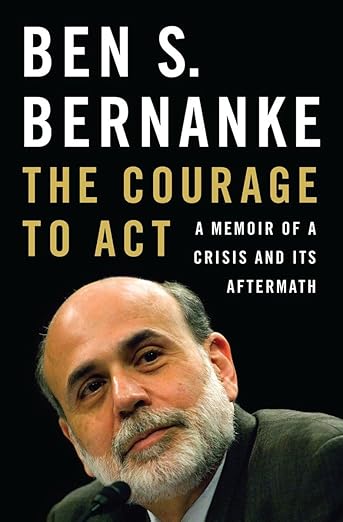
About The Courage to Act by Ben S. Bernanke — An Insider’s Story of the Financial Crisis, the Federal Reserve, and Difficult Decisions
The Courage to Act by Ben S. Bernanke is a detailed memoir about one of the most frightening economic moments in modern history. Bernanke served as chair of the Federal Reserve from 2006 to 2014, which placed him at the center of the global financial crisis and the deep recession that followed. In this book, he explains what happened, what policymakers feared, what choices they made, and why those choices mattered.
The story begins before the worst days of 2008. Bernanke explains his childhood, education, academic career, work on the Great Depression, and path into public service. Those early chapters show how an economist who had spent years studying financial panics later found himself responsible for helping stop one.
As the housing bubble burst and major financial firms began to fail, the Federal Reserve faced decisions that had to be made quickly. Bernanke takes readers inside those moments and explains how officials tried to protect the wider economy while dealing with fear, uncertainty, political pressure, and public anger.
When financial news feels impossible to understand
The 2008 financial crisis is often described with words such as mortgages, liquidity, bailouts, central banks, interest rates, credit markets, and recession. For many readers, these terms can make the event feel distant or too technical.
This book helps solve that problem by connecting the ideas to real decisions. Bernanke explains what policymakers were seeing, why certain firms mattered, and how trouble in one part of the financial system could spread to many others.
Instead of treating economics as a list of formulas, the memoir shows what happens when financial systems stop working properly. Banks become afraid to lend. Businesses struggle to borrow. Families lose jobs, homes, savings, or confidence. Problems that begin on trading desks can move into ordinary life.
That connection makes the book useful for readers who want to understand not only what the Federal Reserve did, but also why leaders believed action was necessary.
From academic study to the center of a crisis
Bernanke had spent much of his academic career studying the Great Depression. That background became especially important when the United States entered its worst financial crisis in generations.
The memoir shows how knowledge from history shaped his thinking. Policymakers understood that allowing a financial panic to grow without response could make an economic downturn much worse. At the same time, they knew that emergency action could be unpopular and could create new risks.
This tension appears throughout the book. Bernanke and his colleagues had to make choices without knowing exactly what would happen next. They needed to act fast, but they also needed to explain why extraordinary steps were being taken.
The result is a story about economics, but also about leadership under uncertainty. Readers see that important decisions are rarely made with perfect information.
Understanding the housing crash and financial panic
One of the central parts of the memoir is the collapse of the housing boom and the damage that followed through the financial system. Falling house prices exposed weak loans and risky financial products that had spread through banks and investment firms.
As losses became larger, trust disappeared. Firms became unsure about who was safe and who might fail. Credit markets tightened. Institutions that looked strong could suddenly face serious pressure.
Bernanke explains how this environment created a dangerous chain reaction. The problem was not only that individual companies could lose money. The fear was that failure at major institutions could freeze the financial system and damage the wider economy.
This helps readers understand why events involving companies such as Bear Stearns and AIG became national concerns rather than private business problems.
Why the Federal Reserve took unusual action
During normal times, the Federal Reserve uses familiar tools such as interest-rate policy. During the crisis, normal tools were not always enough.
Bernanke describes how the Fed created or expanded emergency programs designed to keep credit moving and stabilize markets. Some actions were controversial because they involved support for financial institutions that many people believed had helped create the problem.
The book explains the reasoning from inside the room. Officials worried that letting the system collapse could punish millions of people who had nothing to do with risky Wall Street decisions.
This does not mean every choice was perfect. Bernanke discusses criticism and difficult trade-offs. The memoir is his account, so readers should remember that they are hearing the crisis from one of its main policymakers. That viewpoint is exactly what makes the book valuable.
Bear Stearns, AIG, and the pressure of emergency decisions
The crisis did not arrive as one single event. It came through repeated shocks.
Bear Stearns faced collapse in early 2008, creating fears about wider financial damage. Later, the giant insurer AIG became another emergency. Each case forced officials to decide what they could legally do, what they should do, and what might happen if they did nothing.
Bernanke describes long meetings, fast-moving information, legal limits, political criticism, and the emotional strain of these moments. Readers see how a decision that looks simple years later could feel deeply uncertain at the time.
These chapters are among the most important parts of the memoir because they show policy as action rather than theory. The people involved were not solving textbook exercises. They were trying to prevent a financial breakdown while the situation changed hour by hour.
What makes this book worth reading
-
A firsthand account from the Federal Reserve chair who led the central bank during the 2008 financial crisis.
-
Clear discussion of the housing crash, banking stress, credit markets, emergency lending, and recession.
-
Detailed explanations of major events involving Bear Stearns, AIG, and other financial institutions.
-
Insight into how the Federal Reserve and U.S. Treasury worked during extreme economic pressure.
-
A personal story showing Bernanke’s path from South Carolina to academic economics and national leadership.
-
Discussion of political criticism, public anger, and the challenge of explaining unpopular economic decisions.
-
A useful bridge between economic history, memoir, public policy, and modern central banking.
-
A New York Times bestselling work that remains an important record of the crisis period.
Bernanke also shows that economic policy is ultimately about people, not only numbers. Decisions about interest rates, lending, and financial stability can directly affect jobs, homes, businesses, and savings. That human connection makes the memoir useful for readers who want to see how technical policy choices can shape ordinary life during a national emergency.
A valuable companion for students and professionals
The Courage to Act can be used in several ways. Students can read it alongside courses in macroeconomics, banking, financial history, public policy, or business. It gives real examples that can make classroom ideas easier to remember.
Finance professionals can use it to understand how central banks think during market stress. Business readers can learn how credit problems move through the economy. Policy students can study the relationship between expert institutions, elected government, and public opinion.
The book is also useful for readers comparing the 2008 crisis with later periods of economic stress. It gives a detailed example of how emergency policy tools were developed and why some of them later became part of the wider central-banking toolkit.
A memoir that should also be read critically
Because Bernanke was one of the main decision-makers during the crisis, this book is an insider account rather than a neutral history written from far away.
That is a strength because readers receive detail that an outsider may not have. It is also a reason to read carefully. Bernanke explains and defends many decisions made by the Federal Reserve. Other economists, historians, politicians, and citizens have different views about those policies.
A thoughtful reader can use this memoir as one important source and compare it with other accounts of the financial crisis. Doing so creates a fuller picture.
The book is most useful when readers appreciate both sides: it offers exceptional access to Bernanke’s reasoning, but it also represents Bernanke’s own perspective on events in which he played a major role.
Who should read The Courage to Act?
This book is a strong choice for readers interested in economics, finance, banking, the Federal Reserve, the Great Recession, economic history, leadership, public policy, or modern American history.
It is especially useful for people who remember the 2008 crisis but never understood what happened behind government announcements and emergency meetings. The memoir can fill that gap by showing how financial stress developed and how policymakers responded.
It may also suit readers who enjoy serious memoirs by people who were directly involved in major historical events.
The book is detailed, so readers looking for a very short introduction may prefer a simpler overview first. But anyone willing to spend time with a full insider account can gain a much deeper understanding of the crisis.
Premium reading quality from Bookish Wonderland
Bookish Wonderland offers The Courage to Act for readers who want a comfortable physical copy for study, reference, or long reading sessions.
The book uses premium eye-soothing cream paper, helping reduce the harsh look of bright white pages. Crystal-clear printing keeps financial terms, names, dates, and long explanations easy to follow.
High-quality stitched and glue binding gives the book stronger support for repeated use. This matters for a large nonfiction title that students and serious readers may open many times for study or reference.
Book customization is available for supported requests. Customers can contact Bookish Wonderland before ordering to ask about current customization options.
The Courage to Act by Ben S. Bernanke price in Bangladesh
Readers searching for The Courage to Act by Ben S. Bernanke price in Bangladesh may want more than a low price. A long economics memoir should also be comfortable to read, clearly printed, and durable enough for repeated reference.
Bookish Wonderland provides nationwide delivery inside and outside Dhaka, while Cash on Delivery is available across Bangladesh. Customers in Dhaka can also ask about fast or urgent delivery when available.
The Book price in Bangladesh may change depending on the current listing, edition, availability, and offer. Check the latest product listing before ordering for the current price.
Understand the crisis from the person sitting at the center
The Courage to Act gives readers something difficult to get from short news articles: time inside the decisions.
Bernanke explains how a housing collapse became a financial panic, how that panic threatened the wider economy, and why the Federal Reserve used tools that many people had never heard of before the crisis.
You do not have to agree with every decision to benefit from the book. Its value comes from seeing how policymakers understood the danger, what limits they faced, and why they believed action was necessary.
For readers interested in finance, economics, leadership, or recent history, this memoir can turn a confusing period into a clearer story of choices, risks, and consequences.
Order The Courage to Act by Ben S. Bernanke from Bookish Wonderland and add an important financial memoir to your collection. With comfortable cream paper, clear printing, durable binding, nationwide delivery, and Cash on Delivery, it is prepared for serious reading, study, and long-term reference.
If you require any customization or have any questions, please inbox us via FB or Insta.
| Primary Specification | |
| Author | Ben S. Bernanke |
| Narrator | Grover Gardner |
| Editor | Chris Welch |
| Genre | Economics, Finance, Economic History, Business, Memoir |
| ISBN-13/ISSN | 978-0393353990 |
| ISBN-10 | 9780393353990 |
| Publisher | W. W. Norton & Company |
| Publishing Date | May 2, 2017 |
| Edition | Reprint |
| Language | English |
| Reading Age | 18+ years |
| Format | Printed book |
| Physical Specification & Quality | |
| Paper Quality | Premium eye-soothing cream paper |
| Binding Quality | High quality stitched and glue binding (for longevity) |
| Print Quality | Crystal-clear print |
| Pages | 640 pages |
| Country | USA |
| Logistics Information | |
| Weight | 645g |
| Length | 8.5 inches |
| Width | 5.6 inches |
| Height | 1.1 inches |