

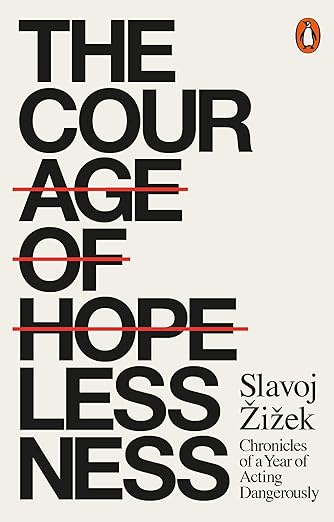
About The Courage of Hopelessness by Slavoj Zizek — A Bold Political and Philosophical Challenge to Easy Optimism
The Courage of Hopelessness by Slavoj Zizek is a political and philosophical book about a difficult question: what if real change begins only after we stop pretending that everything will somehow work out? Žižek argues that false hope can sometimes keep people trapped. When society keeps waiting for an easy solution, it may avoid facing the deeper problems that created the crisis in the first place.
Published during a period of political tension, the book looks at global capitalism, migration, terrorism, nationalism, populism, inequality, failed political movements, and the future of the left. Žižek moves across current events, philosophy, popular culture, history, and political theory to ask whether modern society can continue in the same direction.
The title sounds dark, but the argument is not simply about giving up. Žižek uses hopelessness in a different way. For him, admitting that old answers may no longer work can create the freedom to think more seriously about new possibilities.
Why the idea of hopelessness matters
Most political books try to end with hope. They may describe serious problems and then promise that reform, better leaders, or new technology can fix them. Žižek challenges that habit. He suggests that comforting stories can stop people from seeing how deep a problem really is.
His idea of hopelessness does not mean sitting quietly and doing nothing. It means refusing to depend on easy optimism. If a system keeps producing the same failures, he argues, people should not simply wait for it to correct itself. They should examine the structure of the problem.
This makes the book useful for readers who feel that political debate often repeats the same promises. Žižek asks readers to look at what happens when accepted solutions fail, when old political divisions stop making sense, and when fear or anger creates new movements.
The result is a book that pushes readers to question both comfortable liberal ideas and simple revolutionary slogans.
Global capitalism at the center of the argument
One of the book's main concerns is global capitalism. Žižek asks whether capitalism has become so accepted that people treat it like a permanent fact of human life. He is interested in the contradictions inside the system and whether those contradictions could eventually make change unavoidable.
He connects economic questions with politics, identity, migration, fear, culture, and social conflict. Instead of treating each crisis as separate, he often asks whether several crises come from the same deeper structure.
That approach can be challenging, but it is also what gives the book its energy. A discussion about refugees may lead into nationalism. A discussion about terrorism may move into religion or Western foreign policy. A discussion about elections may turn into a larger argument about ideology.
Readers do not have to agree with every connection. The value comes from seeing how one thinker tries to connect events that are often discussed separately.
Populism, anger, and political frustration
Žižek pays close attention to the rise of right-wing populism and the anger that helped produce it. He looks at political movements that present themselves as voices for people who feel ignored, threatened, or betrayed by established institutions.
Rather than explaining populism as simple ignorance, he asks what social and economic frustrations make it powerful. He also criticizes responses that only shame voters without asking why they became angry.
At the same time, he does not present populist politics as a solution. He questions nationalism, exclusion, and political movements built around fear of outsiders. His wider concern is how frustration can be redirected into simple enemies instead of deeper structural questions.
This section can be useful for readers interested in elections, communication, ideology, nationalism, and the relationship between economic insecurity and cultural conflict.
Migration, borders, and difficult choices
Migration is another major subject in The Courage of Hopelessness. Žižek writes about refugee movements, European politics, cultural conflict, humanitarian responsibility, and the pressure created when large numbers of people are forced to move.
His approach is deliberately uncomfortable. He criticizes simple anti-immigrant politics, but he also challenges idealized discussions that avoid difficult questions about integration, social tension, security, and cultural difference.
This is typical of Žižek's style. He often refuses the answer that seems safest for one political camp. Instead, he looks for contradictions inside both sides of a debate.
Readers may strongly disagree with some of his conclusions. That disagreement can still make the book valuable. It forces readers to identify why they believe what they believe and whether their political language matches the real difficulty of the problem.
Terrorism, religion, and ideology
The book also examines terrorism and religion, especially in relation to political violence, identity, and global conflict. Žižek tries to move beyond explanations that reduce violence to one cause.
He asks how ideology shapes the way people understand enemies, sacrifice, belonging, freedom, and fear. He also looks at how Western countries describe themselves when responding to political violence.
These chapters are not a simple guide to terrorism. They are philosophical arguments about how societies create meaning around danger. Žižek is interested in the stories people tell about themselves and their opponents.
For readers studying political philosophy, sociology, cultural theory, international relations, or ideology, these sections can provide challenging material for discussion.
What makes this book different
-
A provocative argument that real change may require abandoning false or easy hope.
-
Discussion of global capitalism, populism, migration, terrorism, religion, and political crisis.
-
A mix of philosophy, political theory, current events, history, and cultural examples.
-
Criticism aimed at both mainstream liberal politics and simplistic radical alternatives.
-
Questions about whether capitalism can continue without producing deeper contradictions.
-
Analysis of how fear, identity, nationalism, and economic frustration interact.
-
A style that challenges readers to test their own political assumptions.
-
A standalone work that can be read without following a numbered series.
Is this book easy to read?
The Courage of Hopelessness is not written like a basic introduction to politics. Žižek moves quickly between philosophers, political events, historical examples, jokes, cultural references, and theoretical ideas. Some readers may need to pause, reread, or look up names and events.
However, the central questions are understandable. Why do political systems keep producing frustration? Why does public anger move toward populism? Why do societies hold on to solutions that repeatedly fail? Can people imagine a future beyond the choices they already know?
Readers who are new to Žižek may find some passages dense, but they can still follow the broader arguments by reading slowly. It can help to treat the book as a collection of connected political interventions rather than expecting every page to work like a simple textbook chapter.
Who should read The Courage of Hopelessness?
This book suits readers interested in political philosophy, contemporary politics, capitalism, socialism, ideology, globalization, populism, migration, cultural theory, and the modern left.
It can be useful for university students studying philosophy, political science, sociology, international relations, cultural studies, or social theory. Readers already familiar with Marx, Hegel, Lacan, or Žižek's earlier work may notice more of the theoretical background, but previous expertise is not required to understand every major theme.
It may also appeal to readers who enjoy books that challenge rather than comfort. Žižek often asks questions without giving a neat final answer. If you prefer political writing that makes you argue with the author, underline passages, and return to difficult ideas, this book offers plenty of material.
A useful book for debate and study
The Courage of Hopelessness works well for discussion because many of its claims invite disagreement. A reading group can debate whether hopelessness can really create political courage, whether capitalism can reform itself, why populist movements grow, or how migration should be discussed.
Students can use individual chapters to explore ideology, globalization, radical politics, nationalism, terrorism, or the crisis of established political parties. The book can also be paired with writers who disagree with Žižek, giving readers a wider view.
Because the book responds to political events from the mid-2010s, it can now be read in two ways. It is both a political intervention from its own moment and a record of how one philosopher interpreted changes that continued to shape later politics.
Why older political commentary can still be valuable
Some names and events in the book belong clearly to the period in which it was written. That does not make the book useless. Political philosophy often becomes more interesting when readers can compare an author's predictions and fears with what happened later.
Žižek's discussions of populism, migration, ideological division, capitalism, and distrust in institutions still connect with debates that continue today. Readers can ask which arguments aged well, which now look weaker, and which problems became more serious.
This kind of reading builds critical thinking. Instead of accepting the book as a final answer, readers can test it against later events and other political viewpoints.
That is especially useful for students and serious readers who want to understand how political ideas develop during periods of uncertainty.
A premium reading copy from Bookish Wonderland
Bookish Wonderland offers The Courage of Hopelessness for readers who want a comfortable physical copy for study, discussion, and long-term reference. The book uses premium eye-soothing cream paper, giving the pages a softer reading surface during long sessions.
Crystal-clear printing helps philosophical terms, names, quotations, and longer arguments remain sharp and easy to follow. High-quality stitched and glue binding provides stronger support for repeated opening, which is useful for a book readers may underline, annotate, or return to during study.
Book customization is available for supported requests. Customers can contact Bookish Wonderland before ordering to ask which options are currently available.
The Courage of Hopelessness by Slavoj Zizek price in Bangladesh
Readers searching for The Courage of Hopelessness by Slavoj Zizek price in Bangladesh may be looking for a serious political book that is comfortable enough for slow reading and durable enough for reference.
Bookish Wonderland provides nationwide delivery inside and outside Dhaka. Cash on Delivery is available across Bangladesh, and customers in Dhaka can ask about fast or urgent delivery when available.
The Book price in Bangladesh may change depending on the current listing, print option, stock, and offer. Check the latest Bookish Wonderland product listing before ordering for the current price and delivery choices.
Read it when easy answers no longer feel enough
The Courage of Hopelessness is designed for readers who are not satisfied with simple political comfort. Žižek asks what happens when established systems keep producing crisis, when angry voters reject traditional parties, and when both mainstream and radical movements struggle to offer convincing alternatives.
His answer is intentionally unsettling. Before real change can begin, people may need to stop pretending that familiar solutions will save them. What he calls hopelessness is therefore not the end of action. It is an attempt to clear away false promises and face reality without decoration.
You may agree with some chapters and strongly reject others. That is part of the value. The book is most rewarding when it becomes a conversation rather than a set of instructions.
Order The Courage of Hopelessness by Slavoj Zizek from Bookish Wonderland and add a challenging work of political philosophy to your shelf. With comfortable cream paper, clear printing, durable binding, nationwide delivery, and Cash on Delivery, it is prepared for careful reading, study, debate, and repeated reference.
If you require any customization or have any questions, please inbox us via FB or Insta.
| Primary Specification | |
| Author | Slavoj Zizek |
| Genre | Philosophy, World Politics, Political Science, Social Theory, Globalization |
| ISBN-13/ISSN | 978-0141986098 |
| ISBN-10 | 0141986093 |
| Publisher | Penguin UK |
| Publishing Date | June 26, 2018 |
| Language | English |
| Reading Age | 18+ years |
| Format | Printed book |
| Physical Specification & Quality | |
| Paper Quality | Premium eye-soothing cream paper |
| Binding Quality | High quality stitched and glue binding (for longevity) |
| Print Quality | Crystal-clear print |
| Pages | 160 pages |
| Country | UK |
| Logistics Information | |
| Weight | 167g |
| Length | 8.5 inches |
| Width | 5.6 inches |
| Height | 0.75 inches |