

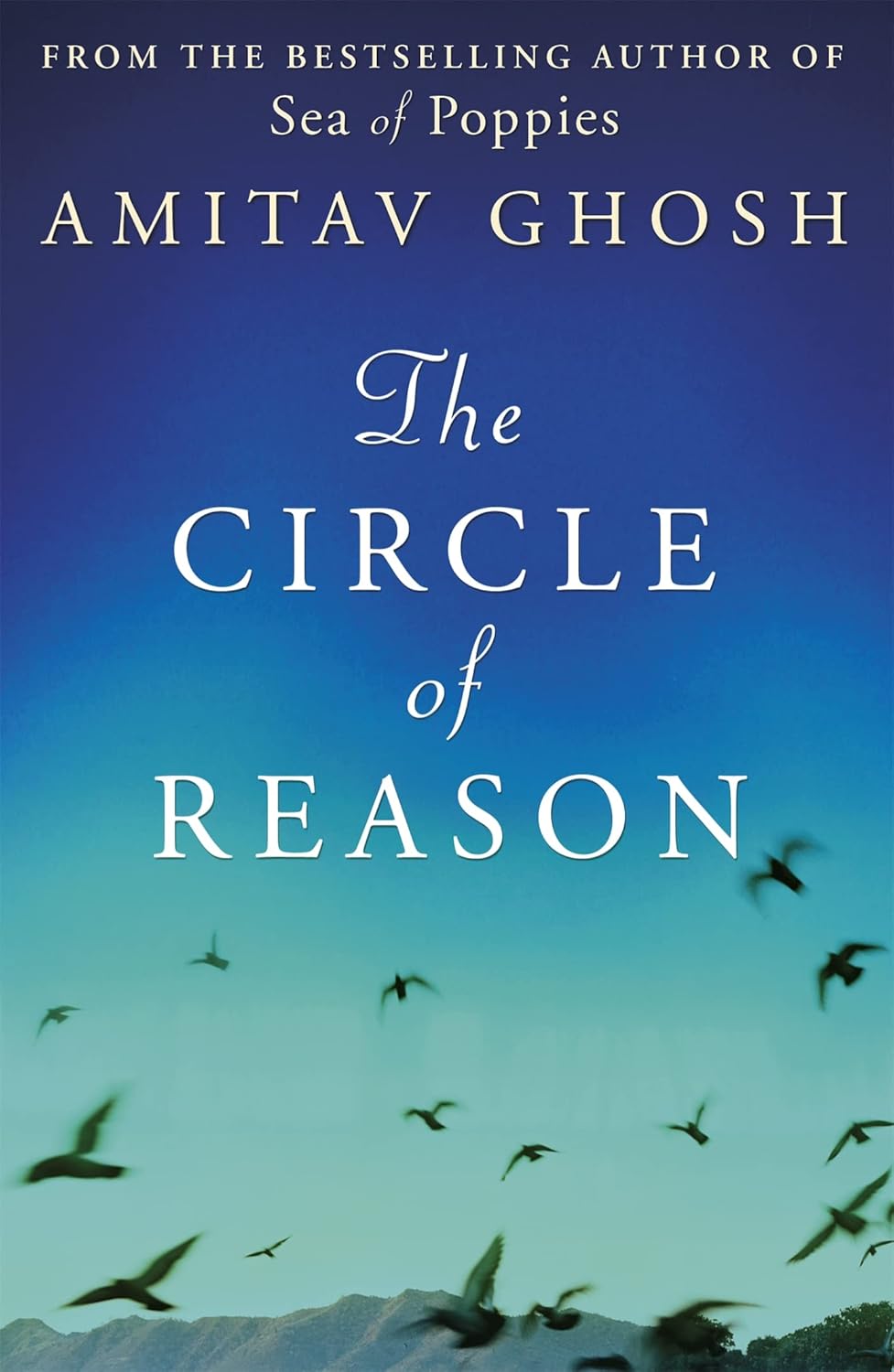
About The Circle of Reason by Amitav Ghosh—A Wide-Ranging Journey of Ideas, Weaving and Escape
A young boy with an unusual head arrives in a Bengali village. His name is Alu, and the people around him soon discover that his hands can create beautiful cloth. His uncle and guardian believes strongly in science, order, and reason. Then a terrible accident changes everything. Alu is wrongly suspected of terrorism and must run from the police, leaving his home and travelling across countries in search of safety.
The Circle of Reason by Amitav Ghosh turns that journey into a lively, thoughtful adventure. Alu moves from Bengal through Calcutta, Goa, the Arabian Sea, the Persian Gulf, and North Africa. A determined police officer follows him, while new friends, workers, traders, migrants, and dreamers enter his life. Some scenes are funny, some are painful, and others are wonderfully strange.
This is Amitav Ghosh’s debut novel, first published in 1986. Even in this early book, readers can see the wide world, rich history, movement across borders, and interest in human connection that later became important parts of his writing. The novel mixes adventure, humour, magical moments, social ideas, and sharp questions about the way people use reason.
When a Straightforward Story Is Not Enough
Many adventure novels move quickly from one danger to the next but leave little behind when the action ends. Other serious novels have strong ideas but feel too dry or heavy. The Circle of Reason brings movement and thought together. It offers a chase across two continents while filling that chase with humour, colourful people, history, work, argument, and surprise.
The book does not follow one narrow road. Stories branch out, characters appear with their own dreams, and small details return later with new meaning. At first, this may feel unusual. Yet the structure is like woven cloth: separate threads slowly cross and form a larger design. Alu’s talent as a weaver becomes a helpful image for the way Ghosh builds the novel itself.
This style gives curious readers a richer experience. You can follow the danger of Alu’s escape while also thinking about science, belief, migration, money, cleanliness, politics, and community. The story never becomes a classroom lesson. Its ideas live inside odd arguments, daily work, sudden accidents, and the choices people make under pressure.
Meet Alu, a Weaver Forced to Run
Alu is an orphan when he comes to the village of Lalpukur. His large, uneven head leads to his nickname, which means “potato.” His guardian, Balaram Bose, is a schoolteacher with a great love of scientific ideas. Balaram studies the shape of heads, praises Louis Pasteur, and dreams of defeating dirt, germs, myth, and what he sees as foolish thinking.
Alu does not become a scientist. Instead, he learns weaving. His skill grows quickly, and the loom gives him a place in the world. Weaving requires care, rhythm, memory, and patience. It is useful work, but it is also an art that joins many threads into one whole.
Village rivalry and Balaram’s fierce ideas create growing trouble. After a tragic explosion, suspicion falls on Alu. Jyoti Das, a police officer who also loves watching birds, becomes convinced that the young weaver is dangerous. Alu is forced to flee, and the chase carries both men far beyond the village.
A Journey Larger Than a Map
The first part takes time to build the village, Balaram’s beliefs, Alu’s childhood, and the conflicts around them. The second part grows faster as the world opens into migration, trade, and life in the Gulf. The final part becomes very quick, bringing events together with the force of a rushing day.
The publisher compares this movement to a raga in Indian classical music. A raga may begin slowly, develop through changing patterns, and rise toward a fast finish. Ghosh shapes the novel in a similar way. Readers are first given time to know the people and ideas, then the story gathers speed.
Every place asks the same quiet question: where does Alu belong? His village rejects him, the police misread him, and borders describe him as an outsider. Yet his weaving skills, friendships, and ability to continue may create a home that no map can fully show.
Reason Can Help—and It Can Become an Obsession
The title may sound like a book about pure logic, but the novel often shows reason behaving in unreasonable ways. Balaram wants to fight superstition and improve life through science. His respect for knowledge is sincere, yet his ideas can become so strong that he stops seeing their limits.
Ghosh does not simply say that science is bad or belief is good. He shows that human beings can misuse any idea when pride takes over. Reason needs kindness, experience, and the ability to listen. Without those things, even a good plan may become foolish.
The novel’s three main parts are linked with the ideas of Reason, Passion, and Death. These parts guide the reader through changing moods rather than giving a simple moral answer. Thought, desire, action, and loss circle around one another. The book invites readers to question easy divisions between logical and illogical, modern and traditional, safe and dangerous.
Features That Make This Novel Stand Out
-
A lively chase: A wrongly accused weaver runs across countries while a determined police officer follows his path.
-
A wide international setting: The journey crosses Bengal, major Indian cities, the sea, the Persian Gulf, and North Africa.
-
A colourful group of characters: Migrants, workers, traders, teachers, officials, and wanderers bring many voices into the story.
-
Humour beside serious ideas: Funny events and strange habits make room for questions about power, science, identity, and belonging.
-
A woven story structure: Side stories and people connect like separate threads forming one large piece of cloth.
-
A changing rhythm: The three parts move from a slow beginning to a much faster ending, following the form of a classical raga.
-
Premium eye-soothing cream paper: The warm page colour helps make long reading sessions more comfortable.
-
Crystal-clear print: Sharp text keeps every paragraph clean and easy to follow.
-
High-quality stitched and glue binding: Strong construction supports repeated reading and helps the pages remain secure for longer.
What the Reader Gains from the Journey
The Circle of Reason gives readers a broad view of people moving through a connected world. Long before global travel became an everyday topic, Ghosh wrote about migrants crossing seas, workers building lives far from home, and communities made from many cultures. These subjects still feel close to modern life.
The novel also helps readers question quick judgments. Alu is labelled a terrorist, but the label does not show who he is. The officer chasing him trusts a theory instead of understanding the person. Across the story, official words and social labels often fail to hold the full truth.
Weaving adds another lasting lesson. Cloth is created through many crossings, not from one thread standing alone. Human life works in a similar way. People carry languages, memories, skills, beliefs, and relationships from place to place. New communities appear when these separate strands meet.
The book can also deepen a reader’s interest in Indian English fiction. It shows a young Amitav Ghosh already experimenting with form and refusing to keep his story inside one nation. Readers can see how adventure, history, philosophy, and humour can live together in the same novel.
Who Is This Book Best For?
This novel is a good choice for adult readers and older teens who enjoy literary adventures, migration stories, magical realism, satire, postcolonial fiction, or books filled with unusual characters. It also suits readers who like travel stories but want more thought than a normal journey tale provides.
Fans of Amitav Ghosh can read it to discover where his career as a novelist began. It is especially interesting beside The Shadow Lines, The Glass Palace, or the Ibis Trilogy because it introduces his long interest in borders, movement, history, language, and lives connected across great distances.
Students may use the book to explore themes such as reason and superstition, migration, identity, colonial influence, labour, science, nationalism, and cultural exchange. Its unusual structure also gives book clubs and literature classes many points to discuss.
The novel may feel challenging for someone who wants a very short book, a single straight plot, or simple realistic storytelling. There are many characters, side stories, changes of place, and ideas. Reading slowly and allowing the threads to join over time will give the best experience.
Good Ways to Read, Study or Gift It
Read The Circle of Reason over several quiet evenings rather than trying to finish it too quickly. The first part builds the foundation, so give the village characters and their arguments time to settle. When the pace increases, you will understand why the early details matter.
Keep a small note of places and key characters if you enjoy close reading. You can also mark repeated images linked to weaving, cleanliness, birds, machines, borders, and travel. These patterns make the novel easier to discuss and remember.
For a book club, ask whether Balaram’s reason becomes another form of belief, why Alu’s weaving matters, and how movement changes the meaning of home. Readers can also discuss whether the chase is mainly comic, tragic, political, or all three at once.
The book makes a thoughtful gift for a reader who loves South Asian literature, international journeys, ambitious first novels, or fiction that mixes ideas with adventure. It can also be a strong addition to a university reading shelf or a personal collection of modern Indian writing.
Bookish Wonderland Makes Ordering Simple
Bookish Wonderland offers a comfortable, durable reading copy made for readers who plan to spend real time with the novel. The book’s physical quality supports its long, detailed story while giving it a clean and attractive place on the shelf.
If you are comparing the Book price in Bangladesh for The Circle of Reason by Amitav Ghosh, consider the reading quality, lasting binding, delivery support, and ease of ordering together. A good-value copy should remain enjoyable from the first village scene to the final stage of Alu’s journey.
Cash on Delivery is available across Bangladesh. Bookish Wonderland delivers inside Dhaka and to districts nationwide. Customers in Dhaka can ask about fast or urgent delivery when available. Message the store to confirm the current cover, page count, dimensions, price, and estimated delivery time, because book formats may vary.
Follow Alu Beyond Every Border
The Circle of Reason is more than the story of a man escaping the police. It is a bold journey through villages, cities, oceans, ideas, and the many ways people try to build a home. Its humour keeps the book alive, while its questions give every strange event a deeper shadow.
Order The Circle of Reason by Amitav Ghosh from Bookish Wonderland today. Choose it for yourself, a student, a book-club friend, or anyone who enjoys rich literary fiction from South Asia. Nationwide Cash on Delivery and service inside and outside Dhaka make the order easy.
For the latest price, available cover, stock, or urgent delivery in Dhaka, inbox Bookish Wonderland through Facebook or Instagram. Begin with Alu in Lalpukur, follow the threads of his flight, and discover how far one story can travel before its circle closes.
If you require any customization or have any questions, please inbox us via FB or Insta.
| Primary Specification | |
| Author | Amitav Ghosh |
| Narrator | Simon Vance |
| Genre | Literary Fiction, Magical Realism, Picaresque Fiction, Satire, Postcolonial Fiction, Adventure |
| ISBN-13/ISSN | 978-1848544161 |
| ISBN-10 | 1848544162 |
| Publisher | John Murray Publishers |
| Publishing Date | January 1, 2011 |
| Language | English |
| Reading Age | 16+ |
| Format | Printed Book |
| Physical Specification & Quality | |
| Paper Quality | Premium eye-soothing cream paper |
| Binding Quality | High quality stitched and glue binding (for longevity) |
| Print Quality | Crystal-clear print |
| Pages | 512 pages |
| Country | India |
| Logistics Information | |
| Weight | 523 gm |
| Length | 8.5 inches |
| Width | 5.6 inches |
| Height | 1.42 inch |