

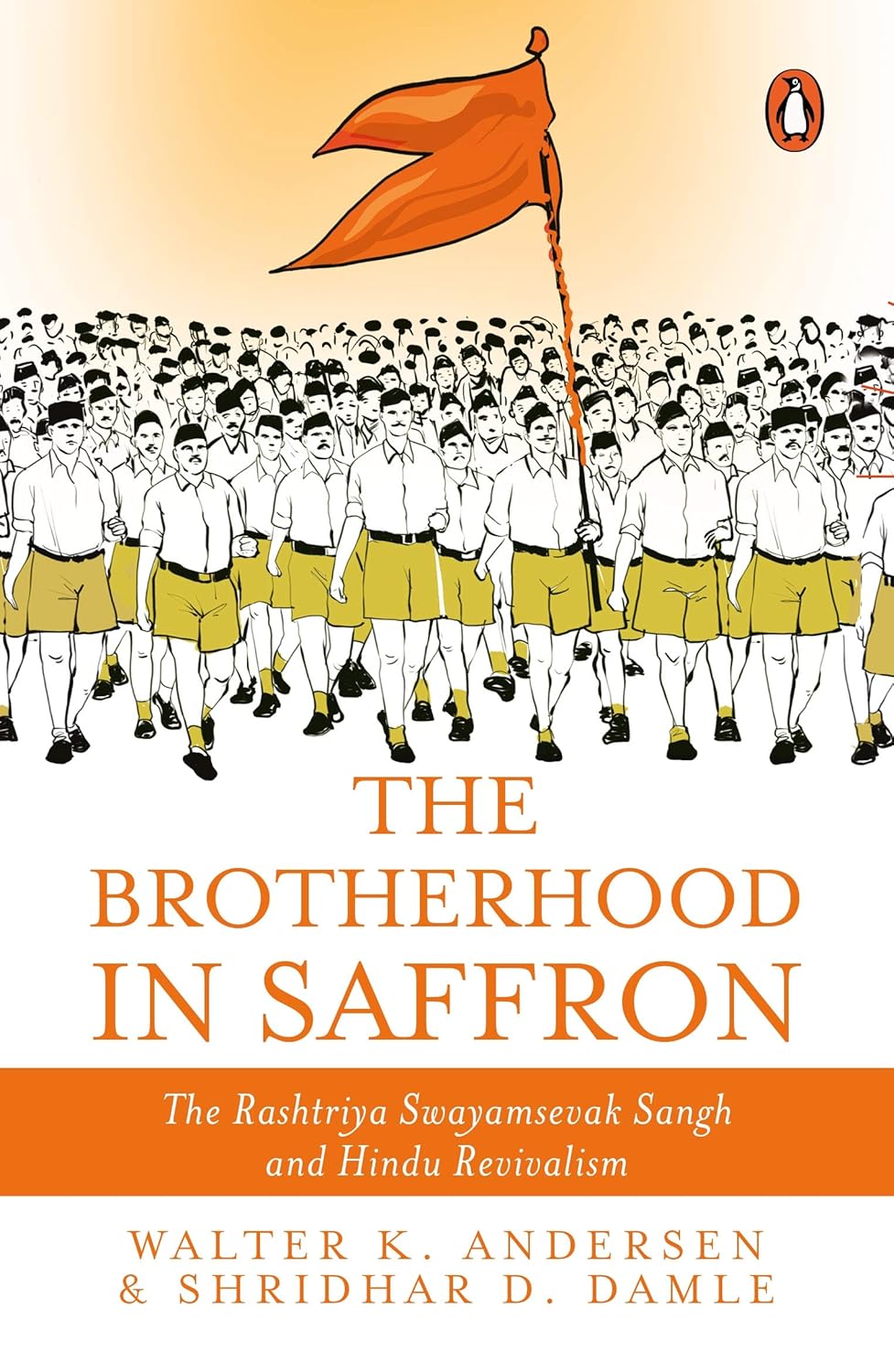
About The Brotherhood in Saffron Book by Walter K. Andersen & Shridhar D. Damle: Understanding the RSS Through Its History and Organization
Why do some organizations remain active for many years, and how do their ideas move from small meetings into wider public life? The Brotherhood in Saffron explores these questions through the history of the Rashtriya Swayamsevak Sangh, usually called the RSS. Walter K. Andersen and Shridhar D. Damle examine its beginnings, beliefs, training, leaders, and links with other groups in India. Their subject is complex, but the central aim is clear: explain how an organization works and how it developed over time. This is nonfiction for readers who want historical context instead of a fictional story or a quick headline.
What This Book Is About
The authors trace the RSS from its formation in the mid-1920s through developments covered in their original 1987 study. They consider how the group understood Hindu revivalism, how it organized its members, and how its activities related to wider social and political life. The book looks beyond public speeches to examine internal practices, training, leadership, and the growth of associated organizations. Readers encounter institutions, ideas, and decisions rather than a single main character. As a result, the book works as a historical study of an organization, not as a general introduction to the Hindu religion or a full history of India.
Begin With the Historical Background
The RSS began during British colonial rule, in a period when people in India debated nationhood, religion, social reform, and political freedom. Understanding that setting helps explain why ideas about community and cultural identity became important to the organization's founders. Andersen and Damle follow its early growth and the conditions that shaped it. The book also shows that an organization does not develop in isolation. Events around it, public arguments, government decisions, and changes in society affect its work. Reading this background first makes later discussions of training and politics easier to place in time.
Explore the Ideas Behind the Organization
One subject of the book is Hindu revivalism and the ways RSS leaders described their goals. The authors examine the organization's stated beliefs and the place of Hindu cultural identity in its thinking. These ideas have been understood and disputed differently by supporters, critics, and researchers. The useful reading question is not simply whether a slogan sounds appealing or troubling. It is what the people using it meant, how they tried to put it into practice, and how others responded. A historical account can help readers separate an organization's own description from independent interpretation without requiring them to accept either uncritically.
See How Training and Everyday Work Fit Together
Organizations are shaped by more than the words of their leaders. The Brotherhood in Saffron also looks at how people were brought together and trained. Local gatherings, regular activities, volunteer roles, and disciplined routines form part of its examination of RSS organizational life. The word shakha refers to a local branch or gathering in this context. Learning such terms can make discussions about the RSS easier to follow, especially if you have only encountered the name in news reports. The book asks readers to pay attention to the everyday methods through which a group develops shared habits and lasting connections.
Understand Leadership Without Reducing Everything to One Person
It is easy to tell the history of a large group as a list of famous names. This study gives readers another way to approach that history by considering structure and the roles people perform. Leadership matters, but so do workers, local units, systems of communication, and rules that help an organization continue through change. Readers can use this approach to ask practical questions. Who sets a direction? How do ideas reach local members? Which activities are shared across different places? These questions describe how an institution operates; they do not, on their own, show whether its goals or actions deserve approval.
Follow the Growth of Related Groups
As the RSS developed, associated bodies appeared in different areas of public life. The authors examine this wider network and the relationships within it, including organizations involved in social and political activity. The connections matter because a reader can easily confuse a parent body, a related association, and a political party. The book provides a historical framework for examining those distinctions. It also raises a broader question found in many studies of institutions: how can one set of ideas move through groups with different tasks? Pay attention to the dates and specific relationships described rather than assuming every group acts in exactly the same way.
Learn About Its Connections With Electoral Politics
The RSS is not itself an electoral party, yet its relationship with political organizations forms an important part of the book's subject. Andersen and Damle consider connections involving the Bharatiya Jana Sangh and the Bharatiya Janata Party within the period they studied. Political relationships can include overlapping people, shared backgrounds, disagreement, and different organizational roles. The book examines these connections historically, rather than serving as a guide to any current election. This difference is especially important for readers encountering a later printing. For questions about today's parties or policies, consult recent, independently checked information alongside this older work.
Place Debates in Their Own Time
A book first published in 1987 reflects the evidence and questions available to its authors at that time. It cannot by itself explain everything that happened in India in the following decades. Penguin issued a later edition in 2019, but a newer publication date should not be confused with proof that every chapter describes current events. Treat the work as a study of an earlier period. A dated source can show how questions were framed then, even when new evidence changes the discussion years later. If you want to connect its findings to newer developments, compare it with more recent reporting, primary records, and research from different viewpoints. That habit keeps the book's historical contribution clear without making claims it was never written to support.
Read the Authors' Account With Useful Questions in Mind
Readers do not need to accept every interpretation in a nonfiction book. Ask what evidence supports a statement, whether the authors are reporting an interview or offering an explanation, and what another source might say. Writing about the RSS has produced disagreement over ideology, social impact, political influence, and the reliability of different kinds of evidence. Some commentators value the access offered by Andersen and Damle's work; others argue that their accounts give too much weight to the organization's own explanations. Those are competing assessments, not settled answers supplied by a product page. The book can be read alongside critical scholarship and documentary sources for a wider view.
Meet the People Who Wrote It
Walter K. Andersen is a scholar of South Asian affairs who has taught at Johns Hopkins University's School of Advanced International Studies and worked on South Asia analysis for the United States government. Shridhar D. Damle is a journalist and researcher of Indian politics. Their different professional backgrounds form part of the context for this joint study. The authors later returned to the subject in another book that examines developments after the period covered here. This volume remains the earlier work, so readers can begin with it when they want to understand the starting point of the authors' longer research project.
Know What You Will Find on the Page
Expect factual discussion, historical explanation, and political analysis, not the plot twists of a thriller. The book deals with institutions, ideas, membership, training, and the ways groups relate to one another. It also includes material that can help a careful reader check names and historical details. The original 1987 edition is catalogued at 317 pages; Penguin's 2019 edition is listed at 432 pages. Page counts therefore depend on which edition you receive. Do not assume that photographs of another printing show the exact size or layout of the copy being sold. Ask for edition details when they matter to you.
Who May Find This Subject Relevant?
This title may interest students of South Asian history, readers studying political movements, journalists working on background research, and people looking into the development of organizations in India. It can also serve readers who want more context before comparing different accounts of Hindu nationalism and related debates. You do not need to belong to, support, or oppose any organization to study its history. The book is more specialized than a general history of modern India, however. Anyone entirely new to the subject may wish to keep a timeline or a short list of unfamiliar organizations nearby while reading.
Make the Reading Easier to Follow
A few simple habits can help with detailed nonfiction. Start by noting the main period covered and the purpose of each chapter. Write down the full name of an organization the first time you meet its shortened form. When the authors describe an idea, check whose view they are presenting. When they describe a political event, note its date before connecting it to later developments. You can return to the introduction and conclusion after finishing the middle chapters to see how the argument fits together. This approach turns a large amount of information into smaller, more manageable parts.
Why a Physical Copy Can Be Useful
Books about history often send readers back to earlier sections. You may want to compare a date with a later event, check the meaning of a term, or revisit an argument after reading a second source. A printed copy makes that kind of back-and-forth reading possible without changing screens. It is also easy to keep a paper notebook next to the book for questions and references.
A Premium Edition for Your Bookshelf
Bookish Wonderland offers its printed copy with premium eye-soothing cream paper for a softer page appearance, crystal-clear printing for legible text, and high-quality stitched and glue binding designed for regular use. These are the store's stated product features, not specifications confirmed for every edition issued by a publisher. If a particular cover, ISBN, exact page count, or publisher is important to you, contact the store to confirm which version is available before ordering.
Book price in Bangladesh for The Brotherhood in Saffron
The current price of The Brotherhood in Saffron by Walter K. Andersen and Shridhar D. Damle should be checked on its Bookish Wonderland listing. Stock, format, and offers can change, so a price from an old post may not match the amount shown when you order. Check the product details and ask about a particular edition before making a purchase. If you are comparing copies, include the edition and delivery cost in your decision rather than looking at the listed price alone. The store can answer questions about availability and customization before you confirm an order.
Ordering From Anywhere in the Country
Bookish Wonderland provides nationwide delivery inside and outside Dhaka, and Cash on Delivery is available across Bangladesh. Readers in Dhaka can also ask about fast or urgent delivery if they need the book sooner. Confirm the expected delivery time and any extra charge before choosing that option. If the listing leaves something unclear, message the store through Facebook or Instagram. You can ask about stock, the exact edition, and the order process without needing to travel. These details help you choose the copy and delivery arrangement that suit your needs.
Add a Historical Source to Your Reading List
The Brotherhood in Saffron offers an account of the RSS's development and internal organization as examined by its authors in the 1980s. It can help readers identify key questions, learn historical terms, and understand the subject of later debate. Its age also makes context important: compare claims and interpretations with other evidence when looking at recent events or contested issues. If this is the kind of nonfiction you are seeking, check the available edition of The Brotherhood in Saffron at Bookish Wonderland. Review the listing, confirm the details that matter to you, and place your order for delivery across Bangladesh.
If you require any customization or have any questions, please inbox us via FB or Insta.
| Primary Specification | |
| Author | Walter Andersen |
| Genre | Political Science, Indian History, Sociology, Religion and Politics |
| ISBN-13/ISSN | 978-0143446132 |
| ISBN-10 | 0143446134 |
| Publisher | India Penguin |
| Publishing Date | May 1, 2019 |
| Edition | 2019th |
| Language | English |
| Reading Age | 18+ years |
| Format | Printed book |
| Physical Specification & Quality | |
| Paper Quality | Premium eye-soothing cream paper |
| Binding Quality | High quality stitched and glue binding (for longevity) |
| Print Quality | Crystal-clear print |
| Pages | 432 pages |
| Country | USA |
| Logistics Information | |
| Weight | 439g |
| Length | 8.5 inches |
| Width | 5.6 inches |
| Height | 1.1 inches |