

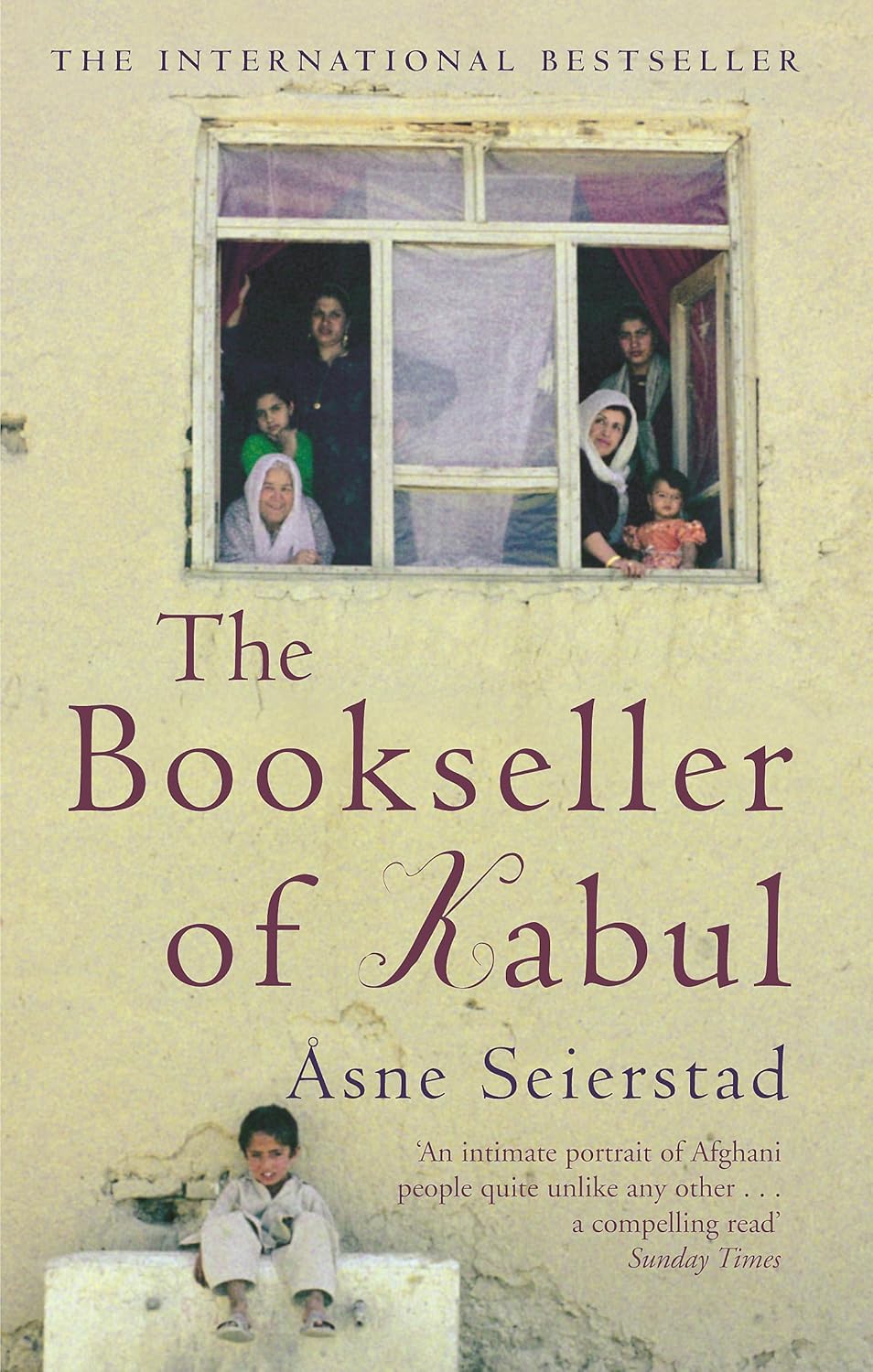
About The Bookseller of Kabul by Asne Seierstad – An Intimate Story of Books, Family, Freedom and Life in Afghanistan
The Bookseller of Kabul by Asne Seierstad takes readers inside one Afghan household at a moment when the country was trying to move forward after years of war and Taliban rule. Norwegian journalist Åsne Seierstad came to Kabul as a reporter and lived with a bookseller’s family. From that experience, she created a work of literary nonfiction about daily life, family duty, marriage, work, freedom, and limits placed on women and younger members of the household.
At the centre is Sultan Khan, the book’s name for a Kabul bookseller who has spent years protecting and selling books through changing political regimes. His public life is tied to learning and the written word. Inside the home, however, family rules and traditional expectations create a very different picture. Through the lives of Sultan, his wives, sisters, sons, and other relatives, Seierstad shows how one family can carry both hope for a new Afghanistan and the weight of older customs.
A Bookshop Surviving Through Years of Change
Books are more than business here. Sultan has built his life around them. Afghanistan has passed through invasion, civil war, Taliban control, and political change, yet he continues to collect and sell printed works. Under governments that restricted ideas and destroyed books, keeping a bookshop alive could require courage, patience, and careful judgment.
That background gives the title power. A bookseller may seem like a quiet figure, but books can become dangerous when rulers fear ideas. Sultan’s shelves connect him with history, literature, education, religion, and political thought. They also show how much people can value knowledge when access to it is uncertain.
The bookshop therefore becomes a useful way to understand the country around it. Customers, banned titles, old collections, new demand, and damaged stock all reflect Afghanistan’s larger changes. Readers who love books may be drawn in by the shop itself, while readers interested in history can see how culture survives when public life is repeatedly disrupted.
Inside a Family, Not Just a News Report
Many people know Afghanistan mainly through headlines about war, governments, soldiers, or international politics. The Bookseller of Kabul moves away from the distant view and looks at ordinary routines inside a home. Meals must be prepared. Children need guidance. Marriages are discussed. Money must be earned. People argue, dream, obey, resist, work, and wait.
This close focus is one of the main reasons the book became widely read. Instead of explaining Afghanistan only through dates and political events, Seierstad shows how large events enter private life. Rules made by governments can affect what women wear, where they go, whether they study, and how families make plans. Economic hardship changes work. Social expectations shape marriage and personal freedom.
The result is a book about Afghanistan, but it is also about a family trying to live together while each person wants something different. That makes the story easier to connect with, even for readers who know little about Afghanistan.
The Women Carry Some of the Strongest Stories
A major part of the book looks at the lives of women in the household. Their wishes are often limited by family expectations and by the wider society around them. Some want education, work, love, independence, or simply more control over everyday choices. Yet those hopes can come into conflict with decisions made by older or more powerful family members.
Seierstad pays close attention to these quiet struggles. The tension does not always come from dramatic public events. Sometimes it comes from being told where to go, what to wear, whom to marry, or what work must be done. Small decisions can carry great emotional weight when a person has little power to choose.
For readers interested in women’s lives, gender roles, human rights, or social history, these chapters may be among the most memorable. They show how political change does not automatically create equal freedom inside every home.
A Country Between Old Rules and New Possibilities
The Afghanistan shown here is in transition. The Taliban government has fallen, but years of conflict and strict social control have left deep effects. People can imagine new possibilities, yet change does not happen at the same speed for everyone.
That gap appears throughout the family. Sultan values books and education, but he also expects authority inside his household. Younger relatives may want more independence than tradition allows. Women may see new chances outside the home while still facing strong limits within it.
This tension gives the book much of its meaning. It avoids the simple idea that one political event can immediately transform daily life. A government can fall in a day, but habits, expectations, fear, poverty, and family structures can last much longer.
Readers who want to understand how history feels at the level of ordinary people may find this especially valuable. The book turns large ideas such as freedom, tradition, modernization, and power into personal choices that affect real lives.
Written Like a Story, Grounded in Reporting
The Bookseller of Kabul is nonfiction, but it often reads with the flow of a novel. Seierstad uses scenes, character-focused chapters, dialogue, and close description to bring the household to life. That style can make the book easier for readers who want to learn about history and society without reading a formal academic work.
The English edition was translated by Ingrid Christophersen from Seierstad’s Norwegian text. The writing keeps a direct, observational feel, moving between different members of the family and allowing readers to see the household from several angles.
Because the book comes from immersive reporting, it also raises interesting questions about journalism. How close should a reporter get to the people being described? How should private life be represented? What happens when a family and an author remember or understand the same events differently? These questions add another level for readers who enjoy media studies, journalism, ethics, or nonfiction writing.
Why the Book Still Creates Discussion
The book became an international bestseller and reached readers far beyond Norway. Its appeal comes partly from access: Seierstad was able to observe areas of family life that foreign reporters might normally never see. That gave readers an unusually close look at everyday routines and relationships in Kabul.
The book also became controversial because members of the family challenged the way they were portrayed. That history is worth knowing because it reminds readers that literary reportage can involve more than one view of the same household. Years later, a Norwegian appeals court overturned an earlier privacy ruling against Seierstad and her publisher and concluded that the factual basis of the book was accurate.
For a thoughtful reader, this does not remove every ethical question. Instead, it can make the book more interesting to discuss. You can read it as a portrait of one family, a piece of war reporting, a study of gender and power, and a case about how nonfiction writers tell other people’s lives.
Who Will Find This Book Most Interesting?
The Bookseller of Kabul is a strong choice for readers of narrative nonfiction, journalism, memoir-style reporting, Afghan history, social studies, women’s studies, and books about everyday life during political change. It may also appeal to readers who enjoy true stories that feel more personal than a traditional history book.
Students can use it as an accessible doorway into questions about Afghanistan after Taliban rule, family structure, gender expectations, censorship, books, and cultural change. Writers and journalism students may notice the way Seierstad builds scenes from observation and moves between private moments and national history.
Book lovers have another reason to read it. The title reminds us that selling books can be a form of cultural survival. Sultan’s work connects the family story to a larger struggle over ideas, literacy, censorship, and the right to read.
A Reading Experience That Rewards Attention
This is not a fast thriller where each chapter ends with a sudden twist. The pull comes from people. Readers gradually understand what different family members want, what stops them, and how their positions inside the household shape their choices.
That makes the book suitable for slow reading, discussion, and annotation. A chapter about a marriage can lead to questions about tradition. A scene in the shop can lead to thoughts about censorship. A young person’s frustration can reveal the gap between political freedom and personal freedom.
The book can therefore work well for reading groups. Different readers may respond differently to Sultan, the women of the household, Seierstad’s role as an outsider, and the choices people make under pressure. Those differences can create meaningful conversation.
Premium Physical Quality for Regular Reading
Bookish Wonderland offers this title for readers who want a comfortable copy for personal reading, study, gifting, or keeping on a shelf. The edition uses premium eye-soothing cream paper, which gives the page a softer background and can feel more pleasant during longer reading sessions.
Crystal-clear printing keeps the text sharp and easy to follow. High-quality stitched and glue binding is used for better strength and longevity, helping the pages remain secure through normal use and repeated reading.
These features are especially useful for a nonfiction title that readers may want to underline, revisit, or use for study. Instead of treating the book as something disposable, the physical quality supports a copy that can remain useful after the first read.
Easy Ordering for Readers Across Bangladesh
Readers searching for The Bookseller of Kabul by Asne Seierstad price in BD can order through Bookish Wonderland without needing to visit a physical shop. Nationwide delivery is available for customers inside and outside Dhaka, making the title accessible to readers across the country.
Cash on Delivery is available throughout Bangladesh. For customers in Dhaka who need a copy sooner, a fast or urgent delivery option can also be requested. This can help when the book is needed for a class, research task, book club, gift, travel plan, or personal reading list.
When comparing Book price in Bangladesh, it is useful to look beyond the number alone. Paper comfort, print quality, binding strength, and dependable delivery can all affect the value of a physical book, especially when you plan to study or keep it.
Order The Bookseller of Kabul by Asne Seierstad from Bookish Wonderland
The Bookseller of Kabul gives readers something a normal news report rarely can: time inside one household. Through the family, the book explores how national history reaches bedrooms, kitchens, workplaces, marriages, schools, and private dreams. It shows a bookseller who fought to keep literature alive while also revealing difficult questions about authority inside his own home.
That contrast is what makes the book memorable. People are not presented as simple symbols. A person can value learning and still control others. A society can become politically freer while many private limits remain. A family can love one another and still contain deep unfairness.
Order The Bookseller of Kabul by Asne Seierstad from Bookish Wonderland if you want nonfiction that combines history, human stories, books, culture, and questions about freedom. With nationwide delivery, Cash on Delivery, premium cream paper, crystal-clear printing, durable binding, and fast delivery options in Dhaka, this widely read work of reportage can become a thoughtful, lasting addition to your personal shelf.
If you require any customization or have any questions, please inbox us via FB or Insta.
| Primary Specification | |
| Author | Asne Seierstad |
| Translator | Ingrid Christophersen |
| Narrator | Henrik Hartvig Jørgensen |
| Genre | Nonfiction, Biography & Autobiography, History, Social/Cultural Studies |
| ISBN-13/ISSN | 978-0316159418 |
| ISBN-10 | 0316159417 |
| Publisher | Little, Brown Paperbacks |
| Publishing Date | October 26, 2004 |
| Edition | 1st US Edition |
| Language | English |
| Reading Age | 18+ |
| Format | Printed Book |
| Physical Specification & Quality | |
| Paper Quality | Premium eye-soothing cream paper |
| Binding Quality | High quality stitched and glue binding (for longevity) |
| Print Quality | Crystal-clear print |
| Pages | 288 pages |
| Country | Norway |
| Logistics Information | |
| Weight | 308 gm |
| Length | 8.5 inches |
| Width | 5.6 inches |
| Height | 1.05 inch |