

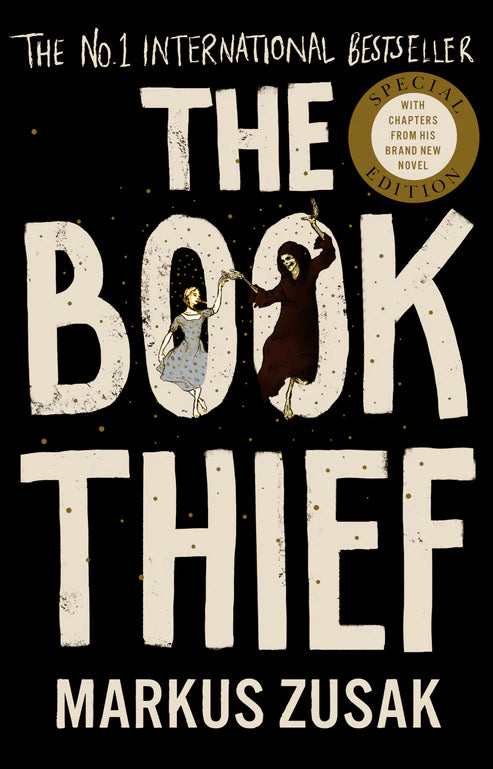
About The Book Thief by Markus Zusak – A Powerful Story of Words, Courage, Friendship and Survival
The Book Thief by Markus Zusak is a moving historical novel about a young girl who discovers the power of words during one of the darkest times in modern history. Set in Nazi Germany, the story follows Liesel Meminger, a foster child who arrives on Himmel Street carrying grief, fear, and very little else. She cannot yet read, but books soon become the thing that helps her understand the world, survive pain, and connect with the people around her.
The story has an unusual narrator: Death. From the beginning, Death tells readers that loss will be part of Liesel’s life. Yet the book is not only about dying. It is also about love, friendship, courage, music, family, and the small acts of kindness that people choose when cruelty becomes normal. Liesel steals books, learns to read with her foster father, shares words during air raids, and forms a bond with the Jewish man hidden in her family’s basement. Through these moments, Markus Zusak shows how words can hurt, heal, control, comfort, and keep memory alive.
A Girl Who Starts With One Stolen Book
Liesel’s story begins with loss. While travelling with her mother and younger brother, tragedy changes her life. Soon afterward, she is taken to live with foster parents Hans and Rosa Hubermann in the town of Molching, near Munich. Everything is unfamiliar. She misses the life she knew, struggles with nightmares, and enters a new home during a frightening political time.
At her brother’s graveside, Liesel picks up a book called The Gravedigger’s Handbook. She cannot read it yet, but she keeps it. That small act becomes the beginning of her life as the book thief.
Hans Hubermann slowly teaches her to read. Their lessons build a strong bond between them. Words that once looked meaningless begin to open doors. Reading gives Liesel confidence, comfort, and a way to understand what is happening around her. As Nazi Germany grows more dangerous, books become both an escape and a form of resistance.
Hans and Rosa Make Himmel Street Feel Like Home
Hans and Rosa Hubermann are very different, but both become important parts of Liesel’s new life. Hans is gentle, patient, and often awake when Liesel has nightmares. He plays the accordion and treats her with a kindness that she needs badly. His reading lessons give her more than literacy. They give her trust.
Rosa appears much harder. She speaks sharply, works hard, and does not show affection in an easy way. Yet her actions reveal care beneath the rough surface. Together, the Hubermanns create a home that is imperfect but deeply human.
Their family life matters because the novel is not only about major historical events. It shows history entering kitchens, bedrooms, schools, streets, and ordinary conversations. Political fear becomes part of daily life. So does hunger. So do rules about what people may say and whom they may help.
That makes the story feel close. Readers do not only learn that Germany was dangerous under Nazi rule. They see how that danger affects one household and the people living around it.
Rudy Steiner Brings Friendship, Energy and Heart
Rudy Steiner becomes Liesel’s closest friend. He is lively, loyal, competitive, and often ready to join her in trouble. Their friendship gives the book warmth and humor even when the world around them becomes increasingly dark.
Rudy and Liesel race, argue, steal food, share adventures, and grow up together. Their friendship feels natural because it includes teasing, jealousy, bravery, mistakes, and affection. Rudy wants Liesel’s attention, while Liesel often struggles to understand exactly what she feels.
For readers, Rudy becomes more than a side character. He represents childhood trying to survive inside a world built by adults. His dreams, games, and jokes exist beside war, propaganda, and fear.
The contrast makes their friendship especially powerful. Children still want to run, compete, laugh, and fall in love even when history is becoming dangerous. Markus Zusak uses that truth to make the novel emotional without turning every scene into sadness.
Max Vandenburg Changes the Meaning of Courage
One of the most important turns in the story comes when the Hubermanns hide Max Vandenburg, a Jewish man, in their basement. Helping him puts the entire family at risk.
Max’s presence changes Liesel’s understanding of the world. Nazi propaganda tells people to see Jewish citizens as enemies. Liesel meets a real person instead: someone who is frightened, tired, intelligent, creative, and capable of friendship.
Liesel and Max connect through words, nightmares, imagination, and stories. Their friendship gives the novel some of its most memorable moments. Books become a language between them.
This relationship also shows what courage can look like. Courage is not always loud or heroic. Sometimes it means opening a door when doing so is dangerous. Sometimes it means sharing food, keeping a secret, or refusing to accept the hatred that everyone around you is being told to believe.
The novel makes those choices feel personal rather than abstract.
Death as Narrator Makes the Story Different
Having Death tell the story could have made the novel cold. Instead, Death is curious about humans. The narrator notices cruelty, but also beauty. Death sees how people destroy one another and still finds small moments of love difficult to forget.
This unusual voice allows the novel to move through time in a special way. Death sometimes tells readers what will happen before it happens. That means the tension does not always come from surprise. Instead, readers know that pain is coming and become more aware of every ordinary moment before it arrives.
The method fits the story because The Book Thief is deeply interested in memory. Knowing that something will end can make a simple conversation, meal, joke, or walk feel more precious.
Death also gives the book a wider view of war. Liesel is the emotional center, but the narrator reminds readers that her street is only one tiny part of a much larger human tragedy.
Words Can Save People and Control Them
One of the central ideas in The Book Thief is the power of language. Hitler’s government uses speeches, slogans, books, and propaganda to control people. Words help spread fear and hatred.
Liesel discovers another use for them.
She reads to people during bombing raids. She shares stories with Max. She steals books that others want destroyed. Reading becomes a way to create calm when the world outside feels impossible.
This contrast gives the novel much of its meaning. Words are not automatically good. They can be used to lie, manipulate, divide, and harm. But they can also teach, comfort, connect, and preserve truth.
That idea makes the novel especially meaningful for book lovers. It asks readers to think about why stories matter. A book cannot stop a bomb or end a dictatorship by itself, but words can shape what people believe and how they treat one another.
Historical Fiction That Feels Personal
Some readers avoid historical fiction because they expect long explanations, difficult dates, or too many political details. The Book Thief works differently. The history matters, but the story stays close to Liesel and the people she loves.
Readers experience Nazi Germany through school, neighborhood life, food shortages, public events, air raids, book burnings, and the fear of helping someone targeted by the state. The larger history becomes understandable because it enters ordinary life.
This makes the novel useful for younger readers as well as adults. Penguin Random House lists the book for readers aged twelve and above. The subjects are serious, including war, persecution, death, grief, and antisemitism, so readers should expect emotionally difficult scenes.
Still, the book also contains friendship, humor, tenderness, music, and hope. That balance is one reason it has reached such a wide audience.
Who Should Read The Book Thief?
The Book Thief is a strong choice for readers who enjoy historical fiction, emotional stories, coming-of-age novels, World War II settings, books about books, and unforgettable narrators.
It can be especially meaningful for students studying war, propaganda, prejudice, literature, or the Holocaust. The novel should not replace factual history, but it can help readers imagine how fear and political control affect ordinary people.
Book clubs can also get a great deal from it. Readers can discuss Death as narrator, Liesel’s stealing, Hans’s choices, Max’s safety, Rudy’s friendship, and the role of words throughout the story.
It is also a thoughtful gift for someone who loves novels that are sad but hopeful. The story asks for emotional attention, yet it gives readers characters who are difficult to forget.
It is also a strong choice for readers who want a story they can discuss, reread, annotate, and remember after the final page closes.
A Premium Reading Copy From Bookish Wonderland
Bookish Wonderland offers this title for readers who want a comfortable physical copy for long reading sessions, study, gifting, or keeping on a personal shelf.
The edition uses premium eye-soothing cream paper, which gives the pages a softer background than very bright white paper. Crystal-clear printing keeps the words sharp and easy to follow. High-quality stitched and glue binding supports better strength and longevity, helping the pages stay secure through regular reading and repeated use.
These features are especially helpful for a longer novel that readers may want to underline, revisit, or keep for years. The physical quality is designed to support the reading experience without distracting from the story.
Easy Ordering Across Bangladesh
Readers searching for The Book Thief by Markus Zusak price in BD can order through Bookish Wonderland with nationwide delivery. Customers in Dhaka and other districts can place an order without needing to visit a physical shop.
Cash on Delivery is available across Bangladesh. Readers in Dhaka can also ask about fast or urgent delivery when the book is needed sooner for a class, gift, book club, trip, or personal reading plan.
When comparing Book price in Bangladesh, it is useful to consider more than the listed amount. Comfortable paper, clear printing, secure binding, and reliable delivery can all add value to a physical copy, especially for a book that may stay on your shelf for a long time.
A Story About Why Words Matter
The Book Thief is remembered because it brings enormous history down to the size of one girl, one street, one basement, and a handful of books. Liesel cannot control the war. She cannot stop the Nazi government. She cannot protect everyone she loves. What she can do is learn, read, share, remember, and choose kindness when cruelty is easier.
That is where the novel finds hope.
It does not pretend that words can erase every tragedy. Instead, it shows that words help people remain human inside tragedy. Hans teaches a child to read. Liesel reads to frightened neighbors. Max makes stories from pain. Friendship continues even when fear surrounds everyone.
Order The Book Thief by Markus Zusak from Bookish Wonderland if you want a historical novel that combines unforgettable characters, the power of books, friendship, grief, courage, and hope. With nationwide delivery, Cash on Delivery, premium cream paper, crystal-clear printing, durable binding, and fast delivery options in Dhaka, adding this modern classic to your collection is simple.
If you require any customization or have any questions, please inbox us via FB or Insta.
| Primary Specification | |
| Author | Markus Zusak |
| Narrator | Allan Corduner |
| Genre | Historical Fiction, Young Adult Fiction, World War II Fiction, Bildungsroman |
| ISBN-13/ISSN | 978-0385754729 |
| ISBN-10 | 0385754728 |
| Publisher | Knopf Books for Young Readers |
| Publishing Date | October 15, 2013 |
| Language | English |
| Reading Age | 11+ |
| Format | Printed Book |
| Physical Specification & Quality | |
| Paper Quality | Premium eye-soothing cream paper |
| Binding Quality | High quality stitched and glue binding (for longevity) |
| Print Quality | Crystal-clear print |
| Pages | 592 pages |
| Country | Australia |
| Logistics Information | |
| Weight | 615 gm |
| Length | 8.5 inches |
| Width | 5.6 inches |
| Height | 1.23 inch |