

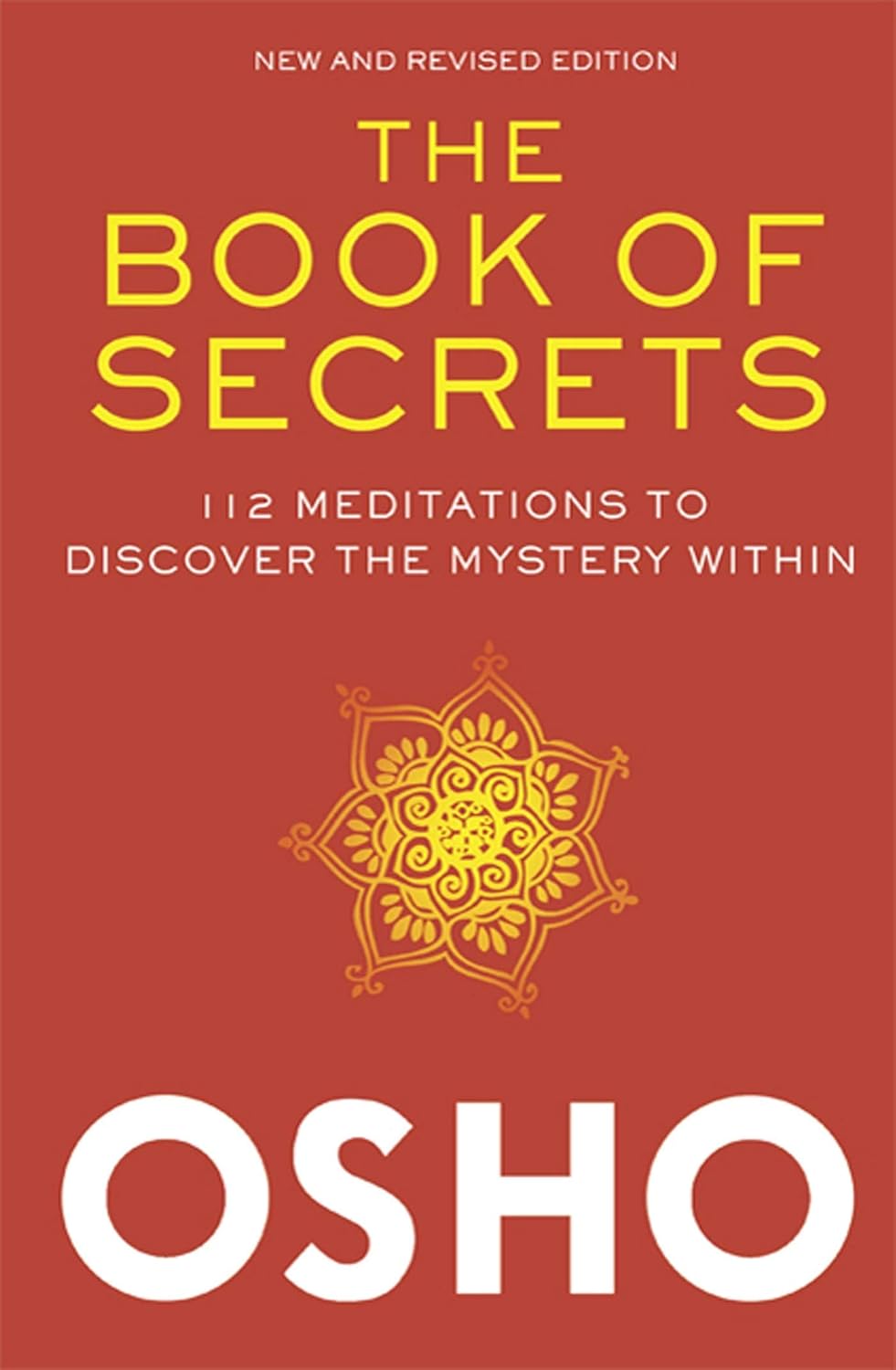
About The Book of Secrets by Osho – 112 Meditation Methods for Awareness, Inner Stillness and Self-Discovery
The Book of Secrets by Osho is a large and practical guide to meditation based on 112 methods from the ancient Vigyan Bhairav Tantra. Instead of asking readers to follow one fixed path, the book presents many different ways to become more aware. Some methods use breathing. Some use sound, silence, movement, touch, darkness, light, attention, imagination, love, or simple observation. The wide range is one reason the book has remained popular with readers who want to explore meditation in a serious but flexible way.
Osho explains these methods through talks and commentary. He does not treat meditation as something that belongs only in a temple or retreat. The main idea is that awareness can be explored in ordinary life. A person may notice the breath, watch thoughts, become fully present in a feeling, or use a simple moment as a doorway into deeper attention.
For readers who feel confused by the huge number of meditation systems available today, this book offers one clear advantage: choice. You can read, experiment, notice what feels natural, and spend more time with the methods that suit you best.
Why So Many Meditation Techniques?
Different people respond to different practices. One person may enjoy sitting quietly, while another finds silence difficult. One person may connect with breath, while another becomes more aware through sound, movement, sensation, or visual focus. The Book of Secrets respects these differences.
Rather than saying there is only one correct meditation, Osho comments on a wide collection of methods. This can help readers who have tried meditation before and felt that they were doing it wrong. A method that does not fit you may simply not be the right starting point.
The book encourages experimentation. That does not mean jumping from one technique to another every minute. It means reading carefully, trying a method with attention, and noticing how your mind and body respond.
This approach can make meditation feel more practical. Instead of forcing yourself into someone else’s routine, you begin learning how awareness works for you.
Based on the Vigyan Bhairav Tantra
The central source behind the book is the Vigyan Bhairav Tantra, an important Sanskrit tantric text presented as a dialogue between Shiva and Devi. The text contains 112 meditation approaches, often called dharanas, that explore different ways of entering awareness.
Osho uses these methods as the starting point for long explanations about mind, attention, emotion, energy, relationships, fear, desire, silence, and daily life. His talks are not a short translation of the ancient text. They are extended interpretations designed for modern readers.
This matters because the book is often misunderstood as being mainly about sexuality. It is not. Tantra here is presented in a much wider sense, as a set of methods for self-observation and inner transformation.
Readers interested in Indian philosophy, meditation history, spirituality, consciousness, or comparative religion may therefore find the book useful even if they do not follow Osho’s wider teachings.
A Book to Use, Not Only Finish
The Book of Secrets is long, and that is part of its purpose. This is not a book that needs to be rushed from the first page to the last. It can be used more like a reference guide.
A reader may study one technique, try it for a period, write notes, and then return to the book. Another reader may read the talks in order because they enjoy the larger philosophical discussion. Both approaches can work.
This makes the book suitable for slow reading. It can sit beside a meditation journal, on a study desk, or near the place where you practice. You can return to sections when a certain idea becomes important in your life.
The size also allows Osho to look at techniques from many angles. Instead of giving only a one-line instruction, he often discusses why a method may work, what kind of person may connect with it, and what common habits can make awareness difficult.
Breath as a Doorway to Awareness
Several techniques use breathing because breath is always present. You do not need special equipment to notice it. You can observe the movement of air, the space between breaths, or the way breathing changes with emotion.
The value of breath awareness is its simplicity. When the mind is busy, returning attention to a physical process can create a clear point of focus.
The Book of Secrets does not present breath as the only path. It is one doorway among many. That variety is useful because readers can compare methods and understand that meditation is larger than simply sitting still and counting breaths.
For beginners, breath-based methods can feel approachable. For experienced readers, the commentary may offer new ways to notice details they usually ignore.
Sound, Silence and the Space Between
Other techniques explore sound. A person may listen deeply to a sound, notice how it begins and ends, or pay attention to the silence around it.
This can be especially interesting for readers who struggle with visual concentration. Listening gives the mind another anchor.
The larger lesson is that ordinary experience can become meditation when attention changes. A sound that normally passes unnoticed can become a full field of awareness. Silence can stop feeling empty and begin to feel active.
This idea runs through much of the book. Meditation does not always require escaping daily life. It can begin by meeting one ordinary experience more completely.
Working With Thoughts Instead of Fighting Them
Many beginners believe meditation means forcing the mind to become blank. When thoughts continue, they think they have failed.
The Book of Secrets offers a different way to look at the problem. Awareness can include watching thoughts without becoming completely involved in them. A thought can appear, move, and disappear while the observer remains present.
This can reduce the pressure to “win” against the mind.
The practical benefit is important. If meditation becomes a battle, people often quit. If thoughts can be watched instead of attacked, the practice may feel more realistic.
The book repeatedly returns to observation. Whether the object is breath, sound, emotion, sensation, or thought, the reader is invited to become more aware of what is happening now.
Emotion Can Also Become Part of Practice
The book does not ask readers to become emotionless. Some methods involve looking directly at strong feelings rather than immediately escaping them.
Anger, fear, love, desire, sadness, and joy can all reveal how attention moves. When an emotion appears, most people react quickly. They speak, hide, defend, blame, or distract themselves.
Meditative observation creates another possibility. A person can notice the feeling, the body response, the thoughts around it, and the urge to act.
This does not mean accepting harmful behavior. It means learning to see an emotion more clearly before it controls the next action.
Readers interested in self-awareness may find this especially useful because it connects meditation with real life rather than keeping practice separate from relationships and daily stress.
Why Beginners May Find the Book Helpful
A beginner can feel lost when every meditation teacher gives different advice. One says focus on breathing. Another says repeat a sound. Another says watch thoughts. Another recommends movement.
The Book of Secrets puts many possibilities in one place. That can reduce the idea that there is one perfect technique everyone must follow.
The explanations are conversational rather than written like a technical manual. Osho often uses stories, questions, comparisons, and everyday examples to explain a point.
The book is still very long, so beginners do not need to understand everything at once. A better approach may be to read slowly and choose a small number of methods to explore.
Useful for Experienced Meditation Readers Too
Readers who already meditate may use the book differently. Instead of looking for a first technique, they may want to compare approaches or refresh a practice that has become mechanical.
A familiar method can feel new when viewed from another angle. The book’s range can also help experienced readers notice where they have become attached to one style.
This does not mean every technique will suit every person. The value is in having a broad map.
For meditation teachers, yoga practitioners, spiritual study groups, and long-term seekers, the book can serve as a large reference text for discussion and personal practice.
Who Should Read The Book of Secrets?
The Book of Secrets is best suited to adults interested in meditation, mindfulness, consciousness, Tantra, Indian spiritual traditions, self-inquiry, and personal growth.
It can also appeal to readers who enjoy large reference-style books that are meant to be revisited rather than finished quickly.
People looking for a short five-minute meditation guide may find this book much larger than they need. Readers who enjoy deep explanations and many options are more likely to appreciate its structure.
It is also important to approach spiritual claims with personal judgment. Meditation can be useful for many people, but a spiritual book should not replace professional medical or mental health care when that care is needed.
A Premium Copy for Long Reading Sessions
Bookish Wonderland offers this title for readers who want a comfortable physical copy for study, meditation practice, annotation, or long-term keeping.
The edition uses premium eye-soothing cream paper, giving the pages a softer background for extended reading. Crystal-clear printing helps keep the large amount of text sharp and easy to follow. High-quality stitched and glue binding supports better strength and longevity, which is especially useful for a thick book that may be opened and revisited many times.
These features make the copy suitable for readers who want to keep it as a reference rather than treat it as a one-time read.
Easy Ordering Across Bangladesh
Readers searching for The Book of Secrets by Osho price in BD can order through Bookish Wonderland with nationwide delivery. Customers in Dhaka and other districts can place an order without visiting a physical shop.
Cash on Delivery is available across Bangladesh. Readers in Dhaka can also ask about fast or urgent delivery when the book is needed sooner for personal study, a meditation group, a gift, or a reading plan.
When comparing Book price in Bangladesh, it is useful to consider the full physical value of a large reference book. Comfortable paper, clear printing, secure binding, and reliable delivery all matter when the book may be used repeatedly for years.
Explore the Method That Fits You
The strongest reason to read The Book of Secrets is its range. It does not ask every person to meditate in the same way. It gives readers many doors and invites them to discover which form of attention feels most natural.
You may connect with breath. You may prefer sound. You may become curious about silence, sensation, emotion, or simple observation. The book gives you space to explore rather than forcing one narrow routine.
Order The Book of Secrets by Osho from Bookish Wonderland if you want a large, practical guide to meditation and self-inquiry. With nationwide delivery, Cash on Delivery, premium cream paper, crystal-clear printing, durable binding, and fast delivery options in Dhaka, adding this detailed meditation reference to your shelf is simple.
If you require any customization or have any questions, please inbox us via FB or Insta.
| Primary Specification | |
| Author | Osho |
| Genre | Spirituality, Meditation, Tantra, Philosophy, Mindfulness / Body, Mind & Spirit |
| ISBN-13/ISSN | 978-0312180584 |
| ISBN-10 | 0312180586 |
| Publisher | First Edition |
| Publishing Date | April 15, 1998 |
| Language | English |
| Reading Age | 18+ |
| Format | Printed Book |
| Physical Specification & Quality | |
| Paper Quality | Premium eye-soothing cream paper |
| Binding Quality | High quality stitched and glue binding (for longevity) |
| Print Quality | Crystal-clear print |
| Pages | 1152 pages |
| Country | India |
| Logistics Information | |
| Weight | 1174 gm |
| Length | 8.5 inches |
| Width | 5.6 inches |
| Height | 1.99 inch |