

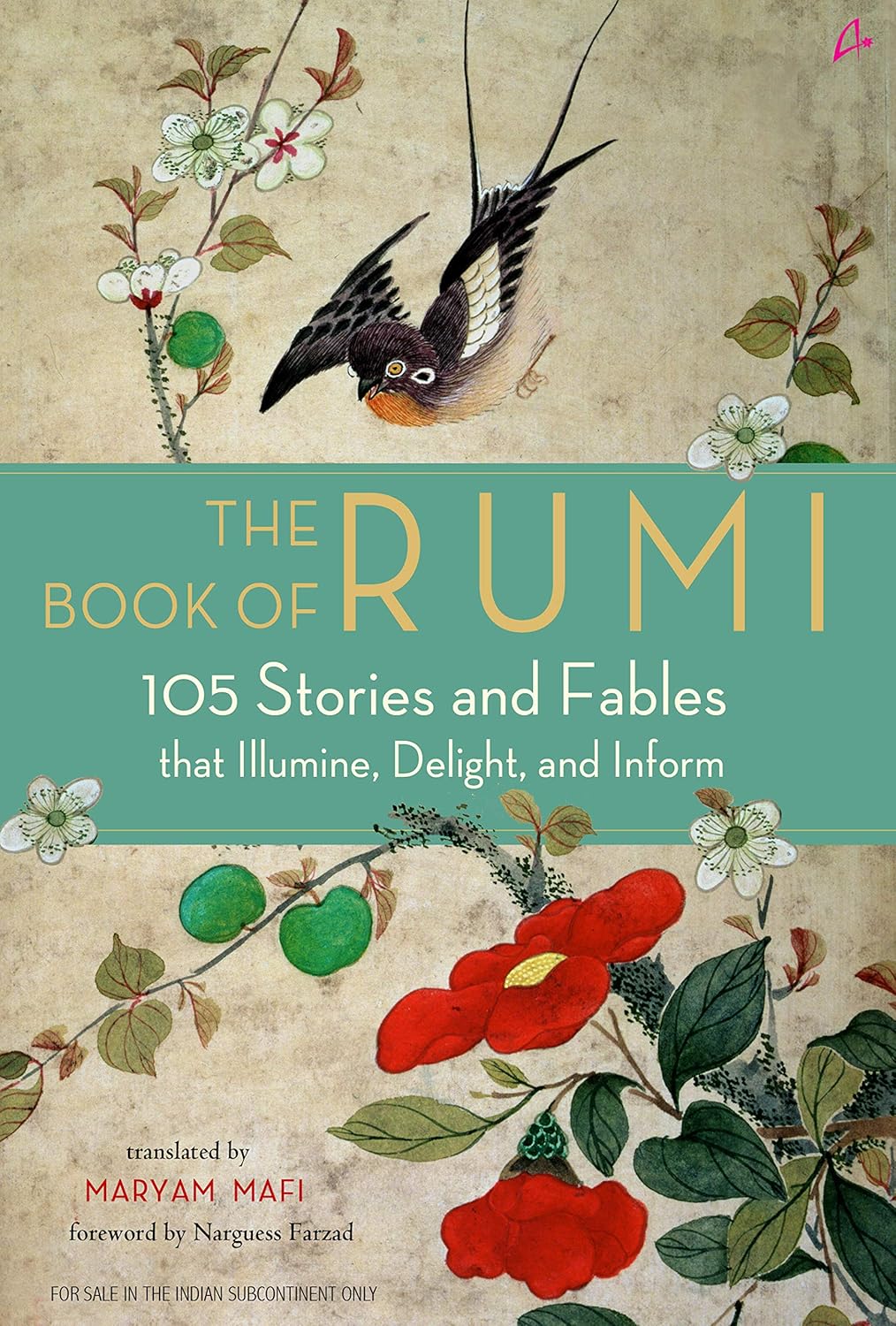
About The Book of Rumi: 105 Stories and Fables that Illumine, Delight, and Inform by Rumi: A Gentle Door into Sufi Wisdom, Love, and Self-Knowledge
The Book of Rumi: 105 Stories and Fables that Illumine, Delight, and Inform by Rumi gathers short teaching tales that turn daily life into a path of thought. A king, a fool, a merchant, an animal, a traveller, or a poor worker may enter a simple scene. Before the story ends, the scene opens a larger question about love, pride, fear, kindness, truth, faith, or the human heart.
These stories come from the Masnavi, Rumi’s great six-volume work of spiritual poetry. Maryam Mafi has translated and retold the selected tales in clear English prose. Her approach helps modern readers enjoy the movement, humour, surprise, and wisdom of the stories without first learning a difficult poetic form. Narguess Farzad provides the foreword, giving readers another helpful way to enter Rumi’s world.
The book can be read from beginning to end, but it also welcomes slow reading. You can open one story in the morning, carry its question through the day, and return later with a new thought. The tales are short, yet their meanings can grow each time they are read. That makes this collection suitable for personal reflection, shared family reading, classroom discussion, or a meaningful gift.
When you want wisdom without a hard lesson
Long books about spiritual life can feel difficult. They may use heavy words or explain one idea for many pages. A reader may want guidance but feel too tired to study a complex text after a busy day. Advice can also feel cold when it tells people what to do without helping them see why.
Rumi’s stories offer a warmer path. They place an idea inside a living scene, so the reader can watch a choice and notice its result. A funny mistake may show the danger of pride. A strange meeting may reveal hidden kindness. A small loss may open a question about what truly matters. Instead of pushing one plain answer, each tale invites the reader to pause and look within.
What is The Book of Rumi about?
This collection brings together 105 stories and fables from Rumi’s Masnavi. The tales explore the hidden spiritual meaning inside ordinary events. Some stories are playful, some are sharp, and some feel tender. Their people often think they understand a problem, only to discover that their own fear, desire, or pride has blocked the truth.
The book includes well-known tales such as Moses and the Shepherd, Chickpeas, and The Greek and Chinese Painters. It also includes stories that many new readers may not know. Different tales speak about patience, inner sight, honest love, false judgment, learning, loss, and the search for what is real.
There is no single hero or straight plot joining all 105 pieces. The connection comes from Rumi’s way of looking at life. Again and again, he asks readers to move beyond the first appearance of a thing. A weak person may hold wisdom. A clever person may fool himself. A hard moment may contain the start of change. This makes every story a small mirror for the reader.
Why short stories can carry deep ideas
A story stays in the mind differently from a rule. We may forget a line of advice, but remember a hungry animal, a proud ruler, or a surprising ending. The image returns when a similar problem appears in real life. This is why teaching tales have travelled between people for centuries.
Rumi uses this power with care. His stories do not always explain themselves in one direct sentence. They let action, humour, and surprise do part of the work. One reader may notice a lesson about patience, while another sees a warning about ego. Years later, the same person may read the story again and find a meaning that was invisible before.
The short form also makes the collection easy to fit into daily life. A reader does not need a full free afternoon. Ten quiet minutes can be enough to meet one tale and begin thinking.
Everyday life becomes a place of wonder
The people and objects in these stories often feel familiar. Food, work, trade, family, travel, friendship, argument, and need all appear. Rumi shows that spiritual thought does not belong only in a special room or rare moment. It can begin while a person cooks, talks, buys, sells, waits, helps, or makes a mistake.
This view gives the book lasting value. Modern life looks different from the medieval world, but people still want love, hide fear, chase praise, judge too quickly, and search for peace. The outer details may change, while the inner struggle remains easy to recognise.
Love is larger than a sweet feeling
Rumi is widely connected with writing about love, but love here is not limited to romance. It can mean care for another person, closeness to God, mercy toward weakness, or the deep wish to move beyond the small self. Love becomes a way of seeing more clearly.
Several tales show what happens when pride, control, or fear pretends to be love. A person may want to own what should be respected. Someone may speak kindly but act for personal gain. By showing these gaps, the stories help readers think about whether their actions match their words.
The collection also gives hope. A mistake does not always close the road. Honest awareness can begin change. A heart that has become hard can learn softness, and a person who feels lost can still turn toward truth.
Pride can hide what is already near
Many of Rumi’s characters search far away for something they cannot see nearby. Some trust their status or cleverness so strongly that they miss an easy truth. Others judge a person by clothes, work, money, or speech and later learn that the first view was incomplete.
These moments make the idea of ego easy to understand. Ego is the voice that always wants to be right, praised, or placed above others. It can protect a false picture of the self even when that picture causes pain. Rumi’s humour lets readers notice this problem without making every lesson feel harsh.
The stories encourage humility, but humility does not mean becoming weak. It means being open enough to learn, admit a mistake, and see value outside oneself. That kind of openness can improve relationships, study, work, and spiritual practice.
Maryam Mafi brings the tales into clear English
Rumi wrote in Persian in the thirteenth century. Language, rhythm, and cultural setting create a real challenge for any translator. Maryam Mafi presents these 105 selections as fresh prose stories, aiming to keep their energy while making them welcoming for a modern English reader.
Her version does not ask the reader to understand Persian verse before enjoying the ideas. The prose form keeps attention on the characters, turns, and lessons. It is a useful starting point for someone meeting Rumi for the first time, while experienced readers can enjoy another way of approaching material from the Masnavi.
Because this is a translated and selected collection, it is wise to understand what you are buying. It is not the full six-volume Masnavi, and it does not replace a scholarly complete translation. It is a carefully chosen doorway made of 105 readable tales. That clear purpose is one of its strengths.
What this collection can give the reader
The first benefit is a calmer way to reflect. A short tale can slow the mind without asking for hours of study. The second is better self-awareness. By watching another person make a mistake, readers may notice pride, impatience, fear, or unfair judgment in their own choices.
The stories can also support empathy. They often show that outer appearance does not reveal the whole person. Wealth may hide emptiness, simple speech may carry wisdom, and a strange action may have a reason that is not clear at first. Learning to look again can make daily relationships kinder.
Another benefit is conversation. A family, class, or book club can read the same short piece and hear several meanings. There does not have to be one quick answer. Listening to another view becomes part of the lesson. The book therefore offers both private comfort and shared discovery.
Good ways to read and use this book
Choose this collection for morning reading, evening reflection, a weekend pause, or a daily story habit. Keep a notebook nearby and write one question after each tale. You can also mark the stories that speak to love, patience, humility, or truth and return when that theme matters in your life.
Teachers and reading groups can use one story to begin a discussion about choices and results. Parents may share selected tales with older children, though adults should read first because some medieval stories include mature situations or ideas. Spiritual readers can use the book beside prayer, meditation, or quiet thought without treating it as a formal religious guide.
A comfortable edition for thoughtful reading
Bookish Wonderland offers a reader-friendly copy made for steady reading and future returns. Premium eye-soothing cream paper gives the pages a soft look, while crystal-clear printing keeps each short tale easy to follow. High-quality stitched and glue binding supports longer book life, and a durable finish helps protect the copy in a bag, study space, or home library.
These physical features support the way this book is often used. Readers may open it many times, mark a favourite story, or share a passage during discussion. A comfortable, secure copy lets attention stay on Rumi’s ideas instead of weak pages or unclear text. It is suitable for personal reading, study, gifting, and a spiritual or world literature shelf.
Easy ordering from Bookish Wonderland
When comparing the Book price in Bangladesh for The Book of Rumi by Rumi, consider paper comfort, print clarity, binding strength, and delivery support along with cost. A collection of teaching tales can remain useful for years, so the quality of the reading copy matters beyond the first day.
Cash on Delivery is available nationwide, with service inside and outside Dhaka. Fast or urgent delivery is available in Dhaka when the book is needed soon. Contact Bookish Wonderland through Facebook or Instagram to confirm the current price, available edition, stock, delivery time, or customization support before ordering.
Open one story and let it stay with you
You do not need to understand every part of Rumi before beginning. Start with one tale. Meet its people, enjoy its turn, and notice the question it leaves behind. The next story may make you smile, challenge a habit, or show an old problem from a kinder side.
With 105 pieces to explore, this book offers many doors into love, humility, truth, faith, and self-knowledge. Some stories may speak at once, while others may wait until life gives them new meaning. That is part of their beauty. They remain ready for the reader to return.
Order The Book of Rumi: 105 Stories and Fables that Illumine, Delight, and Inform by Rumi from Bookish Wonderland today. Bring home a warm and readable collection that can fill short quiet moments with lasting thought, gentle humour, and timeless spiritual insight for many years.
If you require any customization or have any questions, please inbox us via FB or Insta.
| Primary Specification | |
| Author | Rumi |
| Translator | Maryam Mafi |
| Narrator | Keith Szarabajka |
| Editor | Kathryn Sky-Peck |
| Genre | Sufism, Spirituality, Religion, Inspirational Literature, Middle Eastern Literature |
| ISBN-13/ISSN | 978-1571747464 |
| ISBN-10 | 157174746X |
| Publisher | Hampton Roads Publishing |
| Publishing Date | November 1, 2018 |
| Language | English |
| Reading Age | 18+ |
| Format | Printed Book |
| Physical Specification & Quality | |
| Paper Quality | Premium eye-soothing cream paper |
| Binding Quality | High quality stitched and glue binding (for longevity) |
| Print Quality | Crystal-clear print |
| Pages | 208 pages |
| Country | USA |
| Logistics Information | |
| Weight | 231 gm |
| Length | 8.5 inches |
| Width | 5.6 inches |
| Height | 0.7 inch |