

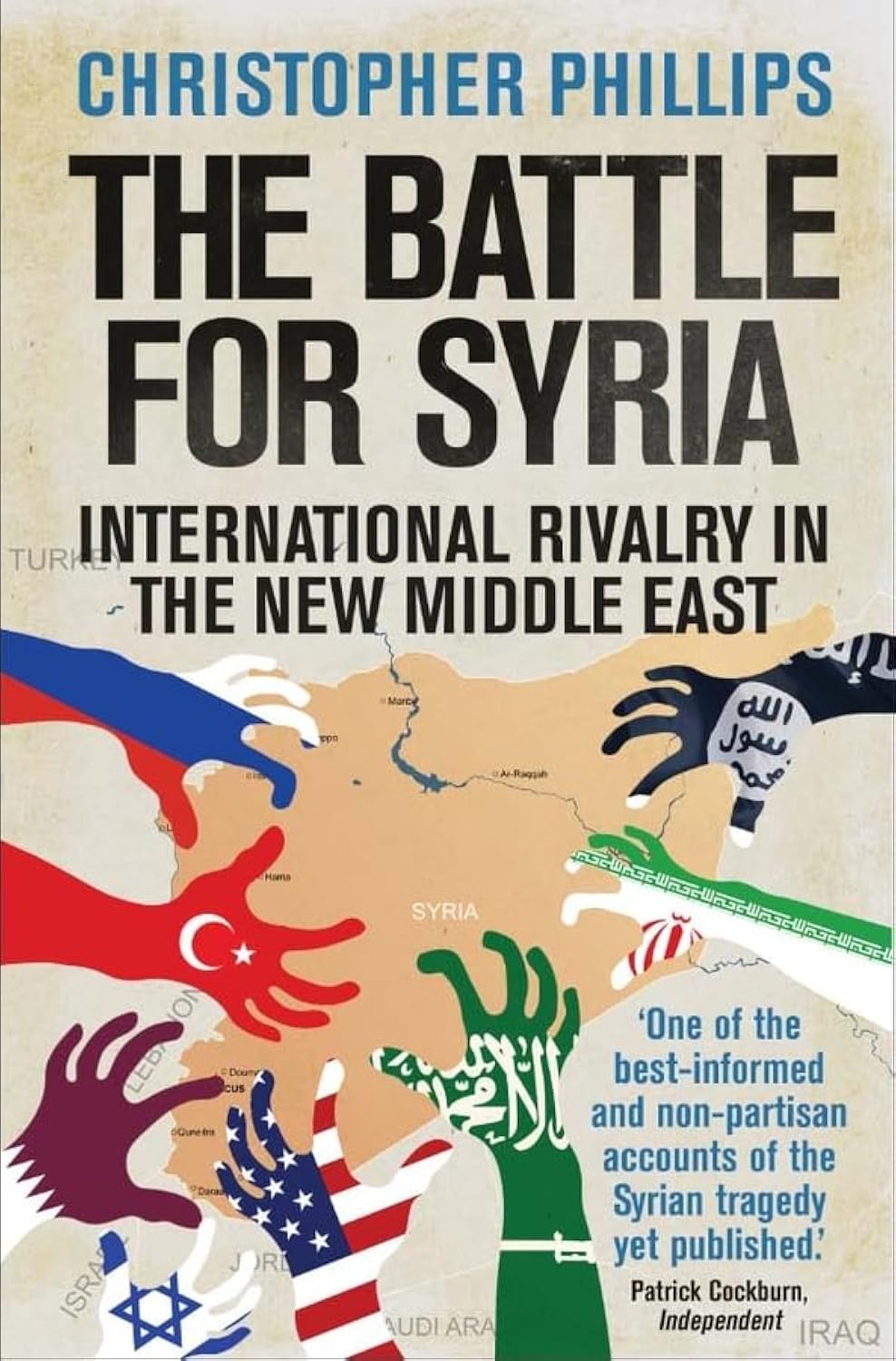
About The Battle for Syria by Christopher Phillips – A Clear Guide to the International Rivalries Behind the Syrian War
The Battle for Syria by Christopher Phillips explains why the Syrian conflict cannot be understood only as a fight inside Syria. Phillips shows how outside powers shaped the war from the beginning and how their goals often pushed the conflict in different directions. The book focuses especially on the United States, Russia, Iran, Saudi Arabia, Turkey, and Qatar, while also looking at the wider regional and global struggle around Syria.
Rather than giving readers a simple story with one cause and one side, Phillips explains how many interests came together at the same time. The uprising against Bashar al-Assad began during the Arab Spring, but the conflict soon became tied to regional rivalry, international power, support for armed groups, the rise of ISIS, and changing ideas about American influence in the Middle East.
This makes the book useful for readers who want more than headlines. It helps explain why the war lasted so long, why foreign states became deeply involved, and why Syria became one of the most important geopolitical battlegrounds of the twenty-first century.
Why Syria Became an International Battlefield
Many people first learn about the Syrian war as a civil conflict between the Assad government and its opponents. Phillips argues that this picture is incomplete. Foreign powers were not simply late visitors to a war that had already formed. Their interests and actions shaped the conflict from very early on.
The United States, Russia, Iran, Saudi Arabia, Turkey, and Qatar all wanted different outcomes. Some supported the Syrian government. Others supported opposition groups. Some were focused on limiting rivals. Others were worried about Kurdish forces, Islamist groups, regional influence, or the future balance of power.
Because these states did not share the same goals, Syria became a place where several rivalries overlapped. The result was a conflict that became harder to stop because decisions made outside Syria often affected what happened inside it.
Phillips makes these connections easier to follow by separating the major actors and showing what each one wanted.
Understanding the Role of the United States
The book spends important time on American policy toward Syria and the wider Middle East. Phillips looks at the idea that U.S. power in the region appeared to be declining and how other states reacted to that perception.
Washington opposed Bashar al-Assad but was often cautious about direct military involvement against his government. At the same time, the United States later became heavily involved in the campaign against ISIS.
This created a difficult policy problem. The United States had to think about Assad, ISIS, regional allies, Russia, Iran, Kurdish forces, and the risks of deeper intervention all at once.
Phillips does not reduce American policy to one simple decision. He shows how hesitation, competing goals, domestic concerns, and changing events shaped the choices made by U.S. leaders.
For readers studying international relations, this section helps show how even a powerful country can face limits when several goals conflict.
Russia, Iran, and Support for Assad
Russia and Iran are central to Phillips’s explanation of why the Assad government survived. Both countries had strong reasons to prevent the Syrian state from moving into the hands of forces they believed would weaken their regional position.
Iran viewed Syria as an important partner in its wider regional network and its relationship with Hezbollah. Russia saw Syria as a key ally and also as a place where it could protect influence in the Middle East.
Their support became increasingly important as the war grew.
The book shows that outside assistance was not only about military power. Diplomatic support, money, weapons, training, political backing, and strategic planning all mattered.
Understanding these relationships helps explain why the Syrian government was able to continue fighting even when large parts of the country moved outside its control.
Saudi Arabia, Qatar, and Competition for Influence
Saudi Arabia and Qatar both opposed Assad, but that did not mean they always worked together. Phillips shows how competition between states on the same broad side could make the opposition more divided.
Different foreign supporters backed different groups. Their choices were influenced by ideology, regional rivalry, personal networks, and ideas about which forces could gain power.
This is one of the most useful lessons in the book. International politics is not always divided into two clean camps. Countries can oppose the same enemy while also competing strongly with one another.
For a reader who finds the Syrian conflict confusing, this helps explain why the opposition often appeared fragmented and why outside support did not always create unity.
Turkey and Its Changing Priorities
Turkey had a major role because it shares a long border with Syria. The conflict affected Turkish security, refugee flows, opposition movements, Kurdish politics, and Ankara’s relations with both Western and regional powers.
Phillips explains how Turkish policy changed as the war developed. Removing Assad was important, but the rise of Kurdish armed groups near the Turkish border became another major concern.
This created new tensions. Turkey was a NATO member and a U.S. ally, yet American cooperation with Kurdish-led forces against ISIS created serious disagreement between Washington and Ankara.
The book uses this example to show how alliances can become strained when partners face different threats.
ISIS and the War Against Terrorism
The rise of ISIS changed the Syrian conflict again. What had begun as an uprising and then expanded into a civil war became part of an international campaign against a powerful jihadist organization.
Western governments that had called for Assad to leave now had to decide how to fight ISIS without helping Assad too much or creating new risks.
Phillips explains the wider conditions that allowed ISIS to grow across Syria and Iraq and how the group changed the priorities of foreign governments.
This section is useful for readers who want to understand why the anti-ISIS campaign became one of the central international parts of the war even though ISIS was not the original cause of the Syrian uprising.
Why This Book Helps With a Complicated Subject
The Syrian war includes governments, rebel movements, jihadist groups, Kurdish forces, regional powers, global powers, and many changing alliances. For a new reader, the number of names and organizations can feel overwhelming.
The Battle for Syria helps by giving the conflict a clear international framework. Instead of treating every event as separate, Phillips asks how outside powers understood Syria and how their actions affected one another.
The book is detailed and can feel academic in places, but that depth is also its strength. It is better suited to readers who want serious understanding than to someone looking for a very short introduction.
Students of politics, history, security studies, Middle Eastern studies, and international relations may find it especially valuable.
Based on Research and Original Interviews
Phillips draws on extensive research and original interviews to build his account. This allows him to explain not only what happened but also how policymakers, officials, and regional actors understood the choices they were making.
The result is a book that combines history with international relations analysis. It follows events but also asks why states behaved as they did.
The revised and updated edition adds two new chapters, extending the original 2016 analysis and giving readers a broader picture of how the conflict developed.
The current revised paperback is listed by Yale University Press at 384 pages.
Who Should Read The Battle for Syria?
This book is a strong choice for university students, researchers, policy readers, journalists, history readers, and anyone trying to understand the international side of the Syrian conflict.
It is also useful for readers who already know the basic story of the Arab Spring but want to understand why foreign intervention became so important.
The writing is serious and information-rich. Readers should expect names, governments, organizations, shifting alliances, and political arguments. It is not written like a fast thriller.
If you want a book that explains how Syria became connected to the wider competition between regional and global powers, this is a valuable place to start.
A Premium Study Copy From Bookish Wonderland
Bookish Wonderland offers this title in a reader-friendly physical format for people who plan to study, highlight, revisit, or keep the book as a reference.
The edition uses premium eye-soothing cream paper for a softer reading surface during long study sessions. Crystal-clear printing keeps names, dates, notes, and political terms easy to follow. High-quality stitched and glue binding is designed to support repeated reading and long-term use.
These features make the copy suitable for students, researchers, teachers, and readers building a serious history or politics collection.
Why the Revised Edition Matters
The revised edition is useful because Syria’s war did not stop where the original 2016 book ended. Phillips added two chapters to extend the analysis and reflect later developments in the conflict and the international struggle around it. This gives readers a wider view of how earlier choices shaped later outcomes. It also makes the book more useful for students comparing the first years of the uprising with the next stage of the war. Readers should still remember that no single book can cover every event, group, or viewpoint in such a complex conflict, but this edition offers a strong international framework for study.
Useful Book Details Before You Order
The full title is The Battle for Syria: International Rivalry in the New Middle East. Yale University Press first published the book in 2016. A revised and updated edition appeared in 2020 with two additional chapters and is listed at 384 pages.
The book is nonfiction and fits within Middle Eastern history, international relations, politics, war studies, and contemporary history.
If you are checking the Book price in Bangladesh for The Battle for Syria by Christopher Phillips, Bookish Wonderland offers a convenient way to order a physical study copy for university work, research, professional reading, or personal learning.
Easy Ordering Across Bangladesh
Bookish Wonderland offers nationwide delivery, including delivery inside and outside Dhaka. Cash on Delivery is available across the country, making it easier for readers to order without paying online first.
Customers in Dhaka can also ask about fast or urgent delivery when the book is needed quickly for study, research, or coursework.
Bookish Wonderland carries a large collection of English books, so readers can also order titles on politics, history, international relations, war, diplomacy, and Middle Eastern studies in one place.
Understand the War Beyond the Headlines
The Battle for Syria by Christopher Phillips helps readers move beyond a simple story of government versus opposition. It shows how the Syrian conflict became tied to the ambitions, fears, rivalries, and mistakes of powerful states.
The United States, Russia, Iran, Saudi Arabia, Turkey, and Qatar all appear as important actors, but Phillips also shows that none had complete control over what happened. Their actions often produced new problems, new alliances, and new reasons for the conflict to continue.
For anyone who wants to understand why Syria became such a major international crisis, this book offers a detailed and structured explanation.
Order The Battle for Syria from Bookish Wonderland and add a serious, research-based work on Middle Eastern politics and international rivalry to your shelf. For customization or questions before ordering, message Bookish Wonderland through Facebook or Instagram.
If you require any customization or have any questions, please inbox us via FB or Insta.
| Primary Specification | |
| Author | Christopher Phillips |
| Genre | International Relations, Political Science, Middle Eastern History, Geopolitics, War & Conflict Studies |
| ISBN-13/ISSN | 978-0300249910 |
| ISBN-10 | 0300249918 |
| Publisher | Yale University Pres |
| Publishing Date | September 22, 2020 |
| Edition | New Edition, Revised and Updated |
| Language | English |
| Reading Age | 18+ years |
| Format | Printed Book |
| Physical Specification & Quality | |
| Paper Quality | Premium eye-soothing cream paper |
| Binding Quality | High quality stitched and glue binding (for longevity) |
| Print Quality | Crystal-clear print |
| Pages | 432 pages |
| Country | USA |
| Logistics Information | |
| Weight | 437g |
| Length | 8.5 inches |
| Width | 5.6 inches |
| Height | 1.25 inches |