

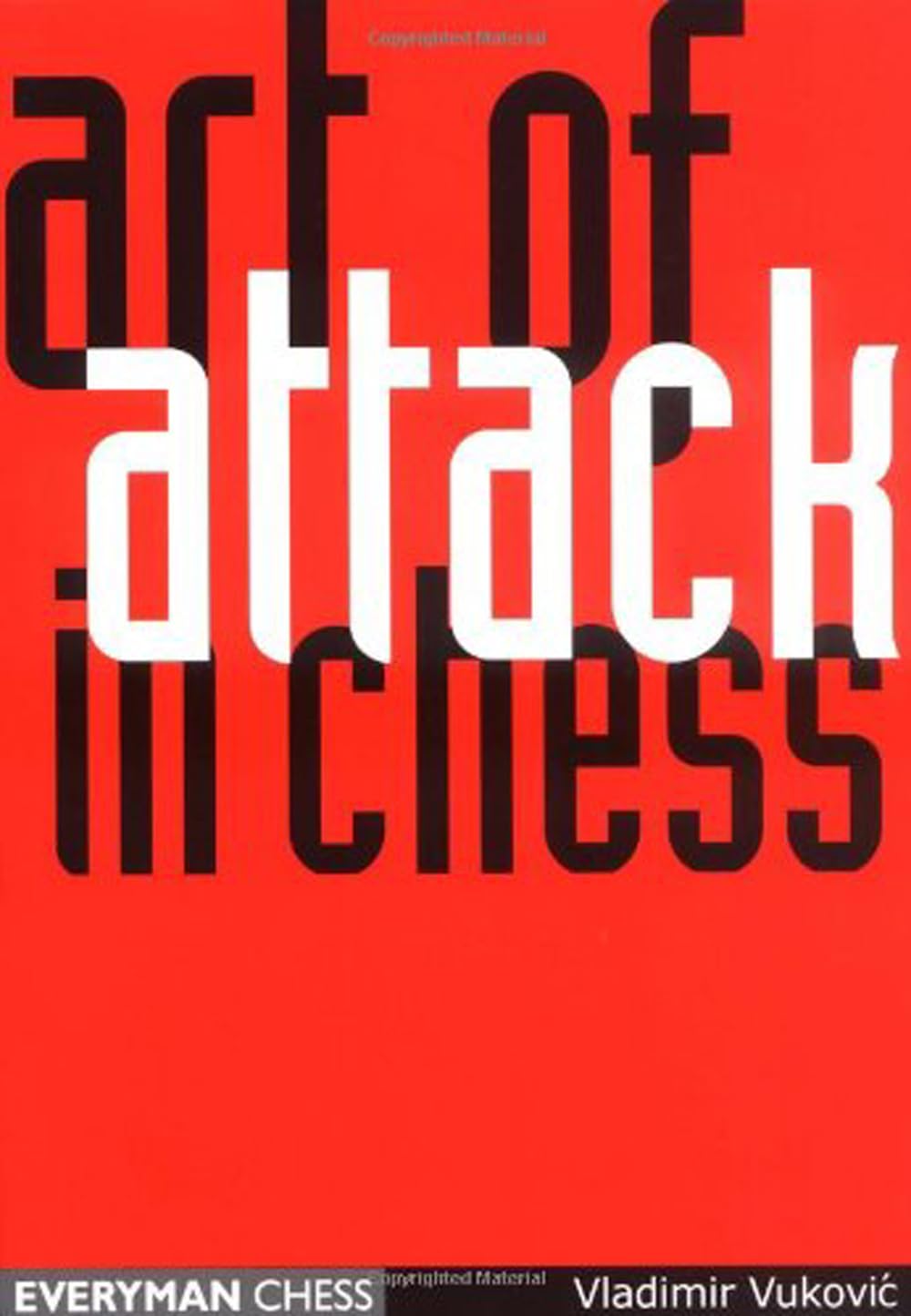
About The Art of Attack in Chess Book by Vladimir Vukovic – Learn When, Where, and How to Attack the King
The Art of Attack in Chess Book by Vladimir Vukovic is a classic chess guide for players who want to understand attacking play instead of making random threats. The book explains how strong attacks are built, when an attack is ready to begin, which pieces should join, and how to finish against the enemy king.
Many players know how the chess pieces move but still struggle when the position becomes sharp. They may attack too early, move the queen too much, sacrifice without enough support, or miss a winning chance because they cannot see the right attacking pattern. Vukovic teaches the ideas behind successful attacks so players can make better decisions at the board.
The revised English edition uses algebraic notation and is published by Everyman Chess. The publisher describes it as a guide that covers both basic attacking principles and more complex forms of attack on the king. It includes attacks on an uncastled king, attacks on castled positions, mating patterns, focal points, classic bishop sacrifices, and the use of ranks, files, and diagonals.
For improving players, club players, coaches, and serious chess students, this is a book made to be studied, not simply read once.
Stop attacking without a clear reason
A common problem in chess is starting an attack because the position looks exciting. A player pushes pawns, brings the queen forward, or sacrifices a piece without checking whether the attack has enough force.
Vukovic teaches a better way. Before attacking, look for the right conditions. Is the enemy king unsafe? Are your pieces active? Can more pieces join quickly? Are important lines open? Does the opponent have defenders nearby? Is the center stable enough for you to spend time attacking?
These questions turn an attack from a guess into a plan.
The book helps readers understand that timing matters as much as courage. A strong attacking player does not attack every position. A strong attacking player knows when the position is asking for an attack and when it is better to improve pieces first.
That lesson alone can save many games.
Learn how to attack an uncastled king
A king in the center can become a target when lines open quickly. The book explains how to use this situation before the king can reach safety.
You still need development, open files or diagonals, and enough force near the center. Vukovic shows how to recognize positions where the king has stayed in the middle too long and how to use that delay.
Developing pieces with threats can make that exposed king weaker.
The book helps you see the difference between a king that is truly in danger and a king that only looks exposed.
Understand attacks after castling
Castling usually makes the king safer, but it does not make the king impossible to attack.
Vukovic explains how the pawn shield around the king can become weak. A pawn may move and create a hole. A defender may leave. A file may open. A bishop may point toward the king. A rook may enter along an open line.
The book also looks at how to defend these positions.
When you understand what an attacker needs, you also become better at stopping those ideas in your own games. You can notice danger earlier, keep key defenders, close important lines, or trade the strongest attacking piece before the position becomes critical.
Mating patterns become easier to recognize
Many winning attacks are not completely new. They use patterns that strong players have seen before.
The Art of Attack in Chess teaches important mating ideas and shows how pieces work together around the king. Knights can control escape squares. Bishops can cut long diagonals. Rooks can use open files and ranks. The queen can join when the other pieces have already created the right conditions.
The exact opening may change, but a king still needs safe squares. Open lines still matter. Piece coordination still matters. A mating net still works because the basic rules of chess have not changed.
The classic bishop sacrifice is explained clearly
One of the famous topics in the book is the classic bishop sacrifice near a castled king. Many players have seen a bishop take a pawn near the king and wonder when that sacrifice is sound.
Vukovic does not treat it as magic. He explains the conditions that make the sacrifice work and the signs that show when it may fail.
That is valuable because copying a sacrifice without understanding it is dangerous.
By studying the pattern carefully, readers can learn to check the supporting pieces, the enemy king's escape squares, the role of the queen and knight, and the timing of the attack.
This turns a famous tactical idea into something you can understand and test over the board.
Files, ranks, and diagonals become attacking roads
An attack needs routes. Your pieces must reach the king somehow.
The book explains how open files, ranks, and diagonals act like roads for attacking pieces. A rook becomes powerful when a file opens. A bishop becomes dangerous when a diagonal points toward the king. A queen can switch sides quickly when lines are clear.
Instead, they begin asking which lines matter in the position.
If a file could open after a pawn exchange, that may be important before the exchange happens. If a bishop is blocked by one pawn, removing that pawn may be more useful than giving a direct check.
This kind of thinking makes attacks more organized and less random.
Focal points help you choose the real target
A king attack often works because one square near the king becomes very important. Vukovic calls attention to focal points, places where attacking pieces can concentrate their power.
Instead of saying, “I want to attack the king,” you can ask a clearer question: “Which square around the king is weak, and how many pieces can attack it?”
That gives the plan a direction.
A weak square may be protected by only one piece. A pawn may no longer be able to defend it. A knight may jump there. A queen and bishop may both point toward it. Once you identify the focal point, the rest of the attack becomes easier to calculate.
This book teaches planning, not only tactics
Players sometimes think attacking chess means solving combinations. Tactics are important, but a winning combination normally appears because earlier moves created the right position.
Vukovic spends time on preparation. Pieces must be placed well. Lines must be opened. Weaknesses must be created. The attacker must know when to increase pressure and when to wait.
This is why the book can help players who already solve puzzles but struggle in real games.
Real games give no hint. You first have to understand whether an attack exists at all.
The Art of Attack in Chess helps build that judgment.
Who should read this chess classic
This book is best for players who already know the rules of chess and understand basic tactics. Complete beginners may find some examples difficult because the book expects readers to follow full positions and attacking ideas.
Club players, improving tournament players, coaches, and serious self-study learners can gain the most from it.
It can also be useful for players who feel too passive. If you often reach good positions but do not know how to create threats, the book gives you a framework for turning active pieces into a real attack.
Students can study a section, set up the examples on a board, and then look for the same pattern in their own games.
A good way to study the book
Do not rush through the examples like a normal storybook.
Keep a chessboard beside you or use a digital board. Set up the positions. Before reading the explanation, try to find the attacking idea yourself. Ask what the attacker wants, what the defender fears, and which pieces are not yet helping.
Then compare your answer with the book.
This active method is slower, but it helps the ideas stay in your memory.
After each chapter, look at some of your own games. Search for moments where you attacked too early, missed an open line, ignored a focal point, or failed to bring enough pieces near the king.
That is where the book becomes practical instead of only theoretical.
A revised edition made easier for modern readers
The Everyman Chess edition is a revised algebraic edition. Older chess books often used descriptive notation, which many modern players find difficult. Algebraic notation makes the games easier to follow for readers who learned chess through today's standard system.
Everyman Chess lists the paperback at 352 pages and ISBN 9781857444001. The publisher presents the work as a classic guide that moves logically from basic attacking ideas to more complex forms.
That structure helps readers build knowledge step by step instead of jumping between unrelated combinations.
Premium physical quality from Bookish Wonderland
Bookish Wonderland prepares this copy for players who want a comfortable study book. Premium eye-soothing cream paper gives the pages a softer background during long training sessions, while crystal-clear printing keeps move notation, diagrams, and explanations easy to read.
The book also uses high-quality stitched and glue binding for better page support and longevity. That matters for a chess manual because readers may open the same chapters many times while studying positions, checking games, or reviewing an attacking pattern.
Why order this chess book from Bookish Wonderland
Bookish Wonderland makes English chess books easier to order across Bangladesh. Nationwide delivery is available inside and outside Dhaka, and Cash on Delivery is available across the country.
Customers in Dhaka can also ask about fast or urgent delivery when available. This can be useful for tournament preparation, coaching, a chess class, or a gift for a serious player.
When comparing the Book price in Bangladesh for The Art of Attack in Chess Book by Vladimir Vukovic, consider the full study experience as well as the listed price. Comfortable paper, clear diagrams, durable binding, simple payment, and convenient delivery can make a technical chess book easier to use for years.
Turn your attacks into real plans
The Art of Attack in Chess Book by Vladimir Vukovic is for players who want to stop hoping an attack works and start understanding why it should work.
The book teaches you to look at king safety, piece activity, open lines, weak squares, timing, focal points, sacrifices, and mating patterns as parts of one plan. It also shows that good attacking chess begins before the final combination.
If you often see a weak king but do not know how to continue, this book can give you a clearer method. If you love tactical chess but want to build stronger attacks, it can help connect your tactics with strategy. If you coach others, its themes can give you useful lesson material.
Order The Art of Attack in Chess Book by Vladimir Vukovic from Bookish Wonderland for a premium serious physical study copy with cream paper, crystal-clear print, stitched and glue binding, nationwide delivery, and Cash on Delivery.
If you require any customization or have any questions, please inbox us via FB or Insta.
| Primary Specification | |
| Author | Vladimir Vukovic |
| Editor | John Nunn |
| Genre | Chess Strategy, Chess Tactics, Games & Activities |
| ISBN-13/ISSN | 978-1857444001 |
| ISBN-10 | 1857444000 |
| Publisher | Everyman Chess |
| Publishing Date | January 1, 1999 |
| Edition | Revised ed. |
| Language | English |
| Reading Age | 8+ years |
| Format | Printed book |
| Physical Specification & Quality | |
| Paper Quality | Premium eye-soothing cream paper |
| Binding Quality | High quality stitched and glue binding (for longevity) |
| Print Quality | Crystal-clear print |
| Pages | 352 pages |
| Country | Yugoslavia |
| Logistics Information | |
| Weight | 352 pages |
| Length | 8.5 inches |
| Width | 5.6 inches |
| Height | 0.85 inches |