

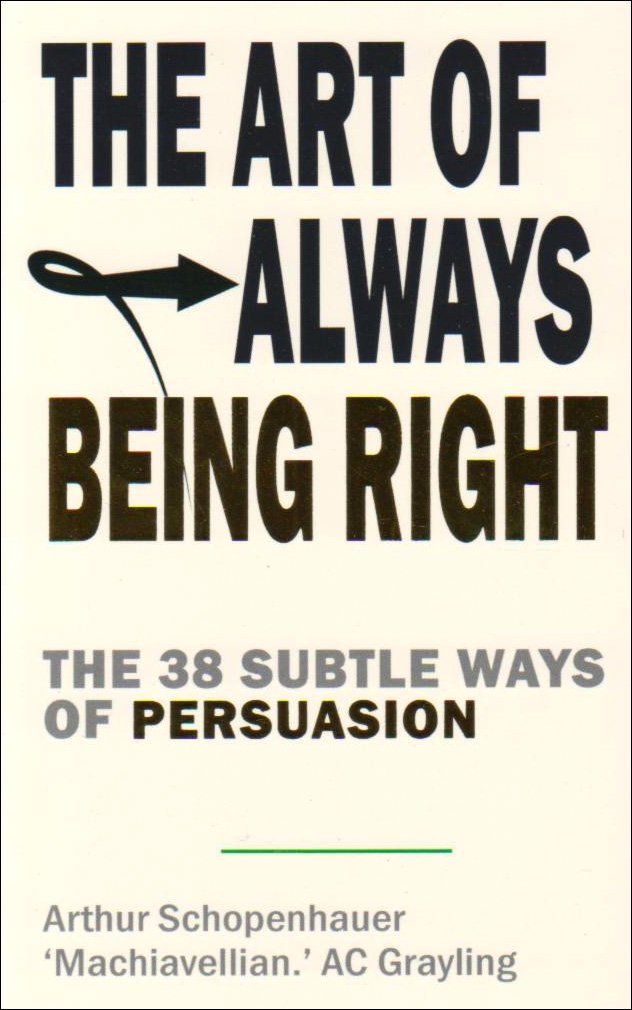
About The Art of Always Being Right by Arthur Schopenhauer: Learn How Arguments Work and Spot the Tricks Behind Them
Have you ever finished an argument and thought, “I was right, so why did I lose?” Maybe someone changed the topic. Maybe they used a big word that sounded smart but proved nothing. Or maybe they spoke so loudly that nobody listened to your point. The Art of Always Being Right by Arthur Schopenhauer explores these strange moments. It looks at the ways people try to win a debate, even when their ideas are weak. This is a small book with a big question: what happens when winning matters more than finding the truth?
Why Being Right Does Not Always Mean Winning
Think about two friends who disagree about a movie. One says the ending was bad. The other asks why. Instead of explaining, the first friend says, “You just do not understand good films.” The talk has moved away from the movie and toward the person. The claim about the ending has not been proved. Still, the second friend may feel beaten. That gap between a good reason and an easy win is at the heart of this work.
Schopenhauer studies a form of argument called eristic dialectic. In easy words, it means debating in order to come out on top, not always in order to find out what is true. His text describes 38 ways that people can bend a debate in their favor. Some use clever words. Others depend on confusion, strong feelings, or attacks on the other person. Knowing these moves does not make every dispute simple. It gives you a useful set of things to watch for.
The title sounds like a promise that you can always win. The book is more interesting than that. It asks readers to face an uncomfortable fact: a person can appear to win while making a poor point. A calm person can have a sound argument and still fail to persuade the room. Once you see the difference, you can think more clearly about what a real win should mean. A question is often worth more than a fast reply, even when the room wants a winner.
Tired of Arguments That Go Nowhere?
You ask a clear question, but the answer goes somewhere else. You share one example, and someone acts as if you made a huge claim about everything. You show a fact, and the reply becomes an insult. It is easy to feel lost when a conversation moves this way. You may waste time answering things you never said. You may even forget what the first question was.
The Art of Always Being Right helps you name these patterns. When a person makes your point sound much bigger than it really is, you can bring the talk back to your actual words. When someone changes the meaning of a word halfway through, you can ask what that word means. When a reply is just a personal attack, you can see that it does not answer the question. The book is not a magic cure for hard talks, but it can help you pay attention to what is happening.
The most useful lesson may be knowing when not to play along. You do not have to reply to every sharp line. Sometimes you can ask for proof. Sometimes you can repeat the main point in plain words. Sometimes you can leave a talk that is no longer about learning. Reading about poor debate tactics can help you make these choices with more care.
Meet the Thinker Behind the Book
Arthur Schopenhauer was a German philosopher who wrote about human life, desire, and the way people think. This work grew from his study of arguments and logic. Its original subject is known as eristic dialectic, and the manuscript was not published as a complete work during his life. It later appeared after his death. English editions have used different titles, including The Art of Being Right and The Art of Controversy.
Those different names point to the same central subject: the methods people use to look right in an argument. They do not mean that this is a novel or the next book in a story series. It is a work of philosophy about speech, debate, and the difference between truth and victory. You can start here without reading a long list of other works first. The ideas may feel old at times, but the situations they describe are easy to recognize.
What Will You Find Inside These Pages?
At the center of the book are 38 methods, often called stratagems. A stratagem is simply a planned move. Here, the moves are used to gain an edge in a disagreement. Schopenhauer explains how a speaker may stretch a small claim into a much larger one, use a word in two different ways, or ask questions in an order that makes the other person slip. He also looks at ways people turn a debate away from reasons and toward feelings.
Picture someone saying, “I think this one rule should change.” Their opponent answers, “So you want to throw away every rule?” That is not the same claim. Or think of a speaker who says, “A famous person agrees with me, so I must be right.” A famous name may be worth hearing, but it cannot replace a sound reason. These easy examples show why the book can feel close to life, even though its roots are in old philosophy.
Not every tactic in the text is fair or kind. Some are openly misleading. The work is best read with that fact in mind. You can study a trick without using it on people. You can also ask a deeper question: if a clever move helps someone win but hides the truth, is that really a result worth wanting? This tension gives the book more to offer than a simple set of lines for your next debate.
Small Details That Change a Whole Conversation
Words matter. A single word can hold two meanings, and a speaker may move from one meaning to the other without saying so. The argument then sounds smooth, but its logic may be broken. Another trick is to take a person’s limited point and turn it into an extreme view that is easier to attack. A third is to press someone with questions before they have time to explain their own position.
These details are useful to notice because they often happen quickly. In a heated talk, people respond to tone before content. They may agree with the person who sounds sure, even if that person has not answered the key point. Schopenhauer turns your attention back to the shape of the argument. What was the first claim? What proof was offered? Did the meaning change? Is the reply about the idea, or is it about the speaker?
Read It to Understand Others and Yourself
It is tempting to imagine that only other people use bad arguments. That would miss half the value of this book. We all want to be heard. We can become upset, rush to defend a belief, or choose a quick answer over a careful one. Reading Schopenhauer can help you notice when your own wish to win starts to lead the conversation. That is not always comfortable, but it can be worthwhile.
The book can also give you a reason to slow down before you reply. Instead of looking for the sharpest comeback, ask whether you understand the other person's words. Check whether your answer meets their real point. If you find that you have made a mistake, you can change your mind. That may not look like victory to a noisy crowd, but it can lead to a better talk and a better decision.
Readers who love philosophy will find a lively look at the link between thought and speech. Readers who enjoy psychology may like watching the habits people show when they disagree. Anyone curious about language can explore how words guide an audience. You do not need a degree to be interested. Curiosity and a willingness to question what you hear are enough to begin.
A Useful Read for Many Parts of Life
Imagine a student preparing for a class discussion. This book can give that student examples of weak reasoning to look out for, as long as the ideas are read with care. Imagine a team member in a meeting where a simple choice turns into a battle over who sounds smarter. The text offers a way to think about what changed. Imagine a reader following a heated comment thread and wondering why nobody answers the main question. The patterns may start to look familiar.
There is value here for people who write, speak, teach, study, or simply talk with friends. A writer can ask whether a claim is clear. A speaker can look for gaps in an argument before sharing it. A reader can pause when a bold statement seems too easy. These are possible ways to use the ideas, not promises that the book will make you unbeatable. Good judgment still takes practice, patience, and fair evidence.
For a reading group, the book can open a fresh kind of conversation. Pick one tactic and ask where people have seen it. Then talk about how to answer it without copying it. Was the original claim true? What would count as proof? Could the two sides have understood each other better? That kind of discussion can be both fun and useful, especially when everyone is willing to laugh at familiar mistakes.
A Premium Copy for Your Reading Shelf
Bookish Wonderland offers this title for readers who want a pleasant printed copy. Its premium eye-soothing cream paper gives the pages a soft look. Crystal-clear printing keeps the words sharp and easy to follow. High-quality stitched and glue binding is designed to help the book stay together through regular reading. These details matter when you want to mark a point, return to a passage, or keep a book for future thought.
A printed book also lets you read at your own pace. You can put it down when an idea needs time, turn back to an earlier point, and keep your favorite questions close. This is especially helpful with a book that asks you to examine how arguments are built. Rather than racing from the first page to the last, you may want to take one idea at a time and let it settle.
Order from Bookish Wonderland in Bangladesh
Book price in Bangladesh can vary by listing, so check the current price of The Art of Always Being Right by Arthur Schopenhauer at Bookish Wonderland before ordering. The store offers nationwide delivery, including addresses inside and outside Dhaka, and cash on delivery across Bangladesh. Readers in Dhaka can also ask about the fast or urgent delivery option. If you have a question about your order or need book customization, message the store through Facebook or Instagram.
If you require any customization or have any questions, please inbox us via FB or Insta.
| Primary Specification | |
| Author | Arthur Schopenhauer |
| Translator | T. Bailey Saunders |
| Narrator | Carl Manchester |
| Genre | Philosophy, Nonfiction, Logic, Rhetoric |
| ISBN-13/ISSN | 979-8322349587 |
| Publisher | Arthur Schopenhauer |
| Publishing Date | April 10, 2024 |
| Language | English |
| Reading Age | 16+ years |
| Format | Printed book |
| Physical Specification & Quality | |
| Paper Quality | Premium eye-soothing cream paper |
| Binding Quality | High quality stitched and glue binding (for longevity) |
| Print Quality | Crystal-clear print |
| Pages | 109 pages |
| Country | Germany |
| Logistics Information | |
| Weight | 115g |
| Length | 8.5 inches |
| Width | 5.6 inches |
| Height | 0.25 inches |