

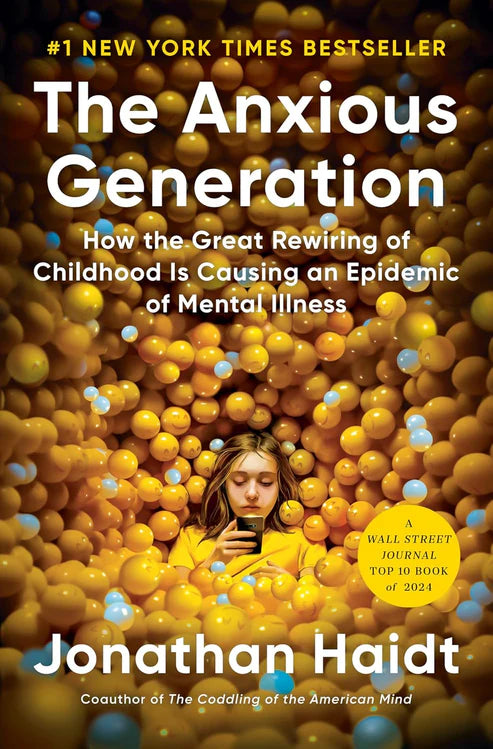
About The Anxious Generation by Jonathan Haidt – Rethink Smartphones, Childhood, and Growing Up
What changed about childhood when smartphones became part of almost every day? The Anxious Generation by Jonathan Haidt explores that question through research, stories, and a plan for families and schools. Haidt argues that the move from outdoor play and time with friends toward constant online activity has contributed to serious problems for many young people. He looks at rising reports of anxiety and depression, but he also asks what children lose when their days leave little room for freedom, discovery, and face-to-face connection. This is a nonfiction book for readers who want to understand Haidt's argument, examine the evidence, and consider practical ways to make childhood less centred on screens. It is not a medical guide or a promise that one rule will solve every problem.
Why This Book Begins With a Big Question
Parents can see a child sitting safely at home and still wonder what is happening on the phone in their hands. Teachers may see students struggling to put devices away. Teenagers may feel pressure to reply at once or keep up with friends online. Haidt connects these familiar experiences to a wider change that he calls the great rewiring of childhood. His account focuses especially on the early 2010s, when smartphones and social media became part of daily life for many adolescents. The book asks whether this change affected sleep, relationships, attention, and emotional health. It also looks back to the decline of independent play, which began before smartphones arrived. The point is not simply that devices exist. It is that the shape of an ordinary day has changed.
The Childhood Children Used to Practise
Haidt describes a play-based childhood in which children spend time outside, make up games, solve disagreements, and slowly become more independent. He argues that these experiences help young people practise everyday skills that cannot be learned only by listening to adults. A game may involve taking turns, coping with losing, or working out a rule with friends. Walking to a nearby place may involve making small decisions and learning what to do when plans change. He believes that many children now have fewer chances for this kind of freedom because adults supervise more closely and schedules leave less open time. His answer includes giving children more chances to play and take reasonable, age-appropriate responsibility in the real world.
How a Phone Can Fill Every Quiet Moment
A smartphone can be useful for learning, maps, calls, photographs, and keeping in touch. It can also bring entertainment, messages, and alerts into every spare minute. Haidt asks readers to notice what happens when a child reaches for a screen whenever nothing else is happening. There may be less time to be bored, talk to a friend, read without interruption, or invent a game. His book examines a phone-based childhood in which online life competes with other activities throughout the day. This does not mean every child uses technology in the same way or receives the same effects. It means families have a reason to look closely at when devices help and when they crowd out something valuable.
Four Harms Haidt Wants Readers to Notice
The book groups its central concerns into four areas: social deprivation, sleep deprivation, attention fragmentation, and addiction. Social deprivation refers to time with other people being replaced by screen activity. Sleep deprivation can happen when devices keep someone awake or interrupt rest. Attention fragmentation describes the difficulty of staying with one task when notifications and feeds keep pulling the mind elsewhere. Addiction is the term Haidt uses for patterns of compulsive engagement that become hard to control. These categories give readers a clear map of his argument. They are not a diagnosis for every teenager, and the strength of the evidence differs across behaviours. Still, the framework can help a family ask more useful questions than simply counting total screen hours.
The Research Is Important, and So Are Its Limits
One reason this book has drawn attention is its effort to connect large social changes with adolescent mental health. But identifying a link is not the same as proving one simple cause. Some scientists challenge Haidt's strong claims about smartphones and rising distress, and later reviews report weak or inconsistent associations for social media use in general. Problematic use shows a clearer association with poorer well-being in some research. Readers can take the book seriously without treating every explanation as settled fact. It is worth asking what a study measured, which young people took part, and whether it can establish cause and effect. That careful approach makes the subject more useful and avoids placing all responsibility for distress on a single device.
Four Changes Haidt Proposes for Communities
Haidt argues that one family may find it hard to change technology habits when every child's friends are online. He therefore proposes four shared norms. The first is delaying smartphones until high school, with basic phones as an option earlier. The second is delaying social media until age sixteen. The third is making schools phone-free during the school day. The fourth is giving children more independence, free play, and responsibility in everyday life. These are the author's recommendations, not rules that every country or family already follows. His broader message is that parents, schools, and communities can work together so one child does not feel left out when a household makes different choices.
Practical Ideas for a Family Conversation
A book cannot choose the right phone plan for your household, but it can make a conversation more thoughtful. Parents can start by asking what their child enjoys online, what feels stressful, and which activities they miss when screen time runs long. They might agree on device-free meals, protect time for sleep, or arrange regular chances to see friends. Older children can help shape workable boundaries and explain when a phone is needed for travel, school, or safety. The aim is to build trust and healthy habits rather than begin with blame. Haidt's proposals offer starting points, while each family still needs to consider the child's needs, local conditions, and access to safe places to play.
Schools and Teachers Have a Role Too
The book does not leave every decision to parents. Haidt discusses the way personal devices can affect a shared learning space and calls for phone-free schools. Teachers may recognise the challenge of helping a class focus when messages can arrive during a lesson. School leaders, however, also have to think about accessibility, emergency contact, learning needs, and clear communication with families. The value of reading this section is in seeing how a schoolwide plan differs from asking one teacher to manage every phone alone. Readers can use the book to frame questions for a school meeting and explore what kinds of rules are practical in their own setting.
What Readers in Bangladesh Can Take From It
The research and examples in The Anxious Generation draw heavily on contexts outside Bangladesh, including the United States, so they should not be treated as a direct study of every Bangladeshi child. Still, the questions can matter wherever young people use smartphones and social media. A parent in Dhaka may think about crowded streets and the need for safe places to play. A teacher outside Dhaka may consider how devices support learning while also creating distractions. Families can discuss costs, transport, family expectations, and internet access when considering any change. This makes the book a starting point for local conversations, not a ready-made solution that ignores how childhood differs from one community to another.
Who Is Likely to Enjoy This Book?
This title is written mainly for adults interested in parenting, education, psychology, and the digital lives of young people. It can also interest older teenagers who want to understand the public debate about their generation. Parents may use it to start discussions at home. Teachers may bring questions from it into staff meetings. Students of psychology or social science may read it beside research that supports or challenges the author's claims. Its style is explanatory rather than fictional, and it contains arguments, examples, and practical proposals. If you want a thoughtful nonfiction book that will give you material to discuss rather than a short list of app settings, it is worth considering.
A Reading Copy Made for Returning to Ideas
Bookish Wonderland offers this title with premium eye-soothing cream paper, crystal-clear printing, and high-quality stitched plus glue binding. A softer page colour gives readers a comfortable-looking surface for longer sessions. Clear text helps with passages that explain studies or practical recommendations. The binding is designed for repeated use when you want to return to a chapter or compare an idea with your own notes. These are the store's stated specifications for its offered edition; check the listing if you need a particular publisher, format, or cover. Keep the book dry and handle its spine gently to help preserve your copy.
Order From Bookish Wonderland Across the Country
Bookish Wonderland carries a large collection of premium English books and offers delivery inside and outside Dhaka. Cash on Delivery is available nationwide, allowing customers to pay when the parcel arrives. For customers in Dhaka who need an order sooner, a fast or urgent delivery option may be requested; confirm availability, charges, and timing before checkout. If you have questions about the offered edition or customization, contact the store through Facebook or Instagram. Buying online lets you review the product details before choosing the option that works for your location. A clear description and simple ordering process can help you focus on selecting a book that fits your interests.
Book Price and Current Availability
Book price in Bangladesh varies by edition and seller; check Bookish Wonderland's current listing for The Anxious Generation by Jonathan Haidt. Check the live amount, edition, and any delivery fee before placing your order. No exact selling price was supplied for this description, so none is guessed here. If you are comparing copies, remember that page counts and covers can differ between publisher editions. Confirm what the store currently offers if those details matter to you. This is especially useful when buying a nonfiction title that you may want to keep as a reference or give to someone else.
Bring a Bigger Conversation Home
The Anxious Generation asks a difficult question: what would childhood look like if young people had more room to play, sleep, focus, and spend time together? You do not need to accept every conclusion to find value in examining that question. Read Haidt's case, consider the scientific debate, and talk with the children, parents, or teachers whose lives are affected. The book can help turn a vague worry about screens into specific questions about daily routines and real-world opportunities. For a book club, each chapter can become a question rather than an instruction. Ask what feels familiar, which examples fit your community, and which claims need more evidence. Listening to young people is important: adults can describe concerns, but teenagers can explain how their own friendships, safety, and schoolwork function. If that is the conversation you want to start, order The Anxious Generation by Jonathan Haidt from Bookish Wonderland. Confirm your copy and delivery details, then make time to read and think.
If you require any customization or have any questions, please inbox us via FB or Insta.
| Primary Specification | |
| Author | Jonathan Haidt |
| Narrator | Sean Pratt, Jonathan Haidt |
| Editor | Daniel Lagin |
| Genre | Psychology, Parenting, Mental Health, Social Science, Technology and Society. |
| ISBN-13/ISSN | 979-8217059201 |
| Publisher | PENGUIN US |
| Publishing Date | March 25, 2025 |
| Language | English |
| Reading Age | 14+ years |
| Format | Printed book |
| Physical Specification & Quality | |
| Paper Quality | Premium eye-soothing cream paper |
| Binding Quality | High quality stitched and glue binding (for longevity) |
| Print Quality | Crystal-clear print |
| Pages | 400 pages |
| Country | USA |
| Logistics Information | |
| Weight | 413g |
| Length | 8.5 inches |
| Width | 5.6 inches |
| Height | 1.02 inches |