

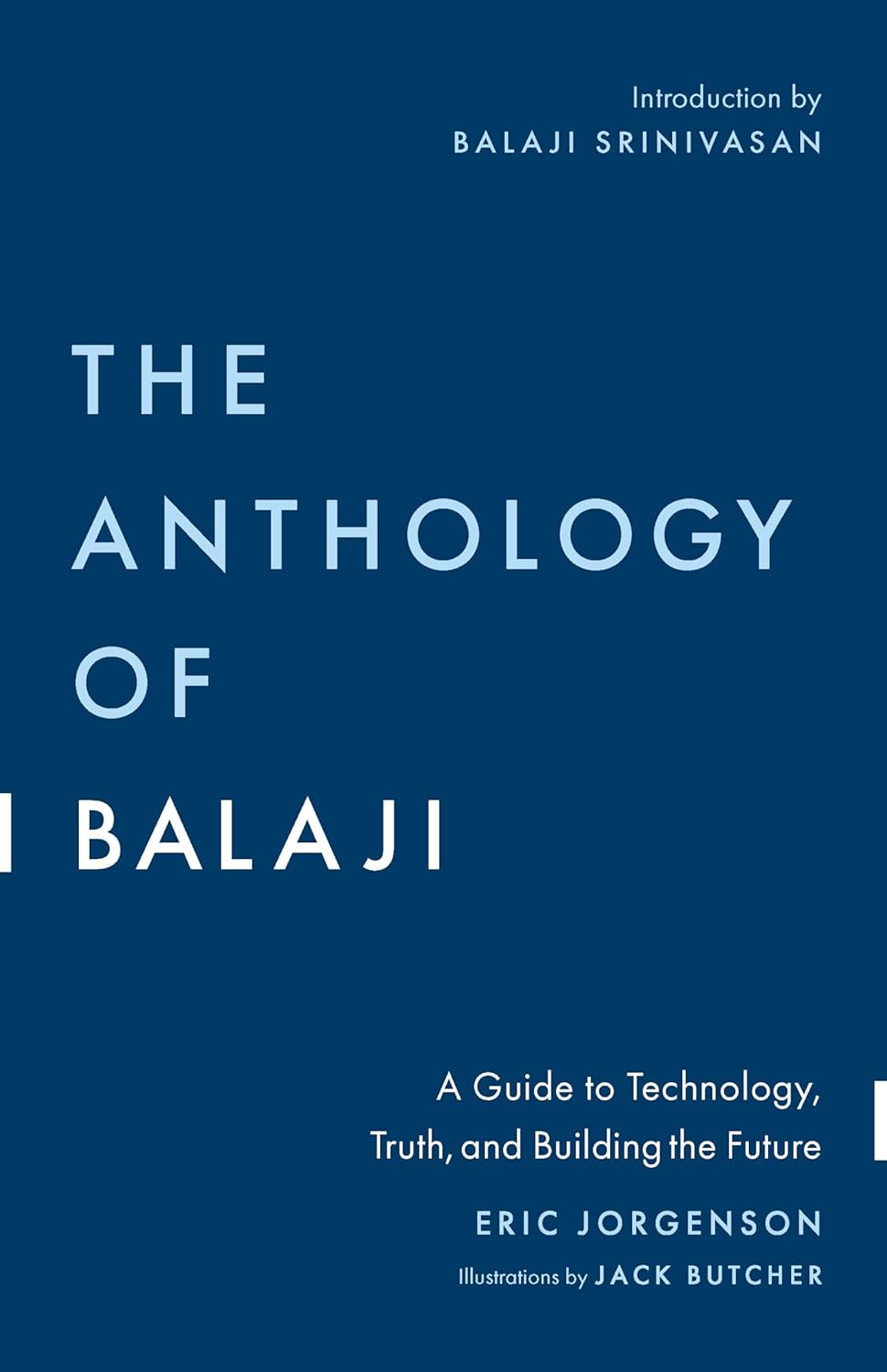
About The Anthology of Balaji by Eric Jorgenson – Ideas on Technology, Truth, and Building the Future
What will the world look like when today's new technology becomes part of everyday life? The Anthology of Balaji by Eric Jorgenson invites you to explore that question through the ideas of entrepreneur and investor Balaji Srinivasan. Instead of asking you to read years of interviews, online posts, and essays separately, Jorgenson gathers selected passages into one organized book. The result covers technology, ways to judge information, and the hard work of turning an idea into something real. It offers a view of possible futures rather than a promise that any one prediction will come true. If you are curious about startups, digital tools, independent thinking, or making useful things, you will find plenty of questions to consider here.
Meet the Thinker and the Editor
Balaji Srinivasan has worked as an entrepreneur and investor and previously held roles at Coinbase and Andreessen Horowitz. His interests reach across software, biotechnology, digital networks, and new ways for people to work together. Eric Jorgenson, known for collecting Naval Ravikant's ideas in The Almanack of Naval Ravikant, takes a similar editorial approach here. The title credits Jorgenson because he selects, arranges, and edits Balaji's existing material; the central ideas are Balaji's. It is important to know that this is not a newly written memoir or an ordinary biography. You are reading a curated collection, with an editor helping many shorter pieces become a connected experience.
Three Parts Give the Big Ideas a Clear Shape
The book has three main parts: Technology, Truth, and Building the Future. The first asks what tools can do and how new inventions change society. The second explores information, evidence, media, and how readers might check competing claims. The third moves from ideas to action, covering the work of making projects and organizations. A bonus section includes Balaji's recommended reading. Start at the beginning to follow the editor's path, or choose a chapter that matches a question you already have. Jorgenson even encourages readers to skip around while remembering that some ideas build on earlier sections.
Technology Is More Than a New Gadget
Balaji argues that technological progress can create value by making products and services faster, less costly, or possible for the first time. His examples and interests extend beyond phones and apps to automation, digital systems, medicine, and new ways of organizing work. A good tool can help a small group do what once needed a much larger team. But this is Balaji's optimistic outlook, not a guarantee that every invention will help everyone. Readers can ask who gains access, what tradeoffs appear, and which problems still require human judgment.
Follow the Shift From Physical to Digital
Many things once tied to a particular place can now be shared through digital networks. People can send information, work with distant partners, or build services for customers they have never met. The book examines this shift and then asks what happens when products and communities are designed for the internet from the beginning. It also introduces blockchains and decentralization, topics that can sound intimidating when explained only through technical language. You do not have to invest in cryptocurrency to consider the underlying question: who controls a system, and how do its users know what is happening?
Imagining the Future of Health and Work
Automation, biotechnology, and tools for measuring health appear among the book's forward-looking subjects. Balaji considers how technology might improve productivity and expand what medicine can do. Some possibilities are ambitious, including much longer healthy lives. They are proposals and predictions, not treatments or established outcomes. This distinction matters when exciting ideas touch health or money. The strongest reading experience comes from being curious without turning speculation into fact. Ask which technologies already exist, which are still being tested, and what evidence would show that an invention truly works. It teaches you to separate a vision for tomorrow from something you can safely use today.
What Does It Mean to Know Something Is True?
The second part asks how people decide what to believe. Balaji distinguishes claims that can be tested through mathematics or experiments from social and political facts that depend partly on institutions and shared recognition. He explores how software and open data might let more people check certain statements for themselves. These categories are his framework, and complex real-world questions do not always fit neatly inside them. Yet the underlying reading habit is useful: when someone makes a strong claim, ask what evidence would support it and whether an independent person could verify it. This section encourages attention to sources rather than simply trusting a confident speaker, including Balaji himself. This can help you decide which claims deserve further reading and which deserve careful testing.
Read the News With More Questions
Balaji criticizes parts of traditional media and argues for alternative ways to gather and distribute information. He is interested in incentives: how a writer is paid, which stories attract attention, and whether audiences can examine the underlying facts. Those views are open to debate; established journalism can also provide original reporting, correction systems, and accountability. Readers do not need to accept a simple choice between old and new media. Instead, use this chapter to examine how a claim was reported, whether its sources are visible, and what important context may be missing.
Turn Curiosity Into Something You Can Build
The final part moves toward action. Balaji discusses finding opportunities, researching a problem, developing an idea, testing it, and bringing a product or project into the world. His advice is not limited to a company that aims to become huge. A reader might apply the same questions to a small business, a community project, a useful website, or a new service. What problem are you solving? Who actually needs the solution? What can you test before spending heavily? It encourages building and learning from results rather than staying forever in the stage of talking about an idea.
Useful Lessons About Teams and Daily Work
Ideas alone do not keep a project alive. The collection also addresses hiring, managing, growing, executing, surviving difficult periods, and improving personal productivity. These subjects turn a broad vision of the future into familiar work: choosing partners, getting feedback, setting priorities, and returning to tasks when enthusiasm fades. Balaji offers a particular founder's perspective, so his approach will not fit every team or workplace. Still, readers may find questions they can use immediately. Are you working on the most important problem? Do the people involved understand the goal? What have you learned from users?
Not Every Bold Idea Is a Prediction You Should Follow
The collection includes views on investment opportunities, cryptocurrency, and even possible new forms of communities and states. Those are Balaji's arguments about the future, not settled descriptions of what will happen. The book is not personalized financial advice, and an exciting prediction does not establish that an investment is suitable or safe. Some proposals about institutions and society are also contested. Read them as ideas to examine, compare with other sources, and discuss rather than instructions to accept. Jorgenson notes that excerpts were edited and moved from their original settings and recommends checking primary sources before quoting Balaji precisely. That honesty makes it easier to approach the book with curiosity and healthy skepticism.
An Anthology You Can Explore in Short Sessions
You do not have to finish a long chapter every time you sit down. The book uses shorter, themed selections, so you can choose a subject and return to it later. Its table of contents works almost like a map of questions: value creation, digital networks, scientific truth, research, hiring, or learning. If a technical term is unfamiliar, pause and look it up rather than guessing. Some concepts need more background than the short passages provide. The format suits readers who like collecting useful observations but want more organization than a social media feed can offer.
Who Should Consider Reading This Book?
The Anthology of Balaji will interest readers of technology, entrepreneurship, business strategy, and contemporary ideas. Startup founders can explore questions about building and scaling. Students can discover fields they may want to study. Product managers and researchers may enjoy the sections on innovation and evidence. Readers familiar with The Almanack of Naval Ravikant may recognize Jorgenson's method of turning public conversations into a book, although the two titles feature different thinkers and have different subjects. It is a collection of arguments and suggestions that may lead you toward more focused reading, careful research, or a project of your own.
A Premium Copy for a Working Bookshelf
Bookish Wonderland offers this title with premium eye-soothing cream paper, crystal-clear printing, and high-quality stitched plus glue binding. The soft page colour gives longer passages a warm background, while sharp text helps with unfamiliar technical terms. The binding is designed for a copy you may reopen while working through an idea or checking an earlier chapter. These are the store's stated specifications for its offered edition, so confirm the cover and format if you need a particular printing. The publisher lists a 290-page edition, but the exact Bookish Wonderland copy has not been independently identified.
English Books Delivered Across Bangladesh
Bookish Wonderland offers a large collection of premium English books and delivers inside and outside Dhaka. Cash on Delivery is available nationwide, so customers can choose to pay when the parcel arrives. Readers in Dhaka can ask about fast or urgent delivery; confirm the timing and any additional charge before ordering. If you need information about stock, the offered edition, or customization, contact the store through Facebook or Instagram. Choosing a printed anthology is especially convenient when you want to return to individual ideas over time. Review the listing and delivery details, then select the option that suits your location and schedule.
Book Price and Availability in Bangladesh
For The Anthology of Balaji by Eric Jorgenson, check the current Bookish Wonderland product page for the book price in Bangladesh and the available format. No selling amount was supplied here, so a price has not been invented. Compare the listed total with any delivery fee before checkout. If you need a particular ISBN or publisher's version, ask the store to confirm it rather than assuming every listing represents the same physical edition. That small check can make the purchase smoother, especially when you are buying a book for study or as a gift.
Open the Book, Then Test an Idea
A good idea is a beginning, not a finished result. This collection asks you to imagine how tools might change the world, think carefully about what you know, and try building something useful. It also gives you room to disagree. Read a chapter, identify one claim worth checking, and decide whether it changes how you approach a problem. That is a more grounded goal than expecting a book to predict the future for you. If you enjoy technology and thoughtful nonfiction, order The Anthology of Balaji by Eric Jorgenson from Bookish Wonderland. Confirm the price and edition, choose delivery to your address, and give yourself time to explore the questions that matter most to you.
If you require any customization or have any questions, please inbox us via FB or Insta.
| Primary Specification | |
| Author | Eric Jorgenson |
| Genre | Business, Entrepreneurship, Technology, Investing, Personal Development. |
| ISBN-13/ISSN | 978-1544542911 |
| ISBN-10 | 1544542917 |
| Publisher | Smart Friends Publishing |
| Publishing Date | October 17, 2023 |
| Language | English |
| Reading Age | 18+ years |
| Format | Printed book |
| Physical Specification & Quality | |
| Paper Quality | Premium eye-soothing cream paper |
| Binding Quality | High quality stitched and glue binding (for longevity) |
| Print Quality | Crystal-clear print |
| Pages | 290 pages |
| Country | USA |
| Logistics Information | |
| Weight | 297g |
| Length | 8.5 inches |
| Width | 5.6 inches |
| Height | 0.73 inches |