

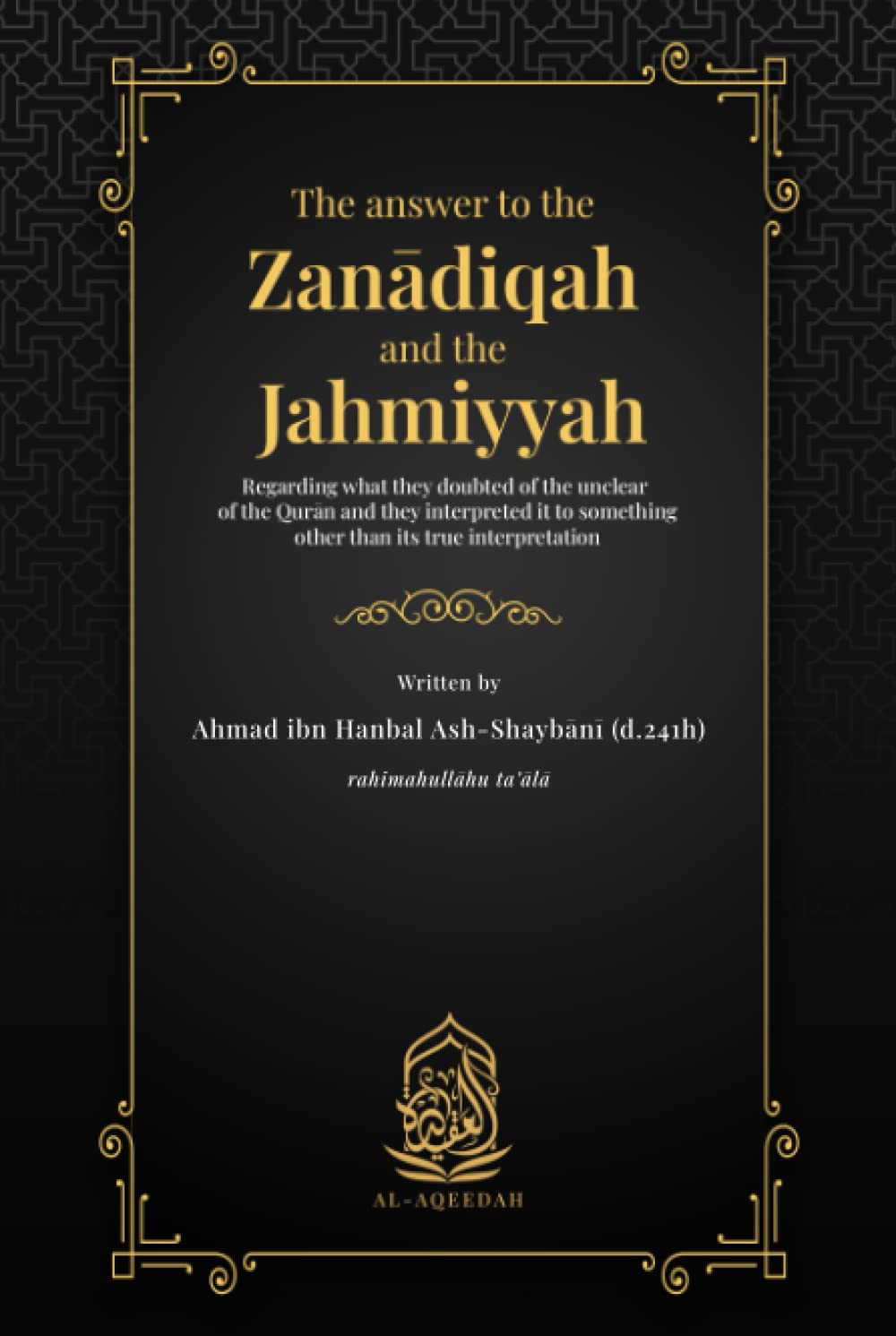
About The Answer to the Zanadiqah and the Jahmiyyah by Ahmad ibn Hanbal Ash-Shaybani – Explore a Classical Debate About the Qur'an and Belief
Some books tell a story. The Answer to the Zanadiqah and the Jahmiyyah is an English translation of a classical theological text traditionally attributed to Imam Ahmad ibn Hanbal. It responds to arguments about verses that some readers regarded as conflicting, the speech and attributes of Allah, and whether the Qur'an is created. The work speaks from a particular early Sunni theological position. It is not a neutral survey of every Muslim school or a beginner's guide to all of Islam. Readers who want to study a historical debate can follow its questions, look at the verses being discussed, and compare the author's responses with other interpretations.
Begin With the Question Behind the Title
The title names two groups as they appear in the text: the Zanadiqah and the Jahmiyyah. Zanadiqah is a historical polemical label applied to people accused of holding unacceptable beliefs; it does not identify one single, clearly defined school in every context. Jahmiyyah is a name associated with theological positions linked to Jahm ibn Safwan and with later debates about divine attributes. Both labels are used from the standpoint of the writer answering them. Understanding that perspective helps a modern reader follow the argument without assuming that every person called by either name believed exactly the same thing. This is a work of religious dispute, not an even-handed account written by representatives of all the groups involved.
What the Book Actually Discusses
The treatise brings forward Qur'anic passages and responds to objections about their meaning. One section addresses claims that certain verses seem inconsistent when read without their context. Another turns to questions about Allah's speech, divine attributes, and the relationship between Creator and creation. Readers will also meet discussions of Allah speaking to Moses, the Throne, and verses describing divine presence. The text argues for its own conclusions through its reading of scripture. A reader does not need to adopt every conclusion to understand the questions it raises or the way its arguments are built.
Why the Created Qur'an Debate Matters
A central question is whether the Qur'an is created or is the uncreated speech of Allah. This was not merely a classroom argument. In ninth-century Abbasid history, the issue was tied to the mihna, an official effort to test certain scholars on their beliefs. Ahmad ibn Hanbal became known for refusing to affirm the doctrine that the Qur'an was created, and he suffered punishment during the ordeal. The book presents one side of the theological dispute. Other schools developed different explanations and arguments, so its conclusions should be understood as a position within a wider intellectual history, not as an uncontested description of every Muslim's belief.
Read the Verses Beside the Explanations
The text's main method is to bring together scriptural passages and explain why the author thinks particular objections are mistaken. Instead of receiving only a short statement of belief, readers can see how an argument is connected to specific Qur'anic wording. That makes the book useful for close reading. Keep a Qur'an translation beside you if you want to check a reference in its broader setting. Notice when the writer moves from quoting a verse to explaining its meaning. The distinction matters because the verse itself and one scholar's interpretation of it are not identical kinds of material. Taking notes on each claim can help you follow a difficult discussion without losing track of the original question.
Questions About Allah's Attributes
Several sections address descriptions of Allah and how they should be understood. The treatise responds to positions it attributes to the Jahmiyyah regarding divine speech, the Throne, and other scriptural passages. Its approach reflects a theological tradition concerned with affirming what scripture says while rejecting readings it considers incorrect. These are sensitive questions, and Muslims have differed over suitable methods of interpretation. The book's sharp language belongs to the style of an argument against opponents. Readers interested in the history of Islamic belief can examine its reasoning carefully while remembering that other theological traditions may explain the same passages differently. A fair reading starts with understanding the author's claim before comparing it with another view.
Moses, Revelation, and the Meaning of Speech
One issue concerns the Qur'anic account of Allah speaking to Moses. The author uses this and other passages in discussing what it means to call the Qur'an divine speech. Another issue involves distinguishing Allah's word from created things. These discussions can be challenging for someone opening a classical theology book for the first time, but the central question is understandable: what kind of speech is revelation, and what does scripture itself establish about it? The text offers a definite response from its own standpoint. You can read it slowly, return to the cited passages, and ask how each example supports the conclusion. That is more useful than rushing past an unfamiliar term or treating a complex point as a slogan.
An Important Note About Authorship
This work is traditionally credited to Ahmad ibn Hanbal, the influential scholar who died in 855. However, its exact authorship and surviving form are debated. A modern study by Andrew G. McLaren identifies three related manuscript versions that developed across several centuries, with the earliest surviving recension appearing after Ibn Hanbal's lifetime. Some traditional scholars and modern editors defend the attribution; other scholars question whether the whole printed text was written by him. It is therefore most accurate to describe this as a work attributed to Ibn Hanbal rather than claiming its entire wording is unquestionably his. That distinction does not make the text unimportant. It helps readers understand what they are actually buying and how historical books reach the present.
Why Different Editions May Not Match
Printed copies do not always contain identical material. Scholars have identified manuscript versions that differ in their introductions and in which sections about the Zanadiqah are included. Modern publishers may also choose different Arabic source editions, add footnotes, or use different translations of technical words. As a result, two books with similar covers and titles can have different lengths or contents. One English edition credits Abu Hajar as translator, but that credit should not automatically be applied to every copy sold under this title. If you need the book for formal study, check the translator, publisher, table of contents, and page count of the specific Bookish Wonderland edition before ordering.
A Careful Choice for Theology Students
This book suits readers interested in Islamic creed, early theological debates, and the way arguments were developed around Qur'anic verses. It may be useful for students studying Hanbali intellectual history or comparing different approaches to revelation. It is less suitable as a first introduction to Islamic practice because it assumes familiarity with names, verses, and past disputes. Beginners may find it helpful to read a short overview of early Islamic theology first or to discuss unfamiliar concepts with a knowledgeable teacher. Adults who enjoy historical religious texts can also approach it as evidence of debates that continued long after the early period. Its value as a historical source is separate from whether a reader personally accepts its arguments.
What This Book Is Not
The title might sound like a story about two people, but it is not a novel, biography, or collection of everyday prayers. Nor is it a general dictionary of Islamic groups. It is a focused refutation, meaning a work that sets out claims attributed to opponents and argues against them. The writer's language can be severe because the subject was treated as important and contested. Readers looking for a balanced survey should consider pairing the text with a history of early Islamic theology that includes several perspectives. Readers seeking a devotional book may prefer a different title. Knowing the format before purchase makes it easier to choose something that truly fits your purpose.
Make Your Reading Time More Useful
Start by reading the headings and identifying the question in each section. Then read the argument once without stopping and a second time while checking references. Write down technical words such as revelation, creation, and attributes, along with the meaning used in that passage. When a line appears to condemn a group, ask who is being described and whether the label has changed meaning across periods. Distinguish what the writer says from what later editors explain in their notes. You can also compare passages across editions when doing detailed research. This approach turns a difficult text into a sequence of manageable questions and keeps you from mistaking a bold claim for a demonstrated conclusion.
Premium Pages for Studying at Home
Bookish Wonderland describes its offered copy as featuring premium eye-soothing cream paper, crystal-clear printing, and high-quality stitched plus glue binding. The warmer page tone provides a softer-looking surface, while clearly printed letters can help you read unfamiliar names and detailed discussions. The binding is designed to support repeated opening when you return to a section or compare two arguments. These are the store's supplied specifications, not independently verified properties of every publisher's printing. Before purchasing, confirm any particular translator, page count, format, or cover you need.
Order English Islamic Books Across Bangladesh
Bookish Wonderland offers a large selection of English books and delivers across Bangladesh, both inside and outside Dhaka. Cash on Delivery is available nationwide for customers who prefer paying when their parcel arrives. Readers in Dhaka can ask about fast or urgent delivery and confirm its timing and charge before checkout. If you have questions about the available edition, printing, or customization, contact the store through Facebook or Instagram. This is especially helpful for translated classical texts, where the source edition and additional notes may matter as much as the cover. Check the product details and choose the delivery option that fits your address.
Book Price and Edition Details in Bangladesh
Book price in Bangladesh for The Answer to the Zanadiqah and the Jahmiyyah should be checked on the current Bookish Wonderland listing. No confirmed selling price was supplied, so none is invented here. Also check the delivery cost and whether the available copy includes the English translation alone or additional material. Printed editions listed by different sellers have varying page counts, so do not assume that a number from another shop describes this copy. If you are buying for a course or research, confirm the ISBN and translation with the store before placing your order.
Bring a Historical Debate Into Your Library
A work like this rewards close attention. It invites you to see how scholars and their followers argued about revelation, what they believed particular verses meant, and why these questions carried weight in their communities. It also encourages a useful habit: check the text, learn the context, and keep separate what is quoted, argued, and historically verified. If your reading interests include Islamic theology and early intellectual history, this translation gives you a focused subject to explore. Order The Answer to the Zanadiqah and the Jahmiyyah from Bookish Wonderland after confirming the edition and current price. Choose delivery to your address, open the book with your questions in mind, and read its arguments carefully rather than treating any one line as the entire debate.
If you require any customization or have any questions, please inbox us via FB or Insta.
| Primary Specification | |
| Author | Imam Ahmad ibn Hanbal |
| Genre | Islamic Theology (Aqidah), Islamic Creed, Religious Criticism, Philosophy of Religion. |
| ISBN-13/ISSN | 979-8426315426 |
| Publisher | March 3, 2022 |
| Publishing Date | March 3, 2022 |
| Language | English |
| Reading Age | 18+ years |
| Format | Printed book |
| Physical Specification & Quality | |
| Paper Quality | Premium eye-soothing cream paper |
| Binding Quality | High quality stitched and glue binding (for longevity) |
| Print Quality | Crystal-clear print |
| Pages | 137 pages |
| Country | Iraq |
| Logistics Information | |
| Weight | 143g |
| Length | 8,5 inches |
| Width | 5.6 inches |
| Height | 0.54 inches |