

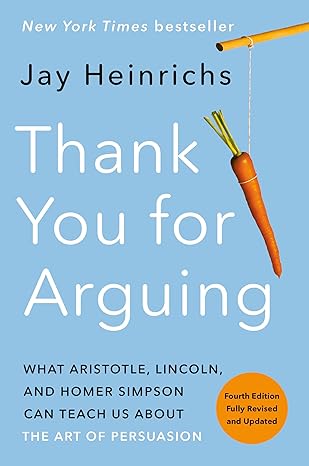
About Thank You for Arguing by Jay Heinrichs – A Smart and Practical Guide to Persuasion, Rhetoric, and Better Conversations
Thank You for Arguing by Jay Heinrichs is a practical guide to persuasion for people who want to speak, write, negotiate, and disagree more effectively. Instead of treating argument as shouting or fighting, Heinrichs shows how argument can be a useful skill. The goal is not simply to defeat another person. The goal is to understand an audience, choose the right words, build trust, use logic, and move a conversation toward a useful result.
The book brings ideas from classical rhetoric into modern life. Heinrichs explains techniques linked to Aristotle, Cicero, and other famous thinkers, then connects them with examples from politics, advertising, family life, popular culture, work, and everyday conversation. This makes an old subject feel much easier to understand.
Arguing Does Not Have to Mean Fighting
Many people hear the word “argument” and imagine anger. They think of two people raising their voices, repeating the same points, and leaving the room more upset than before.
Heinrichs uses the word differently.
In rhetoric, an argument is a form of persuasion. You are trying to move another person toward a choice, belief, feeling, or action. That can happen during a business meeting, a classroom discussion, a family talk, a sales conversation, a speech, an email, or even a small decision about where to eat.
This change in meaning is important because it solves a common problem. If you think every disagreement must become a fight, you may avoid difficult conversations or enter them too aggressively. The book teaches a third option: learn how persuasion works.
You can disagree without losing control. You can make a strong point without making the other person feel attacked. You can also notice when someone else is using persuasive techniques on you.
Learn the Three Main Tools of Persuasion
One of the clearest ideas in the book comes from classical rhetoric: ethos, pathos, and logos.
Ethos is about character and trust. Before people accept your message, they often need a reason to trust you. Heinrichs explains how credibility, values, and the way you present yourself can affect whether an audience listens.
Pathos is about emotion. People do not make every decision through logic alone. Feelings matter. A good persuader understands the emotional state of the audience and chooses language that fits the moment.
Logos is about reason. This includes evidence, examples, comparisons, and the structure of an argument. Logic helps a claim feel solid instead of empty.
These three tools are useful because they give readers a simple way to examine communication. When a message is not working, you can ask whether the problem is trust, emotion, logic, or a mix of all three.
Match the Argument to the Audience
Thank You for Arguing repeatedly shows that persuasion is not only about what you want to say. It is also about what your audience cares about. If you ignore their values, expectations, knowledge, or mood, even a strong point may fail.
This is useful at work, in school, and in normal life. A manager may need one kind of explanation. A customer may need another. A child, friend, teacher, or large audience may respond differently to the same idea.
Heinrichs encourages readers to pay attention before speaking. What does the other person want? What do they fear? What do they already believe? What kind of example will make sense to them?
This does not mean lying or pretending to believe something you do not. It means communicating in a way the other person can actually receive.
Timing Can Change the Result
Heinrichs spends time on timing because persuasion depends on more than words. A person who is angry, tired, embarrassed, or distracted may not be ready to listen. Sometimes the best move is to wait. Sometimes you need to change the mood before making the main point.
Classical rhetoric has long treated timing as part of effective persuasion, and the book turns that idea into practical advice.
Think about asking for something important. If you choose a bad moment, the answer may be no before your real argument even begins. If you understand the moment, the same request may receive a fair hearing.
This lesson is useful in negotiation, leadership, parenting, teamwork, sales, and personal relationships. Knowing what to say matters. Knowing when to say it can matter just as much.
Move From Blame Toward a Better Choice
One helpful difference in the book is the difference between arguing about the past and arguing about the future.
When people focus only on blame, they often become stuck. One person says, “You did this.” The other answers, “No, you did that.” The conversation becomes a trial about who was wrong.
Future-focused argument asks another question: what should we do next?
That small change can make a disagreement more useful. You may still need to understand what happened, but the conversation now has somewhere to go.
This is especially useful in teams and families. After a mistake, people can spend a long time protecting themselves. A better discussion may ask what rule, plan, or action will prevent the same problem from happening again.
Heinrichs helps readers see argument as a tool for decisions, not just a way to score points.
See the Tricks Other People Use
Learning persuasion is not only about becoming more convincing. It can also make you a more careful listener.
Advertisements, politicians, influencers, speakers, companies, and ordinary people all use persuasive techniques. Some are fair and useful. Others can hide weak ideas behind strong emotion or clever language.
Thank You for Arguing introduces readers to many rhetorical moves and shows how they work. The book includes memorable names and humorous examples, which can make the techniques easier to remember.
Once you begin noticing framing, emotional appeals, credibility signals, word choices, and audience targeting, messages can look different. You start asking why a speaker chose a certain phrase or why an advertisement makes one detail feel important while ignoring another.
That awareness can help you become harder to manipulate and better at judging the quality of an argument.
Useful for Writing, Speaking, and Presentations
Its lessons can help with essays, reports, emails, presentations, speeches, social posts, proposals, and other forms of writing. Good writing also needs an audience, a purpose, clear structure, and a reason for the reader to care.
Students can use rhetorical ideas to make essays stronger. Professionals can use them to write clearer proposals or explain a plan. Speakers can use them to organize a presentation and keep an audience interested.
The fourth edition also includes updated material on writing, speaking, framing, and other tools for modern persuasion.
This makes the book useful for anyone who wants communication skills that work in more than one setting. You can read a chapter, test one idea in your next conversation or piece of writing, and slowly build a stronger style.
Humor Makes a Serious Subject Easier to Learn
Heinrichs uses humor, family stories, political examples, famous figures, television characters, and other familiar references to explain complicated ideas. That helps the lessons feel more human.
The publisher describes the book as a master class in persuasion with examples ranging from major historical figures to popular culture. Techniques are often given memorable names, making them easier to recognize later.
This lighter style matters because a 480-page guide to rhetoric could easily feel heavy. Instead, the book tries to keep readers moving by mixing explanation with stories and jokes.
Who Should Read Thank You for Arguing?
This book is a strong choice for students, teachers, writers, speakers, managers, salespeople, marketers, entrepreneurs, debaters, content creators, and anyone who regularly needs to explain ideas to other people.
Students can use it to understand persuasive writing and classroom debate. Professionals may find it useful for meetings, negotiation, leadership, presentations, and workplace communication. Writers and marketers can learn how audience, framing, emotion, and credibility affect a message.
It can also help ordinary readers who simply want calmer conversations. You may want to ask for something without sounding demanding, disagree with a friend without creating a bigger fight, or explain your view more clearly.
A Premium Copy for Study and Rereading
Bookish Wonderland prepares this edition for readers who want a comfortable physical copy for regular use. It features premium eye-soothing cream paper, crystal-clear printing, and high-quality stitched and glue binding designed for better durability.
These qualities fit a practical reference book because many readers may return to individual chapters rather than read it once and forget it. You might underline a technique, mark a page before a presentation, or revisit a section when preparing for an important conversation.
The softer paper tone can support longer reading sessions, while sharp print helps examples and definitions stay easy to follow. Strong binding helps the book remain useful through repeated study.
Looking for Thank You for Arguing by Jay Heinrichs Price in Bangladesh?
If you are comparing the Book price in Bangladesh for Thank You for Arguing by Jay Heinrichs, consider how often you may return to the book.
Unlike a guide that gives one lesson and ends, this title contains many techniques that can be revisited before writing, presenting, negotiating, or having an important conversation. A clear physical copy can therefore remain useful long after the first read.
Bookish Wonderland aims to balance price with comfortable paper, clean printing, and durable binding. Check the current product listing for the latest selling price because book prices can change with stock, printing, edition, and supply conditions.
Easy Ordering Across Bangladesh
Bookish Wonderland offers nationwide delivery, including delivery inside and outside Dhaka. Cash on Delivery is available across Bangladesh, allowing readers to order without paying online first.
Fast or urgent delivery may also be available in Dhaka when you need the book sooner for class, work, a presentation, a debate, or a gift.
If you need customization or have a question about your order, you can contact Bookish Wonderland through its available Facebook or Instagram support channels.
Turn Everyday Disagreement Into a Useful Skill
Instead of seeing every disagreement as a battle, the book shows how persuasion can be a practical form of communication. You learn to think about trust, emotion, logic, timing, audience, framing, and the goal of the conversation.
The strongest lesson may be that winning is not always about making another person look wrong. A better win is moving people toward a useful decision without creating unnecessary anger.
That skill matters almost everywhere. Students need it in essays and debates. Professionals need it in meetings and presentations. Leaders need it when guiding people. Writers need it when building a case. Families and friends need it when they disagree.
If you want to speak with more purpose, write with more force, recognize persuasive tricks, and handle disagreement with greater control, this book gives you a lively introduction to rhetoric that you can use in real life.
Order Thank You for Arguing by Jay Heinrichs from Bookish Wonderland today and start turning difficult conversations into clearer, smarter, and more productive ones.
If you require any customization or have any questions, please inbox us via FB or Insta.
| Primary Specification | |
| Author | Jay Heinrichs |
| Narrator | Jay Heinrichs |
| Genre | Nonfiction, Rhetoric, Communication, Persuasion, Self-Help |
| ISBN-13/ISSN | 978-0141994079 |
| ISBN-10 | 014199407X |
| Publisher | Penguin Books Ltd |
| Publishing Date | April 23, 2020 |
| Language | English |
| Reading Age | 18+ |
| Format | Printed Book |
| Physical Specification & Quality | |
| Paper Quality | Premium eye-soothing cream paper |
| Binding Quality | High quality stitched and glue binding (for longevity) |
| Print Quality | Crystal-clear print |
| Pages | 480 pages |
| Country | USA |
| Logistics Information | |
| Weight | 505 gm |
| Length | 8.5 inches |
| Width | 5.6 inches |
| Height | 0.91 inch |