

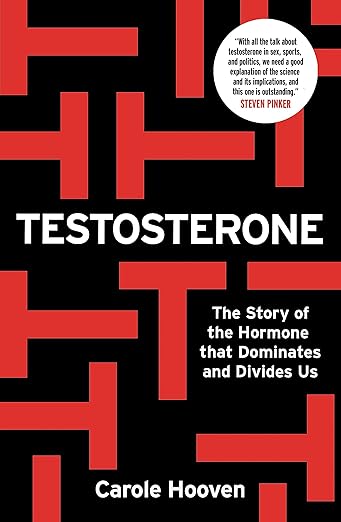
About Testosterone: The Story of the Hormone that Dominates and Divides Us by Carole Hooven – A Clear Guide to Hormones, Behavior, Biology, and Human Differences
Testosterone: The Story of the Hormone that Dominates and Divides Us by Carole Hooven is a science book about one of the most famous and misunderstood hormones in the human body. Carole Hooven uses research, history, animal studies, and personal stories to explain what testosterone is, what it does, and why people argue so much about its effects.
The book looks at testosterone in both males and females and explores its links with the body, reproduction, competition, aggression, sexual behavior, status, and development. It also asks how biology works together with culture, learning, and individual experience.
This is not a book saying that one hormone controls every person. Instead, Hooven argues that testosterone can influence important patterns while people still differ widely from one another. The result is a readable introduction to a subject that sits between biology, psychology, evolution, and society.
When Headlines About Testosterone Feel Too Simple
Testosterone is often talked about as if it explains everything. One headline may call it the hormone of aggression. Another may connect it with strength, confidence, sex, sports, or masculinity. Social media can make the subject even more confusing because strong claims spread faster than careful explanations.
This book gives readers a longer view.
Hooven asks what scientists actually know, how they know it, and where the evidence comes from. She looks at experiments, medical cases, animal research, human studies, history, and her own experience studying chimpanzees.
That approach helps readers move beyond easy slogans. Testosterone matters, but biology is not a simple switch. Hormones work inside bodies that are also shaped by genes, age, health, environment, learning, relationships, and culture.
For readers who want a clear starting point before judging big claims about testosterone, this book offers useful context.
What Testosterone Actually Is
Testosterone is an androgen, a type of steroid hormone. Both males and females produce it, although average levels differ greatly between the sexes, especially after puberty.
In males, the testes are the main source. Smaller amounts are also produced elsewhere in the body, and females produce testosterone too. The hormone is involved in reproductive development and many physical processes.
The book explains how testosterone helps shape male reproductive anatomy and puberty, and how it can affect traits such as muscle, voice, body hair, sexual function, and other parts of physiology.
Hooven then moves into harder questions about behavior.
Does testosterone make someone aggressive? Does it change risk taking? Does it affect sexual desire, competition, or the search for status? These questions are harder because human behavior is shaped by many things at the same time.
The book's value comes from showing readers that biological influence does not mean simple control.
From Chimpanzees to Human Behavior
Hooven's background in evolutionary biology gives the book a wide frame. She writes about work with chimpanzees in Uganda and explains why studying other animals can help scientists ask questions about human evolution.
Chimpanzees do not give direct answers about people. Humans have language, culture, laws, technology, and social systems that make our lives very different. Still, humans are animals too, and comparing species can help researchers understand how hormones may have developed and why certain patterns appear across different animals.
The book discusses competition, mating, reproduction, dominance, and aggression in this evolutionary context.
For readers who enjoy biology, this makes the subject larger than a simple health lesson. Testosterone becomes part of a story about how bodies and behavior developed over very long periods of time.
Biology and Culture Are Not Enemies
A major idea in the book is that biology and culture do not have to cancel each other out.
People sometimes talk as if a trait must come from nature or from society, but real human behavior is usually more complicated. Biological factors can influence tendencies while culture changes how those tendencies are expressed, encouraged, controlled, or understood.
Hooven argues that testosterone works together with genes and culture to help produce the wide variety of human behavior we see.
This distinction matters.
Saying that biology influences an average difference does not mean every individual fits the average. It also does not mean a behavior is good, fixed, or impossible to change. Description is not the same as approval.
That makes the book useful for readers who want to think more carefully about the nature versus nurture debate without reducing everything to one side.
Why Average Differences Need Careful Reading
The book discusses differences between males and females, but averages can easily be misunderstood.
Two groups can have different averages while still having large overlap between individuals. A difference between groups does not tell you exactly what one person will be like.
This is a useful lesson beyond testosterone. Statistics describe patterns, not destinies.
A reader may come to the book expecting simple statements about men and women. Instead, the subject becomes more detailed. Hormone levels vary. People vary. Social settings vary. The same biological system can produce different behavior depending on context.
This helps make the book a better tool for discussion because it encourages readers to separate population patterns from assumptions about individuals.
The History of Testosterone Is Full of Strange Ideas
Hooven also looks backward.
Long before scientists knew the word testosterone, people noticed that the testes were connected with male development and reproduction. Historical practices involving eunuchs, castration, fertility, and attempts to restore youth all became part of the long story that eventually led to modern hormone science.
The book shows how people moved from observation and myth toward laboratory research and endocrinology.
That history makes the science easier to remember because it gives the hormone a human story. People have been curious about sex, strength, fertility, aging, and behavior for centuries. Modern research did not appear from nowhere. It grew from older questions, mistakes, experiments, and discoveries.
Why This Book Can Start Good Discussions
Testosterone touches subjects that can become sensitive very quickly.
People connect it with sex differences, gender, sports, aggression, sexuality, parenting, social roles, and identity. These topics can bring strong opinions.
A useful science book should therefore do more than give readers claims to repeat. It should help them ask better questions.
What does a study actually measure? Is it showing correlation or cause? How large is the effect? Does an average difference apply to every person? Could environment change the outcome? Are we describing behavior or saying what people should do?
Those questions help readers approach controversial subjects with more care.
Not a Simple Guide to Raising Testosterone
Readers should know what this book is not.
It is not a medical guide for diagnosing low testosterone. It is not a supplement manual, bodybuilding plan, or hormone treatment handbook. It does not replace advice from a qualified medical professional.
Its main purpose is to explain the science and history of testosterone and explore how the hormone relates to bodies and behavior.
That makes it better suited to readers interested in biology, psychology, evolution, human behavior, and social debate than to someone looking for personal medical treatment instructions.
Who Will Enjoy This Book Most?
This book is a strong choice for readers who enjoy popular science, evolutionary biology, psychology, human behavior, endocrinology, and books that explain difficult ideas through stories.
Students may find it useful as an accessible introduction before moving into more technical material. Teachers and book clubs can use it to start discussions about hormones, evolution, sex differences, research methods, and the way scientific findings enter public debate.
Readers who often hear confident claims about testosterone online may also find value in seeing a longer explanation of the evidence and its limits.
The book may be especially interesting for people who enjoy writers who combine scientific research with field experience and historical examples.
It is also a useful pick for curious readers who want science explained without heavy textbook language. The book gives enough background to follow the main ideas, while still leaving room to question claims, compare evidence, and think carefully about complexity.
A Comfortable Edition for Detailed Reading
Bookish Wonderland prepares this edition for readers who want a clean physical copy for focused reading. It uses premium eye-soothing cream paper, crystal-clear printing, and high-quality stitched and glue binding designed for better durability.
A science book often invites slower reading than a light novel. You may want to pause at a study, revisit a chapter, underline a point, or compare one idea with another. Comfortable paper and sharp printing can make that experience easier, while a strong binding helps the copy stay useful through repeated reading.
The clean finish also makes it suitable for a personal nonfiction shelf, study collection, or gift for a reader who enjoys science and human behavior.
Looking for Testosterone by Carole Hooven Price in Bangladesh?
If you are comparing the Book price in Bangladesh for Testosterone: The Story of the Hormone that Dominates and Divides Us by Carole Hooven, consider the reading value as well as the price.
This is the kind of nonfiction title readers may return to when discussing biology, behavior, evolution, or social debates. A comfortable page, clear print, and durable binding can therefore matter over time.
Bookish Wonderland aims to balance reading quality, durability, and value. Check the current product listing for the latest selling price because book prices can change with stock, printing, edition, and supply conditions.
Easy Ordering Across Bangladesh
Bookish Wonderland offers nationwide delivery, including delivery inside and outside Dhaka. Cash on Delivery is available across Bangladesh, so readers can order without paying online first.
Fast or urgent delivery may also be available in Dhaka when you need the book sooner for study, gifting, research, or personal reading.
If you need customization or have a question about your order, you can contact Bookish Wonderland through its available Facebook or Instagram support channels.
Read the Science Behind a Hormone Everyone Talks About
Testosterone is famous, but fame does not always bring understanding.
People often use the hormone as a quick explanation for strength, aggression, sex, competition, masculinity, and many other parts of life. Carole Hooven asks readers to slow down and look at the evidence.
Her book moves from animals and evolution to human development, history, behavior, and modern social questions. It shows why testosterone matters while also making clear that human beings are shaped by more than one hormone.
That balance is what makes the book worth reading. You do not have to accept every interpretation without question. In fact, a good science reader should compare evidence, notice uncertainty, and stay open to new research.
If you want an accessible nonfiction book that helps you understand testosterone beyond internet myths and simple slogans, this title can be a valuable addition to your shelf.
Order Testosterone: The Story of the Hormone that Dominates and Divides Us by Carole Hooven from Bookish Wonderland and explore the biology behind one of the most discussed hormones in human life.
If you require any customization or have any questions, please inbox us via FB or Insta.
| Primary Specification | |
| Author | Carole Hooven |
| Narrator | Rachel Perry |
| Editor | Kelly S. Too |
| Genre | Popular Science, Biology, Human Physiology;Endocrinology, Evolutionary Biology |
| ISBN-13/ISSN | 978-1250811455 |
| ISBN-10 | 1250811457 |
| Publisher | Holt Paperbacks |
| Publishing Date | July 5, 2022 |
| Language | English |
| Reading Age | 16+ |
| Format | Printed Book |
| Physical Specification & Quality | |
| Paper Quality | Premium eye-soothing cream paper |
| Binding Quality | High quality stitched and glue binding (for longevity) |
| Print Quality | Crystal-clear print |
| Pages | 352 pages |
| Country | UK |
| Logistics Information | |
| Weight | 373 gm |
| Length | 8.5 inches |
| Width | 5.6 inches |
| Height | 0.88 inch |