

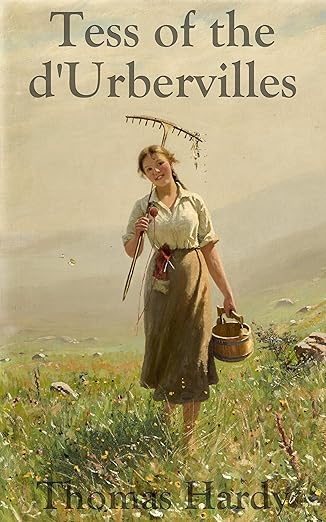
About Tess of the d'Urbervilles by Thomas Hardy – A Powerful Classic About Love, Injustice, Choice, and a Young Woman Fighting for Dignity
Tess of the d'Urbervilles by Thomas Hardy is a classic English novel about Tess Durbeyfield, a young woman whose life changes after her family learns of a possible link to the old d'Urberville name. Because her family is poor, Tess is pushed toward wealthy people who use that name. There she meets Alec d'Urberville, a man whose actions bring fear, pain, and lasting consequences into her life.
Later, Tess tries to begin again. She works at a dairy and meets Angel Clare, a thoughtful young man who seems to offer love and a new future. But Tess carries a painful past, and the world around her judges women by rules that are harsh, unequal, and difficult to escape.
Hardy turns Tess's story into much more than a romance. The novel asks who gets blamed when power is unequal, why society forgives men more easily than women, and whether a person should be judged by what was done to them.
A Classic That Feels Personal Instead of Distant
Some classic novels can feel far away because the language, setting, and social rules belong to another century. Tess of the d'Urbervilles is different because the emotions at its center are easy to understand.
Tess wants to help her family. She wants to work honestly. She wants to be loved without being punished for her past. She wants the chance to begin again.
Those wishes are simple, but the world around her keeps making them difficult.
Hardy shows how money, class, gender, family pressure, and social judgment can shape a person's choices. Tess is often asked to carry the cost of decisions made by other people. This makes the story painful, but it also makes her dignity stand out.
The book itself shows how the social rules work and why they matter.
Tess Durbeyfield Is the Heart of the Novel
Tess is one of Thomas Hardy's most famous characters because she feels both strong and vulnerable.
She is kind, hardworking, sensitive, and deeply aware of the people around her. She often puts family needs before her own comfort. At the same time, she is not a perfect symbol. She can feel fear, shame, hope, anger, love, and confusion.
That human mixture makes her memorable.
Hardy gave the novel the subtitle “A Pure Woman Faithfully Presented,” a bold statement in a time when readers could easily judge Tess by strict ideas about female respectability. The subtitle asks the reader to look beyond society's labels and see Tess as a person.
A person's worth should not be decided by gossip, class, or a past shaped by someone else's power.
Alec d'Urberville Brings Power and Danger
Alec enters Tess's life when she goes to seek help from the wealthy d'Urberville family.
He has money, confidence, and social power that Tess does not have. His pursuit of her is one of the darkest parts of the novel. Modern readers commonly discuss these scenes in terms of sexual coercion and violence, and the consequences shape much of Tess's later life.
He shows how deeply it affects Tess and how unfairly society places shame on her.
Readers should know before buying that the story includes sexual violence, exploitation, death, and emotional suffering.
The subject matter is heavy, but Hardy uses it to criticize a social system that protects powerful men while judging women more harshly.
Angel Clare Seems to Offer a New Beginning
When Tess later works at Talbothays Dairy, the tone of the novel changes.
The countryside feels brighter. Tess meets Angel Clare, and their relationship grows slowly.
Angel is different from Alec. He is thoughtful, educated, and interested in ideas that do not always match the expectations of his family. Tess comes to love him deeply.
But Angel also has limits.
The novel becomes especially painful when Tess tries to be honest about her past. Hardy uses their relationship to expose a double standard: men can expect forgiveness for their own mistakes while refusing the same understanding to women.
His love is real, but his ideas about purity and marriage are shaped by the society around him.
Wessex Gives the Story a Rich Sense of Place
Thomas Hardy set many of his novels in Wessex, his fictional name for a region based largely on southwest England.
In Tess of the d'Urbervilles, fields, farms, roads, villages, seasons, and changing landscapes are never just decoration. They affect the mood of the story.
In other places, hard work, bad weather, and difficult land make Tess's struggle feel even heavier.
Hardy was deeply influenced by Dorset and the rural world he knew. His descriptions help readers see a society changing as older farming life meets modern machines and new economic pressures.
For readers who enjoy novels where nature feels almost like another character, this is one of Hardy's great strengths.
The Book Questions Class and Family Pride
Tess's troubles begin partly because her father learns that the Durbeyfields may be descended from an old aristocratic family.
The news sounds exciting, but it does not give the family real wealth or power.
Hardy uses this to question class pride. A noble ancestor means little when a family needs food, work, and security.
The false glamour of the d'Urberville name also becomes important because the wealthy people Tess meets are not actually the ancient family her parents imagine.
This creates a sharp contrast between names and reality.
The novel keeps asking what truly gives a person value. Is it family history? Money? Reputation? Social approval? Or character?
Tess may have little money and little power, but Hardy repeatedly asks readers to see the moral worth that society fails to protect.
A Story About Injustice as Much as Love
It is easy to describe Tess of the d'Urbervilles as a tragic love story, but romance is only one part of it.
The deeper story is about unequal power.
Tess faces pressure from family, men, money, work, and social rules. When something goes wrong, the people with more power often have more choices. Tess has fewer.
That pattern gives the novel its anger.
Hardy shows how a society can call itself moral while treating vulnerable people without compassion. He asks why women are judged more strictly for sexual behavior, why poverty can force people into dangerous choices, and why respectability can matter more than kindness.
These questions are one reason the book remains widely studied today.
Why Modern Readers Still Talk About Tess
The novel first appeared in 1891, but many of its questions remain familiar.
People still argue about victim blaming. Women are still judged differently from men in many cultures. Money and social status still affect who gets believed, protected, or forgiven. People still struggle to escape labels placed on them by others.
Tess's story gives these issues a human face.
The book does not use modern language for every problem, and some parts reflect the ideas of Hardy's own time. That makes it useful to read both as a story and as a historical work.
Readers can admire Hardy's criticism of Victorian morality while also asking how interpretations of gender, consent, class, and justice have changed since the nineteenth century.
Who Will Enjoy Tess of the d'Urbervilles Most?
This novel is a strong choice for readers who enjoy English classics, tragic romance, literary fiction, Victorian literature, social criticism, rural settings, and character-driven stories.
Students may find it especially useful because the book offers many themes for study, including class, gender, fate, nature, religion, morality, industrial change, and social hypocrisy.
Book clubs can also find plenty to discuss. Was Tess given a fair chance? How should readers judge Angel? How does Hardy use nature? Is fate controlling the story, or are human choices responsible for what happens?
Readers should know that this is not a light romance. It contains sexual violence, grief, death, poverty, rejection, and tragedy. The emotional weight is part of what makes the novel powerful.
A Premium Copy for Long, Thoughtful Reading
Bookish Wonderland prepares this edition for readers who want a comfortable physical copy for regular reading. It uses premium eye-soothing cream paper, crystal-clear printing, and high-quality stitched and glue binding designed for better longevity.
The softer page tone can make longer reading sessions more comfortable, while sharp printing keeps Hardy's detailed prose easy to follow. Strong binding is useful for a classic that readers may underline, study, reread, lend, or keep for years.
The clean finish also makes the book suitable for a personal classics shelf, academic reading, or gifting to someone who enjoys serious literature.
Looking for Tess of the d'Urbervilles by Thomas Hardy Price in Bangladesh?
If you are comparing the Book price in Bangladesh for Tess of the d'Urbervilles by Thomas Hardy, consider the exact edition and physical reading quality as well as the selling price.
This classic appears in many editions, and page count, notes, introductions, cover design, and formatting can differ. A comfortable copy with clear print and durable binding can be especially useful if you plan to study the novel or keep it for years.
Bookish Wonderland aims to balance reading comfort, durability, and value. Check the current product listing for the latest selling price because prices can change with stock, edition, printing, and supply conditions.
Easy Ordering Across Bangladesh
Bookish Wonderland offers nationwide delivery, including addresses inside and outside Dhaka. Cash on Delivery is available across Bangladesh, so readers can order without paying online first.
Fast or urgent delivery may also be available in Dhaka when you need the book sooner for study, gifting, a reading group, or personal reading.
If you need customization or have a question about the exact edition, contact Bookish Wonderland through its available Facebook or Instagram support channels before ordering.
Read a Classic That Refuses to Judge Tess the Easy Way
Tess of the d'Urbervilles by Thomas Hardy lasts because Tess is more than the tragic young woman society tries to define.
She works, loves, hopes, makes choices, suffers from other people's choices, and keeps trying to build a life even when the world gives her fewer chances than the people around her.
Hardy's novel asks the reader to look past labels and see the person underneath.
That makes the story painful, but it also gives it lasting power. Alec shows what unequal power can do. Angel shows how even a loving person can be shaped by unfair social ideas. Tess stands between them, trying to live with dignity in a world that judges her before it understands her.
If you want a classic that combines tragic romance, beautiful rural writing, social criticism, memorable characters, and serious questions about justice, this title deserves a place on your shelf.
Order Tess of the d'Urbervilles by Thomas Hardy from Bookish Wonderland and enter one of English literature's most moving stories about love, judgment, hardship, and the right to be seen as more than your past.
If you require any customization or have any questions, please inbox us via FB or Insta.
| Primary Specification | |
| Author | Thomas Hardy |
| Narrator | Stephen Jack |
| Editor | Tim Dolin |
| Genre | Classic Fiction, Literary Fiction, Tragedy, Social Novel / Romantic Suspense |
| ISBN-13/ISSN | 978-0141439594 |
| ISBN-10 | 0141439594 |
| Publisher | Penguin Classics |
| Publishing Date | May 27, 2003 |
| Language | English |
| Reading Age | 16+ |
| Format | Printed Book |
| Physical Specification & Quality | |
| Paper Quality | Premium eye-soothing cream paper |
| Binding Quality | High quality stitched and glue binding (for longevity) |
| Print Quality | Crystal-clear print |
| Pages | 592 pages |
| Country | USA |
| Logistics Information | |
| Weight | 612 gm |
| Length | 8.5 inches |
| Width | 5.6 inches |
| Height | 1.06 inch |