

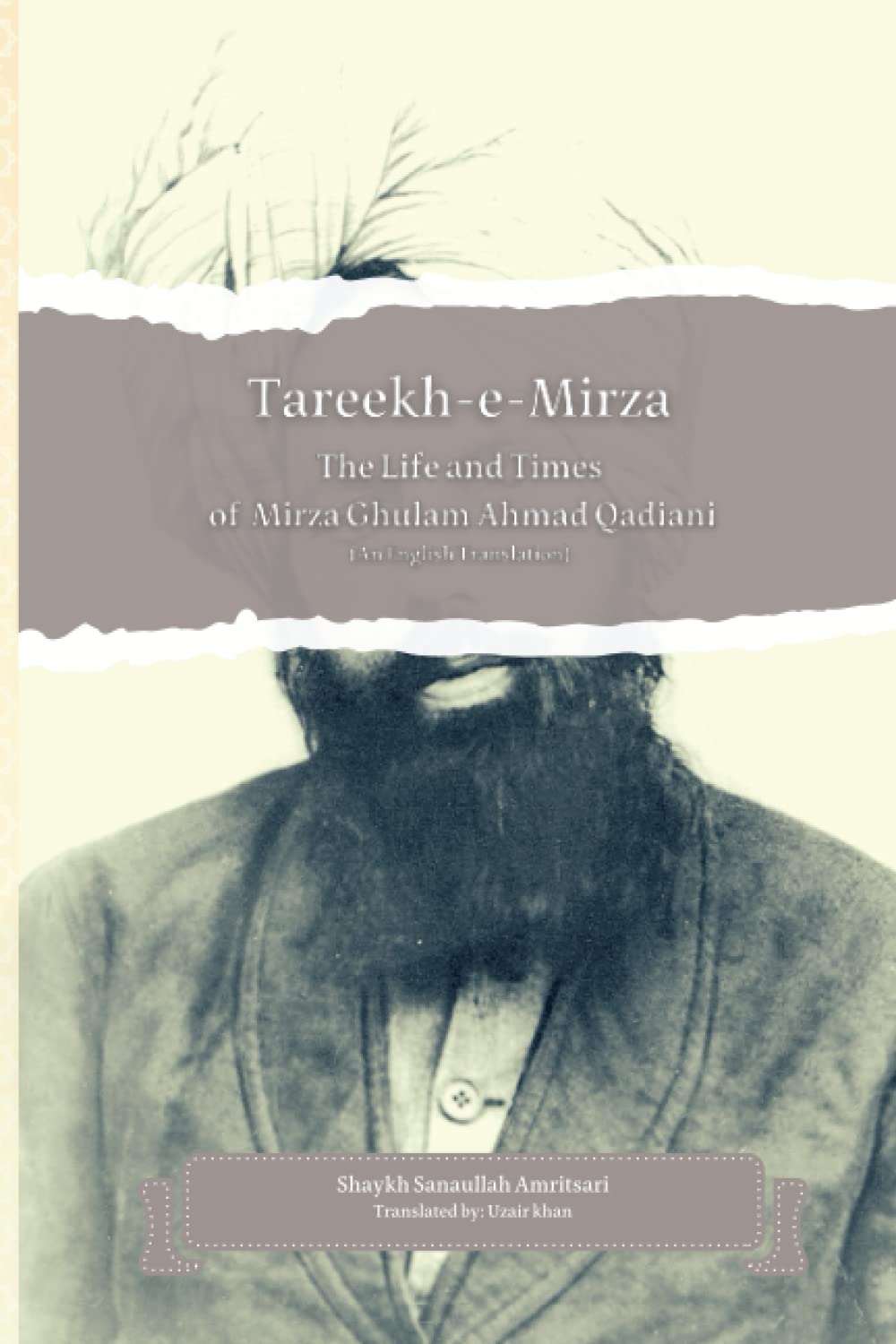
About Tareekh-e-Mirza by Shaykh Sanaullah Amritsari – A Historical Study of Mirza Ghulam Ahmad
Tareekh-e-Mirza by Shaykh Sanaullah Amritsari is an important Urdu religious and historical work about the life, statements, beliefs, and claims of Mirza Ghulam Ahmad of Qadian. Written by the well-known Muslim scholar Maulana Abul Wafa Sanaullah Amritsari, the book studies its subject from a Sunni Ahl-e-Hadith viewpoint.
The author follows important events from Mirza Ghulam Ahmad’s birth to his death. He also discusses the changes that he believed appeared in Mirza Ghulam Ahmad’s ideas and religious claims over time. Instead of presenting only a simple life story, the book examines published statements, historical incidents, written exchanges, and matters of religious debate.
The original Urdu work was first published in Lahore in 1919. A surviving early edition listed by Rekhta contains 68 pages and was published by Matba Lal Steem Press. Other editions have different page counts, including a later 72-page printing, so the exact number of pages depends on the edition offered.
This is a serious book for readers interested in Islamic history, the religious movements of the Indian subcontinent, Qadianism, Ahmadiyya-related debates, and the scholarly work of Shaykh Sanaullah Amritsari.
Understand a Difficult Part of South Asian Religious History
Many readers hear the names Mirza Ghulam Ahmad and Shaykh Sanaullah Amritsari but do not know the history behind their famous disagreements. Information found online is often scattered across short posts, videos, quotations, and arguments. These pieces may not explain how the debate developed or why it became important.
Tareekh-e-Mirza brings the author’s historical account into one focused book. It helps readers explore how Shaykh Sanaullah Amritsari understood the rise of Mirza Ghulam Ahmad, his changing religious claims, and the public discussions that followed.
The work is especially useful for readers who want to study the subject through an early Sunni critic who lived during the same broad historical period. Sanaullah Amritsari was not writing many years after the events as a distant observer. He participated in the religious debates of his time and had direct knowledge of the public arguments surrounding the Qadian movement.
However, readers should understand the nature of the book before purchasing it. This is not a neutral modern biography. It is a critical and polemical historical work written from the author’s Sunni Muslim position. Its purpose is to examine and challenge Mirza Ghulam Ahmad’s ideas and claims. Reading it with this context will help students evaluate its arguments more carefully.
What Is Tareekh-e-Mirza About?
The title Tareekh-e-Mirza can be understood as “The History of Mirza.” The book records events connected with Mirza Ghulam Ahmad of Qadian, beginning with his early life and continuing to his death. Its longer Urdu description says that it contains verified accounts of Mirza Ghulam Ahmad, who claimed to be the Messiah and Mahdi.
A major focus of the book is the difference that Sanaullah Amritsari saw between Mirza Ghulam Ahmad’s earlier ideas and his later claims. The author brings together statements and references to show how he believed those views developed. Rekhta describes the work as a historical treatise compiled from authenticated writings, with special attention to differences before and after the claim of Messiahship.
The book also reflects the culture of religious discussion in colonial South Asia. During that period, scholars often answered one another through books, newspapers, letters, public challenges, and formal debates. Tareekh-e-Mirza belongs to that tradition. It is therefore valuable not only as a theological response but also as a document showing how religious disagreements were recorded and presented at the time.
Readers will find a work built around historical claims, textual evidence, personal observation, and religious criticism. It asks readers to look closely at words, dates, changes in position, and the relationship between claims and established Islamic teachings.
A Book Written by a Scholar of His Time
Shaykh Sanaullah Amritsari, also known as Abul Wafa Sanaullah Amritsari, was born in 1868 and died in 1948. He worked as a Qur’an commentator, Hadith scholar, writer, journalist, historian, public speaker, and religious debater.
His writings covered several areas of Islamic thought. Among his best-known works are Tafsir-e-Sanai, Tafsir al-Qur’an bi Kalam al-Rahman, Haq Prakash, and Muqaddas Rasool. His debates and writings concerning Mirza Ghulam Ahmad became a particularly famous part of his public life, and Tareekh-e-Mirza is recognized as one of his prominent works.
Sanaullah Amritsari also founded the Urdu weekly newspaper Ahl-e-Hadith in 1903. His long experience in journalism helped shape his direct writing style and his habit of responding to current religious questions through published evidence.
Because he lived close to the events discussed, his account gives readers access to the voice of an active participant. That closeness makes the book historically interesting, although it also means that its arguments come from a clearly committed point of view.
Why This Book Still Attracts Readers
The questions discussed in Tareekh-e-Mirza remain important to people studying modern Islamic movements. Readers still ask how the Qadian movement began, how Mirza Ghulam Ahmad’s claims changed, and why leading Muslim scholars opposed those claims.
This book offers one influential Sunni response to those questions. It presents the author’s case in a compact form rather than requiring readers to search through many separate publications.
For students, the book can serve as a starting point for deeper study. It introduces names, events, arguments, and written sources that can then be compared with other historical works. Researchers may also use it to understand how early twentieth-century Muslim scholars discussed religious authority and the meaning of prophethood, Messiahship, and Mahdiship.
General readers may appreciate its direct approach. The book is much shorter than a large academic history, but it covers a subject with wide religious and historical importance. It can therefore be read within a manageable period while still giving the reader many points to think about.
Important Features of the Book
Tareekh-e-Mirza by Shaykh Sanaullah Amritsari offers several qualities that make it useful for the right reader:
- It presents a chronological account covering Mirza Ghulam Ahmad’s life from birth to death.
- It discusses changes that the author identified in Mirza Ghulam Ahmad’s views and claims.
- It uses references to writings, statements, and historical incidents.
- It records the response of an important Sunni scholar who lived close to the events.
- It offers insight into religious debates in the Indian subcontinent.
- It is written in Urdu, making the original argument accessible to Urdu readers.
- It is suitable for personal study, research, discussion, and reference.
- It brings a complex historical disagreement into one focused volume.
The original publication was a short historical treatise, but the meaning of its subject is much larger than its physical size. Readers should move through it slowly, note the sources mentioned, and compare difficult points with other historical records.
What Readers Can Learn from It
The first benefit of this book is historical understanding. It helps readers see that major religious movements do not appear in isolation. They develop through books, public claims, supporters, critics, social conditions, and long exchanges of ideas.
The second benefit is familiarity with primary-era religious writing. Although the book is written from a strong critical position, it allows readers to encounter the language and concerns of a scholar connected to the events. This is different from reading only a recent summary.
The third benefit is the development of careful reading. The author asks readers to compare earlier and later statements. This encourages attention to dates, context, wording, and evidence.
The fourth benefit is a better understanding of Shaykh Sanaullah Amritsari himself. Readers can observe the type of argument, source use, and direct language that made him a significant religious writer and debater.
The fifth benefit is convenience. Instead of collecting many separate articles about the historical disagreement, readers receive a compact study that introduces its main points in one place.
Who Should Read Tareekh-e-Mirza?
This book is suitable for adult readers interested in Islamic history and theology. It may be particularly useful for:
- Students researching religious movements in colonial India
- Readers studying Qadianism or the Ahmadiyya movement
- People interested in Sunni responses to Mirza Ghulam Ahmad
- Students of Ahl-e-Hadith scholarship and intellectual history
- Researchers studying religious debate and print culture
- Readers exploring the writings of Sanaullah Amritsari
- Teachers preparing lessons on South Asian Islamic history
- Personal collectors of classical Urdu religious literature
It is not designed as a light story or a fictional biography. The content deals with doctrinal disagreements, historical claims, and criticism. Younger readers may need help from a teacher or knowledgeable adult because some of the religious ideas and historical references require background knowledge.
Readers who want a balanced academic study should use this book alongside works representing other views. Doing so helps separate historical facts, interpretations, and polemical arguments. This does not reduce the book’s importance; it simply allows the reader to understand exactly what kind of source it is.
Useful for Study, Research, and Discussion
For personal study, readers can underline names, dates, claims, and references. A notebook can help record the author’s main points and any questions that require further research.
For classroom use, a teacher can select sections that show how printed religious debates worked in the early twentieth century. Students can compare the author’s style with modern academic writing and discuss the difference between a participant’s account and a neutral historical analysis.
For research, the book may be used as a primary-era source reflecting the Sunni polemical response to the Qadian movement. Researchers should verify quotations against the edition they are using because pagination may differ between printings.
For group discussions, the book can lead to careful conversations about evidence, religious authority, historical method, and respectful disagreement. Such discussions should focus on understanding the text and its context rather than attacking individual readers or communities.
For book collectors, it represents an important title in the written legacy of Shaykh Sanaullah Amritsari. It can sit alongside his Qur’anic commentaries, theological responses, and other works concerning the religious debates of his period.
Made for Comfortable and Regular Reading
Bookish Wonderland offers this title for readers who want a clean and durable printed book. The premium eye-soothing cream paper gives the pages a soft appearance and can feel more comfortable during longer reading sessions.
Crystal-clear printing keeps the Urdu text sharp and easy to follow. This is particularly important in a religious and historical work, where readers may need to examine words, quotations, names, and references carefully.
The high-quality stitched and glue binding is designed for longevity. It helps the pages remain secure through repeated reading, note-taking, study sessions, and careful storage. The book can therefore become a useful part of a personal, family, madrasa, or research collection.
These physical qualities make the edition suitable for readers who prefer a printed copy instead of reading a long digital scan on a phone. A physical book is easier to mark, revisit, lend, and place on a reference shelf.
Why Order from Bookish Wonderland?
Bookish Wonderland provides a large collection of premium and durable English, Urdu, and educational books for readers across the country. Each available edition is prepared with attention to reading comfort, printing clarity, and binding strength.
Customers can enjoy:
- Premium eye-soothing cream paper
- Crystal-clear and easy-to-read printing
- High-quality stitched and glue binding for longevity
- Nationwide delivery across Bangladesh
- Delivery inside and outside Dhaka
- Cash on Delivery across Bangladesh
- Fast or urgent delivery options in Dhaka, subject to availability
- Customer support through Facebook and Instagram
When checking the Tareekh-e-Mirza by Shaykh Sanaullah Amritsari book price in Bangladesh, remember that a good reading copy should offer more than a low price. Clear text, comfortable paper, and durable binding can make a major difference, especially when the book is used for serious study.
Publication and Edition Note
The documented 1919 edition was published in Lahore by Matba Lal Steem Press and contains 68 pages. A bibliographic record also identifies a fifth edition published in Delhi in 1992 by Maktaba Maulana Sanaullah Amritsari Academy. Another source describes a fourth edition issued in 1973 by Al-Maktabah Al-Salafiyyah after its references received additional checking. Edition details and page numbers may therefore vary between copies.
Customers should rely on the specifications shown for the particular Bookish Wonderland copy when exact page count, dimensions, publisher, or edition information is important.
What books are in the Tareekh-e-Mirza series by Shaykh Sanaullah Amritsari?:
Tareekh-e-Mirza is not verified as part of a numbered series. It is a standalone historical and religious book.
Add This Important Historical Work to Your Collection
Tareekh-e-Mirza is a meaningful choice for readers who want to study Mirza Ghulam Ahmad through the writings of one of his best-known Sunni critics. It is compact enough for focused reading yet important enough to support deeper research into Islamic thought and South Asian religious history.
The book gives readers an early historical voice, a clear critical position, and a collection of arguments connected with one of the region’s most discussed religious movements. It can help students understand the debate, help researchers locate important historical questions, and help general readers learn why Sanaullah Amritsari became closely associated with opposition to Qadianism.
Order your copy from Bookish Wonderland and enjoy premium cream paper, crystal-clear printing, and a strong stitched and glue binding made for lasting use. Cash on Delivery and nationwide delivery are available. Fast or urgent delivery may also be arranged within Dhaka.
If you require any customization or have any questions, please inbox us via FB or Insta.
| Primary Specification | |
| Author | Shaykh Sanaullah Amritsari |
| Translator | Uzair Khan |
| Genre | Biography, Islamic History, Religious Studies |
| ISBN-13/ISSN | 979-8373275910 |
| Publisher | Independently published |
| Publishing Date | January 12, 2023 |
| Language | English |
| Reading Age | 11+ years |
| Format | Printed Book |
| Physical Specification & Quality | |
| Paper Quality | Premium eye-soothing cream paper |
| Binding Quality | High quality stitched and glue binding (for longevity) |
| Print Quality | Crystal-clear print |
| Pages | 85 pages |
| Country | India |
| Logistics Information | |
| Weight | 101 gm |
| Length | 8.5 inches |
| Width | 5.6 inches |
| Height | 0.2 inch |