Skip to product information
1 of 1

Bookish Wonderland

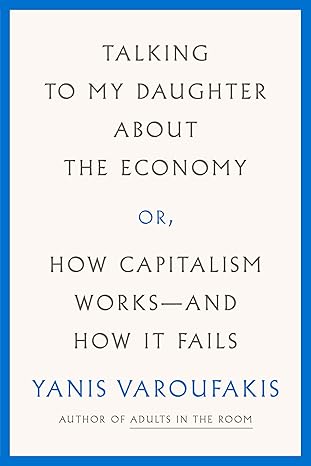
Talking to My Daughter about the Economy by Yanis Varoufakis

Talking to My Daughter about the Economy by Yanis Varoufakis

Regular price Tk 152.00 BDT
Regular price Sale price Tk 152.00 BDT
Sale Sold out
Book cover type
Quantity

Talking to My Daughter About the Economy is Yanis Varoufakis’s accessible explanation of how modern economies, markets, money, debt, banks, inequality, and capitalism developed. Addressing his daughter directly, Varoufakis avoids technical jargon and uses history, mythology, literature, science fiction, and everyday examples to show that economics is deeply connected to politics and power. He traces the rise of market societies, explaining how land and labor became commodities and how debt and profit shaped industrial capitalism. The book also examines banking, financial crises, automation, unemployment, and the environmental limits of market-driven systems. Varoufakis argues that economic arrangements are human creations rather than natural laws, so citizens should question who benefits from them and how they might be changed. Written for readers without formal economics training, the book encourages curiosity, skepticism, and democratic participation while showing why understanding the economy is essential for making informed choices about society’s future and shared prosperity.

Read More

View full details

About Talking to My Daughter about the Economy by Yanis Varoufakis – A Simple Guide to Money, Markets, Power, and Everyday Life

Talking to My Daughter about the Economy by Yanis Varoufakis is for anyone who has looked at money, jobs, prices, banks, debt, or inequality and wondered, “Why does the world work like this?” The book takes big economic ideas and makes them feel like a normal conversation. Varoufakis writes as a father speaking to his daughter, so he avoids heavy jargon and long formulas. He uses stories, history, myths, movies, and simple examples to show how the economy became part of everyday life.

This is not a dry textbook. It asks where money came from, why debt matters, why banks have so much power, why some people have far more than others, and why markets can help us while also creating serious problems. The result is a thoughtful introduction that can make a beginner feel curious instead of confused.

Economics Without the Fear

Many people want to understand economics but stop because the subject looks too technical. Charts, formulas, difficult words, and expert debates can make ordinary readers feel that the economy belongs only to economists.

Varoufakis takes another path. He starts with questions people already understand. Why are some countries rich and others poor? Why can banks lend money? Why do financial crises happen? Why can technology make life easier but also put jobs at risk? Why do we treat so many things as if they have a price?

Through stories, he turns abstract ideas into things you can picture. The book does not ask you to become an economist. It helps you think about economic claims with more confidence.

A Father Explaining a Complicated World

The personal style is one of the book’s strongest parts. Varoufakis writes to his daughter, Xenia, and that choice changes the tone. He explains ideas with patience, moving from family memories to ancient stories, popular culture, and large economic systems.

The book refers to Oedipus, Faust, Frankenstein, and The Matrix. These examples help show how fear, desire, debt, machines, choice, and power appear again and again in human life. This makes the reading experience feel closer to a story than a school lesson.

First published in Greek in 2013, the book later appeared in English with revisions. Its goal stayed simple: explain economics in language ordinary people can understand.

Where Inequality Comes From

One of the first big questions is simple: why is there so much inequality? Varoufakis looks back at farming, surplus food, property, states, and organized power. He explains how extra goods changed human societies. When some people could control land, food, tools, or armies, wealth and power could become uneven.

He then connects those changes to modern market societies. Inequality is not shown as only a matter of one person working harder than another. History, ownership, institutions, debt, and political choices all help shape who gets opportunities and who does not.

This gives readers a wider way to think about rich and poor people. Instead of looking only at individuals, the book asks what systems sit behind personal outcomes.

Money, Debt, Banks, and Crashes Made Easier

Money feels simple when we use it to buy food or pay a bill, but the system behind it is more complex. Varoufakis explains how money, debt, profit, and banking connect.

He also looks at financial crises. Credit can help businesses grow and people buy homes, but too much debt and weak rules can create danger. A crash is not always a strange accident; risk can build quietly inside the system.

This gives beginners a useful mental map. News about interest rates, loans, banks, business failures, or financial panic can feel less distant when you understand how these pieces connect.

Machines Can Free Us and Frighten Us

Technology can save time, increase production, and remove hard work. It can also replace workers or move more income toward the people who own the machines.

Varoufakis asks what happens when technology changes work on a large scale. That question feels especially relevant as automation and artificial intelligence affect offices, factories, transport, media, and many other jobs.

The book does not give a simple “technology is good” or “technology is bad” answer. It asks who owns new tools, who gains from them, and how society shares the benefits. That makes the discussion useful for students, workers, business readers, and anyone thinking about the future of work.

Why This Book Can Change the Way You Read the News

After reading this book, economic news can start to feel more connected. A story about inflation is not only about prices. A story about a bank is not only about one company. Wages, public debt, automation, and climate policy can all connect to larger questions about power and choice.

Decisions about money, taxes, debt, banking, work, and public spending affect different groups in different ways. Economic rules are also social choices.

You do not need to agree with every argument to benefit from the book. Its strength is that it pushes you to ask better questions and read claims more carefully.

Who Will Enjoy This Book Most?

Talking to My Daughter about the Economy is a strong choice for teenagers, university students, new economics readers, curious adults, and people who want to understand capitalism without starting with a heavy textbook. It is also useful for parents who want to talk about money and society with older children.

A business student can use it to see the human side of markets. A social science reader can connect economics with history and politics. A general reader can understand common ideas such as debt, profit, market, crisis, and inequality in a wider way.

A Reading Experience Made for Comfort

At Bookish Wonderland, this edition is prepared for readers who want a comfortable physical copy for regular reading. The pages use premium eye-soothing cream paper, giving the text a soft background during longer sessions. Crystal-clear printing keeps letters sharp and easy to follow.

High-quality stitched and glue binding is used for better longevity. The book is suitable for repeated reading, note taking, study, and shelf storage. These physical features matter for a title that readers may return to when they see related topics in the news.

Talking to My Daughter about the Economy Book price in Bangladesh

When choosing a copy, price matters, but reading comfort and durability matter too. At Bookish Wonderland, readers can order Talking to My Daughter about the Economy by Yanis Varoufakis with nationwide delivery, including addresses inside and outside Dhaka. Cash on Delivery is available across Bangladesh, and fast or urgent delivery may be available in Dhaka.

The book is easy to order for personal reading, study, gifts, or classroom discussion. Readers who want a way to add this economics title to their shelf can order a copy without making the buying process complicated.

What You Can Take Away From It

The biggest benefit is not memorizing economic terms. It is learning how to question the world around you. Why does a bank work the way it does? Why can one crisis affect millions of people? Why does new technology help some workers and hurt others? Why do markets price some things but fail to protect other things we value?

The book gives you ideas you can carry into daily life. You may understand news better, ask stronger questions in class, and become more careful when someone says an economic problem has only one answer. You may also see that money is not just about numbers. It is connected with people, rules, power, history, and choices.

That makes Talking to My Daughter about the Economy more than an introduction to economics. It is an invitation to think.

If you require any customization or have any questions, please inbox us via FB or Insta.

Primary Specification
AuthorYanis Varoufakis
TranslatorJacob Moe and Yanis Varoufakis
Narrator Leighton Pugh
GenreEconomics, Political Economy, Economic History, Capitalism / Business & Economics
ISBN-13/ISSN978-0374538491
ISBN-10 0374538492
Publisher Farrar, Straus and Giroux
Publishing Date‎ May 21, 2019
LanguageEnglish
Reading Age16+
FormatPrinted Book
Physical Specification & Quality
Paper QualityPremium eye-soothing cream paper
Binding QualityHigh quality stitched and glue binding (for longevity)
Print QualityCrystal-clear print
Pages224 pages
CountryGreece
Logistics Information
Weight232 gm
Length 8.5 inch
Width5.6 inch
Height0.53 inch
What is Talking to My Daughter about the Economy by Yanis Varoufakis about?

Talking to My Daughter about the Economy explains how modern economies and market societies developed and why they affect almost every part of our lives. Yanis Varoufakis discusses inequality, money, debt, banks, profit, financial crises, technology, work, and economic power. Instead of using difficult formulas, he uses history, everyday examples, myths, films, and conversations with his daughter. The book is especially useful for readers who want to understand why some people and countries become richer than others and why economic systems sometimes create instability.

How many books are in the Talking to My Daughter about the Economy series by Yanis Varoufakis, and what are they?

Talking to My Daughter about the Economy is not part of an official book series. It is a standalone nonfiction book by Yanis Varoufakis, so there is no numbered series list or Book 1, Book 2, or Book 3 connected to this title.

Is Talking to My Daughter about the Economy good for beginners?

Yes. The book was written to make difficult economic ideas easier for people who do not already study economics. Varoufakis explains concepts through stories and familiar situations rather than filling the book with equations and technical language. This makes it a useful starting point for teenagers, university students, and adults who want a basic understanding of economics before moving to more detailed textbooks. It is simple in style, but the questions it explores are serious and often make readers think deeply about society and money.

Is Talking to My Daughter about the Economy a neutral economics textbook?

No. Readers should not expect a completely neutral Economics 101 textbook. Yanis Varoufakis has a clear view of capitalism, inequality, banking, debt, and economic power, and he argues that economics cannot be fully separated from politics. This is one of the points readers often discuss about the book. It can be very useful for understanding Varoufakis's perspective and questioning common ideas about markets, but students who want a broad academic education should read it alongside other economics books presenting different schools of thought.

What economic topics does Talking to My Daughter about the Economy explain?

The book explores some of the biggest questions beginners have about economics. It looks at why inequality exists, how markets developed, where money and debt came from, how banks work, why financial crises happen, and how machines and technology affect jobs. Varoufakis also discusses the difference between a market and an economy and asks whether everything valuable should have a price. These topics give readers a broad introduction to the relationship between money, society, politics, and power rather than teaching only personal finance or investing.

Is Talking to My Daughter about the Economy difficult to read?

For an economics book, it is relatively approachable. Varoufakis avoids mathematical models and explains ideas through stories, historical examples, Greek myths, family experiences, and references to popular culture such as Frankenstein and The Matrix. However, it is still a book about serious economic and political ideas, so some sections may require careful reading. Someone completely new to economics can still start with it without first learning advanced mathematics, finance, or economic theory.

Is Talking to My Daughter about the Economy useful for students and young readers?
Yes, especially for older teenagers, university students, and young adults beginning to think about economics and society. The book was written around explanations Varoufakis wanted to give his daughter, so it starts from basic questions instead of assuming the reader already knows economic terminology. It can help students understand ideas they later meet in economics, politics, history, business, or social science classes. It is better suited to readers who want to understand ideas and ask questions than to someone looking only for definitions to memorize for an exam.
Is Talking to My Daughter about the Economy a personal finance or investment book?
No. This book does not teach readers how to create a budget, choose stocks, build an investment portfolio, or become rich. Its focus is much wider. Varoufakis looks at how economies developed, why money and debt exist, how banking systems influence society, why financial crashes occur, and how wealth and economic power are distributed. Readers interested in understanding capitalism and the global economy may find it valuable, but anyone looking specifically for investing or money-management advice will need a different type of book.
Is Talking to My Daughter about the Economy available as a premium edition at Bookish Wonderland?

Yes. Bookish Wonderland offers this title with a reading-focused physical quality designed for customers who want a comfortable and durable copy. The book comes with premium eye-soothing cream paper, which provides a softer page background during longer reading sessions. Crystal-clear printing keeps the letters clean and easy to follow. It is a suitable choice for personal reading, study, gifting, or adding an important economics title to your nonfiction collection.

How durable is the binding of Talking to My Daughter about the Economy from Bookish Wonderland?

The Bookish Wonderland copy uses high-quality stitched and glue binding for better longevity. Stitching helps hold the page sections together, while the additional glued construction gives the book extra support during regular use. This is particularly useful for students and readers who may open the book repeatedly for study, discussion, or reference. With normal handling and proper storage away from excess moisture and heat, the strong binding is designed to keep the pages secure for long-term reading.

What is the paper and print quality of Talking to My Daughter about the Economy at Bookish Wonderland?

The book is produced with premium eye-soothing cream paper rather than a harsh bright-white reading surface. The softer page tone can feel more comfortable during long reading sessions, while the crystal-clear print keeps sentences sharp and readable. Clean text is especially useful in a nonfiction book where readers may stop, reread an argument, highlight an idea, or return to an earlier chapter. Bookish Wonderland focuses on providing durable English books with comfortable paper and clear printing for everyday readers.

Why should I buy Talking to My Daughter about the Economy from Bookish Wonderland in Bangladesh?

Bookish Wonderland combines convenient ordering with reader-friendly book quality. Customers can order Talking to My Daughter about the Economy by Yanis Varoufakis for delivery inside Dhaka or anywhere else in Bangladesh. Nationwide Cash on Delivery is available, and customers in Dhaka can ask about fast or urgent delivery when available. Along with a large English book collection, Bookish Wonderland provides premium cream paper, crystal-clear printing, and strong stitched-and-glue binding, making it a practical choice for readers who care about both the content of a book and how comfortably it can be read and kept.

These FAQs deliberately distinguish the book from a neutral textbook and from a personal-finance guide—two points that commonly come up in reader discussions about beginner economics books. Reader communities repeatedly recommend it as an accessible starting point, while professional reviews also note that Varoufakis presents a clear political interpretation rather than pretending economics is detached from politics