

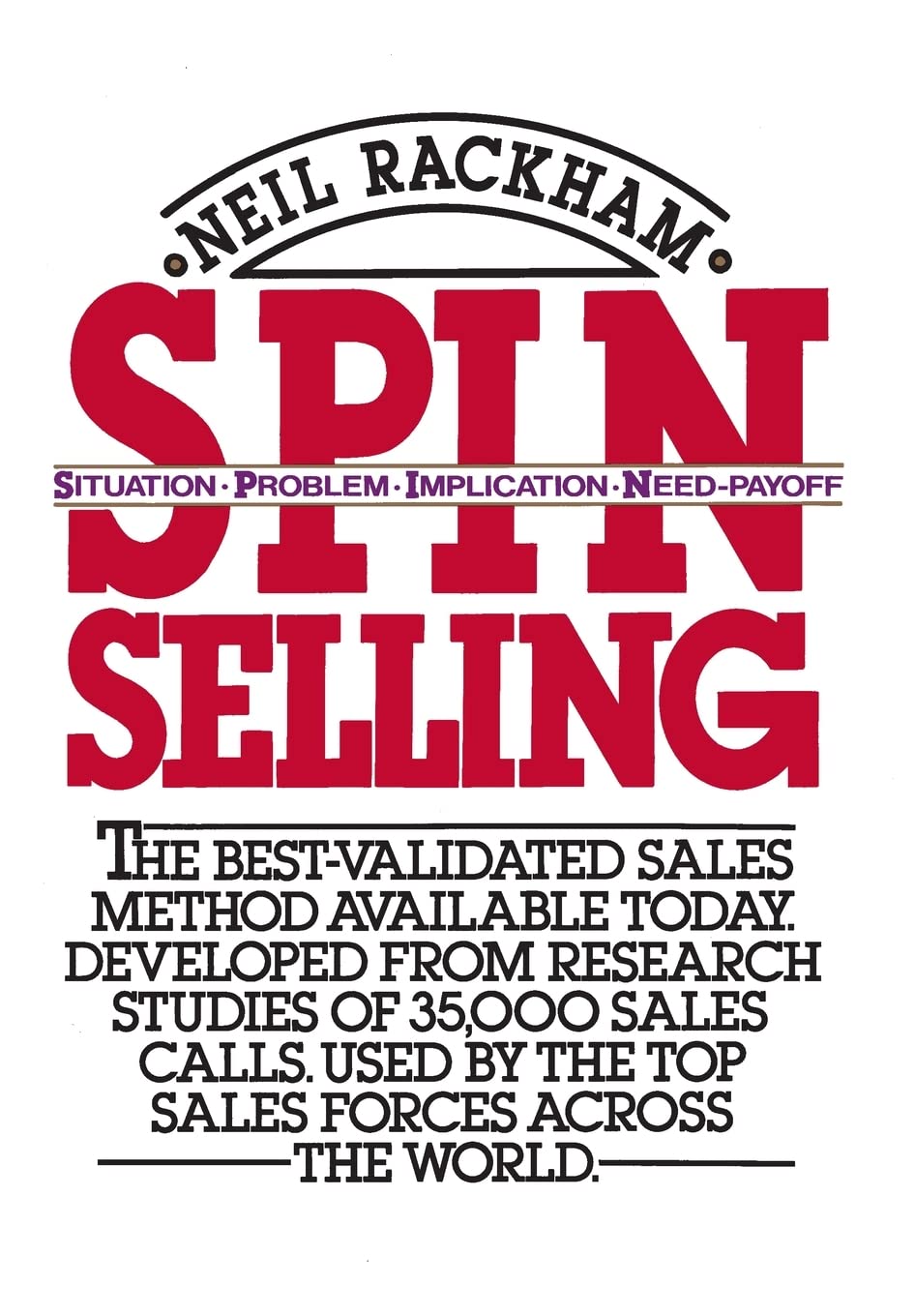
About SPIN Selling by Neil Rackham: A Research-Based Guide to Better Questions and Bigger Sales
SPIN Selling by Neil Rackham explains why strong sales do not begin with a pitch. They begin with questions. Instead of talking about features, the seller learns about the buyer’s world, finds problems, explores why problems matter, and helps the buyer see the value of a solution.
The name SPIN comes from four question types: Situation, Problem, Implication, and Need-payoff. Together, they give salespeople a clear way to guide a serious business talk. The method works especially well when a sale is costly, complex, or spread across several meetings and decision-makers.
Rackham did not build the method from opinion alone. Huthwaite International, the organization behind SPIN, says its research involved observing more than 35,000 sales calls. The book turns those findings into lessons that salespeople, managers, founders, consultants, and account teams can study and practice.
When talking more leads to fewer sales
Many sellers believe they must explain every feature, answer every doubt, and push for a quick yes. This may work in a small and simple sale, but it can fail when the buyer faces a large cost or a risky change. Too much talking can make the customer feel unheard and create objections that were not there before.
SPIN offers a calmer path. The seller asks focused questions and listens closely. The buyer is given space to describe the current situation and uncover the cost of a problem. A product is discussed only after its value can be joined to a need the buyer has clearly expressed.
What is SPIN Selling about?
Rackham shows that a large sale is rarely completed in one short meeting. The customer may need to check cost, risk, users, timing, and results. More people may join the decision. A seller therefore needs to develop value over time instead of treating every call as a race to an order.
The SPIN framework helps the buyer move from a small concern to a clear reason for change. It is not a script that must be followed word for word. It is a flexible map for discovering what matters and helping the customer say why solving it would be useful.
Situation questions build the first clear picture
Situation questions gather facts about the customer’s present world. A seller may ask about the current process, team, tool, target, supplier, or workflow. These answers create the background needed for better questions later.
The book also warns against asking too many basic questions. Buyers may become bored when a seller asks for facts that could have been found before the meeting. Good preparation keeps Situation questions short and purposeful. The goal is to confirm useful facts, not make the customer complete the seller’s research.
Problem questions uncover difficulty and dissatisfaction
Problem questions help buyers talk about what is not working well. They may reveal delay, waste, missed targets, high cost, poor quality, unhappy users, or a process that takes too much effort.
These questions move the discussion from facts to pain. Still, finding a problem does not guarantee a sale. A buyer may accept a small problem for years if changing feels harder or more costly. The next question type helps the customer understand the wider effect of leaving that problem alone.
Implication questions make the cost easier to see
Implication questions explore what a problem causes. A delay might upset customers, increase staff time, hold back cash, or stop a team from reaching a target. One weakness may create several other costs that were not clear at first.
These questions are powerful because they help a small concern become an important business issue. The seller should not use fear or make up danger. The buyer must be allowed to explain the true result in their own words. Careful listening keeps the conversation honest and useful.
Need-payoff questions turn attention toward value
Need-payoff questions ask the buyer to describe the benefit of solving the problem. The talk moves from what is wrong to what a better future could look like. The customer begins to state the value instead of only hearing a salesperson claim it.
A seller may ask: How would faster work help your team? Would fewer errors improve customer trust? What could your staff do with the time saved? Why would reaching this result matter now?
These questions can create hope and clear direction. They also give the seller the buyer’s own language for presenting a suitable solution. When the customer explains the payoff, the benefit feels connected to a real need rather than added as part of a general pitch.
Implied needs must grow into explicit needs
The book separates implied needs from explicit needs. An implied need is a problem or dissatisfaction, such as saying a current system is slow. An explicit need is a clear wish for a solution, such as needing a faster system that can handle more orders.
In a small sale, one complaint may be enough to support a purchase. In a major sale, the buyer must believe that the value of change is greater than its cost and risk. A small problem rarely creates that belief by itself.
Problem and Implication questions develop the concern. Need-payoff questions help the buyer explain the value of fixing it. This movement is central to SPIN because it builds a reason to act before the seller presents an answer.
Features and benefits need the right timing
A feature tells what a product or service has. An advantage tells what that feature can do. A benefit, in the book’s strict sense, shows how the solution meets an explicit need stated by the buyer.
This difference protects the seller from giving a broad presentation too early. A feature that excites one company may mean nothing to another. Even a real advantage can invite an objection when it answers a problem the buyer does not have.
After careful discovery, the seller can demonstrate capability by linking the offer to the customer’s words. The presentation becomes shorter, clearer, and more relevant. Instead of listing everything the product can do, the seller shows how selected parts can solve needs already made important in the discussion.
Why hard closing can hurt a major sale
Traditional sales advice often gives special lines for pushing customers to decide. Rackham’s research found that repeated closing techniques can be counterproductive in major sales. Pressure may increase concern when the customer is already thinking about cost, risk, and change.
The book gives more attention to obtaining commitment. Commitment does not always mean a signed order. In a long buying process, success may be an agreed demonstration, access to another decision-maker, a technical review, or a clear meeting with a set purpose.
The seller should ask for the highest realistic commitment that moves the sale forward. A friendly promise to speak again with no action may feel positive, but it may not be progress. A useful next step has an owner, a purpose, and real movement.
What makes this sales book useful
- Four question types create a simple framework for complex conversations.
- Research from more than 35,000 sales calls supports the main ideas.
- Clear examples show how buyer needs develop during a meeting.
- Large and consultative sales receive more attention than quick transactions.
- Call stages help readers plan, act, and review each conversation.
- Lessons about objections reduce the urge to argue with customers.
- Commitment is treated as real progress, not only a final order.
- Practical exercises and call analysis encourage steady skill building.
Skills readers can develop
The book can help readers ask shorter and more useful questions. It can also improve listening because every later question should grow from what the buyer has said. Sellers learn to follow meaning instead of rushing back to a prepared pitch.
Managers can use the framework when coaching a team. Rather than saying a call felt good or bad, they can discuss which needs were found, how implications were developed, whether benefits matched explicit needs, and what commitment was gained.
Readers may also gain more confidence. A salesperson does not need to know every answer before the meeting or depend only on charm. Good preparation, curiosity, patient questions, and clear next steps provide a repeatable path.
A simple way to practise SPIN
Choose one real customer and write a few possible questions in each SPIN group. Research the account first, then remove any Situation question that can be answered online. Keep the remaining questions open, clear, and linked to a useful purpose.
During the call, listen instead of trying to use every question. Ask for examples when an answer is broad. Note the customer’s exact words. Do not present the solution until the need and its value are clear enough.
After the meeting, review the conversation. Which question opened useful thought? Where did you talk too much? Did the customer state an explicit need? Was the next step a true advance? Repeating this review can turn a reading idea into a working habit.
Who should read this book?
This guide is a strong choice for sales representatives, account executives, business development teams, sales managers, founders, consultants, and people preparing for a customer-facing role. Students of marketing, business, and communication can also use it as a clear introduction to consultative selling.
New sellers may value its structure because it replaces guesswork with a process. Experienced sellers can compare their habits with research and notice where early pitching or weak implication questions may limit results.
The book is most useful when readers practise between chapters. Simply remembering what the four letters mean will not change a call. Skill grows through planning, real conversation, review, feedback, and repeated coaching.
A comfortable copy for work and study
Bookish Wonderland offers a reader-friendly copy prepared for regular reading, notes, and team review.
- Premium eye-soothing cream paper gives every page a soft appearance.
- Crystal-clear print keeps examples and question types easy to follow.
- High-quality stitched and glue binding supports longer book life.
- A durable finish helps protect the copy at work or on a shelf.
The edition is suitable for personal learning, sales coaching, office discussion, workshops, university study, or a practical gift for someone starting a sales career.
Easy ordering from Bookish Wonderland
When comparing the Book price in Bangladesh for SPIN Selling by Neil Rackham, consider print clarity, paper comfort, binding strength, and delivery support along with cost. A practical guide should remain easy to use while you mark questions, review calls, and coach a team.
Cash on Delivery is available nationwide, with delivery inside and outside Dhaka. Fast or urgent delivery is available in Dhaka when the book is needed soon. Contact Bookish Wonderland through Facebook or Instagram for the current price, stock, edition, delivery time, or customization help.
Make your next sales talk more useful
A buyer does not need another long speech about a product. The buyer needs help seeing a problem clearly, understanding its effect, and deciding whether change has enough value. SPIN Selling gives you a tested way to guide that process through questions and careful listening.
Order SPIN Selling by Neil Rackham from Bookish Wonderland today. Bring home a research-based sales classic and start turning customer conversations into clearer value, stronger trust, and meaningful progress.
If you require any customization or have any questions, please inbox us via FB or Insta.
| Primary Specification | |
| Author | Neil Rackham |
| Narrator | Eli Woods |
| Editor | Martha Jewettt |
| Genre | Business & Economics, Sales & Selling, Marketing |
| ISBN-13/ISSN | 978-0070511132 |
| ISBN-10 | 0070511136 |
| Publisher | McGraw-Hill |
| Publishing Date | May 1, 1988 |
| Language | English |
| Reading Age | 18+ |
| Format | Printed Book |
| Physical Specification & Quality | |
| Paper Quality | Premium eye-soothing cream paper |
| Binding Quality | High quality stitched and glue binding (for longevity) |
| Print Quality | Crystal-clear print |
| Pages | 224 pages |
| Country | USA |
| Logistics Information | |
| Weight | 246 gm |
| Length | 8.5 inches |
| Width | 5.6 inches |
| Height | 0.8 inch |