

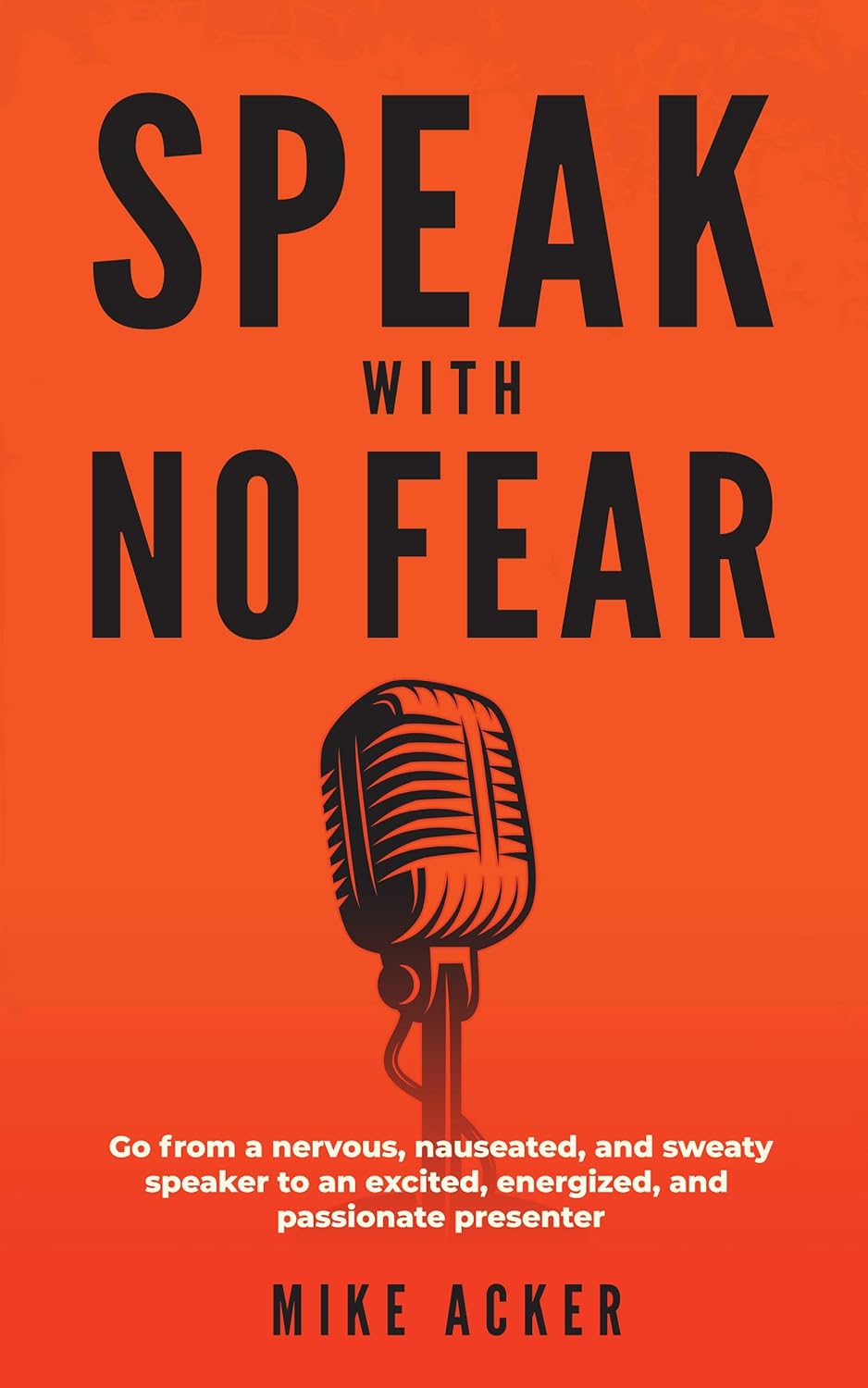
About Speak With No Fear by Mike Acker – A Practical Guide to Public Speaking Confidence, Preparation, and Clear Communication
Speak With No Fear by Mike Acker is a practical guide for people who feel nervous when they have to speak in front of others. The book is built around seven strategies that readers can use before and during presentations, meetings, interviews, classroom talks, speeches, and other situations where confidence matters.
Mike Acker writes as a speaker and communication coach. He explains public speaking fear through everyday examples and gives readers actions to practice instead of leaving the ideas at the level of theory.
The advice covers past negative speaking experiences, preparation, personal speaking style, audience connection, nervous energy, and staying present.
Public Speaking Fear Can Affect Good Speakers Too
A person can know a subject well and still feel nervous before speaking.
Common reactions include a fast heartbeat, sweating, shaking, dry mouth, racing thoughts, stomach discomfort, or the fear of forgetting what to say. Some people avoid speaking opportunities because they expect these reactions to happen.
Acker encourages readers to understand the fear instead of treating it as proof that they are bad speakers. He presents confidence as something that can grow through preparation, repetition, and better habits.
This approach makes the book useful for beginners as well as people who already speak at work or school but want more control over their nerves.
Start by Looking at Past Speaking Experiences
The first strategy is called “Uncover and Clean the Wound.”
Acker asks readers to think about painful speaking memories that may still affect them. A bad school presentation, public mistake, harsh criticism, or embarrassing moment can stay in memory for years.
A person may enter a new presentation expecting the same result even when the situation is completely different.
The book asks readers to write down those memories, name the feelings connected to them, and look at what they learned from the experience.
The goal is to understand where some of the fear comes from and stop allowing one old moment to define every future speaking opportunity.
This section is practical because it gives readers a clear place to begin. Someone who has avoided public speaking for years may first need to understand the event that taught them to avoid it.
Prepare for Problems Before They Happen
Another strategy asks readers to imagine what could go wrong during a presentation.
This may sound unusual because nervous speakers already think about mistakes. Acker uses that habit in a more organized way.
Readers can list possible problems and decide how they would respond.
If a slide does not work, continue without it. If you lose your place, check your notes. If someone asks a difficult question, take a moment before answering. If you say the wrong word, correct it and continue.
Preparation reduces the number of surprises that can turn normal nerves into panic.
It also reminds the speaker that most mistakes have a simple response. A small error rarely destroys an entire presentation.
Use a Speaking Style That Fits You
The book encourages readers to stop copying other speakers too closely.
Watching a skilled presenter can be useful, but comparison can also create pressure. A quiet person may think confidence requires a loud voice and constant movement. A serious speaker may believe every presentation needs jokes.
Acker’s approach is to improve the way you naturally communicate.
A calm speaker can learn stronger eye contact and clearer structure. An energetic speaker can work on pace and control. A thoughtful speaker can use pauses instead of trying to sound fast.
This gives readers a more realistic goal. Improvement becomes easier when the speaker works with their own personality instead of trying to perform someone else’s style.
Make the Audience Feel Smaller
Large groups can feel difficult because the speaker sees many people at once.
Acker suggests focusing on individuals rather than treating the audience as one large block.
Looking at one person, finishing a thought, then moving naturally to another person can make speaking feel closer to a conversation.
Meeting a few audience members before a talk can also help. Familiar faces can reduce the feeling of entering a room full of strangers.
This strategy is simple, but it can be useful for people who speak comfortably one-to-one and become anxious in larger groups.
The speaker can bring some of the same habits from normal conversation into a presentation.
Focus on What the Audience Needs
Nervous speakers often spend too much attention on themselves.
They may wonder whether their hands are shaking, whether their voice sounds strange, whether people can see their anxiety, or whether they look confident enough.
Acker asks readers to move more attention toward the audience.
What do these people need to understand? Why are they listening? What information will help them? What should they remember after the presentation?
A clear purpose makes it easier to concentrate on the message.
This idea is useful in work settings because presentations usually have a job to do. A manager may need to explain a change. A salesperson may need to describe value. A teacher may need to make a topic easier to understand. A student may need to present research clearly.
When the message has a clear purpose, personal nervousness can take up less mental space.
Learn to Use Nervous Energy
Acker also discusses the physical energy that appears before speaking.
A faster heartbeat or increased alertness does not always need to be treated as a problem. The body may simply be preparing for something important.
The book encourages readers to direct that energy into the presentation.
Preparation helps because a speaker who knows the structure can use extra energy without losing control. Breathing, pacing, posture, and practice can also help make the physical response easier to manage.
Over time, repeated speaking experience can make these sensations feel more familiar.
The aim is practical control. Readers learn how to work with the body’s response rather than expecting every sign of nervousness to disappear.
Stay With the Part You Are Speaking Now
The final strategy focuses on being present.
A speaker may make one small mistake and continue thinking about it for the next five minutes. Another speaker may spend the whole opening worrying about a difficult question that could come later.
Both habits take attention away from the current sentence.
Acker encourages readers to stay with the point they are making now. Listen to the room, watch the audience, and continue with the message.
If a mistake happens, correct it when needed and move on.
This habit helps speakers recover more quickly and can make the presentation feel less mechanical.
Being present is also useful during questions because the speaker is more likely to listen carefully instead of preparing an answer before the question is finished.
Each Chapter Includes Action
One useful feature of Speak With No Fear is the practical work at the end of the strategies.
Acker’s official book site explains that chapters include action steps. Readers are expected to write, reflect, prepare, and practice.
A reader can use one exercise before a classroom talk, another before a business meeting, and another before an interview.
The ideas become more useful when they are tested in real situations.
Useful for Students
Students often have to speak even when they do not consider themselves public speakers.
Class presentations, group projects, oral exams, debates, interviews, club activities, and thesis defenses can all require clear communication.
Fear can make a student rush, avoid eye contact, speak too quietly, or forget material they already know.
The strategies in this book give students simple ways to prepare.
They can look at past speaking experiences, plan for possible problems, practice a natural speaking style, and focus on what classmates or teachers need to understand.
Because the language is direct, the book can work for readers who are just beginning to learn presentation skills.
Useful for Work and Business
Workplaces create many speaking situations.
Employees may need to explain an idea during a meeting, present results, train coworkers, speak with clients, answer questions, lead a team, interview for a role, or give a formal presentation.
Technical knowledge alone does not guarantee clear communication.
A person may understand the work but still struggle when they have to explain it in front of others.
Speak With No Fear gives professionals a short framework for handling that problem.
The audience-focused ideas are especially useful for managers, salespeople, trainers, team leaders, and people whose work depends on explaining ideas clearly.
About Mike Acker
Mike Acker is a speaker, communication coach, author, and founder of Uplevel Communication.
His official website says his books and coaching have reached readers and professionals in more than fifty countries.
He works with leaders, executives, professionals, and other people who want to improve clarity, presence, and confidence.
Speak With No Fear was his first book. He later wrote additional books on communication and confidence.
His background helps explain the practical tone of this title. The advice is written for people who need to speak in real situations rather than for readers studying communication only as an academic subject.
Publication and Edition Details
The original edition of Speak With No Fear was published in 2019.
Google Books lists that edition at 182 pages.
A second edition was published by Advantage Publishing Group on May 10, 2021. Google Books lists the second edition at 190 pages.
The full subtitle is Go from a Nervous, Nauseated, and Sweaty Speaker to an Excited, Energized, and Passionate Presenter.
Page count can vary by edition and format, so customers should check the specific copy being purchased if exact pagination matters.
Book Quality at Bookish Wonderland
Bookish Wonderland offers this title with premium eye-soothing cream paper, crystal-clear printing, and high-quality stitched plus glue binding.
The softer paper tone can make reading and note-taking more comfortable. Clear printing keeps headings, exercises, and short sections easy to follow. Strong binding supports repeated use if the book is kept as a communication reference.
The copy is suitable for personal study, professional development, workplace use, or gifting.
Why Order from Bookish Wonderland?
Bookish Wonderland delivers books across Bangladesh, including inside and outside Dhaka. Cash on Delivery is available nationwide.
Customers in Dhaka can also ask about fast or urgent delivery when available.
If you are checking Speak With No Fear by Mike Acker Book price in Bangladesh, it is useful to compare the physical quality of the copy along with the listed price.
Book customization is also available. For stock, customization, or delivery questions, you can contact Bookish Wonderland through Facebook or Instagram.
Who Should Read Speak With No Fear?
Speak With No Fear by Mike Acker is useful for readers who want practical help with speaking anxiety.
The seven strategies cover past negative experiences, preparation, personal style, audience connection, nervous energy, attention, and practice.
Students can use the book for classroom presentations and interviews. Professionals can use it for meetings, training, sales, leadership, and workplace presentations. New speakers can use it as a starting point for building better habits.
The book works best when the exercises are used in real situations and repeated over time.
Order your copy from Bookish Wonderland for nationwide delivery, Cash on Delivery, premium cream paper, clear printing, and strong stitched plus glue binding.
If you require any customization or have any questions, please inbox us via FB or Insta.
| Primary Specification | |
| Author | Mike Acker |
| Genre | Self-Help, Personal Development, Communication, Public Speaking, Business Communication |
| ISBN-13/ISSN | 978-1954024182 |
| ISBN-10 | 1954024185 |
| Publisher | Advantage Publishing Group |
| Publishing Date | June 5, 2021 |
| Edition | 2nd ed. |
| Language | English |
| Reading Age | 22+ |
| Format | Printed Book |
| Physical Specification & Quality | |
| Paper Quality | Premium eye-soothing cream paper |
| Binding Quality | High quality stitched and glue binding (for longevity) |
| Print Quality | Crystal-clear print |
| Pages | 188 pages |
| Country | USA |
| Logistics Information | |
| Weight | 208 gm |
| Length | 8.5 inches |
| Width | 5.6 inches |
| Height | 0.43 inch |