

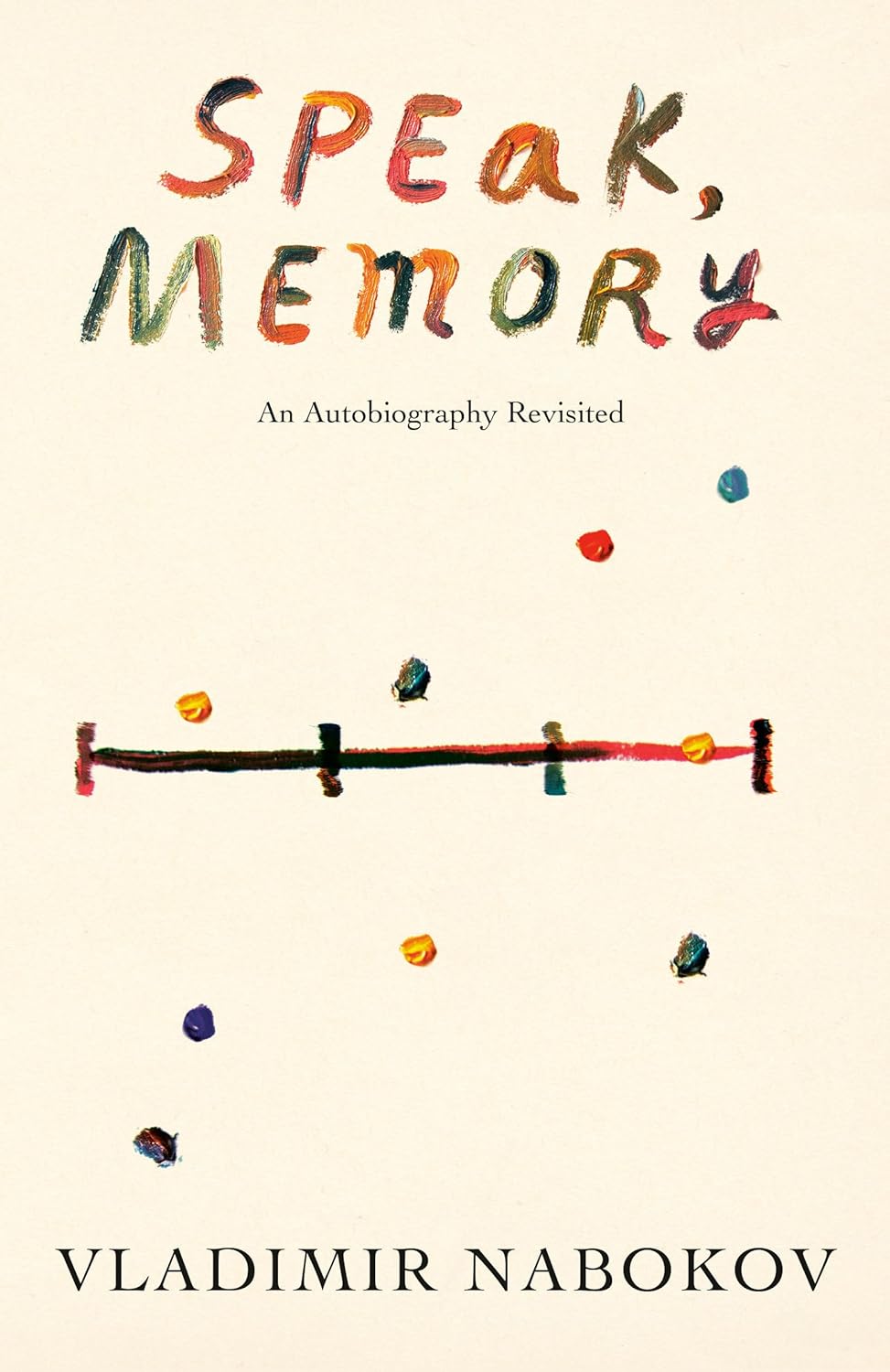
About Speak, Memory by Vladimir Nabokov: A Beautiful Journey Through Childhood, Exile, Time, and the Art of Remembering
Speak, Memory by Vladimir Nabokov is a literary autobiography about a lost home and the strange power of memory. Nabokov looks back at his early life in an aristocratic Russian family, his childhood in Saint Petersburg and on country estates, the Russian Revolution, his education at Cambridge, and his years as an émigré in Berlin and Paris. The journey moves toward 1940, when he left Europe for the United States with his wife and son.
This is not a plain record of dates. A colour, sound, face, butterfly, room, or path can open a whole part of the past. Nabokov studies each memory as if it were a rare object held under clear light. He asks what time takes away, what art can save, and how a person may rebuild a vanished world through words.
When an autobiography feels like a list of facts
Many memoirs tell readers what happened and then move to the next event. That approach can be useful, but it may leave the inner life hidden. Speak, Memory offers something richer. Nabokov does not only report a home, garden, train ride, or family member. He tries to recover how each one looked, sounded, and felt.
What is Speak, Memory about?
The memoir begins with Nabokov's early awareness of life and time. It enters the protected world of his childhood, where family homes, parks, servants, tutors, books, games, travel, and nature form a bright pattern. His family is wealthy and educated, but the book also shows its political and cultural life.
The Russian Revolution destroys the world he knew. Land, houses, and ordinary routines are lost, and the family enters exile. Nabokov later studies at Trinity College, Cambridge, before living among Russian émigrés in Berlin and Paris. He writes, loves, remembers, and learns to carry Russia inside his mind.
Enter a vanished Russian childhood
Nabokov grew up in a family of liberal Russian aristocrats. His early world included a Saint Petersburg home and country estates, especially Vyra. He remembers rooms, roads, gardens, meals, journeys, family habits, and changing seasons with unusual sharpness.
The setting is beautiful, but the value of these pages is not simply wealth or comfort. Nabokov watches how a child begins to understand space, time, language, and other people. A hallway can become a map of fear or joy. A lamp, window, or patch of snow may return many years later with its old feeling still attached.
Family portraits bring the past close
The book offers vivid portraits of Nabokov's mother, father, relatives, governesses, tutors, and childhood companions. These people are not presented as perfect figures. Their habits, voices, clothes, gifts, limits, and strange qualities make them feel alive.
His mother helps him value memory and small wonders. His father stands within family life and the politics of late imperial Russia. Other relatives carry stories of inheritance, custom, affection, and change. The famous chapter about Mademoiselle O recalls his large, dramatic Swiss-French governess with both comedy and uncertainty.
Butterflies teach him how to look
Nabokov's love of butterflies was not a small hobby. He became a serious student of them, and the memoir shows how early this passion began. Hunting, studying, naming, and comparing butterflies trained his eye to notice colour, form, place, and tiny differences.
That careful looking also shapes his writing. A scene does not stay general. It becomes exact through light, texture, movement, and colour. The natural world gives him joy, but it also teaches him that beauty may be brief and difficult to hold.
Sounds and letters can carry colour
Nabokov describes experiencing letters and sounds as colours, a form of perception commonly called synesthesia. This helps readers understand why language in the memoir often feels painted as well as spoken.
Words are never only tools for passing information. Their sound, shape, rhythm, and hidden links matter. A name may lead toward another time. A colour may join different memories. Patterns appear across years, making life feel designed even when history brings disorder.
Revolution turns home into memory
The Russian Revolution is the great break behind the book. Nabokov was eighteen when the old family world was swept away. The memoir does not become a full history of the revolution, but political change enters through the loss of property, safety, habit, and home.
Exile means more than moving to another country. It changes language, identity, money, work, and the meaning of belonging. A person may remember a garden perfectly while knowing that return is impossible. The past becomes both shelter and pain.
Cambridge, Berlin, and Paris open a new life
After leaving Russia, Nabokov studied at Trinity College, Cambridge. His English education, literary interests, friendships, and sense of being Russian abroad form part of the later chapters. He is building a future while still looking back toward a lost country.
Berlin and Paris become centres of Russian émigré life. Nabokov writes in Russian under the name Sirin and lives among people separated from their homeland. Exile creates a community, but it also brings uncertainty and the need to adapt.
The memoir eventually turns toward Véra and Dmitri. Family life gives the later journey a new shape. When war threatens Europe, leaving for America becomes another act of escape. The ending joins one generation's loss with the hope of protecting the next.
Memory does not move in a straight line
Speak, Memory is arranged more by theme and pattern than by a strict year-by-year path. One chapter may centre on a person, another on butterflies, poetry, education, first love, or exile. Images and ideas return across the book like repeated colours in a painting.
This structure may surprise readers expecting a simple timeline. It helps to follow the main movement from childhood to exile while allowing each chapter to build its own small world. The memoir's form reflects the way memory often works: one detail calls another, even when many years stand between them.
The author corrects and questions himself
The work was first published in 1951 in the United States as Conclusive Evidence. Nabokov later returned to his memories, corrected details, rewrote passages, and published the revised form in 1966 as Speak, Memory: An Autobiography Revisited.
That history fits the book's deepest question. Memory can feel clear while still being incomplete or wrong. New information from relatives, another visit to Europe, or harder thought may change the picture. Revising a memory does not always weaken it; revision can show a more honest search for truth.
Beautiful prose is part of the experience
Nabokov is famous for close control of language, and this memoir displays that skill on nearly every page. His sentences can be bright, playful, exact, and carefully shaped. He uses image, sound, rhythm, and comparison to make distant experiences feel present.
This style is one of the book's greatest pleasures, but it asks for attention. A reader who moves too quickly may miss a joke, a pattern, or a small shift in meaning. Pausing after a rich paragraph can make the reading easier and more enjoyable.
More than background for Lolita and Pale Fire
Readers often discover Nabokov through Lolita, Pale Fire, Pnin, or his Russian novels. Speak, Memory gives useful background, but it deserves to be read as its own work rather than only as a key to the fiction.
The memoir reveals interests that appear across his writing: doubles, patterns, exile, lost time, chance, art, games, butterflies, and the uncertain border between truth and invention. It also shows the mind of a writer learning to turn close attention into style.
What makes this memoir worth keeping
- A complete literary memoir follows Nabokov from childhood toward America.
- Vivid family portraits bring a vanished Russian world close to the reader.
- Butterflies, books, travel, and first love reveal a growing artistic mind.
- Revolution and exile show how history enters one family's private life.
- Cambridge, Berlin, and Paris widen the journey beyond childhood Russia.
- Thematic chapters reflect the natural movement of memory.
- Rich language rewards rereading and supports the study of prose style.
- The revised text openly explores the limits and corrections of memory.
The book offers history, autobiography, nature writing, and literary art in one volume. Its strongest benefit is a new way of seeing the past. Readers may begin thinking about Nabokov's life and finish by noticing how their own memories are built from places, people, colours, sounds, and loss.
Who will enjoy and use this book?
Speak, Memory suits readers of literary memoir, Russian history, twentieth-century literature, and books about exile. It is also valuable for students, teachers, writers, historians, and anyone studying Nabokov's fiction.
A book club can discuss whether memory tells truth, how wealth shapes the childhood scenes, and what exile does to identity. A writing group can choose one description and study how sound, colour, and detail create emotion. Students can compare the memoir's personal view with a historical account of revolution or émigré life.
The prose may be difficult for very young readers or anyone seeking a quick, simple autobiography. Older teens and adults who read patiently are more likely to enjoy its language, structure, and ideas.
A comfortable copy for close reading
Bookish Wonderland offers a reader-friendly copy prepared for thoughtful reading, notes, and future rereading.
- Premium eye-soothing cream paper gives every page a soft appearance.
- Crystal-clear printing keeps detailed sentences and punctuation easy to follow.
- High-quality stitched and glue binding supports longer book life.
- A durable finish helps protect the copy on a study table or shelf.
This edition is suitable for personal reading, a literature course, writing practice, book-club discussion, a home library, or a meaningful gift for someone who values classic memoirs.
Easy ordering from Bookish Wonderland
When comparing the Book price in Bangladesh for Speak, Memory by Vladimir Nabokov, consider paper comfort, clear printing, binding strength, and delivery support along with cost. A book built from rich sentences should remain pleasant when you pause, mark a detail, or return to an earlier chapter.
Cash on Delivery is available nationwide, with delivery inside and outside Dhaka. Fast or urgent delivery is available in Dhaka when the book is needed soon. Contact Bookish Wonderland through Facebook or Instagram for the current price, stock, edition, delivery time, or customization help.
Let memory open a vanished world
Open Speak, Memory and follow one of the twentieth century's great prose writers through gardens, family rooms, butterfly paths, revolution, study, love, and exile. Nabokov cannot return to the Russia of his childhood, but his words make its colours and voices rise again.
Read it for the story of a remarkable life. Keep it for the beauty of its language and its questions about time. Return to it whenever you want to see how close attention can turn a lost moment into lasting art.
Order Speak, Memory by Vladimir Nabokov from Bookish Wonderland today. Bring home a classic literary autobiography that can change the way you think about childhood, language, loss, and the memories that help form a life.
If you require any customization or have any questions, please inbox us via FB or Insta.
| Primary Specification | |
| Author | Vladimir Nabokov |
| Narrator | Stefan Rudnicki |
| Genre | Autobiography, Memoir, Literary Nonfiction, Classic Nonfiction |
| ISBN-13/ISSN | 978-0679723394 |
| ISBN-10 | 0679723390 |
| Publisher | Vintage |
| Publishing Date | August 28, 1989 |
| Language | English |
| Reading Age | 16+ |
| Format | Printed Book |
| Physical Specification & Quality | |
| Paper Quality | Premium eye-soothing cream paper |
| Binding Quality | High quality stitched and glue binding (for longevity) |
| Print Quality | Crystal-clear print |
| Pages | 336 pages |
| Country | UK |
| Logistics Information | |
| Weight | 359 gm |
| Length | 8.5 inches |
| Width | 5.6 inches |
| Height | 0.74 inch |