

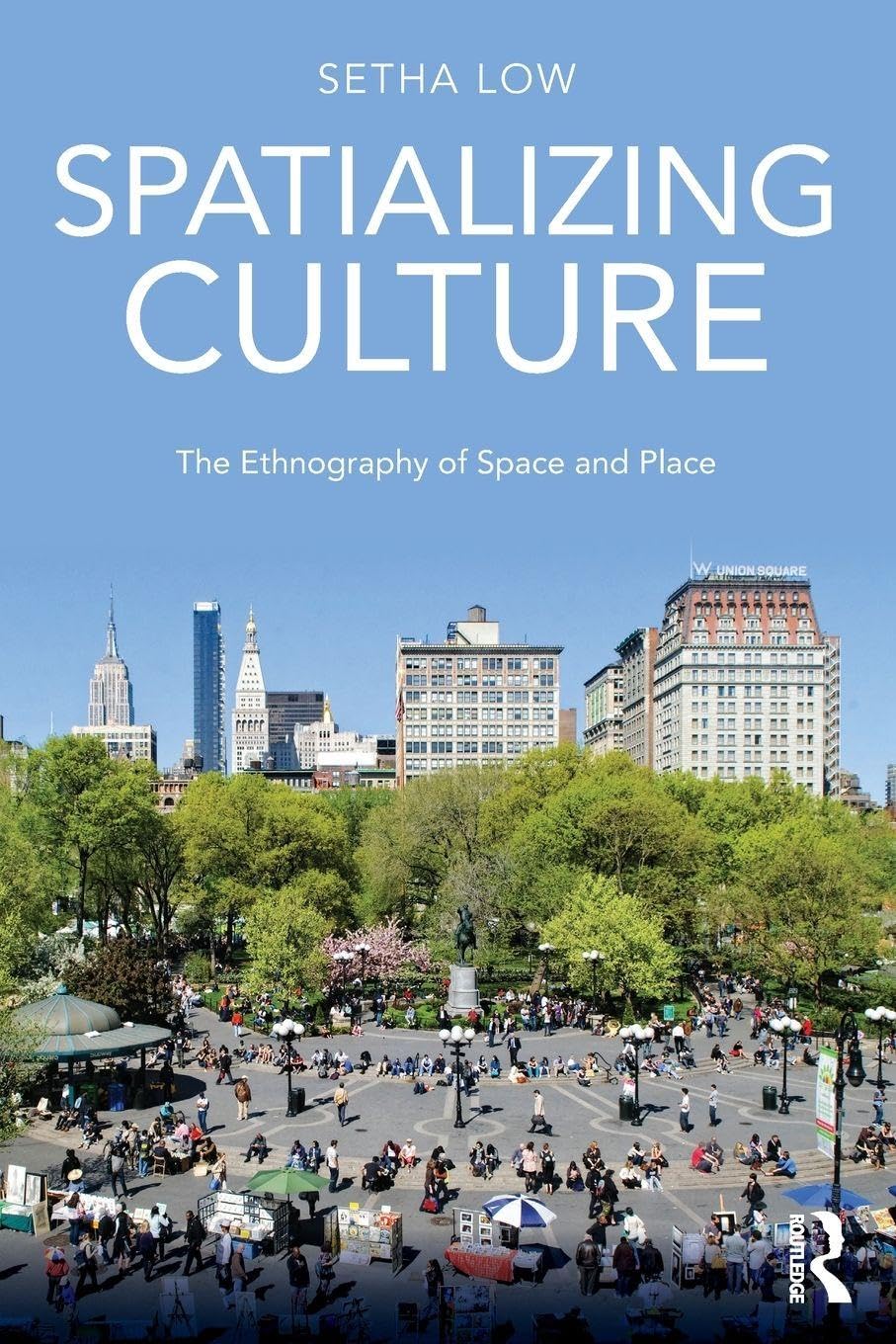
About Spatializing Culture by Setha Low: A Clear Guide to How People Make, Use, and Understand Space and Place
Spatializing Culture by Setha Low explores a simple but powerful idea: culture does not exist only inside people's minds. It also takes shape in homes, streets, parks, plazas, shops, borders, workplaces, and other places where life happens. The design of a place, the rules around it, and the people allowed to use it can all reveal how a society works.
The book's full subtitle is The Ethnography of Space and Place. It shows how close observation, interviews, movement, memory, language, and everyday experience can help researchers understand a setting. Setha Low brings together more than twenty years of work and explains several ways to study the link between people and their surroundings.
When space feels too abstract to study
Words such as space, place, culture, embodiment, and discourse can sound difficult. A student may read several theories and still wonder what to look for during fieldwork. A planner may see buildings and paths but miss the memories, fears, habits, and social rules connected to them. This gap can make research feel distant from real people.
Low offers a practical way forward. She places theory beside ethnography, the close study of people in their daily worlds. Instead of treating a location as an empty container, the reader learns to ask who made it, who uses it, what it means, how it feels, and how it connects with other locations.
What is Spatializing Culture about?
The book explains how researchers can study culture through space and place. It covers social production, social construction, embodied space, discursive space, emotive and affective space, and translocal space. Each view directs attention toward a different part of lived experience.
Social production looks at the larger forces that create a setting, including politics, money, planning, labour, law, and history. Social construction asks how people understand and give meaning to that setting. Embodied study follows what people sense and do with their bodies. Discursive study examines words and stories, while emotion and affect show how places are felt. Translocal work follows links across more than one location.
Space and place are connected but different
Space can mean an area, distance, arrangement, or physical setting. Place is often space filled with human meaning. A square on a map may become a childhood meeting point, a site of protest, a market, a sacred ground, or a place someone avoids after dark.
The difference matters because the same location can hold many meanings. A designer may call a plaza open and public, while a street seller may face removal there. A visitor may see beauty, while a resident remembers loss. No single view tells the whole story.
Ethnography brings the setting to life
Ethnography asks researchers to spend time with people and learn from ordinary life. Observation may show where people sit, which paths they choose, when a place becomes busy, and who remains at the edge. Interviews can reveal memories, hopes, worries, and reasons that are not visible from a map.
Low demonstrates why spatial research benefits from several forms of evidence. A researcher can listen to stories, watch movement, note bodily reactions, study local language, examine plans, and trace historical change. Each source answers a different kind of question.
See how society produces a place
Social production explains how wider forces help create physical space. Governments plan roads and parks. Builders choose materials. Businesses invest in some areas. Laws set borders and uses. Workers turn plans into real structures. Older choices remain visible long after the people who made them are gone.
This view helps readers look behind a finished landscape. A gated community, public square, shopping centre, housing block, or transport station did not simply appear. Land ownership, finance, policy, labour, design, and political goals shaped it.
Learn how people construct meaning
Social construction focuses on the meanings people give a place through memory, use, belief, and interaction. A house may mean safety to one person and control to another. A street can be a workplace, a shortcut, a danger, or a stage for community life.
Meanings are shared, but they are not always equal or peaceful. Official signs may describe an area one way while residents use a different name. Tourism may celebrate a neighbourhood's past even as local families feel pushed out. Stories can protect a place, sell it, shame it, or claim it.
This approach teaches readers to listen for more than one account. The goal is not to choose the prettiest story. It is to understand how meanings are created, repeated, challenged, and changed. Such attention makes culture visible in everyday talk and action.
Follow the body through space
People experience places through bodies. They walk, wait, sit, touch, hear, smell, watch, and change direction. Stairs may welcome one body and block another. Heat, noise, light, crowding, and distance can shape who stays and who leaves.
Embodied space draws attention to these lived details. A researcher may notice posture, pace, routes, gestures, comfort, tiredness, or fear. These signs can reveal knowledge that a person may not explain in an interview because the response has become a habit.
Notice the power of words and stories
Discursive space examines how language helps shape places. News reports may call an area dangerous. Advertisements may call it new and exciting. Officials may describe a project as improvement, while residents call it displacement. These words guide attention and can support action.
Names, signs, maps, rules, speeches, and everyday conversations all matter. They tell people what a place is supposed to be and who is expected there. Repeated language can make one version seem natural even when other experiences exist.
Readers learn to place words beside behaviour and material conditions. A park may be described as open to everyone, yet policing or design may discourage certain users. The gap between a public claim and daily experience can become an important research finding.
Understand emotion and atmosphere
Places can carry joy, grief, pride, shame, safety, tension, or longing. Some feelings grow from personal memory, while others spread through a crowd or seem connected to an atmosphere. Low includes emotive and affective approaches so these experiences are not treated as unimportant extras.
A memorial may invite quiet reflection. A busy market may create excitement for one visitor and stress for another. A fenced entrance may produce calm in people seeking security while making others feel watched or unwelcome.
Follow connections across locations
Life often stretches across more than one place. Families, goods, money, media, memories, and customs move between cities and countries. A migrant may build a new home while remaining closely connected to another home far away. A local street may be shaped by global business or online images.
Translocal space helps researchers follow these links. Instead of treating one field site as sealed from the world, they can ask what travels into it and what moves outward. This is useful for studying migration, tourism, trade, development, and changing identities.
The approach also prevents a simple split between here and there. People may belong to several places at once. Their choices can be shaped by journeys, family duties, past homes, and imagined futures. Place becomes a network of relationships, not only one fixed point.
Make inequality easier to see
The book shows that spatial study can uncover prejudice, inequality, and social exclusion. Rules about entry, surveillance, cost, transport, housing, and acceptable behaviour may benefit some people while limiting others. Design can quietly support these differences even when no sign states them directly.
Ethnography adds the voices and actions that broad data may overlook. It can show how a rule feels in daily life, how people adapt, and how they resist. This makes spatial analysis valuable for questions of justice.
Readers are encouraged to ask who belongs, who decides, who benefits, and who carries the cost. These questions can turn an ordinary-looking street, park, building, or boundary into a clear picture of social relations. They also help research connect with better policy and more inclusive design.
What makes this study valuable
It joins spatial theory with practical ethnographic methods, explaining several approaches within one connected framework while drawing on more than twenty years of research and fieldwork examples from different world settings. The book connects physical design with meaning, bodies, and emotion, helping readers examine power, prejudice, and exclusion. It supports research across anthropology, geography, and planning, offering useful concepts to guide observation and interviews. The main benefit is a richer way of seeing: after reading, a familiar place may no longer seem neutral or simple, as its paths, stories, rules, feelings, and users become parts of a larger cultural process.
Useful for study, research, and practice
This book is suited to university students, teachers, researchers, architects, planners, geographers, sociologists, environmental psychologists, and people studying public space. It can support courses about culture, cities, qualitative methods, design, inequality, migration, or place-making.
A student can use the framework to plan a thesis or field assignment. A researcher can compare methods and choose evidence that fits a question. A planner or designer can learn why community experience must be studied alongside maps and buildings.
The book is detailed and written for academic readers, so complete beginners may need to read slowly and keep a list of key terms. Start with one approach, connect it to a familiar place, and then compare it with the other approaches. This method can turn difficult theory into a usable research tool.
A reader-friendly copy for close study
Bookish Wonderland offers a copy prepared for steady reading, marking, and later review.
- Premium eye-soothing cream paper gives each page a soft look.
- Crystal-clear printing keeps academic terms and examples readable.
- High-quality stitched and glue binding supports longer book life.
- A durable finish helps protect the copy during study or travel.
These features make the edition suitable for a student, teacher, researcher, office shelf, home library, or thoughtful academic gift. A book used for notes and repeated reference should remain comfortable and secure through many study sessions.
Easy ordering from Bookish Wonderland
When comparing the Book price in Bangladesh for Spatializing Culture by Setha Low, consider print clarity, paper comfort, binding strength, and delivery service along with cost. An academic reference should stay easy to read while you underline a concept, prepare class notes, or revisit a method.
Cash on Delivery is available nationwide, with delivery inside and outside Dhaka. Fast or urgent delivery is available in Dhaka when the book is needed soon. Contact Bookish Wonderland through Facebook or Instagram for the current price, stock, edition, delivery time, or customization support.
Begin seeing everyday places differently
A park is never only grass and paths. A home is more than walls. A street carries work, movement, memory, rules, and power. Spatializing Culture teaches readers how to notice these layers and study them through the lives of real people.
Read it to build stronger research questions, connect theory with fieldwork, and understand how places include, exclude, comfort, or control. Its framework can help you move from simply describing a setting to explaining how culture becomes spatial and how space becomes meaningful.
Order Spatializing Culture by Setha Low from Bookish Wonderland today. Add a respected interdisciplinary guide to your shelf and begin exploring the social life hidden inside the places where people live, work, meet, shop, travel, and build belonging.
If you require any customization or have any questions, please inbox us via FB or Insta.
| Primary Specification | |
| Author | Setha M. Low |
| Genre | Anthropology, Human Geography, Cultural Studies, Urban Studies, Research Methodology |
| ISBN-13/ISSN | 978-1138945616 |
| ISBN-10 | 1138945617 |
| Publisher | Routledge |
| Publishing Date | September 6, 2016 |
| Edition | 1st |
| Language | English |
| Reading Age | 18+ |
| Format | Printed Book |
| Physical Specification & Quality | |
| Paper Quality | Premium eye-soothing cream paper |
| Binding Quality | High quality stitched and glue binding (for longevity) |
| Print Quality | Crystal-clear print |
| Pages | 276 pages |
| Country | USA |
| Logistics Information | |
| Weight | 300 gm |
| Length | 8.5 inches |
| Width | 5.6 inches |
| Height | 0.63 inch |