

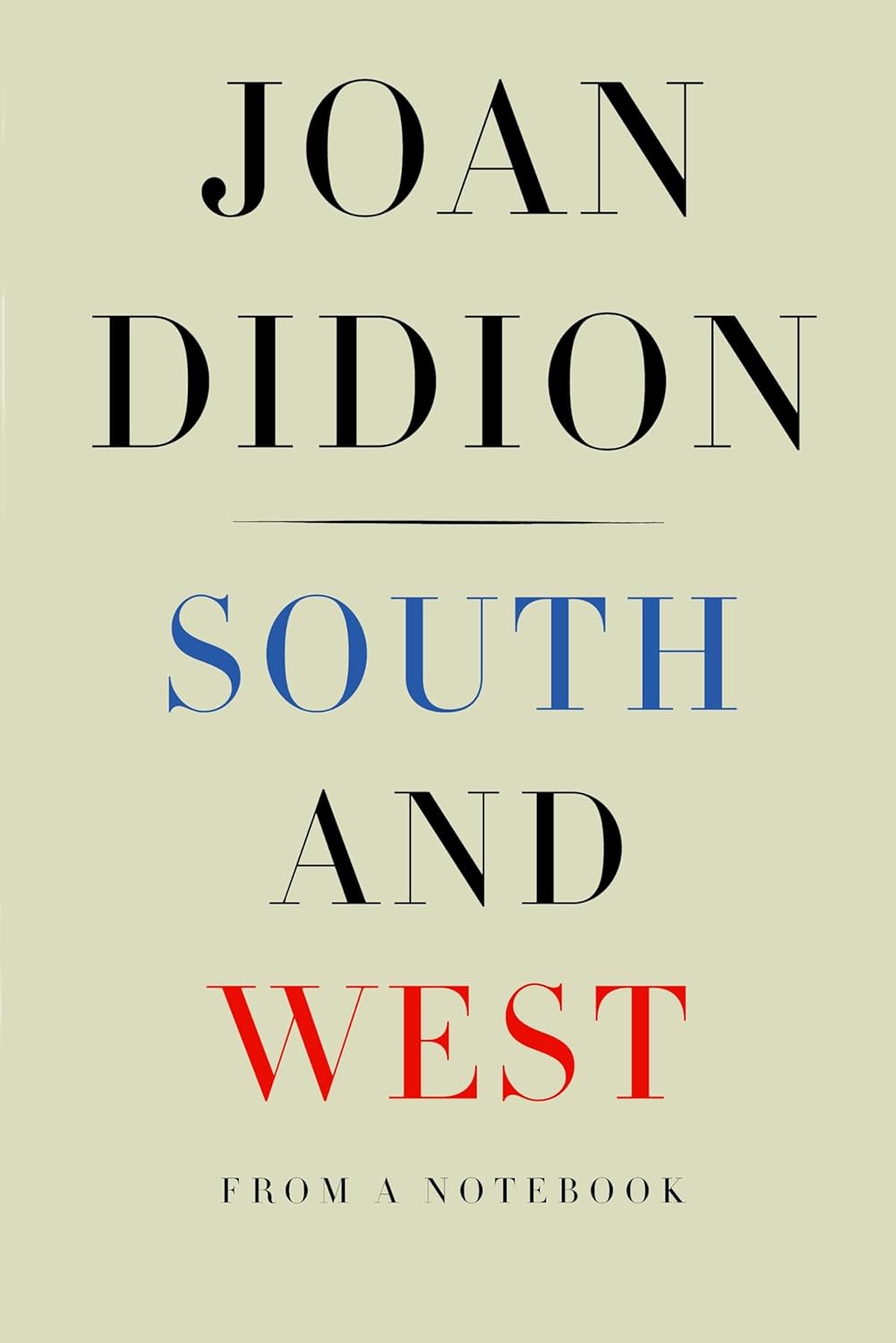
About South and West by Joan Didion – Notes on America, Place, Memory and Change
South and West by Joan Didion is a short but rich work of nonfiction built from two extended notebook pieces that reveal how one of America’s most famous writers watched people, places, class, race, memory, and power. The first section, “Notes on the South,” comes from a road trip Didion took with her husband, John Gregory Dunne, through Louisiana, Mississippi, and Alabama in June 1970. The second, “California Notes,” grew from time she spent in San Francisco in 1976 while following the Patty Hearst trial for a possible Rolling Stone assignment.
This is not a normal travel book and it is not a novel. It reads like a close look inside a writer’s working mind. Didion records overheard speech, strange details, local habits, social divisions, weather, buildings, roads, people, and moments that might look small at first. Together, these notes create a sharp picture of two parts of the United States and show how deeply place can shape the way people think about themselves.
A Road Trip That Becomes a Study of the American South
In “Notes on the South,” Didion travels through Louisiana, Mississippi, and Alabama with John Gregory Dunne. She moves through small towns, motels, diners, highways, private homes, public events, and local gatherings. Instead of giving readers a simple guide to where she went, she watches the people around her and asks what their words reveal about the region.
She notices conversations about race, class, history, family, money, and tradition. She pays attention to the pace of daily life and to the way people speak about the past. The result is a picture of the South that feels personal rather than like a textbook. Readers see a place through details: a room, a meal, a meeting, a road, a face, or a sentence someone says without knowing how revealing it may sound.
This makes the book useful for readers who enjoy travel writing but want something deeper than descriptions of famous places. Didion is interested in what a place believes about itself. She also notices the difference between what people say and what may be happening underneath.
Why the Notebook Form Makes the Book Special
One of the most interesting things about South and West is that the writing comes from notebooks rather than from a polished long-form book Didion completed at the time. That gives the work an immediate feeling. Readers can see observations before they have been turned into a more finished argument.
The notes move through scenes, comments, interviews, thoughts, and impressions. At times, a small detail becomes more important than a long explanation. This is part of Didion’s style. She trusts the reader to notice patterns. Instead of telling you exactly what to think after every scene, she often places the detail in front of you and lets its meaning grow.
For students, writers, journalists, and readers interested in how nonfiction is made, this is a major benefit. The book offers a look at how a skilled observer gathers material. You can see how Didion listens, selects, remembers, and connects details. It shows that strong writing often begins with careful attention.
A South Shaped by Race, Class and Memory
The American South Didion visits in 1970 carries the weight of history. The Civil Rights era is close, and questions of race, class, heritage, and social order appear again and again in the conversations and places she records.
Didion does not present the region as one simple thing. She finds beauty, discomfort, pride, fear, politeness, tension, and contradiction. People may be friendly while holding ideas that reveal deep divisions. A town can appear calm while history sits heavily beneath the surface.
That complexity gives the book lasting value. South and West is not only about what Didion saw during one trip. It is also about how societies remember themselves and how old ideas continue to affect daily life. Readers interested in American culture, politics, history, social class, journalism, or identity can find many points worth thinking about.
From the Deep South to California
The second part, “California Notes,” changes the setting but keeps many of the same questions. Didion had gone to San Francisco in 1976 because of a Rolling Stone assignment connected to the Patty Hearst trial. She never completed the planned article, but being there made her think about California, the Hearst family, social position, San Francisco, and her own childhood in Sacramento.
This section is shorter, but it adds an important contrast. The South is often described as deeply tied to history, family, and place, yet Didion begins to see that California has its own stories about identity and belonging. She thinks about the West, its landscape, the people who shaped her early ideas, and the myths Californians tell about themselves.
These notes later connect with ideas she explored more fully in Where I Was From. For readers who already know that book, South and West can feel like an early window into thoughts that would develop years later.
A Book About Place, but Also About Identity
At its heart, South and West asks how places shape people. A person may believe they are making private choices, but family history, local culture, class, race, money, geography, and memory can influence the way they see the world.
Didion notices this in the South, and she notices it again when thinking about California. The two regions are different, yet both carry powerful stories about who belongs, what matters, and how the past should be remembered.
This makes the book more than a collection of travel notes. It becomes a study of identity. Readers may begin thinking about their own hometowns, families, or countries. What ideas feel normal simply because we grew up around them? Which stories about a place are true, and which are repeated because people want to believe them?
The book does not give easy answers. Its value comes from the questions it leaves behind.
Short, Clear and Full of Things to Think About
South and West is a relatively short book, which makes it easy to fit into a weekend or a few quiet reading sessions. Yet its size should not be mistaken for lack of depth. Didion can make a single scene carry several ideas at once.
This is a good choice for readers who want serious nonfiction without beginning with a very long history or political book. The writing is compact, the scenes change often, and the subject stays close to people and places.
It can also be a useful introduction to Joan Didion. Readers who have heard of The Year of Magical Thinking, Slouching Towards Bethlehem, The White Album, or Where I Was From but have not yet read her work may find this volume approachable. It shows her eye for detail, her interest in American culture, and her ability to create meaning through observation.
Why Writers and Journalists May Love It
Writers often want to know how experienced authors notice things other people miss. South and West gives a rare answer. Didion watches rooms, roads, clothes, voices, habits, heat, buildings, social rules, and small acts. She records what catches her attention before every observation has been shaped into a finished essay.
That can be helpful for anyone learning creative nonfiction, journalism, travel writing, cultural criticism, or memoir. The lesson is simple: pay attention. A good writer does not only collect facts. A good writer notices how facts feel in a place and how people reveal themselves through language and behavior.
Who Should Read South and West?
This book is a strong fit for readers who enjoy essays, literary nonfiction, travel writing, American history, cultural observation, journalism, and books about place. It is also a good choice for people who already admire Joan Didion and want to see a less polished, more immediate side of her writing process.
Readers who like fast plots, romance, fantasy, or mystery should know that this book offers a different kind of experience. Its movement comes from observation rather than suspense. The pleasure is in noticing what Didion notices and thinking about what those details mean.
Students can use it to study voice, description, scene building, and cultural writing. Writers can use it as inspiration for notebooks and field notes. General readers can simply enjoy the feeling of travelling beside a sharp observer who rarely accepts a place at face value.
A Good Book for Slow Reading and Rereading
Although South and West can be finished quickly, it rewards slow reading. A sentence that seems simple may carry a larger idea about class, race, memory, or power. A short description may reveal how Didion sees an entire town.
This makes the book well suited to annotation. Readers who enjoy underlining passages, writing notes in the margin, or discussing books with others may find plenty to return to.
It can also work well for book clubs. The two sections invite comparison. Readers can discuss how the South and California are different, how they are similar, and how Didion’s own background shapes what she notices.
A Reader-Friendly Edition from Bookish Wonderland
Bookish Wonderland offers South and West for readers who want a comfortable physical copy for regular reading, study, annotation, or collecting. This edition uses premium eye-soothing cream paper, giving the pages a softer background that is pleasant during longer reading sessions.
The text comes with crystal-clear printing so the words remain sharp and easy to follow. High-quality stitched and glue binding is used for better strength and longevity, helping the pages stay secure through repeated reading and normal shelf use.
Easy Ordering Across Bangladesh
Readers checking South and West by Joan Didion price in BD can order through Bookish Wonderland with nationwide delivery. Customers can order from Dhaka as well as other districts, and Cash on Delivery is available across Bangladesh.
For readers in Dhaka who need the book sooner, fast or urgent delivery can also be requested. This can be useful when the book is needed for a class, writing project, book club, gift, trip, or personal reading plan.
When comparing Book price in Bangladesh, consider the full reading experience as well as the listed price. Clear printing, comfortable paper, durable binding, and reliable delivery can make a physical copy more useful over time, especially for a nonfiction book you may want to underline, study, or reread.
Add Joan Didion’s Sharp Eye to Your Shelf
South and West shows why Joan Didion remains such an important voice in American nonfiction. She does not simply travel through a place and report what she sees. She listens for the beliefs hidden inside everyday speech. She notices how history lives in rooms, roads, families, social rules, and small habits.
The Southern notebook gives readers a close view of Louisiana, Mississippi, and Alabama in 1970, while the California notes turn toward San Francisco, Sacramento, the Hearsts, and Didion’s own connection to the West. Read together, the two sections become a compact study of America, memory, identity, and the stories people tell about where they come from.
Order South and West by Joan Didion from Bookish Wonderland if you want thoughtful nonfiction that is short enough to read easily but deep enough to stay in your mind. With nationwide delivery, Cash on Delivery, premium cream paper, crystal-clear printing, durable binding, and fast delivery options in Dhaka, bringing this distinctive work to your shelf is simple.
If you require any customization or have any questions, please inbox us via FB or Insta.
| Primary Specification | |
| Author | Joan Didion |
| Narrator | Kimberly Farr, Nathaniel Rich |
| Editor | Iris Weinstein |
| Genre | Literary Nonfiction, Travel Writing, Cultural Criticism, Memoir/Essays |
| ISBN-13/ISSN | 978-0525434191 |
| ISBN-10 | 0525434194 |
| Publisher | Vintage |
| Publishing Date | January 2, 2018 |
| Language | English |
| Reading Age | 18+ |
| Format | Printed Book |
| Physical Specification & Quality | |
| Paper Quality | Premium eye-soothing cream paper |
| Binding Quality | High quality stitched and glue binding (for longevity) |
| Print Quality | Crystal-clear print |
| Pages | 160 pages |
| Country | USA |
| Logistics Information | |
| Weight | 185 gm |
| Length | 8.5 inches |
| Width | 5.6 inches |
| Height | 0.47 inch |