

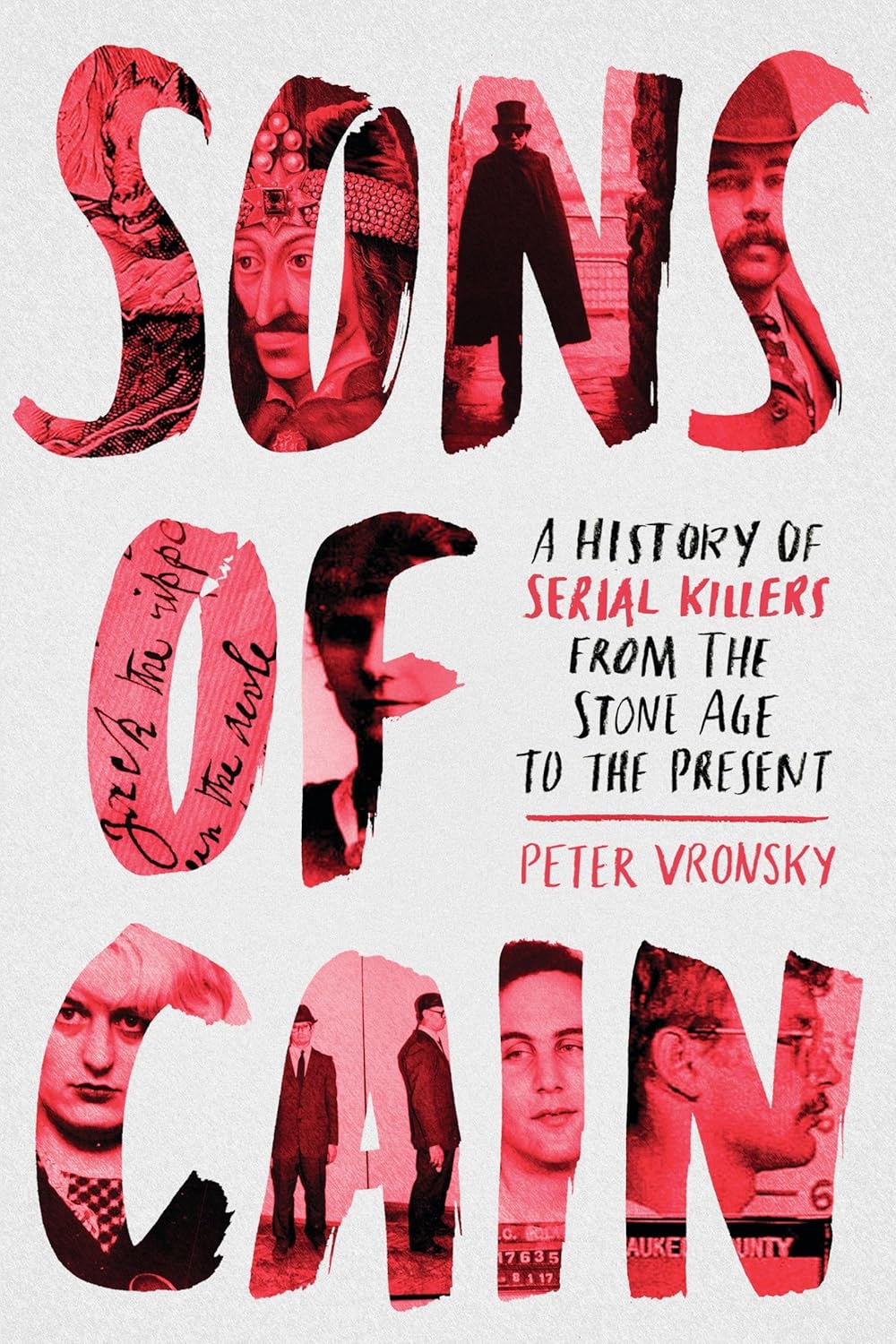
About Sons of Cain by Peter Vronsky – A Deep History of Serial Killers, Human Violence, and the Dark Side of Crime
Sons of Cain by Peter Vronsky is a true crime history that asks a question: where did serial killing come from, and why has it appeared across human history? Instead of looking only at famous modern killers, Peter Vronsky goes further back. He studies violence from prehistoric times, legends, early criminal records, nineteenth-century cases, and today.
The book focuses mainly on sexual serial killers and the way societies have tried to understand them. Long before people used the words “serial killer,” communities explained terrifying crimes through ideas about monsters, werewolves, vampires, witches, demons, and other frightening beings. Vronsky shows how these old ideas slowly changed as medicine, psychology, policing, criminology, and modern media developed.
This is not a light crime book. It deals with murder, sexual violence, torture, and other disturbing acts. But its main purpose is historical and analytical. It asks how human beings became capable of repeated predatory killing, how society has named that violence, and why people remain so interested in these crimes today.
More Than a Collection of Famous Murder Cases
Many true crime books focus on one killer, one police case, or one shocking event. Sons of Cain takes a wider path.
Peter Vronsky wants readers to see serial murder as a long historical subject. He moves across very different periods and asks how repeated killing fits into changes in human society. This means the book is not only about crime. It also touches anthropology, history, psychology, culture, policing, and the way communities explain evil.
That wider view can solve a common problem for true crime readers. If you have already read about famous names such as Jack the Ripper or Ted Bundy, another simple case summary may feel familiar. This book gives more context. It asks what came before modern serial killers, how older societies described similar offenders, and what may have changed as cities, law enforcement, science, and mass media grew.
From Ancient Fear to the Modern Term “Serial Killer”
One of the book’s most interesting ideas is that people committed repeated violent crimes long before society had a modern label for them.
In earlier times, terrifying offenders could be described as monsters or supernatural creatures. Stories about werewolves, vampires, ghouls, and witches sometimes became part of the way communities explained acts that seemed beyond normal human behavior. As science and criminal investigation developed, the language changed.
Vronsky traces this long change in understanding. He looks at how religion, folklore, medicine, psychology, police work, and criminology gave people new ways to talk about violent offenders.
This matters because names shape how people think. When society changes the label, it can also change the questions being asked. Is the killer evil, sick, criminal, abnormal, or shaped by something in human development? Different periods have answered in different ways.
Sons of Cain does not reduce the whole subject to one easy explanation. Instead, it gives readers a long timeline and lets them see how ideas about these crimes developed.
Why Peter Vronsky Looks Back So Far
The book reaches into prehistory because Vronsky is interested in the possible roots of predatory violence.
He explores the idea that some forms of aggression may have very old origins in human development. This does not mean that violence is simple or that every criminal can be explained by one ancient cause. Rather, the historical approach asks whether parts of human behavior that existed before modern civilization may still matter when we study extreme violence today.
That approach makes Sons of Cain different from books that begin with twentieth-century psychology or modern police files. Vronsky tries to connect the modern serial killer to a much longer human story.
For readers interested in criminal psychology, this creates a useful starting point for debate. You do not have to agree with every theory to find the questions valuable. The book invites readers to compare biology, environment, culture, history, and individual choice instead of assuming one answer explains every offender.
The Book Focuses on Sexual Serial Killers
It is important to know the book’s main scope before buying it.
Vronsky focuses especially on sexual serial killers, meaning repeated killers whose crimes may involve sexual violence, torture, mutilation, necrophilia, cannibalism, or related forms of predatory behavior. He separates this subject from other kinds of repeated killing carried out mainly for money, politics, terrorism, organized crime, or genocide.
Because of this focus, the subject matter can be disturbing. Readers should expect discussion of real crimes and harmful behavior. The book is best suited to mature readers who are comfortable with serious true crime.
At the same time, the book aims to explain rather than simply shock. Its value comes from the attempt to place these offenders inside a broad historical frame. Readers learn not only that terrible crimes happened, but also how investigators, doctors, writers, and societies tried to make sense of them.
A Long View of Crime Changes the Way You Read True Crime
Reading one case can make a killer seem completely unique. Reading across centuries can reveal repeating questions.
How does a person become a repeat killer? Why do some offenders hide for years? Why are certain victims targeted? Why do communities sometimes miss warning signs? Why do some killers become famous while others are almost forgotten? Why does popular culture turn real violence into stories people consume?
Sons of Cain gives readers historical material that helps place these questions beside one another.
This can be especially useful for readers who follow true crime documentaries, podcasts, criminal psychology books, or crime history. Modern media often presents cases one at a time. Vronsky’s book encourages a wider view, showing that the way we understand serial killers has changed along with the societies investigating them.
Why This Book Can Be Useful for Students and Serious Readers
Sons of Cain can be a strong choice for readers studying criminology, criminal justice, psychology, history, sociology, or media studies.
It does not replace an academic textbook, and readers should still compare different scholarly views. But it can give a broad, readable introduction to the historical development of ideas about serial murder.
Students may find the timeline useful because it connects older beliefs with later scientific and police approaches. Researchers and serious true crime readers may also appreciate the attempt to bridge popular crime writing and more academic discussion.
The book can also support classroom or book-club discussion. Readers can ask whether violent behavior is best explained by biology, environment, culture, individual choice, or several factors working together. They can also discuss why societies turn some killers into cultural symbols and what ethical limits true crime should have.
A Book That Asks Why We Keep Looking at Darkness
Vronsky does not ignore that strange attraction. Part of the book considers why extreme violence holds public attention. Fear, curiosity, the wish to understand danger, and the mystery of abnormal behavior can all pull people toward true crime.
Why do we want to understand someone who commits terrible acts? Does knowledge make us safer? Are we trying to understand human nature? Or can repeated media attention sometimes turn criminals into dark celebrities?
These questions are important because true crime is not only about offenders. It is also about audiences, publishers, journalists, investigators, and the stories societies choose to remember.
A Premium Reading Copy for a Detailed Nonfiction Book
Bookish Wonderland prepares this edition for readers who want a comfortable copy for long reading sessions. It features premium eye-soothing cream paper, crystal-clear printing, and high-quality stitched and glue binding for better strength and longevity.
A detailed nonfiction book is often read differently from a fast novel. You may stop to think, return to an earlier section, compare cases, or make notes. Comfortable paper and clean printing can make that kind of reading easier, while stronger binding helps the book handle repeated use.
The copy can suit a personal true crime collection, a study shelf, or a gift for an adult reader interested in criminal history. Book customization may also be requested when available.
Who Should Read Sons of Cain?
This book is best for mature readers who want a serious history of serial killing rather than a simple collection of crime stories.
It may appeal to readers of true crime, criminal psychology, criminology, forensic history, dark history, sociology, and investigative nonfiction. Fans of documentaries or podcasts about serial killers may also enjoy seeing how modern cases connect to a much longer historical background.
Because the book discusses murder, sexual violence, torture, and other disturbing crimes, it is not suitable for every reader. Anyone who prefers light nonfiction or who is uncomfortable with detailed discussion of violent crime may want a different book.
For readers who can handle the subject, however, Sons of Cain offers a large and ambitious view of one of the darkest areas of criminal history.
Looking for Sons of Cain by Peter Vronsky Price in Bangladesh?
If you are comparing the Book price in Bangladesh for Sons of Cain by Peter Vronsky, consider both the current selling price and the physical reading quality.
This is a 432-page nonfiction title in the Berkley paperback edition, so many readers may spend several long sessions working through its historical material. A clear print, comfortable page tone, and durable binding can make that experience more pleasant.
Bookish Wonderland aims to offer readers a useful balance of quality, durability, and value. Check the current product listing for the latest selling price because book prices can change with stock, printing, and supply conditions.
Easy Ordering Across Bangladesh
Bookish Wonderland offers nationwide delivery, including delivery inside and outside Dhaka. Cash on Delivery is available across Bangladesh, giving readers a simple way to order without paying online first.
Fast or urgent delivery may also be available in Dhaka when you need the book sooner. This can be helpful for study, gifting, research, or adding a new title to your true crime collection.
If you need customization or have a question about an order, you can contact Bookish Wonderland through its available Facebook or Instagram support channels.
Add a Dark but Important Crime History to Your Shelf
Sons of Cain by Peter Vronsky is not designed to make serial killers look glamorous. Its strongest reason to read is the historical question behind the crimes.
How did people understand repeated predatory murder before the modern term existed? Why did old societies speak about monsters and supernatural evil? How did science, psychology, policing, and criminology change that picture? And what can the long history of extreme violence tell us about human behavior today?
Vronsky follows these questions across thousands of years and brings together crime history, cultural belief, human behavior, and modern investigation.
For readers who want true crime with a wider historical frame, this book offers much more than a quick collection of shocking cases. It asks you to look at the subject over time and think about why these crimes happen, how society explains them, and why we continue to study them.
Order Sons of Cain by Peter Vronsky from Bookish Wonderland and carefully explore a serious history of serial murder from humanity’s distant past to the modern age.
If you require any customization or have any questions, please inbox us via FB or Insta.
| Primary Specification | |
| Author | Peter Vronsky |
| Narrator | Mikael Naramore |
| Genre | True Crime, Criminology, History, Social Science |
| ISBN-13/ISSN | 978-0425276976 |
| ISBN-10 | 042527697X |
| Publisher | Berkley |
| Publishing Date | August 14, 2018 |
| Language | English |
| Reading Age | 18+ |
| Format | Printed Book |
| Physical Specification & Quality | |
| Paper Quality | Premium eye-soothing cream paper |
| Binding Quality | High quality stitched and glue binding (for longevity) |
| Print Quality | Crystal-clear print |
| Pages | 432 pages |
| Country | United States |
| Logistics Information | |
| Weight | 453 gm |
| Length | 8.5 inches |
| Width | 5.6 inches |
| Height | 0.94 inch |