

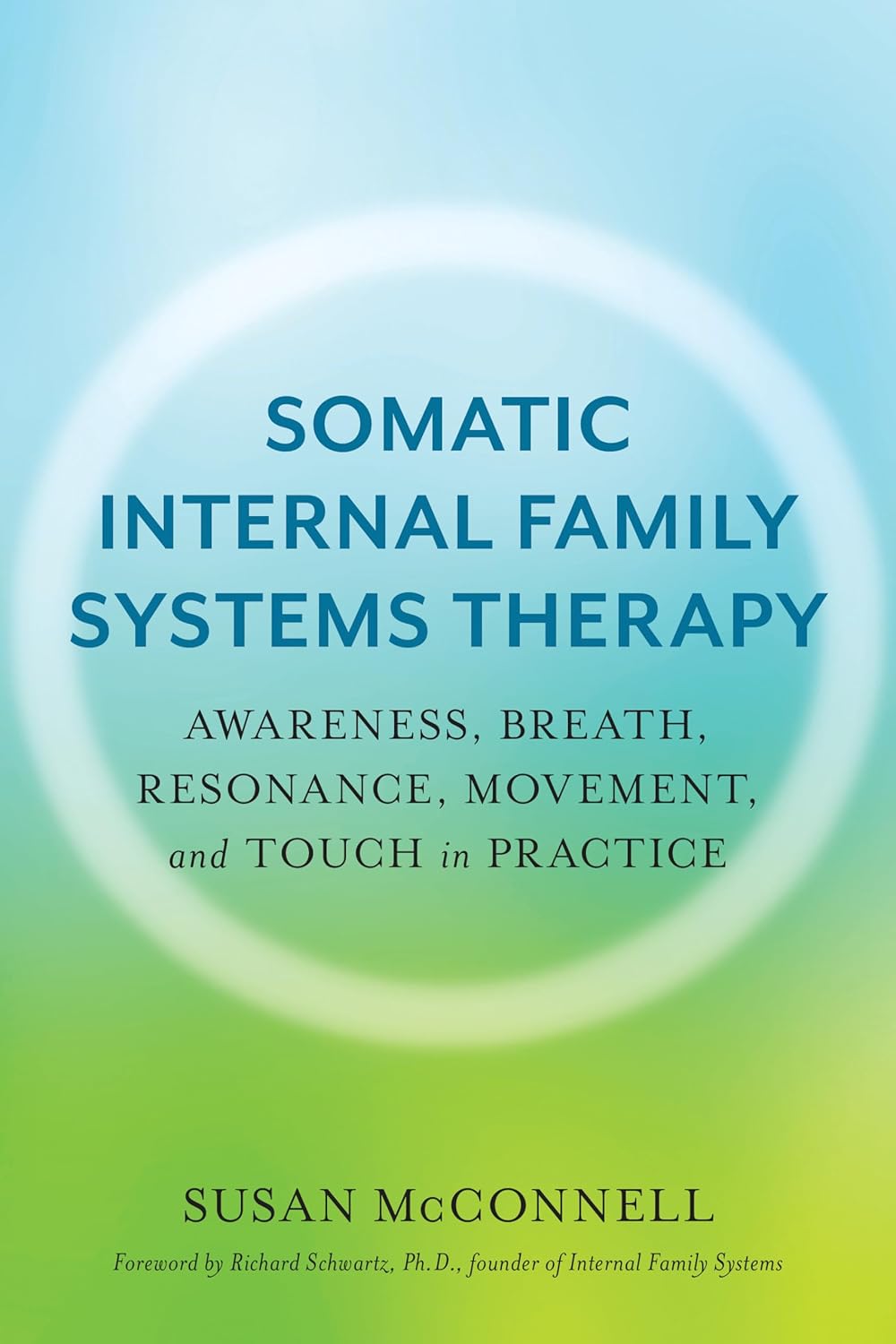
About Somatic Internal Family Systems Therapy by Susan McConnell – A Practical Guide to Healing Through Body, Mind, and the IFS Model
Somatic Internal Family Systems Therapy by Susan McConnell brings the body into the Internal Family Systems approach in a clear and practical way. The book explains how thoughts, feelings, body sensations, movement, breathing, and touch can all carry useful information during therapy. McConnell combines the IFS model with decades of experience in somatic work to help readers understand how the body can support healing.
The book is built around five main practices: somatic awareness, conscious breathing, radical resonance, mindful movement, and attuned touch. These practices are designed to help therapists and clients notice what happens inside the body, connect with different inner parts, and develop a stronger sense of safety and Self.
This is not a simple self-help book or a quick fix. It is a professional guide with theory, clinical examples, exercises, and practical methods. It is especially useful for therapists, counselors, somatic practitioners, mental health professionals, and readers already interested in Internal Family Systems. People learning about trauma, embodiment, or body-based therapy may also find it valuable.
Bringing the Body Into Internal Family Systems
Internal Family Systems, often called IFS, views the mind as made up of different inner parts. These parts may carry fear, anger, shame, pain, or protective roles. IFS also teaches that beneath these parts is a calm and compassionate core called Self.
Susan McConnell takes this model further by asking readers to pay close attention to the body. A part may not only appear as a thought or memory. It may show up as tight shoulders, shallow breathing, pressure in the chest, numbness, shaking, heat, or a wish to move away.
By noticing these body signals, a therapist can learn more about what a client is experiencing. The body becomes another way to listen.
Five Practices Form the Heart of the Book
The book organizes Somatic IFS around five core practices. Each practice gives therapists another way to work with the connection between mind and body.
Somatic awareness means learning to notice sensations in the body with curiosity. Conscious breathing uses breath carefully and intentionally rather than simply telling someone to relax. Radical resonance focuses on the therapist being deeply present and responsive to the client. Mindful movement explores how movement can express, release, or understand inner experience. Attuned touch looks at the careful and ethical use of therapeutic touch when it is appropriate, trained, and consented to.
The five practices are not presented as a rigid checklist. They can be used in flexible ways depending on the client, the therapist, the setting, and what feels safe.
A Useful Resource for Trauma-Informed Practice
Many people who have experienced trauma feel its effects in both mind and body. A memory may be difficult to talk about, yet the body may react through tension, freezing, racing heart, numbness, or other sensations.
Somatic IFS gives therapists tools for working with these experiences without treating the body as separate from the mind. The book discusses ways the approach may be used with trauma, anxiety, depression, eating disorders, chronic illness, and attachment difficulties.
The goal is not to push clients into difficult sensations. A key part of the work is learning to notice signs of overwhelm and move at a pace that supports safety.
This makes the book especially relevant for professionals interested in trauma-informed, body-aware therapy. It can help them think about how a client’s nervous system, physical reactions, emotions, and inner parts may be connected.
Learning to Listen to the Body
One of the simplest ideas in the book is also one of the most important: the body has a story.
A person may say, “I am fine,” while their body becomes tense. They may talk about a memory while holding their breath. They may feel a strong urge to curl inward, stand up, push away, or reach toward someone.
Somatic awareness asks the therapist and client to notice these signals without rushing to judge them. The question becomes less about fixing the sensation and more about understanding what it may be protecting, expressing, or asking for.
This can create a different kind of conversation. Instead of staying only in thoughts, the client can learn to recognize physical signals and connect them with emotions, memories, or inner parts.
Over time, this may help people develop a clearer relationship with their own body and internal experience.
Breathing Is More Than “Just Relax”
Breathing exercises are common in wellness and therapy, but McConnell treats breath with more care. Conscious breathing is not simply about taking a deep breath whenever someone feels stressed.
Breath can change when fear, grief, anger, excitement, or protection appears. Paying attention to breathing may help a person notice how different parts of the internal system respond.
The book encourages curiosity rather than control. A client may first notice where breathing feels free, where it feels blocked, or what emotions appear when attention moves toward the breath.
This slower approach matters because some people, especially those with trauma histories, may not find breath-focused exercises calming at first. The therapist needs to notice the client’s response rather than assume one method works for everyone.
Movement Can Reveal What Words Cannot
Mindful movement gives clients another way to explore inner experience. A body may want to turn away, push, hide, reach, stretch, stand taller, or make a movement that was not possible during an earlier painful event.
McConnell shows how movement can be explored with attention and choice. The aim is not exercise or performance. The movement itself can become a way of understanding a part and what it needs.
For therapists who usually work mainly through conversation, this section may open new possibilities. It shows how a small physical action can sometimes communicate something that is difficult to put into words.
The approach still depends on consent, pacing, and careful attention to safety. Movement should support the client rather than pressure them.
Understanding Radical Resonance
Radical resonance focuses on the therapist’s presence. Therapy is not only about techniques. The way a therapist listens, responds, and stays connected can shape how safe the session feels.
McConnell asks therapists to notice their own bodies and internal reactions as they work. A therapist may feel tension, distance, warmth, fear, or another response while sitting with a client. These reactions should not automatically be treated as facts about the client, but they can be useful information when handled carefully.
This practice encourages therapists to stay grounded and aware instead of becoming emotionally disconnected or overly reactive.
It also fits closely with the IFS idea of Self-led presence, where curiosity, compassion, calm, and clarity guide the work.
Attuned Touch Requires Care and Consent
Attuned touch is one of the most sensitive practices in the book. McConnell does not present touch as something every therapist should immediately use.
Therapeutic touch requires proper training, clear boundaries, informed consent, awareness of professional rules, and careful attention to the client’s history and comfort. In some settings or professions, touch may not be appropriate at all.
The value of this section is that it treats touch as a serious clinical subject rather than something casual. For trained practitioners who use body-based approaches, the discussion can help them think more carefully about safety, connection, boundaries, and the meaning touch can carry.
Readers who do not use touch professionally can still learn from the wider ideas about consent, body awareness, and respecting a client’s signals.
Clinical Stories Make the Ideas Easier to Understand
A theory can sound useful but still feel difficult to apply. This book includes clinical examples and experiential practices that show how Somatic IFS may work in real sessions.
These examples help connect the model with everyday therapeutic questions. What happens when a client becomes overwhelmed? How can a therapist help someone notice a sensation without pushing too far? What can happen when an inner part is afraid of body awareness? How might breathing or movement support a session?
The examples do not turn therapy into a fixed script. Instead, they show how the principles can be adapted.
This is one reason the book can be valuable for trained professionals and students. It offers enough theory to explain the model while also showing what the work can look like in practice.
Who Should Read This Book?
Somatic Internal Family Systems Therapy is especially useful for psychotherapists, counselors, IFS practitioners, somatic therapists, bodyworkers working within appropriate professional boundaries, trauma-informed clinicians, and mental health students.
It can also interest readers who already understand IFS and want to learn more about embodiment. The publisher notes that the book can be useful beyond professional audiences, but readers should remember that it discusses clinical methods and is not a replacement for personal medical or mental health care.
A Professional Book Made Comfortable to Read
Bookish Wonderland offers this title in a reader-friendly physical format for people who plan to study, highlight, revisit, or use the book over time.
The edition uses premium eye-soothing cream paper, giving the pages a softer look during long study sessions. Crystal-clear printing helps keep clinical terms, examples, and exercises easy to read. High-quality stitched and glue binding is designed to support the pages through regular use and repeated reference.
These features can be helpful for therapists, students, and readers who may return to the same chapters many times.
Useful Book Details Before Ordering
The paperback edition was published by North Atlantic Books on September 22, 2020. It has 320 pages and includes a foreword by Richard Schwartz, PhD, founder of Internal Family Systems therapy.
The full subtitle is Awareness, Breath, Resonance, Movement and Touch in Practice. The book combines scientific ideas, clinical stories, guided practices, body-based methods, and the IFS framework.
If you are checking the Book price in Bangladesh for Somatic Internal Family Systems Therapy by Susan McConnell, Bookish Wonderland provides an easy way to order a physical copy for study, professional reference, or personal learning.
Order From Bookish Wonderland
Bookish Wonderland offers nationwide delivery across Bangladesh, including delivery inside and outside Dhaka. Cash on Delivery is available across the country, giving customers the option to pay when the parcel arrives.
Readers in Dhaka can also ask about fast or urgent delivery when the book is needed sooner. Bookish Wonderland carries a large collection of English books, making it easier to order professional psychology, therapy, self-development, and mental health titles from one place.
Add a Practical Somatic IFS Guide to Your Shelf
Somatic Internal Family Systems Therapy by Susan McConnell offers a detailed bridge between the inner world of IFS and the physical experience of the body. It gives therapists and serious learners practical ways to notice sensation, breathing, movement, presence, and touch while staying connected to the core ideas of parts and Self.
Order your copy from Bookish Wonderland for a comfortable physical edition designed for reading, study, and repeated reference. If you need customization or have a question before ordering, message Bookish Wonderland through Facebook or Instagram.
If you require any customization or have any questions, please inbox us via FB or Insta.
| Primary Specification | |
| Author | Susan McConnell |
| Narrator | Julie Slater |
| Genre | Psychology, Psychotherapy, Somatic Therapy, Trauma Therapy, Counseling |
| ISBN-13/ISSN | 978-1623174880 |
| ISBN-10 | 1623174880 |
| Publisher | North Atlantic Books |
| Publishing Date | September 22, 2020 |
| Edition | 1st |
| Language | English |
| Reading Age | 22+ years |
| Format | Printed book |
| Physical Specification & Quality | |
| Paper Quality | Premium eye-soothing cream paper |
| Binding Quality | High quality stitched and glue binding (for longevity) |
| Print Quality | Crystal-clear print |
| Pages | 320 pages |
| Country | USA |
| Logistics Information | |
| Weight | 327g |
| Length | 8.5 inches |
| Width | 5.6 inches |
| Height | 0.83 inches |