

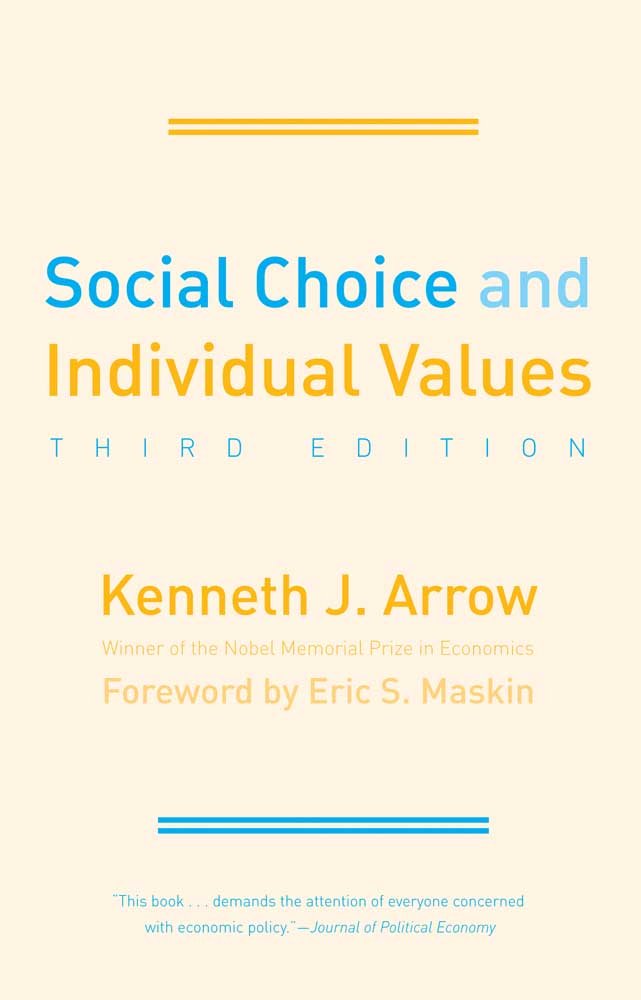
About Social Choice and Individual Values by Kenneth J. Arrow – A Landmark Book on Voting, Choice, and Fair Decisions
Social Choice and Individual Values by Kenneth J. Arrow is one of the most important books in modern economics and political theory. First published in 1951, it asks a simple but difficult question: how can a group turn many different personal choices into one fair social decision?
People often disagree. One voter may prefer option A, another may prefer option B, and someone else may prefer option C. A society, committee, government, or organization still needs a way to choose. Arrow studies what happens when we try to combine these different rankings into one result that represents the group.
The book became famous for what is now called Arrow’s Impossibility Theorem. In simple terms, Arrow showed that when there are several choices, no voting system can always turn individual rankings into a complete and consistent group ranking while meeting a set of reasonable fairness rules at the same time. This result changed how economists, political scientists, mathematicians, and voting theorists think about collective decisions.
This is not a casual storybook. It is a short but serious academic work. Readers who study economics, public policy, political science, mathematics, philosophy, voting systems, or decision theory can find lasting value in its ideas.
Why group decisions can be harder than they look
At first, voting seems easy. Count the votes and choose the winner. But problems appear when people rank several options rather than simply choosing yes or no.
Imagine three people choosing among three plans. One person prefers A over B and B over C. Another prefers B over C and C over A. A third prefers C over A and A over B. When these choices are compared in pairs, the group may prefer A to B, B to C, and C to A. The group preference can move in a circle even though each person has a clear personal ranking.
This problem shows why a fair rule for social choice is not simple. A method that seems reasonable in one case may produce a strange or unfair result in another.
Arrow studies this problem in a careful mathematical way. Instead of asking which voting rule feels best, he asks what properties a good decision rule should have and whether those properties can all exist together. His answer is surprising and powerful.
The idea behind Arrow’s Impossibility Theorem
Arrow’s theorem is the heart of the book. The full mathematics can be demanding, but the main idea can be understood without advanced training.
Suppose a society has at least three possible choices. Each person can rank those choices. We want a rule that combines those personal rankings into one social ranking. We may also want the rule to respect several reasonable conditions.
For example, if everyone prefers A to B, society should not rank B above A. The final result should not simply follow one permanent dictator. The social choice between A and B should depend on how people rank A and B, rather than being changed by an unrelated third option. The system should also work for a wide range of possible personal preferences.
Arrow showed that no rank-order voting system can satisfy all of these conditions together in every possible case. Something has to give.
This does not mean voting is useless. It means every collective decision rule has limits, tradeoffs, or assumptions. That lesson is one reason the book remains important decades after it first appeared.
A small book that changed several fields
Social Choice and Individual Values is not large, but its impact is much bigger than its size. Yale University Press describes the work as the book that introduced Arrow’s Impossibility Theorem and founded the field of social choice theory in economics and political science.
Social choice theory studies how individual wishes, rankings, or values can be turned into group decisions. This includes voting, public policy, welfare economics, committee choices, and other situations where many people want different things.
Arrow’s result also helped create new questions. Researchers began studying which fairness conditions should be relaxed, what kinds of voting systems work better under different goals, how strategic voting changes outcomes, and how group decisions can be designed when perfect rules are impossible.
More than a book about elections
Any group may need to combine individual preferences. A company may choose between projects. A committee may rank candidates. A university may decide between policies. A public agency may compare social outcomes. An online platform may need to rank options. Economists may compare different distributions of welfare.
Arrow’s framework helps readers see that a group does not automatically have a single mind. The word “society” can hide many different people with different goals. A rule is needed to turn those goals into an outcome, and the rule itself affects what happens.
This makes the book useful far beyond economics. It connects with political science, philosophy, public policy, mathematics, law, game theory, and modern mechanism design.
Understanding social welfare in a clearer way
One important part of the book is the idea of a social welfare function. This does not mean welfare payments. In this context, it is a formal way to describe how individual preferences might be combined into a social ordering.
Arrow asks whether society can rank possible states of the world by using the rankings of individuals. He then studies what rules such a system should follow.
This approach is important because it separates personal choice from collective choice. One person can have a consistent preference, but a group made from many consistent people may still produce an inconsistent result.
That difference is easy to miss in normal conversation. We often say that “the public wants” something or “society prefers” one policy. Arrow forces the reader to ask how that social preference was created and what assumptions were used.
Is this book easy for beginners?
The ideas can be explained simply, but the original text is academic and uses formal reasoning. Readers should not expect the style of a modern beginner guide.
A basic understanding of economics, logic, mathematics, or political science can make the book easier. However, a motivated reader can still gain value by focusing first on the big questions and then returning to the more technical sections slowly.
The best approach is not to rush. Read a small section, identify the rule or problem being discussed, and connect it to a simple voting example. Notes can help. A separate introduction to Arrow’s theorem can also make the original text easier to follow.
For university students, this is the kind of book that becomes more useful when read beside lectures, class notes, or a course on microeconomics, political economy, voting theory, or social choice.
Why students still study Arrow today
Arrow’s work remains important because it does not depend on one election, country, or political party. It studies the structure of collective choice itself.
The theorem teaches a lasting lesson: there may be no perfect method that satisfies every fairness goal at once. When institutions choose a voting or decision rule, they are also choosing which tradeoffs they are willing to accept.
That insight matters in economics and politics, but it also matters in system design. Modern researchers study voting methods, matching systems, auctions, recommendation rules, and collective decision tools. Many of these fields ask how individual choices can be combined under clear rules.
Kenneth J. Arrow later shared the 1972 Sveriges Riksbank Prize in Economic Sciences in Memory of Alfred Nobel with John R. Hicks for pioneering contributions to general economic equilibrium theory and welfare theory. His work on social choice remains one of the ideas most closely linked with his name.
What the later editions add
The first edition appeared in 1951. A second edition followed in 1963 and included additional notes on the theory of social choice. Yale University Press later issued a third edition in 2012 with a new foreword by Nobel laureate Eric S. Maskin.
These editions reflect the long life of the book. The central argument remains historically important, while later material helps place it within the development of the field.
If your copy is a different edition, page count and front matter may vary. The core work, however, remains Arrow’s classic treatment of preference, social welfare, collective rationality, and the general possibility theorem.
A useful reference for study and research
Economics students can use it when studying welfare economics and collective choice. Political science students can connect it to voting systems and democratic decision making. Mathematics students may appreciate the formal structure of the theorem. Philosophy students can use it when thinking about fairness, values, and public choice.
It is also a strong choice for readers who enjoy books that change how a familiar idea is understood. Voting feels ordinary until Arrow shows how difficult it is to create one consistent social ranking from many individual rankings.
Reading quality made for serious study
Bookish Wonderland prepares this physical copy for readers who may spend long periods studying, marking ideas, and returning to important sections. Premium eye-soothing cream paper gives the pages a softer look than bright white paper, while crystal-clear printing keeps formulas, headings, and normal text easy to follow.
The book also uses high-quality stitched and glue binding for better strength and longevity. That matters for an academic title that may be opened many times during a course or kept as a reference after study is complete.
Why order this academic classic from Bookish Wonderland
Bookish Wonderland helps readers across Bangladesh order English books without making the buying process difficult. Nationwide delivery is available, including addresses inside and outside Dhaka. Cash on Delivery is available across the country, and customers in Dhaka can ask about fast or urgent delivery when needed.
When comparing the Book price in Bangladesh for Social Choice and Individual Values by Kenneth J. Arrow, it is worth looking beyond the price alone. Comfortable paper, clear printing, durable binding, convenient payment, and reliable delivery can make an academic book easier to study and keep.
Add a foundational idea to your economics shelf
Social Choice and Individual Values is a book for readers who want to understand what lies beneath voting, fairness, and collective decisions.
Arrow shows that even reasonable rules can conflict with one another. That discovery does not end the search for better decision systems. It makes the search more careful. Readers learn to ask which values a rule protects, which tradeoffs it accepts, and what happens when individual choices must become one group result.
If you study economics, political science, public policy, mathematics, philosophy, or voting theory, this book can give you direct access to one of the field’s foundational arguments for serious study.
Order Social Choice and Individual Values by Kenneth J. Arrow from Bookish Wonderland for a premium physical reading experience with cream paper, crystal-clear print, strong stitched and glue binding, nationwide delivery, and Cash on Delivery. For customization questions or urgent delivery support, contact Bookish Wonderland through Facebook or Instagram before placing your order.
If you require any customization or have any questions, please inbox us via FB or Insta.
| Primary Specification | |
| Author | Kenneth J. Arrow |
| Genre | Economics, Social Choice Theory, Political Science, Welfare Economics |
| ISBN-13/ISSN | 978-0300179316 |
| ISBN-10 | 0300179316 |
| Publisher | Yale University Press |
| Publishing Date | June 26, 2012 |
| Language | English |
| Reading Age | 18+ years |
| Format | Printed book |
| Physical Specification & Quality | |
| Paper Quality | Premium eye-soothing cream paper |
| Binding Quality | High quality stitched and glue binding (for longevity) |
| Print Quality | Crystal-clear print |
| Pages | 144 pages |
| Country | USA |
| Logistics Information | |
| Weight | 149g |
| Length | 8.5 inches |
| Width | 5.6 inches |
| Height | 0.4 inches |