

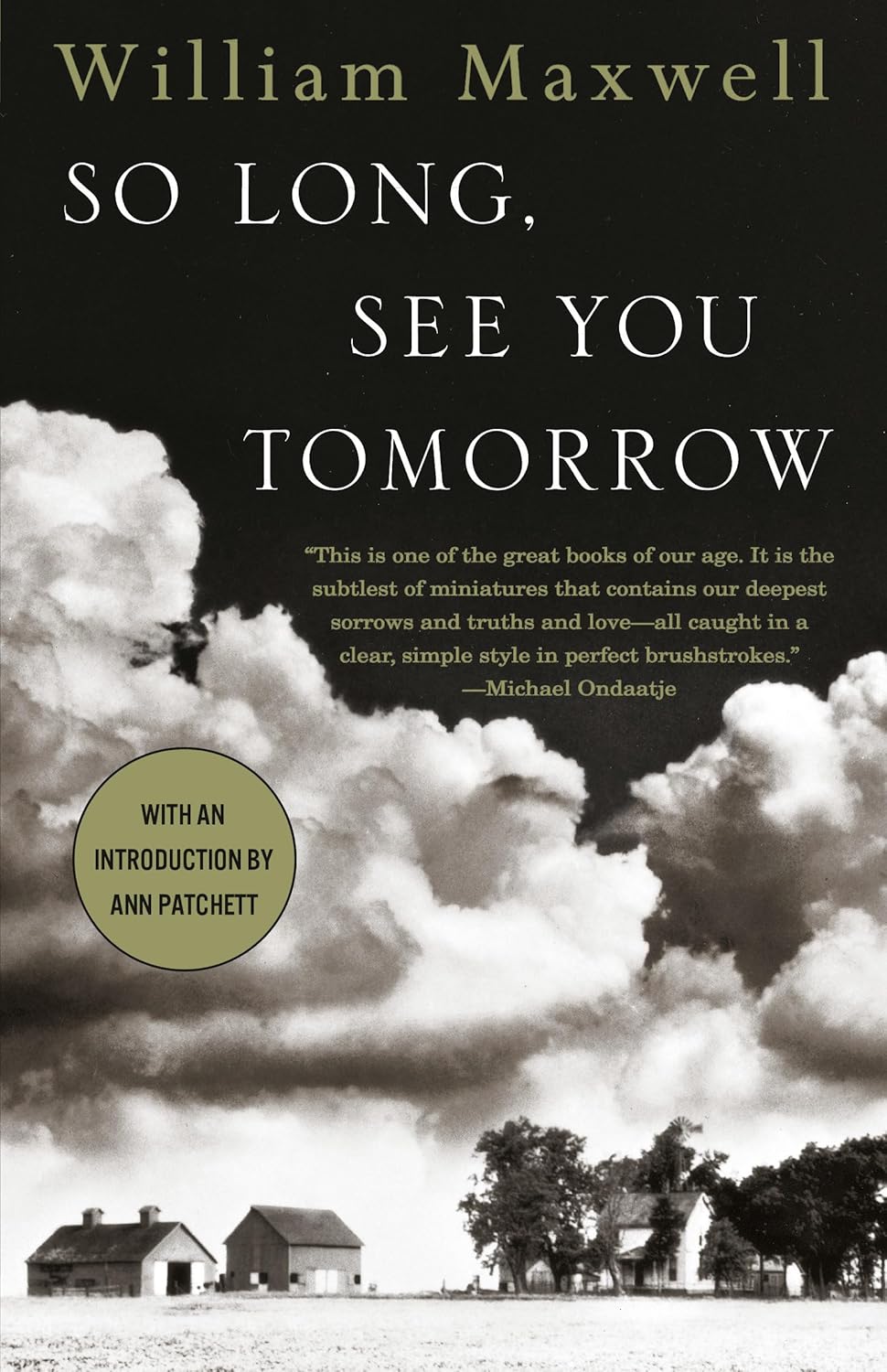
About So Long, See You Tomorrow by William Maxwell – A Quiet American Classic About Memory, Guilt, Friendship, and Forgiveness
So Long, See You Tomorrow by William Maxwell is a short novel with a deep emotional weight. It begins with a murder on a farm in rural Illinois during the 1920s. Lloyd Wilson is killed, and the event destroys more than one family. It also ends a fragile friendship between two boys who are already carrying loneliness of their own.
Many years later, the narrator looks back and tries to understand what happened. He remembers his childhood, his own grief, and his friend Cletus Smith, the son of the man who killed Lloyd Wilson. The narrator is troubled by one small moment from the past: after the murder, he saw Cletus in a school hallway and failed to speak to him. That silence stays with him for decades.
From this simple memory, William Maxwell builds a moving story about how people live with regret. The novel mixes memory, imagination, family history, and grief. It asks whether we can ever know another person completely, whether the past can be understood clearly, and whether telling a story can become a form of apology.
First published as a book in 1980, So Long, See You Tomorrow later won a National Book Award and became a finalist for the Pulitzer Prize for Fiction.
A murder story that is really about memory
At first, the book may sound like a crime novel. There is a killing, a broken family, jealousy, and a question about how the tragedy happened. But Maxwell is not mainly interested in solving a mystery. The reader learns the basic facts early.
The real mystery is memory.
The narrator is trying to understand a past that he cannot fully recover. He knows what he remembers, but memory is incomplete. He also knows that he was not present for every private conversation or family conflict that led to the murder. To tell the story, he must combine known facts with imagination.
That makes the novel powerful for readers who have ever looked back and wondered what they should have said, what another person was feeling, or whether one small action could have changed something.
Two lonely boys connected by loss
The friendship between the narrator and Cletus is quiet and delicate. Both boys carry pain from their home lives. They find some comfort in each other, but neither has the language or confidence to explain everything he feels.
Then the murder changes Cletus’s life completely.
Cletus becomes connected to an act he did not commit. His father is responsible, but the shame and damage reach the child as well. The narrator later understands that Cletus may have needed kindness at the exact moment when he himself was too frightened or unsure to offer it.
That missed chance becomes the emotional center of the book.
Maxwell does not turn it into a loud lesson. He shows how one ordinary moment can grow in meaning over time. A boy walking past another boy in a hallway may seem small, but decades later the narrator still remembers it. He wants to go back, speak, and make a different choice, but the past cannot be changed.
Why this short novel feels so large
Some books need hundreds of pages to create emotional depth. So Long, See You Tomorrow does something different. It is compact, careful, and quiet.
Maxwell uses simple language to describe complicated feelings. He does not fill every page with action. Instead, he gives attention to small memories, family habits, houses, farms, school corridors, grief, and silence.
Because the writing is so controlled, small details carry extra weight. A room, a dog, a road, or a brief conversation can hold an entire history.
This style makes the book a good choice for readers who enjoy literary fiction that rewards slow reading. You can finish the novel quickly, but you may want to return to certain pages afterward. The story becomes richer when you think about what the narrator knows, what he imagines, and what he wishes he had done differently.
Grief shapes the narrator before the murder story begins
The narrator’s own childhood loss is important. He loses his mother when he is young, and that grief changes the way he experiences home, family, and memory.
This personal pain is not separate from the story of Cletus. It helps explain why the narrator feels such a strong connection to another lonely boy. Both children live near adults whose choices and losses shape them.
Maxwell shows that childhood grief does not simply disappear when a person grows older. It can remain inside memory, changing how later events are understood.
For readers, this gives the novel more emotional layers. It is not only about a murder. It is also about a child trying to understand death, a family trying to continue, and an adult looking back at the person he once was.
The past becomes something the narrator keeps revisiting because he is still trying to make peace with it.
A story about guilt without easy punishment
The narrator did not cause the murder. He did not destroy Cletus’s family. Yet he still feels guilt.
His guilt comes from a much smaller act: he failed to speak to his friend when that friend was suffering.
People often carry guilt for things that would look minor to someone else. A missed phone call, an unkind word, a silence, or a moment of fear can remain in memory for years.
Maxwell treats that feeling seriously. He does not tell the reader that the narrator is foolish to care. Instead, he asks what a person can do when an apology arrives too late.
Writing becomes part of the answer. By reconstructing Cletus’s story, the narrator tries to give attention to the friend he once failed to acknowledge.
The novel cannot change the past, but it can refuse to forget it.
Rural Illinois becomes part of the emotional world
The setting matters deeply. Farms, fields, roads, houses, barns, and small-town life create the world around the families.
This is not a glamorous setting. It is ordinary, which makes the tragedy feel even more real. People work, visit neighbors, raise children, care for animals, argue, fall in love, become jealous, and make choices that can change several lives.
The narrator is looking back across many years, almost as if the old Illinois world exists behind glass. He can see parts of it clearly, but he cannot step back inside it.
Who will enjoy So Long, See You Tomorrow most
This novel is a strong choice for readers who enjoy literary fiction, quiet stories, family drama, psychological depth, historical settings, memory, grief, and moral questions.
It may especially appeal to readers who like books where the biggest events happen inside a character’s mind. The story is not fast in the usual thriller sense, even though a murder is central to the plot.
Instead, the tension comes from understanding how people reached a terrible moment and how one survivor continues to carry it.
The book is also useful for students and book clubs. It can open discussion about memory, truth, guilt, childhood, grief, storytelling, friendship, responsibility, and forgiveness.
Because it is short, it is easy to assign or read in a few sittings. Because it is emotionally rich, there is still plenty to discuss after the final page.
An award-winning American novel with lasting respect
So Long, See You Tomorrow received major literary recognition. The National Book Foundation records the book as a 1981 National Book Award finalist in hardcover and a 1982 winner in paperback. It was also a finalist for the 1981 Pulitzer Prize for Fiction.
The novel later received the William Dean Howells Medal, adding to its reputation as an important work of American fiction.
Awards are not the only reason to read a book, but they help show how strongly Maxwell’s work has been valued by writers, critics, and literary institutions.
William Maxwell also spent decades as a fiction editor at The New Yorker, where he worked with major American writers.
A comfortable physical copy for thoughtful reading
Bookish Wonderland prepares this copy for readers who want a clean and comfortable physical edition. Premium eye-soothing cream paper gives the pages a softer look during longer reading sessions. Crystal-clear printing keeps the text sharp and easy to follow.
The book also uses high-quality stitched and glue binding for better strength and longevity. That is useful for a literary novel you may want to reread, underline carefully, or keep as part of a personal classics collection.
These physical details are included in one place so you can understand the reading quality without seeing the same specifications repeated throughout the page.
A meaningful choice for study, gifting, or quiet reading
This book works well for several kinds of readers. A literature student can study its structure, memory, and narrative voice. A book club can discuss whether the narrator’s imagined reconstruction brings him closer to truth. A reader dealing with grief may connect with the way the past remains present.
It can also make a thoughtful gift for someone who prefers literary classics over fast commercial fiction.
The novel is short enough for a weekend but deep enough to stay in the mind afterward. It is especially good for quiet reading, when you have time to notice the small sentences and emotional details.
When comparing the Book price in Bangladesh for So Long, See You Tomorrow by William Maxwell, consider the complete physical experience as well as the listed price. Comfortable paper, clear print, durable binding, Cash on Delivery, and nationwide delivery can make the book easier to buy, read, and keep.
Why order from Bookish Wonderland
Bookish Wonderland offers nationwide delivery across Bangladesh, including addresses inside and outside Dhaka. Cash on Delivery is available across the country, giving customers an easy payment option without requiring online payment first.
Readers in Dhaka can also ask about fast or urgent delivery when available. This can help when the book is needed for a class, a gift, a reading plan, or a book-club meeting.
Bookish Wonderland also offers a large collection of premium and durable English books, making it easier to build a personal shelf one title at a time.
Read a small novel that leaves a long shadow
So Long, See You Tomorrow by William Maxwell shows how one brief moment can remain inside a person for half a century. A murder begins the tragedy, but the deepest wound comes from memory, friendship, and the words that were never spoken.
The narrator cannot return to the school hallway and greet Cletus. He cannot repair another family’s past. What he can do is remember, imagine, and tell the story with care.
That quiet act gives the novel its power.
If you enjoy books about memory, loss, childhood, guilt, family, and forgiveness, this American classic deserves a place on your reading list. It is short without feeling small and sad without losing compassion.
Order So Long, See You Tomorrow by William Maxwell from Bookish Wonderland and experience a novel that proves a few pages can hold decades of regret, love, and human understanding. For customization questions or urgent delivery support, message Bookish Wonderland through Facebook or Instagram before placing your order.
For your repeated book-catalog workflow, Airtable can also be connected in ChatGPT to keep title, author, genre, summaries, SEO metadata, series position, and publishing status in structured fields.
If you require any customization or have any questions, please inbox us via FB or Insta.
| Primary Specification | |
| Author | William Maxwell |
| Narrator | William Maxwell |
| Genre | Literary Fiction, Historical Fiction, Coming-of-Age, Psychological Fiction |
| ISBN-13/ISSN | 978-0679767206 |
| ISBN-10 | 0679767207 |
| Publisher | Vintage |
| Publishing Date | January 3, 1996 |
| Edition | First Edition |
| Language | English |
| Format | Printed book |
| Physical Specification & Quality | |
| Paper Quality | Premium eye-soothing cream paper |
| Binding Quality | High quality stitched and glue binding (for longevity) |
| Print Quality | Crystal-clear print |
| Pages | 144 pages |
| Country | USA |
| Logistics Information | |
| Weight | 151g |
| Length | 8.5 inches |
| Width | 5.6 inches |
| Height | 0.4 inches |