Skip to product information
1 of 1

Bookish Wonderland

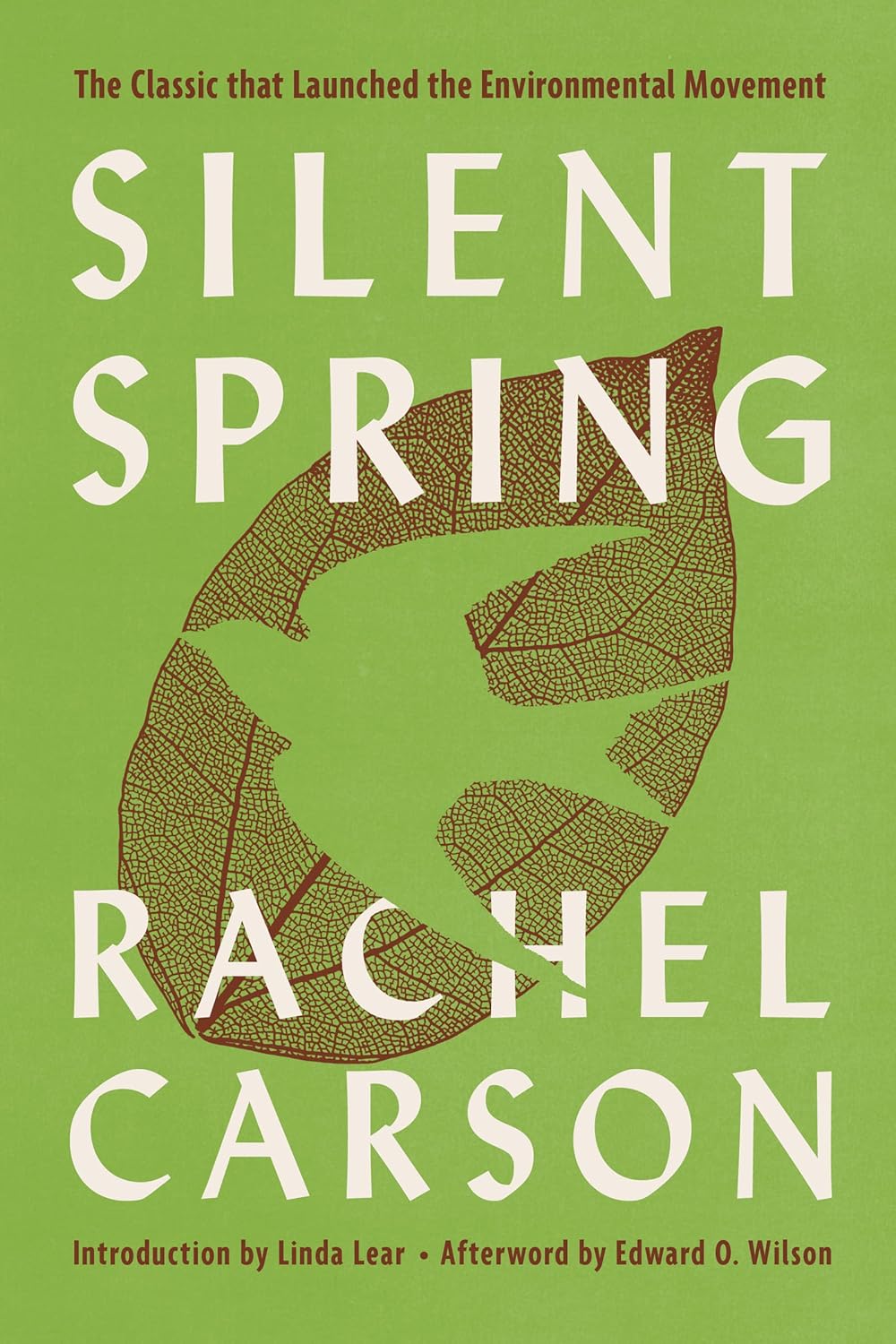
Silent Spring by Rachel Carson

Silent Spring by Rachel Carson

Regular price Tk 230.00 BDT
Regular price Sale price Tk 230.00 BDT
Sale Sold out
Book cover type
Quantity

Silent Spring by Rachel Carson is a powerful nonfiction classic that changed the way people think about nature, pesticides, pollution, and human responsibility toward the environment. First published in 1962, the book explains how the careless use of chemical pesticides can affect birds, insects, water, soil, animals, and even human health. Carson shows that nature works as one connected system, so damage to one part can create problems in many other areas. She uses scientific research, real examples, and clear explanations to help ordinary readers understand difficult environmental issues without making the book feel too technical. Silent Spring is especially useful for students, teachers, science readers, environmentalists, and anyone interested in ecology, agriculture, public health, or environmental history. The book also encourages readers to question quick solutions and think about long-term effects before making decisions that may harm nature. Thought-provoking, educational, and historically important, Silent Spring by Rachel Carson remains an essential book for understanding modern environmental awareness and the need for careful, responsible use of science and technology. Read More

View full details

About Silent Spring by Rachel Carson – The Environmental Classic That Changed Public Debate

Silent Spring by Rachel Carson is one of the most important environmental books of the twentieth century. First published in 1962, it asks a simple but serious question: what happens when people use powerful chemicals without fully thinking about what those chemicals do to birds, insects, soil, water, animals, and human life? Carson takes a subject that could feel difficult and explains it through examples, observation, and science. The result is a book that made readers look at pesticides in a new way.

This is not only a book about one chemical or one moment in history. It is a book about responsibility. Carson shows that nature works like a connected system. When one part is harmed, the effect can move through many other parts. A chemical placed on a field may not stay only on that field. It can reach water, enter food chains, affect wildlife, and remain in the environment. That idea gives the book its lasting power.

For students, teachers, science readers, environmentalists, history lovers, and anyone who wants to understand how public concern about pollution grew, Silent Spring remains a meaningful and readable choice.

Why This Book Still Matters

Rachel Carson wrote at a time when synthetic pesticides were widely treated as powerful tools for farming, pest control, and public health. She did not argue that every chemical should be rejected. Instead, she questioned careless, repeated, and large-scale use. She asked whether people were creating new dangers while trying to solve old problems.

That question still feels familiar today. Modern life often depends on chemicals, machines, medicines, farming systems, and industrial tools. Many of them bring benefits. But every powerful tool can also have side effects. Silent Spring teaches readers to ask better questions: What are the long-term effects? Who checks the risks? What happens to other species? Can a substance build up in nature? Are there safer ways to solve the same problem?

The book became important because Carson made these questions understandable to the public. She connected scientific evidence with everyday life. Instead of speaking only to experts, she showed why environmental decisions also matter to families, farmers, communities, and future generations.

When a Quick Fix Creates a Bigger Problem

Pesticides are made to kill or control unwanted insects, weeds, or other pests. The problem begins when a chemical does more than the job it was meant to do. It may also harm useful insects, fish, birds, or other animals. Some chemicals can stay in the environment for a long time. Others may move through food chains or spread beyond the place where they were first used.

Carson’s answer is not fear. Her answer is care, evidence, restraint, and better choices. She asks readers to think before acting. She argues for closer study, stronger control, more careful use, and alternative ways to manage pests where possible.

That makes Silent Spring more than a warning. It is also a lesson in decision-making. The book shows why science should not only ask, “Does this work?” It should also ask, “What else happens when we use it?” This wider way of thinking is one reason the book continues to appear in courses on environmental science, ecology, history, public policy, and science communication.

What Rachel Carson Explains

One of the strongest parts of Silent Spring is the way Carson connects different parts of nature. She writes about insects, birds, forests, farms, rivers, soil, and people as parts of one shared system. A change in one place can travel through that system.

The book discusses the heavy use of chemical pesticides, including DDT, and the damage that uncontrolled use could cause. Carson explains how persistent chemicals can remain in the environment and how exposure can spread beyond the target pest. She also draws attention to wildlife, especially birds, because changes in bird populations can reveal deeper damage in an ecosystem.

The title itself creates a simple image: a spring season with no birdsong. That image helps readers understand the cost of environmental harm without needing advanced scientific knowledge.

Carson also challenges the idea that humans stand outside nature. Her message is that people live inside the same world as every other living thing. Clean water, healthy soil, useful insects, plants, birds, and balanced ecosystems are not separate from human life. They support it.

Readers will also notice how carefully Carson builds her case. She combines scientific reporting with clear language and memorable examples. This makes the book useful not only for learning about environmental history, but also for seeing how complex science can be explained to the public.

A Book About Science, Power, and Responsibility

Silent Spring asks who should decide when a new technology or chemical is safe enough to use. It also asks how much evidence society should demand before allowing a practice that may affect many people and ecosystems.

These questions make the book useful beyond environmental science. It can lead to discussions about government rules, business responsibility, scientific research, public health, farming, consumer safety, and the role of citizens in public decisions.

Carson’s work also shows the value of independent questioning. A product can be useful and still need limits. A scientific advance can solve one problem and create another. A popular practice can still deserve review. These ideas matter for readers learning to think critically about technology and risk.

The book does not ask readers to reject progress. It asks them to define progress more carefully. If a solution damages the systems that support life, then the full cost must be considered.

What You Will Find in This Book

  • A clear discussion of pesticides and their wider effects on nature

  • Explanations of how chemicals can move through ecosystems and food chains

  • Examples involving birds, insects, water, soil, farms, and wildlife

  • A strong argument for careful, evidence-based environmental decisions

  • Historical insight into the rise of modern environmental awareness

  • Accessible science writing for readers who are not specialists

  • Questions about responsibility, regulation, safety, and long-term thinking

  • A classic example of how one book can shape public discussion

What Readers Can Gain From It

Reading Silent Spring by Rachel Carson can help you understand why environmental problems are often connected. It encourages you to look beyond the first result of an action and think about second and third effects. This is useful in science, business, policy, farming, health, and everyday decision-making.

The book can also improve critical reading. Carson presents evidence, builds an argument, and asks readers to question common assumptions. Students can study how she explains technical ideas. Teachers can use the book to discuss science and society. General readers can learn the background behind debates over pesticides, pollution, conservation, and environmental law.

Most importantly, the book helps readers see nature as a system rather than a set of separate parts. That way of thinking is useful far beyond the subject of pesticides.

Who Should Read Silent Spring?

This book is a choice for readers interested in environmental science, biology, ecology, history, public policy, conservation, agriculture, or science writing. It is useful for university and college students who need a classic text connected to environmental thought.

Teachers can use it to start discussions about evidence, risk, public communication, and ethics. Young adult readers interested in science can read it with guidance, although some parts use scientific terms and historical examples that may need extra explanation.

It is equally suitable for readers who simply want to understand why Silent Spring is still mentioned decades after publication. You do not need to be a scientist. Carson explains her ideas in a way that lets general readers follow the main argument.

A Useful Book for Study, Discussion, and Personal Reading

Silent Spring works well in more than one setting. You can read it slowly and make notes for a course. You can use it for an assignment on environmental history. You can compare its arguments with current discussions about farming, pollution, chemical safety, biodiversity, or public health. You can also read it simply as a nonfiction work that helped change how people talk about the environment.

For group study, each chapter can open a different discussion. Readers can ask what evidence Carson uses, what risks she describes, what solutions she supports, and which ideas remain relevant today. For personal reading, the book rewards patience because its main value comes from seeing how all the examples connect.

A Premium Reading Copy from Bookish Wonderland

A serious nonfiction book is easier to enjoy when the physical copy is comfortable to read and made to last. Bookish Wonderland offers this title with premium eye-soothing cream paper, crystal-clear print, and high-quality stitched and glue binding for longevity. The cream-colored pages help reduce the harsh look of bright white paper during longer reading sessions, while the clear print keeps the text easy to follow.

The strong binding is useful for students and regular readers who may open the book many times for study, notes, or reference. This makes the copy suitable for a personal collection, classroom use, or repeated reading.

When checking Book price in Bangladesh options for Silent Spring by Rachel Carson, it is worth looking beyond price alone. Paper comfort, print clarity, binding strength, delivery support, and overall reading quality all matter when you plan to keep a book for years.

Bookish Wonderland also provides nationwide delivery across Bangladesh, delivery inside and outside Dhaka, Cash on Delivery, and a fast or urgent delivery option in Dhaka. Readers can also explore a large collection of premium and durable English books in one place.

Why Add This Book to Your Collection?

Some books are useful because they explain a topic. Others are valuable because they help readers see an entire subject in a new way. Silent Spring does both.

It gives you a clear starting point for understanding the history of environmental awareness and pesticide debate. It also teaches a wider habit of thought: look at connections, question easy answers, and think about long-term effects.

That makes the book especially useful for readers building a nonfiction collection. It sits at the meeting point of science, history, ethics, policy, and nature writing. You can read it for knowledge, use it for study, discuss it in class, or return to it later as a reference point for modern environmental questions.

If you enjoy books that explain why major public debates began, this title deserves attention. If you study biology, ecology, agriculture, environmental policy, or science communication, it gives you important historical context. If you simply want a book that encourages careful thinking about how humans use power over nature, it offers that too.

Order Silent Spring by Rachel Carson Today

Choose Silent Spring by Rachel Carson if you want a readable environmental classic with lasting historical and educational value. This is a book for readers who want to understand how scientific evidence can enter public discussion and how environmental choices can affect more than their original target.

Order your copy from Bookish Wonderland and read it in a durable format made for regular use. With premium cream paper, clear printing, strong binding, Cash on Delivery, nationwide delivery, and urgent delivery options in Dhaka, it is easy to add this important nonfiction work to your reading list.

Read it for the history. Read it for the science. Read it to understand why careful choices matter when people change the natural world. Silent Spring remains a book that asks simple questions with serious meaning, and those questions are still worth thinking about today.

If you require any customization or have any questions, please inbox us via FB or Insta.

Primary Specification
AuthorRachel Carson
NarratorKaiulani Lee
GenreEnvironmental Science, Ecology, Nature, Environmental Conservation, Pesticides and Environment
ISBN-13/ISSN978-0618249060
ISBN-100618249060
PublisherMariner Books Classics
Publishing DateOctober 22, 2002
LanguageEnglish
Reading Age15+ years
FormatPrinted book
Physical Specification & Quality
Paper QualityPremium eye-soothing cream paper
Binding QualityHigh quality stitched and glue binding (for longevity)
Print QualityCrystal-clear print
Pages400 pages
CountryUSA
Logistics Information
Weight419 gm
Length8.5 inches
Width5.6 inches
Height0.88 inch
What is Silent Spring by Rachel Carson about, and what is its main message?

Silent Spring by Rachel Carson is a landmark environmental nonfiction book about the effects of widespread and careless chemical pesticide use on wildlife, ecosystems, and human health. Carson explains how pesticides do not necessarily remain only where they are sprayed; persistent chemicals can move through soil, water, food chains, animals, and the wider environment. Her main argument is not that every pesticide should automatically be eliminated, but that powerful chemicals should be used carefully, scientifically, and with full consideration of their long-term consequences. The book especially examines damage to birds and other non-target species and shows how closely different parts of nature are connected. This combination of science, environmental observation, and public responsibility made the book highly influential after its publication in 1962.

How many books are in the Silent Spring series by Rachel Carson, and what are they?

There are no additional books in a numbered Silent Spring series. Silent Spring by Rachel Carson is a standalone nonfiction book containing Carson's complete investigation and argument about pesticides, environmental contamination, wildlife, and the responsibility people have when introducing powerful chemicals into natural systems. Rachel Carson wrote several other important books, particularly works about the sea and natural history, but those titles are separate works rather than sequels or volumes of a Silent Spring series. Therefore, customers do not need to purchase or read another book before starting Silent Spring, and there is no Book 1, Book 2, or continuing storyline to follow. Readers can approach this title independently as a complete work of environmental science and literature.

Why is the book called Silent Spring, and what does the title mean?

The title Silent Spring presents one of the book's most memorable warnings: a future spring in which birds are no longer singing because environmental contamination has severely damaged wildlife populations. Carson begins the book with a disturbing imagined community where nature has become strangely quiet after widespread ecological damage. The image is symbolic rather than simply a prediction about one particular location. It helps readers understand how actions directed at insects can affect birds, fish, mammals, plants, and ultimately people because ecosystems are interconnected. The National Park Service specifically explains that the title refers to the threat of a world without birdsong if destructive pesticide practices continued. This simple image made a complicated environmental issue understandable to ordinary readers and remains one reason the title is still widely recognized.

Is Silent Spring still worth reading today even though it was published in 1962?

Yes. Silent Spring should be read partly as an important historical work and partly as a broader examination of environmental responsibility. Some pesticide science, chemical regulations, agricultural practices, and available evidence have naturally developed since 1962, so it should not replace a modern environmental-science textbook. However, its larger questions remain relevant: What happens when chemicals persist in ecosystems? How carefully should new technologies be tested? Who should bear the environmental risks of industrial decisions? How should scientific evidence influence public policy? The Library of Congress notes that the book's influence is still felt as concern about environmental contaminants continues, while recent reader discussions repeatedly describe its central ideas as surprisingly relevant decades later. This continuing relevance makes it useful for environmental studies, history, policy, and general nonfiction readers.

Did Silent Spring really lead to the banning of DDT and change environmental policy?

Silent Spring had major influence, but it is more accurate to say that it helped transform public discussion and contributed to a much larger scientific and regulatory process rather than claiming that one book alone immediately banned DDT. The U.S. Environmental Protection Agency states that the book's 1962 publication stimulated widespread concern about improper pesticide use. Scientific investigation, public debate, regulatory hearings, environmental organizations, and government action continued afterward, and the EPA issued its order cancelling most DDT uses in the United States in 1972. Carson's work also became closely associated with the growth of modern environmental awareness. Its historical importance therefore comes not simply from criticizing one chemical but from changing how many people thought about pollution, ecological consequences, scientific evidence, and public oversight of environmental risks.

Is Silent Spring difficult to read, and is it suitable for students and beginners in environmental science?

Silent Spring is accessible to general readers, but it is more demanding than light nonfiction because Carson includes scientific explanations, chemical names, ecological relationships, case studies, and detailed evidence. TeachingBooks lists the title for grades 7–12 while also giving it a relatively high text-complexity level, so younger readers may benefit from guidance when encountering unfamiliar scientific vocabulary. Reader discussions show a similar pattern: some describe the book as dense because of the amount of evidence, while others praise Carson for explaining technical environmental issues in language ordinary people can understand. Students studying environmental science, biology, ecology, history, public policy, or sustainability may find it particularly valuable. Readers do not need professional scientific training, but patient reading will help them understand Carson's arguments and supporting examples more clearly.

Is Silent Spring a dry scientific textbook, or does Rachel Carson use an engaging writing style?
Although Silent Spring deals seriously with science, it is not written like a conventional technical textbook. Rachel Carson was both a trained biologist and an accomplished nature writer, and she combines scientific evidence with clear explanation, observation, imagery, and literary prose. That combination helped her communicate complicated subjects—including pesticides, food chains, wildlife deaths, contamination, and ecological relationships—to readers outside scientific professions. Modern reader discussions frequently mention this feature: some readers find portions scientifically dense, while others specifically praise the prose and the way Carson makes environmental information compelling rather than purely academic. The National Park Service similarly describes her language as poetic and compelling. This balance between scientific argument and literary writing is one of the reasons Silent Spring continues to be studied not only in environmental courses but also as an important work of nonfiction writing.
Is the science in Silent Spring accurate, and was Rachel Carson against all pesticides?
A useful way to read Silent Spring is to separate its enduring environmental arguments from scientific details that reflect knowledge available in the early 1960s. Later research and regulation have expanded considerably since Carson wrote the book, so readers seeking present-day pesticide guidance should also consult modern scientific sources. However, one common misconception is that Carson simply demanded that every pesticide be abandoned. Historical EPA and National Park Service accounts state that she did not advocate eliminating all chemical pesticides. Instead, she challenged indiscriminate use, emphasized the dangers of persistent chemicals such as DDT, supported stronger regulation, and encouraged safer or biological alternatives where appropriate. Later evidence also established DDT's environmental persistence, accumulation in fatty tissues, and serious effects on wildlife, reinforcing important parts of the ecological concerns that brought widespread attention to the book.
Is Silent Spring by Rachel Carson available as a premium edition from Bookish Wonderland?

Yes. The Bookish Wonderland version is prepared for customers who want a comfortable and durable printed English book rather than a poorly produced copy that becomes unpleasant to read after repeated handling. This premium edition focuses on clean presentation, readable text, solid physical construction, and materials suitable for keeping the book in a personal, academic, or institutional collection. Silent Spring contains detailed discussions that readers may want to underline, revisit, or reference during environmental science and sustainability studies, so physical quality matters for long-term use. Bookish Wonderland combines its premium production standard with careful presentation so customers receive a book designed for both regular reading and collection purposes. It is a practical choice for students, teachers, researchers, environmental readers, and anyone building a durable English nonfiction library.

What kind of paper and print quality does the Bookish Wonderland edition of Silent Spring have?

The Bookish Wonderland edition of Silent Spring uses premium eye-soothing cream paper intended to provide a comfortable reading surface during longer sessions. The softer cream tone reduces the harsh visual feeling that very bright white pages can create for some readers, which is particularly useful for a nonfiction book containing extended paragraphs, scientific explanations, examples, and detailed arguments. The text is produced with crystal-clear printing so letters remain sharp, clean, and easy to follow throughout the book. Good print clarity is especially important in Silent Spring because readers need to distinguish scientific terminology and follow Carson's reasoning carefully. Together, the cream paper and clear text create a smoother physical reading experience for study, casual reading, annotation, or repeated reference without sacrificing readability.

How durable is the binding of Silent Spring from Bookish Wonderland, and will the book last for repeated reading?

Bookish Wonderland uses high-quality stitched and glue binding for Silent Spring, combining two forms of support to improve page security and overall longevity. This construction is particularly useful for books that may be opened frequently for study, classroom discussion, research, highlighting, or repeated reference. A weak binding can gradually cause pages or sections to loosen after regular handling, whereas reinforced construction is designed to keep the book together more securely over time. That makes this edition suitable for readers who plan to preserve Silent Spring as part of a long-term personal collection rather than treating it as a one-time read. Proper storage still matters—keeping the book away from excessive moisture, heat, and rough handling will help protect the paper, cover, spine, and binding for considerably longer use.

Why is Bookish Wonderland one of the best choices for buying Silent Spring by Rachel Carson in Bangladesh?

Bookish Wonderland combines book quality with purchasing options designed specifically for customers across Bangladesh. Readers can order Silent Spring with nationwide delivery, including addresses both inside and outside Dhaka, while Cash on Delivery is available across Bangladesh for customers who prefer to pay when their order arrives. For customers in Dhaka who need the book quickly for study, coursework, a gift, or personal reading, a fast or urgent delivery option is also available. Along with these delivery choices, Bookish Wonderland maintains a large collection of premium and durable English books and focuses on readable printing, dependable construction, and comfortable page quality. This makes the store convenient for customers looking for a well-produced physical copy of an important environmental classic without having to depend on international ordering.