

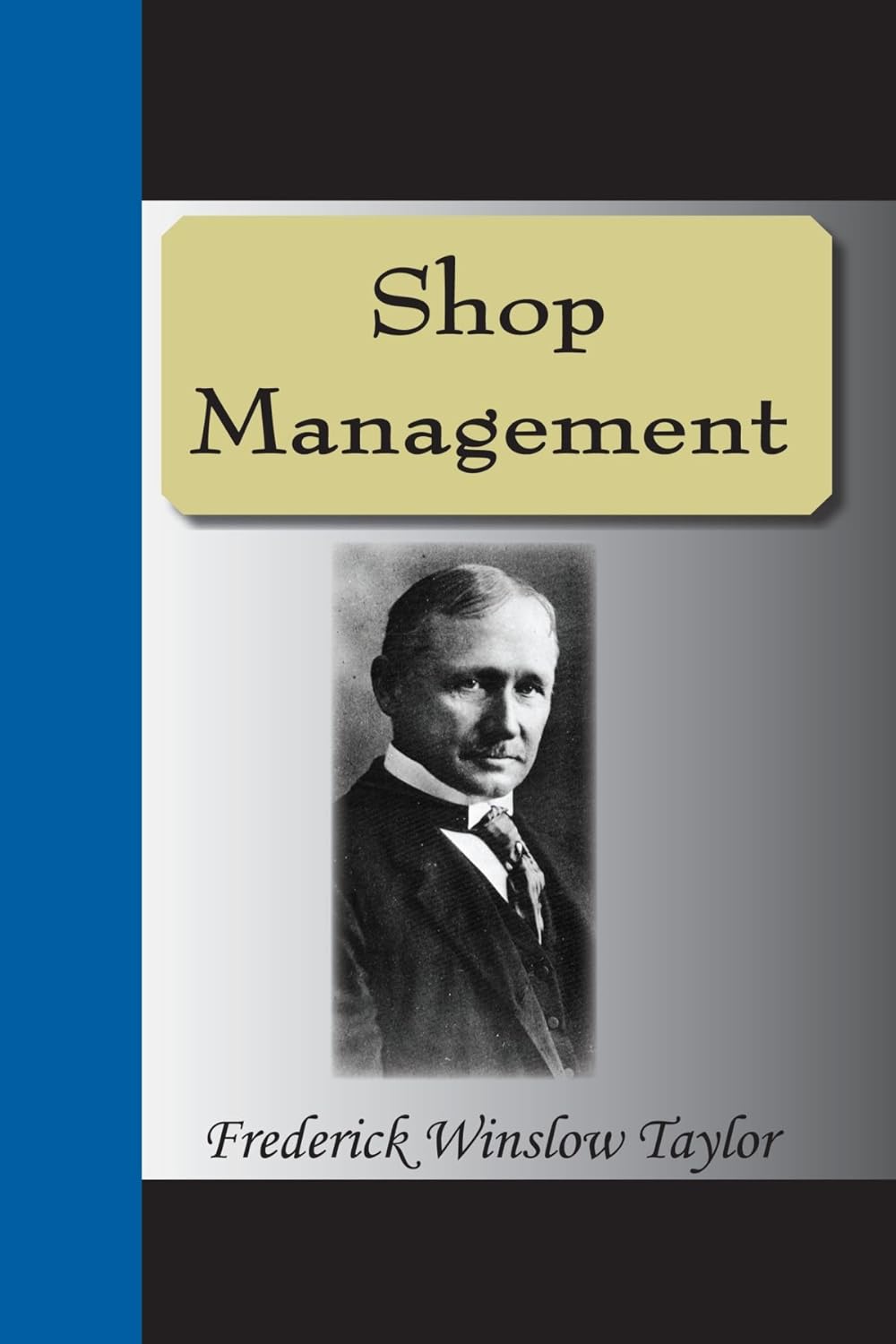
About Shop Management by Frederick Winslow Taylor – A Classic Guide to Scientific Management, Factory Planning, Work Measurement, and Industrial Efficiency
Shop Management by Frederick Winslow Taylor is an early management text about how factories and machine shops can organize work in a more systematic way. Taylor wrote from years of experience in industrial settings, especially machine shops, where he studied how workers, supervisors, tools, schedules, pay systems, and planning affected output.
The book is closely connected with the development of scientific management. Taylor argues that good management should not depend only on habit, guesswork, or the personal style of one foreman. Instead, managers should study work carefully, record what they learn, set clear standards, prepare work in advance, and give workers better instructions and support.
Taylor Starts With a Basic Management Problem
Taylor believed many factories were badly organized even when they appeared successful.
Different departments could use completely different methods. Important knowledge often stayed inside the heads of experienced workers or supervisors. Managers might know that production was slow without knowing exactly why.
Taylor wanted management to become more systematic.
Instead of relying only on experience and personal judgment, he wanted managers to collect information, study tasks, compare methods, and build clear systems.
High Wages and Low Labor Cost Are Central Goals
One of Taylor’s repeated ideas is that higher wages for workers and lower labor cost for employers do not always have to conflict.
He argues that better methods can increase output enough for workers to earn more while the cost of producing each unit falls.
This is different from simply telling people to work faster.
Taylor’s system depends on studying the job, improving tools and methods, planning the work, and setting a clear task.
When productivity improves because the whole system improves, both workers and employers may gain.
Taylor Discusses “Soldiering”
Taylor uses the word “soldiering” for deliberately working below a person’s possible pace.
He believed this happened for several reasons.
Workers might fear that higher output would lead management to reduce piece rates or cut jobs. Groups of workers could also pressure one another not to work too fast. Management itself could create mistrust by changing rates or setting unfair expectations.
Taylor therefore saw slow work as a management problem as well as a worker problem.
His solution was to replace uncertainty with measured standards, clearer instructions, and pay systems designed to reward higher performance.
Time Study Turns Work Into Measurable Elements
Time study is one of the best-known ideas connected with Taylor.
Instead of estimating how long an entire job should take, he breaks work into smaller elements.
A manager or specialist can observe those elements, measure the time required, compare methods, and build a standard time for the task.
The purpose is to find a more efficient method and make planning more accurate.
This approach influenced later work measurement, industrial engineering, production planning, and process improvement.
Planning Should Happen Before Work Reaches the Shop Floor
Taylor argues that important planning work should be separated from the immediate physical work of production.
He wanted a planning department to prepare instructions, routes, schedules, tools, and other information before the worker began the task.
This reduced the need for each worker or foreman to solve the same planning problem again.
The idea was to move knowledge into a system that could be recorded, shared, and improved.
For modern readers, this resembles production planning, operations scheduling, process documentation, and standardized work.
Taylor’s language is old, but the basic problem is still familiar: work becomes slower when people have to stop constantly and figure out what should have been prepared earlier.
Functional Foremanship Divides Supervisory Work
Traditional factories often expected one foreman to handle many different duties.
Taylor thought that was too much for one person.
His system of functional foremanship divided supervision among people with different specialties.
Some supervisors focused on planning, speed, quality, maintenance, or instruction rather than having one foreman control every part of the job.
The exact system Taylor proposed is not commonly copied today, but the idea of specialization inside management became important.
Modern factories and companies use different specialists for quality, maintenance, scheduling, engineering, safety, training, and operations.
Instruction Cards Make Expectations Clear
Taylor wanted workers to receive written instructions instead of depending only on verbal directions.
An instruction card could explain what work to do, which tools to use, the sequence of operations, and the expected time.
This was part of his larger effort to make knowledge repeatable.
If the best method exists only in one person’s memory, it can disappear when that person leaves.
Written instructions allow organizations to train people more consistently and reduce variation.
Today, businesses use standard operating procedures, checklists, work instructions, digital task systems, and training documents for similar reasons.
Standardization Extends Beyond Time
Taylor’s approach is not only about measuring minutes.
He also discusses the importance of standard tools, equipment, methods, and working conditions.
If every worker uses a different tool or method, it becomes difficult to compare performance or improve the process.
Standardization creates a common starting point.
Once the process is stable, managers can study what works and what needs improvement.
This idea later became important in manufacturing, quality management, lean systems, and process control.
Modern management usually gives more attention to worker input and flexibility than Taylor did, but stable processes are still useful when consistency matters.
Pay Systems Are Part of the Management System
Taylor spends significant time discussing wages and piece-rate systems.
He believed pay should encourage workers to meet scientifically determined tasks.
His differential piece-rate approach offered a higher rate for meeting or exceeding the standard and a lower rate for falling below it.
The purpose was to connect higher productivity with higher earnings.
Pay systems can change behavior, and poorly designed incentives can create pressure, shortcuts, quality problems, or unfair treatment.
For modern readers, this section is valuable partly because it shows how early management thinkers tried to connect measurement, motivation, and compensation.
Management Carries Responsibility Too
Taylor is often remembered for measuring workers, but Shop Management also places heavy responsibility on management.
Managers are expected to study the work, plan it, provide proper tools, create instructions, select suitable workers, maintain standards, and organize support.
In his system, management cannot simply demand better performance without doing preparation.
It shifts part of the responsibility for productivity from individual effort to system design.
A poorly designed process can make good workers look inefficient.
The Book Uses Industrial Examples
Shop Management comes from a period when manufacturing, machine tools, steel, and large industrial plants were central to management thinking.
Taylor discusses factories, machine shops, piece work, foremen, tools, time study, and physical production.
However, many underlying questions still apply.
How should work be planned? How should knowledge be documented? How can delays be reduced? How should managers set expectations? What information should workers receive? How should performance be measured?
Readers can separate the old industrial setting from the broader management questions.
Modern Readers Should Also Notice the Limits
Shop Management is historically important, but it should not be treated as a complete modern management manual.
Taylor’s system places strong emphasis on efficiency, measurement, specialization, and managerial control.
Modern management also considers worker autonomy, teamwork, creativity, psychology, organizational culture, employee wellbeing, safety, diversity, and other human factors in much greater depth.
Some later critics argued that Taylorism could reduce workers to parts of a production system if applied too rigidly.
This makes the book useful for critical study.
Readers can learn what Taylor contributed while also asking what his system overlooks.
Shop Management Helped Shape Scientific Management
Taylor later became best known for The Principles of Scientific Management, published in 1911.
Shop Management came earlier and contains many ideas that would become associated with Taylorism.
These include systematic planning, time study, task standards, specialized supervision, written instructions, and incentive pay.
The book therefore helps readers see scientific management developing before Taylor’s later work became famous.
For students of management history, industrial engineering, or organizational theory, that makes Shop Management especially useful.
Original Publication and Later Book Edition
The Library of Congress identifies Shop Management as a paper read before the American Society of Mechanical Engineers and published in New York in 1903.
The original printing appeared within the society’s transactions, on pages 1337 through 1480.
Harper & Brothers later published Shop Management as a separate book in 1911.
Google Books lists that Harper edition at 207 pages.
Project Gutenberg provides a public-domain digital version based on the 1911 text.
Because Shop Management has been reprinted by many publishers, modern page counts, cover designs, and ISBNs vary widely.
Customers who need a particular edition should check the exact product details before ordering.
About Frederick Winslow Taylor
Frederick Winslow Taylor was born in Philadelphia in 1856 and became an American mechanical engineer, consultant, and management thinker.
He worked at Midvale Steel and later Bethlehem Steel, where he studied industrial work and production.
The Library of Congress describes him as an important figure in the birth of scientific management.
Taylor also served as president of the American Society of Mechanical Engineers.
His work influenced industrial engineering, management consulting, production planning, work measurement, standardization, and later discussions about efficiency.
He died in 1915.
Who Will Benefit Most From This Book?
Shop Management is most useful for students and readers interested in management history, scientific management, industrial engineering, operations, manufacturing, productivity, and organizational theory.
Business students can use it to understand where many modern management ideas came from.
Engineering students may find the discussions of work measurement and process design especially relevant.
Managers can read it as a historical source and compare Taylor’s system with modern approaches.
It is not written in modern business language, so some parts require patience.
The best use is to read it as an influential early management text rather than a complete guide for running a modern workplace.
Book Quality at Bookish Wonderland
Bookish Wonderland offers this title with premium eye-soothing cream paper, crystal-clear printing, and high-quality stitched plus glue binding.
The cream paper supports comfortable reading, while clear printing helps keep older management language, examples, and technical explanations easy to follow. Strong binding supports repeated study and shelf storage.
The copy is suitable for personal reading, university study, management courses, research, professional development, or building a business and management collection.
Why Order from Bookish Wonderland?
Bookish Wonderland delivers books across Bangladesh, including inside and outside Dhaka. Cash on Delivery is available nationwide.
Customers in Dhaka can also ask about fast or urgent delivery when available.
If you are checking Shop Management by Frederick Winslow Taylor Book price in Bangladesh, it is useful to compare the physical quality of the copy along with the listed price.
Book customization is also available. For stock, customization, or delivery questions, you can contact Bookish Wonderland through Facebook or Instagram.
Why Shop Management Is Still Studied
Shop Management by Frederick Winslow Taylor is useful because it shows an early attempt to turn management into a systematic discipline.
Taylor examines planning, work measurement, supervision, wages, standardization, and responsibility in a way that helped shape later management thinking.
Some of his methods now look dated, and modern workplaces require a wider understanding of people and organizations.
Even so, the book gives students and managers valuable historical context for ideas that later became normal parts of operations and industrial management.
Order your copy from Bookish Wonderland for nationwide delivery, Cash on Delivery, premium cream paper, clear printing, and strong stitched plus glue binding.
If you require any customization or have any questions, please inbox us via FB or Insta.
| Primary Specification | |
| Author | Frederick Winslow Taylor |
| Genre | Business & Economics, Management, Scientific Management, Industrial Engineering |
| ISBN-13/ISSN | 978-1444476941 |
| ISBN-10 | 1444476947 |
| Publisher | ValdeBooks |
| Publishing Date | August 12, 2026 |
| Language | English |
| Reading Age | 15+ |
| Format | Printed Book |
| Physical Specification & Quality | |
| Paper Quality | Premium eye-soothing cream paper |
| Binding Quality | High quality stitched and glue binding (for longevity) |
| Print Quality | Crystal-clear print |
| Pages | 113 pages |
| Country | USA |
| Logistics Information | |
| Weight | 134 gm |
| Length | 8.5 inches |
| Width | 5.6 inches |
| Height | 0.45 inch |