

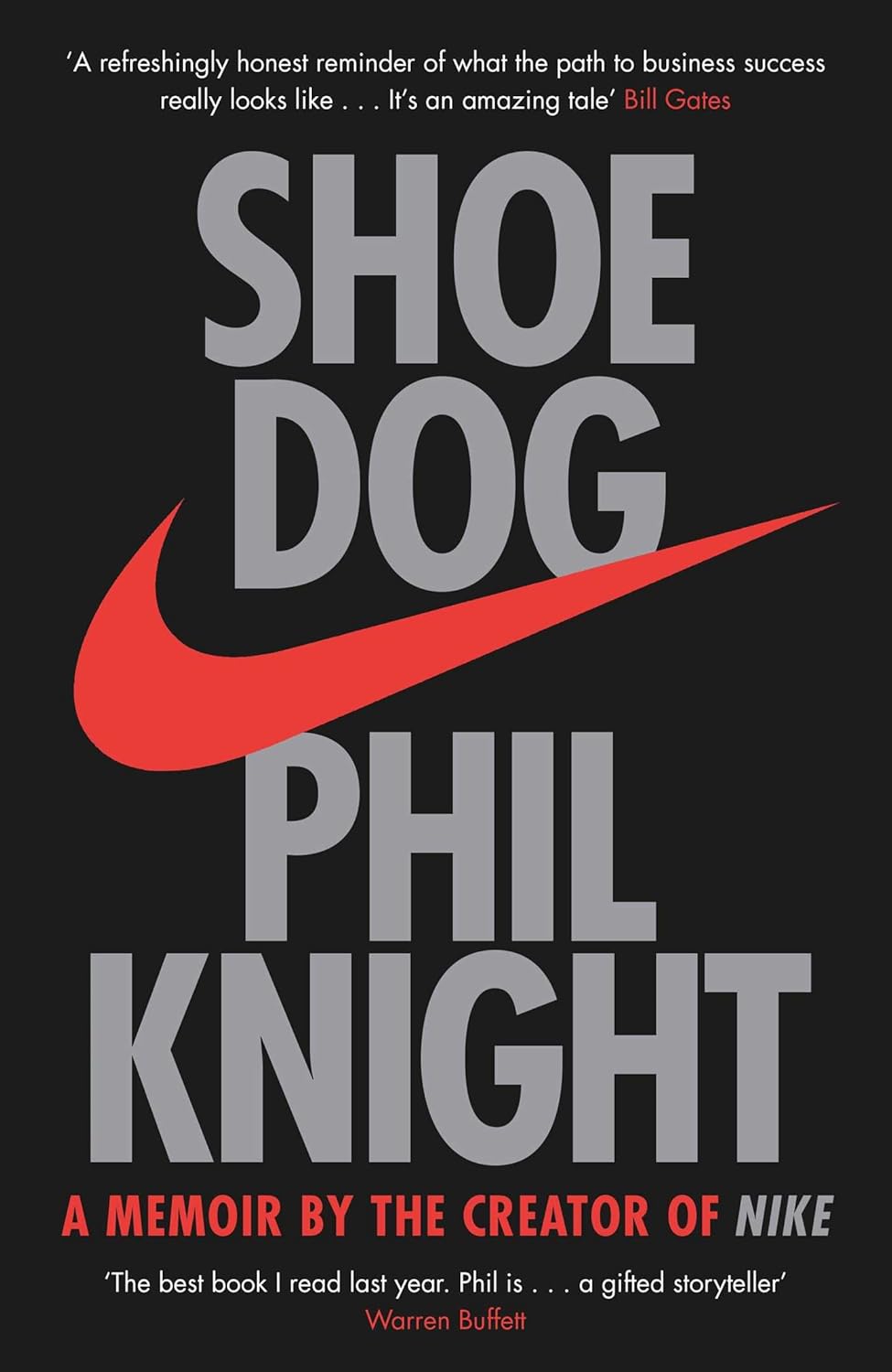
About Shoe Dog by Phil Knight – A Practical Business Memoir About Building Nike, Taking Risks, Solving Problems, and Growing a Brand
Shoe Dog by Phil Knight is the memoir of Nike’s founder and the story of how a small running-shoe business became one of the world’s best-known companies. Knight begins with his early idea of importing high-quality, lower-cost running shoes from Japan and selling them in the United States.
At first, the business was called Blue Ribbon Sports. Knight sold shoes from the trunk of his car, worked other jobs to support himself, borrowed money, dealt with banks, managed suppliers, and tried to keep the company alive while sales grew.
The book is useful because it does not present business growth as a smooth process. Knight writes about cash shortages, supply problems, legal disputes, hiring, product design, branding, mistakes, and difficult decisions. He also explains how relationships with people such as Bill Bowerman and the company’s early employees helped shape what later became Nike.
The Story Starts Before Nike Had a Name
Knight was interested in running and had competed as a middle-distance runner at the University of Oregon.
He later studied business at Stanford, where he wrote a paper about importing athletic shoes from Japan. His idea was that Japanese running shoes could compete with German brands in the American market.
After school, he travelled through Asia, Europe, and Africa.
In Japan, he met representatives of Onitsuka, the company that made Tiger running shoes. He presented himself as a distributor and eventually gained the right to sell Tiger shoes in parts of the United States.
The business idea was simple, but turning it into a working company required years of effort.
Blue Ribbon Sports Grew From a Small Beginning
Knight borrowed fifty dollars from his father and began selling Japanese running shoes.
He first sold directly to runners, coaches, and people he met at track events.
The business was small enough that Knight often handled many jobs himself.
He ordered shoes, dealt with customers, tracked money, communicated with the Japanese supplier, and looked for ways to increase sales.
The company grew because the founders understood runners.
They were not simply selling a product they knew nothing about. Knight had been a runner, and his former coach Bill Bowerman spent years studying how shoes affected athletes.
That direct connection with the customer became important to the company’s early growth.
Bill Bowerman Brought Product Knowledge
Bill Bowerman was Knight’s former track coach at the University of Oregon.
He became Knight’s business partner and played a major role in product development.
Bowerman was interested in improving running shoes. He experimented with weight, cushioning, materials, and shoe construction because he wanted athletes to run more efficiently.
His approach helped Blue Ribbon Sports become more than a distributor.
The company started learning how to improve products rather than simply resell what another manufacturer made.
This part of the memoir is useful for entrepreneurs because it shows why product knowledge matters.
A company may begin by selling something that already exists, but long-term growth often depends on understanding customers well enough to improve what they are buying.
Growth Created Cash Problems
One of the most important business lessons in Shoe Dog is that rising sales do not automatically mean a company has enough cash.
Blue Ribbon Sports kept ordering larger quantities of shoes because demand was increasing.
But the company had to pay for inventory before it could sell that inventory and collect money from customers.
This created constant pressure.
Knight often needed bank loans or other financing to place new orders.
Banks worried about the company’s fast growth, limited cash, and debt.
Knight therefore spent a large part of his early business life trying to finance the next stage of growth.
This makes the memoir useful for readers who want to understand the difference between revenue, profit, inventory, and cash flow.
The Relationship With Onitsuka Became Difficult
Blue Ribbon Sports depended heavily on Onitsuka for its products.
That relationship gave Knight access to shoes, but it also created risk because the supplier had significant power.
As the American business grew, disagreements developed over distribution rights, contracts, and control.
Knight became worried that Onitsuka might replace Blue Ribbon Sports with another distributor.
This pushed the team to think seriously about creating its own brand.
The conflict shows why dependence on a single supplier can become dangerous.
A business can grow quickly and still remain vulnerable if another company controls the product, manufacturing, or key contract.
Nike Developed From the Need for Independence
The company eventually began developing its own line of shoes.
The name Nike came from the Greek goddess of victory.
The famous Swoosh logo was created by Carolyn Davidson, a graphic design student whom Knight knew through Portland State.
Knight did not immediately love the logo, but the company needed a mark for its shoes and moved forward with it.
This part of the story is useful because it shows that major brand decisions do not always begin with certainty.
Some choices are made because the business must keep moving.
A name, logo, or product can become meaningful later because of the work, quality, marketing, and culture built around it.
The Early Team Had Different Strengths
Knight spends a large part of the memoir describing the people who helped build the company.
Many were runners or people connected to sports.
They also had different personalities, skills, weaknesses, and working styles.
Knight did not build Nike alone.
The company needed people who understood sales, accounting, law, product development, operations, and athletes.
The team often worked under pressure and had limited resources.
This is one reason the memoir is useful for managers.
A growing company needs people who can take responsibility for different problems rather than waiting for one founder to make every decision.
Knight Writes Openly About Mistakes
Shoe Dog is not written as a list of perfect business decisions.
Knight describes moments when he was uncertain, secretive, stubborn, financially stretched, or wrong.
He also writes about difficult relationships with employees, banks, suppliers, competitors, and family.
That makes the book different from business books that explain success only after the result is already known.
That matters.
Persistence Is One of the Main Themes
The company repeatedly reaches points where failure seems possible.
There are problems with money, inventory, suppliers, legal disputes, manufacturing, and growth.
Knight and his team keep trying to find another solution.
Persistence in the book does not mean repeating the same action forever.
It often means changing the plan while continuing toward the larger goal.
The company changes suppliers, develops new products, creates a new brand, finds new financing, and hires people who can solve problems Knight cannot solve alone.
That is a more useful idea of persistence than simply working longer hours.
The Memoir Also Shows the Personal Cost of Business
Knight does not describe entrepreneurship only through sales and growth.
He also writes about time away from family, stress, uncertainty, friendships, marriage, and personal loss.
His wife Penny and his children appear in the story, and the memoir reflects on the cost of giving so much attention to a company.
This adds balance to the business story.
A company can become successful while the people building it still face difficult personal consequences.
For readers interested in entrepreneurship, this is important because business decisions affect more than balance sheets.
The Book Is More Memoir Than Business Textbook
Shoe Dog contains many business lessons, but it is not organized like a management manual.
Knight tells the story year by year, focusing on events, people, decisions, setbacks, and turning points.
Readers learn through the story rather than through formal frameworks.
There are no long chapters explaining accounting formulas or marketing models.
The value comes from seeing how one company developed over time.
This makes the book accessible to readers who normally find traditional business books too technical.
Publication and Edition Details
Scribner published Shoe Dog on April 26, 2016.
The hardcover edition is listed at 400 pages with ISBN 9781501135910.
Simon & Schuster also lists a 400-page trade paperback edition published on May 1, 2018 with ISBN 9781501135927.
The full subtitle is A Memoir by the Creator of Nike.
There is also a separate Young Readers Edition published in 2017. That version is shorter and adapted for younger readers, so customers should check which edition they are ordering.
Shoe Dog Became a Major Bestseller
Simon & Schuster identifies Shoe Dog as a New York Times bestseller.
The publisher also notes that Bill Gates named it one of his favorite books of 2016.
The book became widely read by entrepreneurs, managers, students, athletes, and readers interested in major companies.
Its popularity comes partly from the fact that Nike is familiar around the world while the early years of the company are less well known.
The memoir gives readers a direct account from the founder rather than an outside company history.
About Phil Knight
Phil Knight is the founder of Nike, Inc.
Simon & Schuster states that he served as Nike’s CEO from 1964 to 2004 and as board chairman through 2016. He later became Chairman Emeritus.
Before Nike became a global company, Knight was a runner, business-school graduate, accountant, teacher, and shoe distributor.
Shoe Dog gives readers his own account of the years when the business was uncertain and still developing.
Who Will Benefit Most From This Book?
Shoe Dog is a strong choice for entrepreneurs, business students, managers, marketers, founders, athletes, and readers interested in company history.
It can be especially useful for people starting a business because it shows problems that often disappear from polished success stories.
These include cash flow pressure, supplier risk, hiring, branding, legal disputes, product development, financing, and uncertainty.
The book can also suit readers who simply want to know how Nike was built.
Book Quality at Bookish Wonderland
Bookish Wonderland offers this title with premium eye-soothing cream paper, crystal-clear printing, and high-quality stitched plus glue binding.
The cream paper supports comfortable reading through the long memoir, while clear printing keeps names, dates, business details, and conversations easy to follow. Strong binding supports repeated reading and shelf storage.
The copy is suitable for personal reading, gifting, business study, entrepreneurship courses, book clubs, or building a business and memoir collection.
Why Order from Bookish Wonderland?
Bookish Wonderland delivers books across Bangladesh, including inside and outside Dhaka. Cash on Delivery is available nationwide.
Customers in Dhaka can also ask about fast or urgent delivery when available.
If you are checking Shoe Dog by Phil Knight Book price in Bangladesh, it is useful to compare the physical quality of the copy along with the listed price.
Book customization is also available. For stock, customization, or delivery questions, you can contact Bookish Wonderland through Facebook or Instagram.
Why Shoe Dog Is Useful for Business Readers
Shoe Dog by Phil Knight gives readers a detailed look at building a company before the brand became famous.
The memoir covers selling, financing, product development, supplier relationships, branding, hiring, legal problems, and growth.
It also shows that business success can include uncertainty, mistakes, stress, and changes in direction.
For readers who want a business memoir based on one founder’s direct experience, Shoe Dog is practical, readable, and useful.
Order your copy from Bookish Wonderland for nationwide delivery, Cash on Delivery, premium cream paper, clear printing, and strong stitched plus glue binding.
If you require any customization or have any questions, please inbox us via FB or Insta.
| Primary Specification | |
| Author | Phil Knight |
| Narrator | Norbert Leo Butz |
| Editor | Kyle Kabel |
| Genre | Memoir, Business, Entrepreneurship, Biography & Autobiography |
| ISBN-13/ISSN | 978-1471146725 |
| ISBN-10 | 1471146723 |
| Publisher | SIMON SCHUSTER |
| Publishing Date | May 2, 2018 |
| Language | English |
| Reading Age | 16+ |
| Format | Printed Book |
| Physical Specification & Quality | |
| Paper Quality | Premium eye-soothing cream paper |
| Binding Quality | High quality stitched and glue binding (for longevity) |
| Print Quality | Crystal-clear print |
| Pages | 400 pages |
| Country | USA |
| Logistics Information | |
| Weight | 423 gm |
| Length | 8.5 inches |
| Width | 5.6 inches |
| Height | 0.94 inch |