

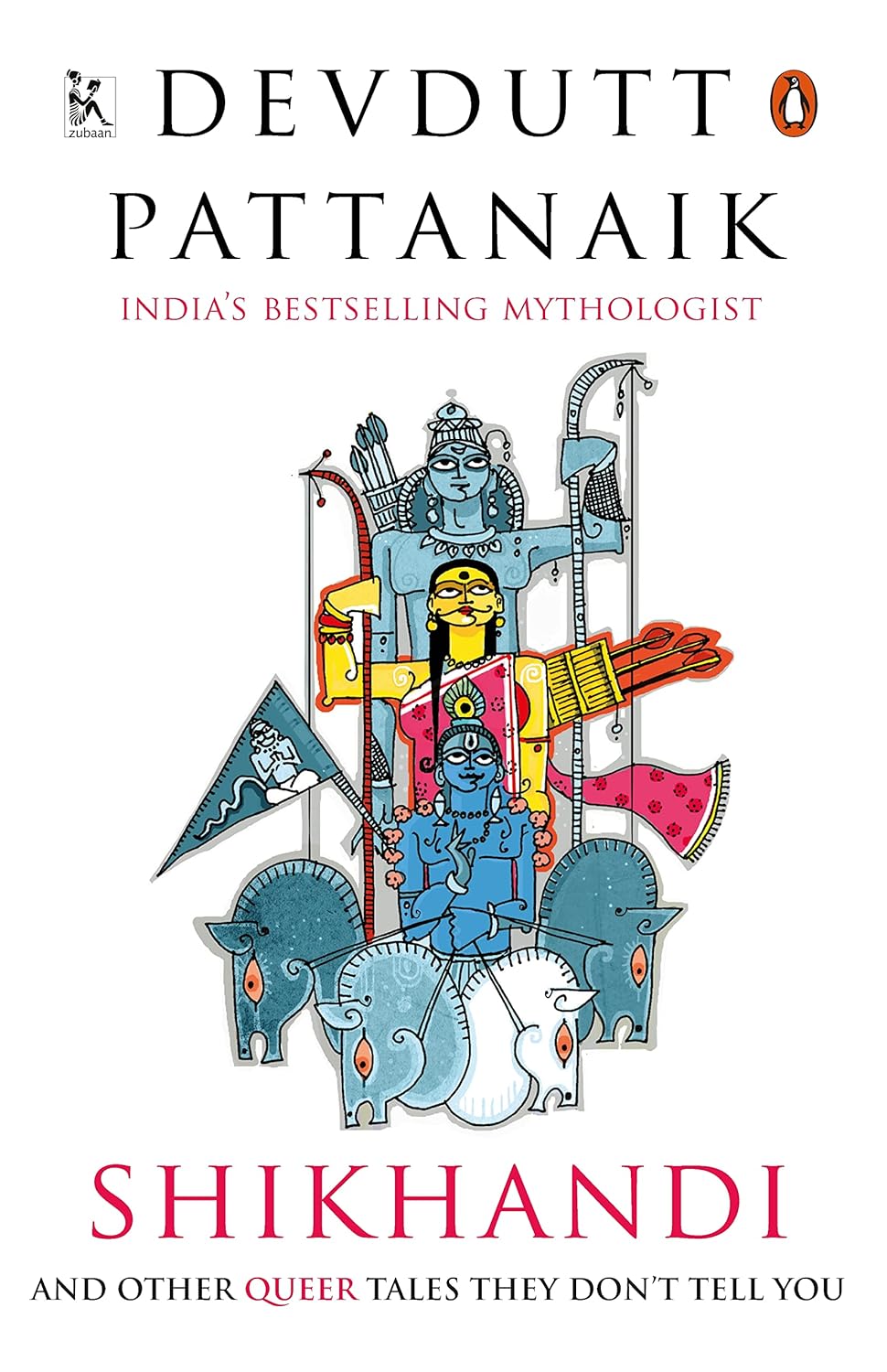
About Shikhandi: And Other Tales They Don't Tell You by Devdutt Pattanaik – A Bold Mythology Collection About Gender, Identity, Transformation, and Forgotten Stories
Shikhandi: And Other Tales They Don't Tell You by Devdutt Pattanaik is a short, thought-provoking collection that looks at gender, identity, desire, and transformation through stories from Indian mythology and related traditions.
At the center is Shikhandi, the Mahabharata character whose life crosses gender boundaries and whose presence becomes important in the fall of Bhishma. Around this story, Pattanaik presents many other tales involving transformation, same-sex bonds, unusual births, cross-dressing, shifting identities, and bodies that do not follow ordinary expectations.
The current Penguin edition uses the subtitle And Other Queer Tales They Don't Tell You. Earlier editions were published without the word “Queer” in the subtitle.
Old Stories That Many Readers Rarely Hear
Many people grow up hearing the most famous parts of the Ramayana, Mahabharata, Puranas, and other Indian traditions. They know the great wars, famous kings, divine heroes, and well-known moral lessons.
But large traditions contain far more than the most repeated stories.
Pattanaik chooses episodes that are often left out of school lessons, family retellings, television versions, and popular summaries. Some are playful. Some are strange. Some are deeply moving. Others can be disturbing.
Instead of treating mythology as one fixed story, the book shows a world filled with many versions, regional memories, oral traditions, symbols, and unusual characters.
Shikhandi Opens the Door to a Bigger Question
Shikhandi is one of the most important figures in the collection.
In the Mahabharata tradition, Shikhandi is connected with Amba and later becomes central to Bhishma's defeat at Kurukshetra. Pattanaik uses the character to open a wider discussion about gender change, social identity, marriage, duty, and the way people define manhood and womanhood.
The story matters because Shikhandi is not placed at the edge of the epic.
Pattanaik then moves outward from Shikhandi to other stories where bodies, names, roles, or relationships change. By placing these tales together, he asks readers to notice a pattern that may be missed when each story is heard alone.
Gods and Humans Do Not Always Stay Inside One Gender Role
The collection includes stories about figures who move between male and female forms, take on another gender for a purpose, or are born in ways that challenge ordinary family patterns.
The publisher highlights examples such as Mahadeva becoming a woman to deliver a devotee's child, Chudala becoming a man to enlighten her husband, and Samavan becoming the wife of his male friend.
These stories are not all the same.
Some involve desire. Some involve disguise. Some involve divine power. Some are about teaching, duty, birth, marriage, friendship, or social rules. That difference matters.
Pattanaik does not present every transformation as identical. Instead, the collection shows how varied Indian mythic imagination can be.
For readers, this variety can make the book more useful than a simple list of labels. Each tale asks you to think about why a character changes and what that change means inside the story.
The Book Connects Mythology With Modern Questions
One reason Shikhandi continues to attract readers is that the stories are old, but the questions feel current.
How do people decide what counts as masculine or feminine? Is gender only about the body? What happens when social rules do not fit a person's life? Why are some stories remembered while others are quietly ignored?
Pattanaik uses mythology to open these questions without pretending that ancient tales use modern language in exactly the same way we do today.
The book is an interpretation of myth, not proof that every ancient community understood gender and sexuality in one single modern way. Mythological traditions are complex, and scholars, readers, believers, and communities may interpret the same story differently.
Simple Retellings Make Difficult Ideas Easier to Enter
Pattanaik is known for writing mythology in a clear, direct style, and that approach suits this collection.
The stories are short. The language is simple. The author often adds notes or ideas that help readers connect the tale with wider questions.
You do not need to be a scholar of Sanskrit texts or Indian religious history to begin.
A short retelling can introduce a character or idea, and readers who want more detail can later explore other translations, commentaries, or source traditions.
It gives you names, stories, symbols, and questions that can lead to deeper reading.
Devdutt Pattanaik's Illustrations Add Another Layer
Pattanaik does not only write about mythology. He is also known for his simple line illustrations, and Penguin notes that he illustrates his own books.
The drawings fit his storytelling style because they reduce a complex scene to a few clear visual signs.
For some readers, that makes mythology easier to remember. A symbol, body position, object, or relationship shown in a small drawing can help connect the visual idea with the story.
They are part of Pattanaik's own modern presentation.
Indian Traditions Are Compared With Stories From Elsewhere
The publisher description notes that Pattanaik places Indian tales beside examples from other cultures, including stories connected with Gilgamesh, Ganymede, Sodom, and the Chinese “cut sleeve” tradition.
By looking at different cultures, readers can see that societies across time have told stories about desire, gender, friendship, bodies, and relationships that do not always fit simple rules.
This comparative approach can be useful for readers interested in mythology beyond one country. It shows that questions about identity are not limited to one religion, language, or historical period.
The Collection Can Challenge What You Thought You Knew
A familiar mythology can feel fixed when we hear the same stories again and again.
Shikhandi works by breaking that comfort.
A reader may recognize Krishna, Shiva, Arjuna, or other famous figures but discover an episode they have never heard before. Another reader may know the episode but have never considered it through questions of gender or queerness.
The book encourages readers to ask why some parts of tradition become famous while other parts stay hidden.
Sometimes the reason may be simple: epics are enormous, and no retelling can include everything. In other cases, social discomfort may affect what families, teachers, publishers, or television producers choose to repeat.
Read It With Curiosity, Not as the Only Interpretation
Mythology does not belong to one voice.
Stories can have different versions across texts, regions, languages, communities, and historical periods. A character may be understood differently depending on which source a reader follows.
Pattanaik offers one accessible interpretive lens. His focus here is queerness, fluidity, and the limits of rigid gender categories.
Readers should remember that this is his presentation of the material.
You can compare his retelling with another translation, look for the original source he mentions, or discuss why two readers understand the same myth differently.
Who Will Enjoy Shikhandi Most?
This book is a strong choice for readers interested in Indian mythology, Hindu traditions, gender studies, queer studies, cultural history, folklore, comparative mythology, and short retellings.
Students can use it as a starting point for discussion, but it should not be treated as the only academic source on ancient Indian gender or sexuality.
Book clubs may find plenty to talk about because the stories raise questions about tradition, interpretation, identity, social rules, marriage, bodies, and memory.
Penguin also gives a mature-audience warning. Some stories include sexual themes, unusual births, bodily transformation, and material that may be disturbing for younger readers.
A Premium Copy for Reading and Reference
Bookish Wonderland prepares this edition for readers who want a comfortable physical copy for regular reading. It uses premium eye-soothing cream paper, crystal-clear printing, and high-quality stitched and glue binding designed for better longevity.
The softer page tone can make reading easier during longer sessions, while sharp printing keeps both text and illustrations clear. Strong binding is useful for a mythology book you may return to for reference, lend to a friend, mark for study, or keep in a personal collection.
Looking for Shikhandi by Devdutt Pattanaik Price in Bangladesh?
If you are comparing the Book price in Bangladesh for Shikhandi by Devdutt Pattanaik, consider the exact edition as well as the current selling price.
Penguin Random House India lists the paperback edition at 200 pages with ISBN 9789383074846. Earlier listings and reprints may show small differences in subtitle, pagination, cover design, or imprint.
Bookish Wonderland aims to balance reading comfort, durability, and value. Check the current product listing for the latest selling price because book prices can change with stock, edition, printing, and supply conditions.
Easy Ordering Across Bangladesh
Bookish Wonderland offers nationwide delivery, including delivery inside and outside Dhaka. Cash on Delivery is available across Bangladesh, so readers can order without paying online first.
Fast or urgent delivery may also be available in Dhaka when you need the book sooner.
You can order it for personal reading, study, discussion, gifting, or a growing mythology collection. If you need book customization or have a question about the exact edition, contact Bookish Wonderland through its available Facebook or Instagram support channels.
Discover the Stories That Sit Outside the Familiar Version
Shikhandi: And Other Tales They Don't Tell You by Devdutt Pattanaik is valuable because it asks readers to notice what familiar retellings often leave behind.
These are not new characters invented for a modern debate. They come from old mythic, literary, and oral traditions that have been told in different forms for generations.
By placing them together, Pattanaik creates a book about variety.
Bodies change. Roles change. Relationships take unexpected forms. Gods and humans step outside ordinary categories. Stories that may once have seemed like strange side episodes begin to look connected.
The result is a collection that can surprise readers who think they already know Indian mythology.
If you want a short, illustrated book that opens discussion about gender, identity, queerness, mythology, and the many ways ancient stories imagine human experience, this is a meaningful addition to your shelf.
Order Shikhandi: And Other Tales They Don't Tell You by Devdutt Pattanaik from Bookish Wonderland and explore a side of Indian mythology that is playful, challenging, sometimes unsettling, and far more varied than many popular retellings suggest.
If you require any customization or have any questions, please inbox us via FB or Insta.
| Primary Specification | |
| Author | Devdutt Pattanaik |
| Genre | Indian Mythology, Hinduism, Gender Studies, LGBTQ+/Queer Studies, Nonfiction |
| ISBN-13/ISSN | 978-9383074846 |
| ISBN-10 | 9383074841 |
| Publisher | Zubaan Books |
| Publishing Date | August 15, 2015 |
| Language | English |
| Reading Age | 18+ |
| Format | Printed Book |
| Physical Specification & Quality | |
| Paper Quality | Premium eye-soothing cream paper |
| Binding Quality | High quality stitched and glue binding (for longevity) |
| Print Quality | Crystal-clear print |
| Pages | 192 pages |
| Country | India |
| Logistics Information | |
| Weight | 212 gm |
| Length | 8.5 inches |
| Width | 5.6 inches |
| Height | 0.6 inch |