

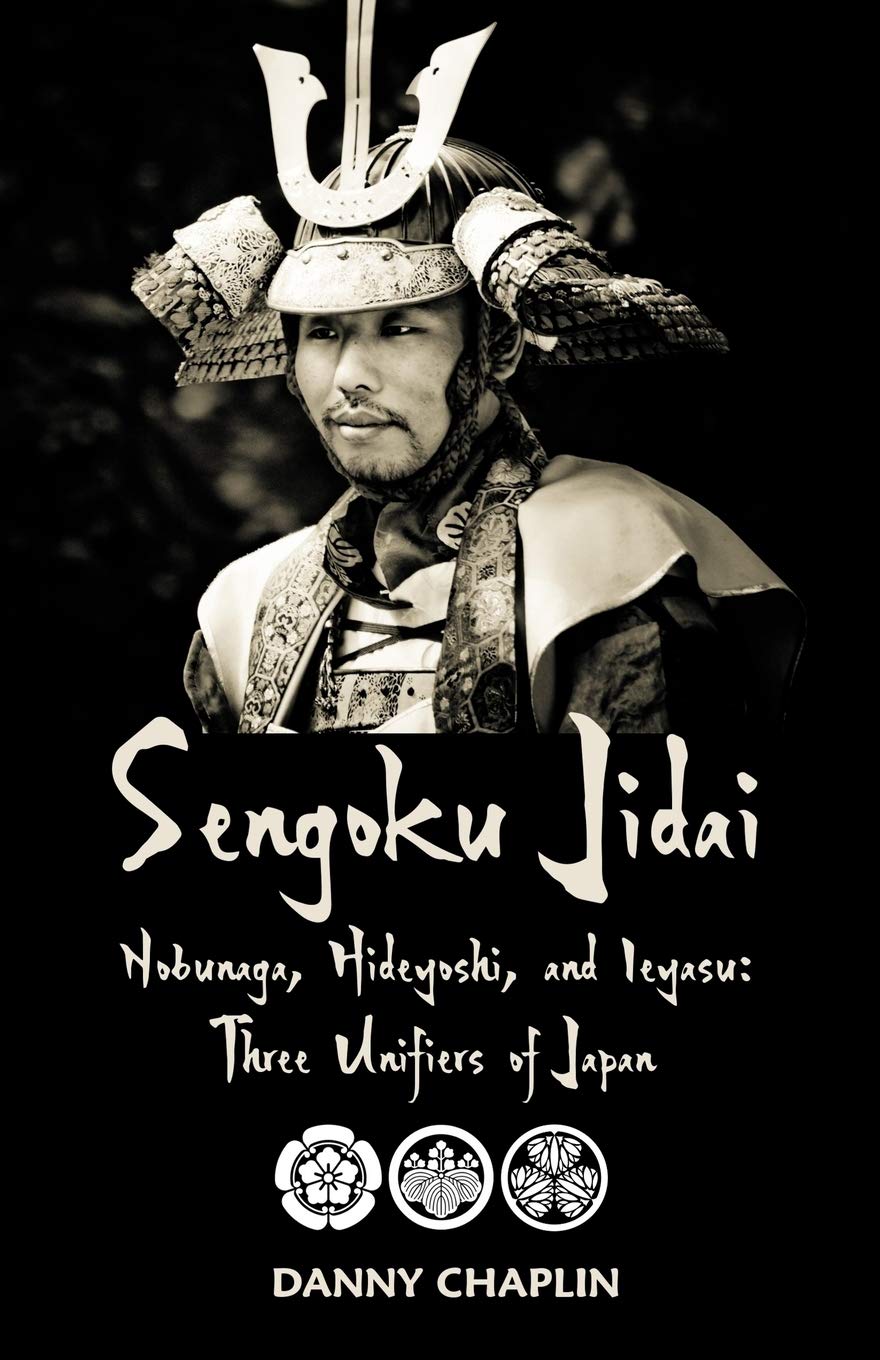
About Sengoku Jidai. Nobunaga, Hideyoshi, and Ieyasu: Three Unifiers of Japan by Danny Chaplin – A Detailed History of Japan’s Warring States and the Road to Unification
Sengoku Jidai. Nobunaga, Hideyoshi, and Ieyasu: Three Unifiers of Japan by Danny Chaplin is a detailed history of the long struggle that helped turn a divided Japan into a more unified state. The book focuses on three major leaders: Oda Nobunaga, Toyotomi Hideyoshi, and Tokugawa Ieyasu.
Each man played a different role. Nobunaga broke the power of many rivals and pushed military unification forward. Hideyoshi continued the process and brought most of the country under his control. Ieyasu then used military victory, political patience, and careful organization to establish the Tokugawa shogunate.
Chaplin follows their campaigns, alliances, rivalries, political choices, and systems of rule. The book also looks at major battles, castles, regional warlords, Christianity, European contact, and the administrative changes that helped shape early modern Japan.
The Book Covers More Than Three Biographies
Chaplin uses the careers of these men to explain the larger Sengoku and unification period.
Their success depended on armies, alliances, family ties, betrayals, local politics, economic resources, castle networks, and the decisions of many other people.
The Sengoku Period Was a Time of Political Fragmentation
The Sengoku era is often called Japan’s Warring States period.
During this time, regional military lords competed for land, influence, and security.
Central authority was weak, and many daimyo built their own power through local armies, castles, alliances, and control of resources.
The book explains how this unstable environment created both danger and opportunity.
A capable leader could rise quickly, but even a powerful house could collapse after a defeat, betrayal, or succession problem.
They operated inside a country where military power was spread across many competing domains.
Oda Nobunaga Begins the Main Drive Toward Unification
Oda Nobunaga is the first of the three unifiers.
He came from Owari Province and built his position through warfare, political planning, and bold decisions.
One of the key events in his rise was the Battle of Okehazama in 1560, where his smaller force defeated the army of Imagawa Yoshimoto.
That victory helped establish Nobunaga as a serious regional power.
He later expanded into neighboring provinces and entered Kyoto in 1568.
From there, his influence grew as he fought rival daimyo, religious military groups, and other opponents.
Chaplin follows these campaigns in detail, showing how Nobunaga moved from regional lord to the strongest military figure in much of central Japan.
Nobunaga Combined Force With Political Strategy
Nobunaga is often remembered for military aggression, but military force was only part of his method.
He also used alliances, marriage ties, diplomacy, economic policy, and relationships with important retainers.
He understood that controlling roads, cities, markets, and castles could be as important as winning one battle.
His rule also took place during a period when firearms were becoming more important in Japanese warfare.
Portuguese traders had introduced matchlock guns to Japan earlier in the century, and several daimyo adopted them.
Nobunaga became closely associated with the effective use of firearms and disciplined infantry.
Akechi Mitsuhide Ends Nobunaga’s Career
Nobunaga did not complete the unification process.
In 1582, his retainer Akechi Mitsuhide turned against him in what became known as the Honno-ji Incident.
Nobunaga died before he could finish bringing the country under his rule.
His death created an immediate struggle over who would control the political and military position he had built.
Toyotomi Hideyoshi moved quickly.
He defeated Mitsuhide and then worked to place himself at the center of the new balance of power.
A leader could spend decades building power and still leave an uncertain succession.
Toyotomi Hideyoshi Rose From a Humble Background
Hideyoshi’s career is one of the most unusual in Japanese political history.
He did not begin as the heir of a major daimyo house.
He rose through service under Nobunaga and became one of his most capable commanders.
After Nobunaga’s death, Hideyoshi used military success, negotiation, family alliances, and political skill to defeat rivals and gain support.
By 1590, after the defeat of the Hojo at Odawara, he had brought most of Japan under his authority.
Hideyoshi Did More Than Win Battles
Hideyoshi’s rule was also important because of administrative and social policies.
He ordered land surveys, worked to clarify taxation, reduced the number of independent military strongholds, and carried out the famous sword hunt.
The separation between warriors and farmers became stronger under his rule.
These policies were designed to create more control and reduce the ability of local groups to challenge central authority.
The book therefore treats unification as more than conquest.
Winning battles could bring territory under control, but lasting rule required systems for land, taxation, class, law, and military organization.
Hideyoshi’s Korean Invasions Show the Limits of Expansion
After unifying most of Japan, Hideyoshi launched invasions of Korea in the 1590s.
These campaigns became costly and destructive.
Japanese forces achieved major early gains, but Korean resistance and Ming Chinese intervention prevented Hideyoshi from achieving his larger goals.
The invasions continued until his death in 1598.
For readers, this part of the story shows that success inside Japan did not mean unlimited power outside it.
The campaigns also affected military resources, political relationships, and the position that would be inherited by the leaders who survived Hideyoshi.
Tokugawa Ieyasu Was Patient and Politically Careful
Tokugawa Ieyasu had been an ally, rival, and political partner to both Nobunaga and Hideyoshi at different times.
His long career required survival as much as conquest.
He built his own power base, made alliances when necessary, accepted compromise when useful, and waited for better opportunities.
After Hideyoshi died, political tension grew around the future of the Toyotomi government and the position of Hideyoshi’s young heir, Hideyori.
Ieyasu emerged as the strongest figure in the struggle that followed.
His reputation for patience comes from the way he survived several changing political systems before becoming the final dominant leader.
Sekigahara Changed the Balance of Power
The Battle of Sekigahara in 1600 is one of the most important events covered in the book.
Forces supporting Tokugawa Ieyasu fought a western coalition associated with Ishida Mitsunari and other opponents.
Ieyasu won.
The victory gave him the power to redistribute lands, reward supporters, weaken enemies, and build a new political order.
In 1603, he received the title of shogun.
Sekigahara did not end every conflict immediately, but it made Tokugawa supremacy much stronger.
The book uses the battle as a major turning point between the Sengoku struggle and the early Tokugawa system.
The Osaka Sieges Complete the Story
The book continues beyond Sekigahara because the Toyotomi house still remained at Osaka.
The final major confrontation came during the sieges of Osaka in 1614 and 1615.
Tokugawa forces eventually destroyed the remaining Toyotomi political and military challenge.
This helped secure the Tokugawa position.
By following events through 1616, Chaplin gives readers more than a story ending at Sekigahara.
The book shows how military victory had to be followed by the removal of remaining rivals and the creation of a stable succession.
Christianity and European Contact Matter in This Period
The sixteenth century brought increasing contact between Japan and Europeans.
Portuguese merchants, missionaries, firearms, and Christianity became part of political life.
Some daimyo accepted Christian missionaries or converted, while other rulers later restricted or opposed the religion.
Chaplin includes this foreign presence as part of the wider story.
This is useful because the unification period was not happening in isolation.
Trade, religion, weapons, and foreign visitors affected local politics and gave Japanese rulers new opportunities as well as new concerns.
Castles and Military Geography Are Important
The Sengoku period cannot be understood only through famous commanders.
Castles, roads, mountain routes, river crossings, ports, and regional geography affected campaigns.
A daimyo needed secure bases, supplies, communication, and control over key routes.
Major strongholds such as Azuchi, Osaka, and Edo became closely connected with political power.
The book’s battle-by-battle detail helps readers see why geography mattered.
A victory in one province could open a route into another region, while a strong castle could delay an army and change a campaign.
The Book Is Detailed Rather Than Short
Sengoku Jidai is a large history book.
Google Books and Open Library list the 2018 CreateSpace paperback at 638 pages.
CiNii’s library record lists x plus 618 pages and notes that the book includes bibliographical references and an index.
That level of detail means readers should not expect a quick overview.
There are many names, battles, clans, places, and political changes to follow.
Publication and Edition Details
CreateSpace Independent Publishing Platform published the English paperback in 2018.
The edition is listed with ISBN-10 1983450200 and ISBN-13 9781983450204.
Google Books lists the book at 638 pages and categorizes it under Japanese history.
CiNii records it as an English-language paperback and notes bibliographical references and an index.
Because independent and later international editions may use different layouts, customers who need a specific page count, cover, language, or ISBN should check the exact edition before ordering.
Who Will Benefit Most From This Book?
This book is a strong choice for readers interested in Japanese history, samurai history, military history, the Sengoku period, the Azuchi-Momoyama period, daimyo politics, castles, and the formation of the Tokugawa shogunate.
It can also be useful for students who want a detailed narrative covering the three unifiers in one volume.
Readers should expect a dense book with many names and events.
It is better suited to people who want detail than to readers looking for a very short introduction.
Book Quality at Bookish Wonderland
Bookish Wonderland offers this title with premium eye-soothing cream paper, crystal-clear printing, and high-quality stitched plus glue binding.
The cream paper supports comfortable reading through a long history book, while clear printing helps keep names, dates, battles, and place names easy to follow. Strong binding supports repeated study and shelf storage.
The copy is suitable for personal reading, university study, history collections, research, gifting, or readers building a collection about Japan and samurai history.
Why Order from Bookish Wonderland?
Bookish Wonderland delivers books across Bangladesh, including inside and outside Dhaka. Cash on Delivery is available nationwide.
Customers in Dhaka can also ask about fast or urgent delivery when available.
If you are checking Sengoku Jidai. Nobunaga, Hideyoshi, and Ieyasu: Three Unifiers of Japan by Danny Chaplin Book price in Bangladesh, it is useful to compare the physical quality of the copy along with the listed price.
Book customization is also available. For stock, customization, or delivery questions, you can contact Bookish Wonderland through Facebook or Instagram.
Why This Book Is Useful for Japanese History Readers
Sengoku Jidai. Nobunaga, Hideyoshi, and Ieyasu: Three Unifiers of Japan by Danny Chaplin brings the careers of the three unifiers into one detailed narrative.
It follows the military campaigns that broke rival power, the political deals that held alliances together, and the administrative changes that helped turn temporary victory into longer rule.
The book also gives space to battles, castles, regional lords, foreign contact, Christianity, social policy, and the transition into Tokugawa government.
For readers who want one large volume focused on the unification period rather than a short overview, it provides substantial detail and a clear focus on the people and events that shaped the era.
Order your copy from Bookish Wonderland for nationwide delivery, Cash on Delivery, premium cream paper, clear printing, and strong stitched plus glue binding.
If you require any customization or have any questions, please inbox us via FB or Insta.
| Primary Specification | |
| Author | Danny Chaplin |
| Narrator | Virtual Voice |
| Genre | Japanese History, Military History, Biography |
| ISBN-13/ISSN | 978-1983450204 |
| ISBN-10 | 1983450200 |
| Publisher | CreateSpace Independent Publishing Platform |
| Publishing Date | January 1, 2018 |
| Language | English |
| Reading Age | 16+ |
| Format | Printed Book |
| Physical Specification & Quality | |
| Paper Quality | Premium eye-soothing cream paper |
| Binding Quality | High quality stitched and glue binding (for longevity) |
| Print Quality | Crystal-clear print |
| Pages | 638 pages |
| Country | UK |
| Logistics Information | |
| Weight | 661 gm |
| Length | 8.5 inches |
| Width | 5.6 inches |
| Height | 1.44 inch |